 How to resolve AdBlock issue?
News
- Details
- Written by: Lake County News reports
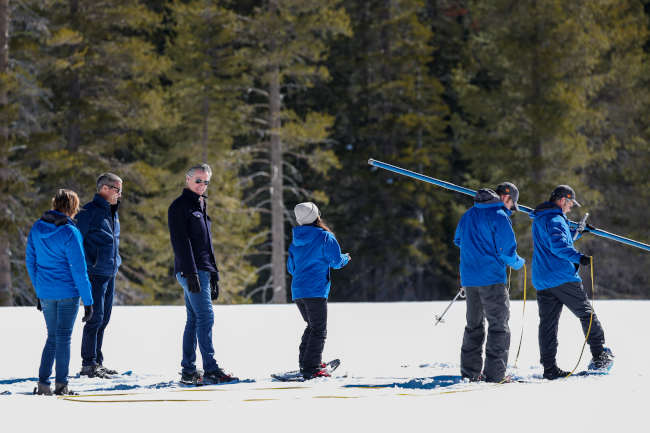
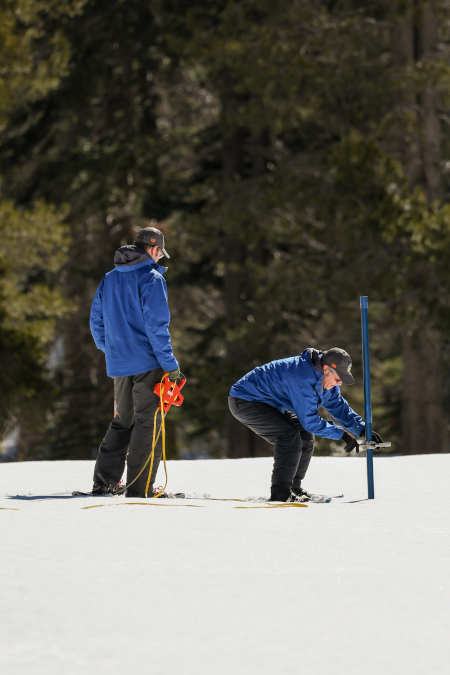
The Department of Water Resources on Tuesday conducted the all-important April snow survey, the fourth measurement of the season at Phillips Station.
The manual survey recorded 64 inches of snow depth and a snow water equivalent of 27.5 inches, which is 113 percent of average for this location.
The snow water equivalent measures the amount of water contained in the snowpack and is a key component of DWR’s water supply forecast.
The April measurement is critical for water managers as it’s considered the peak snowpack for the season and marks the transition to spring snowmelt into the state’s rivers and reservoirs.
DWR’s electronic readings from 130 stations placed throughout the state indicate that the statewide snowpack’s snow water equivalent is 28.6 inches, or 110 percent of the April 1 average, a significant improvement from just 28 percent of average on January 1.
The focus now shifts to forecasting spring snowmelt runoff and capturing as much of that water as possible for future use.
“It’s great news that the snowpack was able to catch up in March from a dry start this year. This water year shows once again how our climate is shifting, and how we can swing from dry to wet conditions within a season,” said DWR Director Karla Nemeth. “These swings make it crucial to maintain conservation while managing the runoff. Variable climate conditions could result in less water runoff into our reservoirs. 100 percent snowpack does not mean 100 percent runoff. Capturing and storing what we can in wetter years for drier times remains a key priority.”
California’s reservoirs remain in good shape thanks to state efforts to capture and store as much water as possible from record storms in 2023 and again this season.
The State Water Project has increased storage by 700,000 acre-feet at Lake Oroville and by 154,000 acre-feet at San Luis Reservoir since January 1. Statewide, reservoir levels currently stand at 116 percent of average.
However, there are challenges ahead as the spring runoff begins. The dry start to the year, soot and ash from burn scars that accelerates snowmelt, and other factors may result in below average spring runoff which can impact water availability.
Recently, the State Water Project increased its forecasted allocation of water supplies for the year to 30 percent, up from an initial 10 percent, due to the storms in February and March.
However, uncertainty about the spring runoff and ongoing pumping restrictions to protect threatened and endangered species in the Delta has impacted that allocation forecast.
“California has had two years of relatively positive water conditions, but that is no reason to let our guard down now,” said Dr. Michael Anderson, state climatologist with DWR. “With three record-setting multi-year droughts in the last 15 years and warmer temperatures, a well above average snowpack is needed to reach average runoff. The wild swings from dry to wet that make up today’s water years make it important to maintain conservation while managing the runoff we do receive. Our water years moving forward will see more extreme dry times interrupted by very wet periods like we saw this winter.”
That need to adapt to a changing climate is why Gov. Gavin Newsom joined Tuesday’s snow survey at Phillips Station to announce the release of the California Water Plan Update 2023.
The Water Plan Update sets forth a vision for all Californians to benefit from water resources that are sustainable, resilient to climate change and achieves equity for all communities and benefits the environment.
Check out the Water Plan Update to learn more about how the plan focuses on key issues including addressing climate urgency, strengthening watershed resilience, and achieving equity in water management.
As part of the state’s climate adaptation efforts, over the past two years, California has worked with local groundwater agencies and state and federal partners to capture as much water as possible to prepare for the next drought.
In 2023, more than 1.2 million acre-feet of groundwater recharge was permitted by state agencies, with nearly 400,000 acre-feet of flood water recharged using the executive orders issued by Gov. Newsom.
On average, the Sierra snowpack supplies about 30 percent of California’s water needs. Its natural ability to store water is why the Sierra snowpack is often referred to as California's “frozen reservoir.”
Data from these snow surveys and forecasts produced by DWR’s Snow Surveys and Water Supply Forecasting Unit are important factors in determining how DWR provides water to 27 million Californians and manages the state’s water resources.
DWR conducts five snow surveys at Phillips Station each winter near the first of each month, January through April and, if necessary, May.
For California’s current hydrological conditions, visit https://cww.water.ca.gov.

- Details
- Written by: Lake County News reports
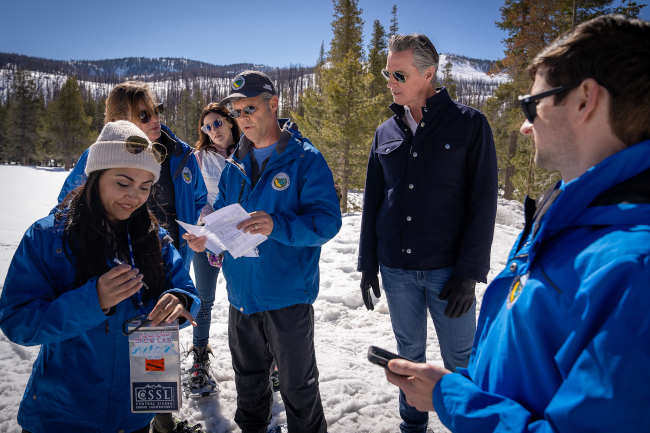
NORTHERN CALIFORNIA — In the face of the climate crisis, the Newsom Administration announced actions to protect water supplies when it’s dry and to capture more water during wet seasons.
In addition to investing billions of dollars to boost water supplies and drastically expanding the state’s storage capacity, the updated California Water Plan demonstrates how planning at a watershed scale provides the most comprehensive solutions for climate resilient water supplies for all Californians.
This plan is directly tied into Tuesday’s snow survey, a key indicator of expected runoff that this plan helps both state and local governments capture and store.
It recorded 64 inches of snow depth and a snow water equivalent of 27.5 inches, which is 113 percent of average for this location and above average overall.
“In the past few years alone, we’ve gone from extreme drought to some of the most intense rain and snow seasons on record — showcasing the need for us to constantly adapt to how we manage our water supplies,” said Gov. Gavin Newsom. “The water plans and strategies we’re implementing are each targeted components of our overall effort to deliver clean water to Californians by capturing, storing, and conserving more water throughout the state. This plan is a critical component of that effort.”
Here are just a couple examples of what California has implemented since the last Water Plan, highlighting its importance:
• Created a Flood-Managed Aquifer Recharge program, capturing and spreading flood flows to recharge aquifers – boosting the state’s water capture and storage abilities.
• Integrated climate science and research to help vulnerable communities defend against floods and drought.
This plan is a critical component of how California plans to capture more water, store it in reservoirs, replenish and recharge groundwater aquifers, protect against floods, and more. It’s directly tied to the state’s other water strategies:
• Water Resilience Portfolio. Outlines 142 state actions to protect our water supply from climate impacts by boosting water supplies, restoring natural ecosystems, and building infrastructure to store and move more water.
• Water Supply Strategy. Hotter and drier weather could diminish our water supply up to 10% by 2040, and this strategy offsets that loss – adding enough storage, recycling, and smarter water use to supply 8.4 million households every year.
These plans and reports are all intertwined, serving as critical blueprints for managing different parts of California’s complex water supply system – the Supply Strategy is offsetting the 10% loss we’re facing, the Resilience Portfolio boosts water supplies on top of that by building more and restoring natural water sources, and the Water Plan guides California's water management and conservation.
California’s other actions to boost water supplies include:
• Nearly $9 billion in water investments over the last three years. Track water projects in your community here.
• Expanded water supply and storage through groundwater recharge and other projects by over 400 billion gallons.
• Streamlining projects and limiting litigation delays to spur new and improved water infrastructure.
• Large-scale environmental restoration, including the removal of four dams from the Klamath River – the nation’s largest dam removal project.
More is needed to expand California’s water supplies. During this year's storms alone, the Delta Conveyance Project could’ve captured enough water to supply 9.4 million people; the streamlined Sites Reservoir Project could hold enough water for three million households’ yearly usage.
- Details
- Written by: Elizabeth Larson
The city of Lakeport is the only place in Lake County where safe and sane fireworks can be bought, sold and used for a four-day period each July.
The city previously had attempted to stop the sales of safe and sane fireworks. However, in November 2009, city voters approved Measure C, which requires the city to allow the sales by a group of designated nonprofits.
At the council’s March 19 meeting, Police Chief Brad Rasmussen said a new Assembly bill, AB 1403, which went into effect on Jan. 1, allows cities to implement a 2% surcharge, or permit fee, on gross sales in order to recover more of the actual costs to respond to and deal with fireworks impacts.
“There’s a lot of different work that goes into dealing with that,” Rasmussen said of the fireworks sales and use.
Rasmussen explained that the city’s handling of fireworks begins with the city clerk processing the permits by the nonprofits to sell them, then work in the field to enforce rules, setting up a special discharge area on Fourth Street during the Independence Day festivities and, finally, cleanup of the debris left behind by the fireworks.
“Annually the costs just for police and public works — not counting any other department — is between $25,000 and $30,000 a year for us to deal with and respond to fireworks issues,” Rasmussen told the council.
Measure C allowed for a 5% surcharge. However, Rasmussen said that doesn’t come close to covering the city’s costs to deal with fireworks.
Over the past six years, Rasmussen said the 5% surcharge averaged $4,000 to $6,000 annually. Then, in 2023, that amount went up to $11,200 because one nonprofit vendor did very well and sold more than previous years. Also, the Lakeport Police Department worked with TNT Fireworks and Revell Communications, who voluntarily gave another 2% over that 5% surcharge.
Rasmussen said last year the city had planned to hire a private company to do fireworks enforcement due to not having capacity. However, that contractor couldn’t provide the necessary insurance documents.
The city has put that additional 2% from last year aside to use this year, Rasmussen said.
“We only recover a very small percentage of our costs to deal with the impacts,” he said.
Rasmussen reported that all current fireworks permit holders — Clear Lake High School Boosters, Lake County Channel Cats, Lake County Realtors Scholarship & Community Fund and Terrace School Parent Teacher Organization — were notified of the proposed fireworks sales permit fee for sales within the city and were invited to give public input.
Dennis Revell of Revell Communications, who represents TNT Fireworks, said the fireworks company and the nonprofits who sell the fireworks in the city support the new surcharge.
Jen Richardson, representing the Clear Lake High Boosters and Terrace Middle School Parent Teacher Organization, confirmed those groups also are on board.
The only person speaking against the surcharge was business owner Nancy Ruzicka, who had been a proponent of the ballot measure to allow fireworks sales in the city. She said it would dip into the nonprofits’ profits.
District 4 Supervisor Michael Green — also a former Lakeport City Council member — said he respectfully disagreed with Ruzicka, that the city needed to be able to cover the impacts. He called fireworks sales in the city “an attractive nuisance.”
Green — referencing the city’s new Xabatin Park — said there is now twice as much park area to patrol as before. He said he wasn’t swayed by Ruzicka’s claims, although he understands the difficulties of fundraising.
The surcharge, he added, “in no way is a responsive to the larger issue of the disconnect between the city's policy and the county's policy on fireworks, and I know we're not here to talk about a ballot measure that would be needed to change that but that's front and center on my mind, and has been for several years.”
Lakeport Fire Chief Patrick Reitz said the surcharge is needed to help the city. He recounted how last year outside and partner agencies came in to help assist the city with enforcement, which he called “a tremendous effort.”
Reitz said they did a lot of confiscations, with a number of citations and a handful of arrests resulting. He said it takes a very big team to make that happen.
He also clarified that the fire district does not receive any of the mitigation funds. “An event like this is an out of pocket expense for the district.”
Reitz said they tried to trace the illegal fireworks confiscated in the city to find out where they were purchased. He said they found that quite a few of them had been purchased in Colusa County on “sovereign nation property,” referencing tribal lands. Some also came from outside of the state.
He encouraged the council to accept the surcharge, adding, “I don't see a significant impact to the nonprofits.”
Mayor Michael Froio said the surcharge would help the city offset the costs, and Councilwoman Stacey Mattina agreed that it would help.
Councilman Brandon Disney moved to adopt the resolution establishing a 2% permit fee for permit processing inspections, public awareness and education, campaigns and fire operations and suppression efforts related to the sale of safe insane fireworks, with councilman Kenny Parlet seconding and the council voting 5-0.
Also at the March 19 meeting, the council met new city employees Bryan Carlson, Mel Olea, Jen Baker and Michelle Brown, adopted a resolution to submit an application to the California State Department of Housing and Community Development for funding under the HOME Investment Partnership Program and got a progress update from staff on accomplishments and progress toward the fulfillment of the city’s 2023-24 departmental goals.
Email Elizabeth Larson at
- Details
- Written by: Lake County News reports

UPDATE: The Clearlake Police Department reported that she has been located.
LAKE COUNTY, Calif. — The Clearlake Police Department is asking for the community’s help in locating a missing woman.
Police are seeking information about 47-year-old Leslie Likens.
Likens was last known to be in Oregon on her way to California.
She is described as a white female adult, 5 feet 5 inches tall and 130 pounds with blonde hair and blue eyes.
If you have any information regarding her whereabouts please contact the Clearlake Police Department at 707-994-8251, Extension 1 for dispatch.