 How to resolve AdBlock issue?
News
- Details
- Written by: LAKE COUNTY NEWS REPORTS
On Wednesday, May 29 from 5:30 to 7 p.m., PG&E experts, including Regional Vice President Dave Canny, will provide a brief presentation during which participants will have the opportunity to ask questions.
The event can be accessed through this link or by phone. Dial-in at 888-282-0377, conference ID is 7793612.
Access also can be gained by visiting PG&E’s website.
The town hall will cover Lake, Humboldt, Marin, Mendocino, Napa, Siskiyou, Sonoma and Trinity counties.
American Sign Language interpretation will be available. For the full webinar events schedule, additional information on how to join and to view past event recordings and presentation materials, visit the PG&E webinars website.
- Details
- Written by: Francis Reddy
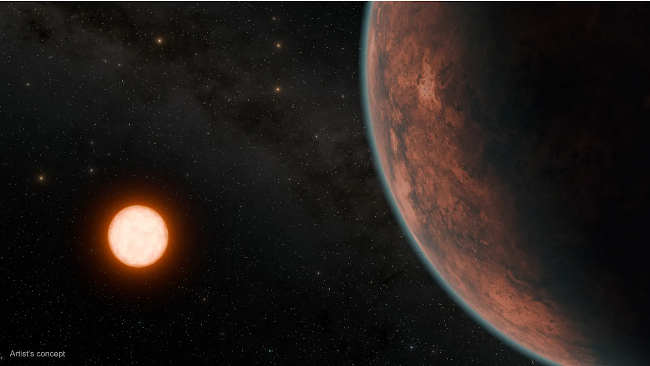
Using observations by NASA’s TESS, or Transiting Exoplanet Survey Satellite, and many other facilities, two international teams of astronomers have discovered a planet between the sizes of Earth and Venus only 40 light-years away. Multiple factors make it a candidate well-suited for further study using NASA’s James Webb Space Telescope.
TESS stares at a large swath of the sky for about a month at a time, tracking the brightness changes of tens of thousands of stars at intervals ranging from 20 seconds to 30 minutes. Capturing transits — brief, regular dimmings of stars caused by the passage of orbiting worlds — is one of the mission’s primary goals.
“We’ve found the nearest, transiting, temperate, Earth-size world located to date,” said Masayuki Kuzuhara, a project assistant professor at the Astrobiology Center in Tokyo, who co-led one research team with Akihiko Fukui, a project assistant professor at the University of Tokyo. “Although we don’t yet know whether it possesses an atmosphere, we’ve been thinking of it as an exo-Venus, with similar size and energy received from its star as our planetary neighbor in the solar system.”
The host star, called Gliese 12, is a cool red dwarf located almost 40 light-years away in the constellation Pisces. The star is only about 27% of the Sun’s size, with about 60% of the Sun’s surface temperature.
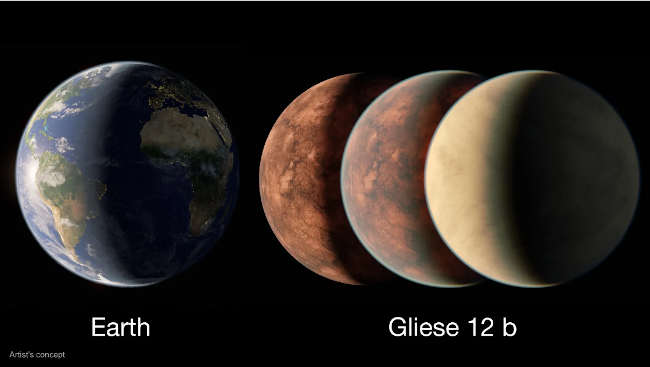
The newly discovered world, named Gliese 12 b, orbits every 12.8 days and is Earth’s size or slightly smaller — comparable to Venus. Assuming it has no atmosphere, the planet has a surface temperature estimated at around 107 degrees Fahrenheit (42 degrees Celsius).
Astronomers say that the diminutive sizes and masses of red dwarf stars make them ideal for finding Earth-size planets. A smaller star means greater dimming for each transit, and a lower mass means an orbiting planet can produce a greater wobble, known as “reflex motion,” of the star. These effects make smaller planets easier to detect.
The lower luminosities of red dwarf stars also means their habitable zones — the range of orbital distances where liquid water could exist on a planet’s surface — lie closer to them. This makes it easier to detect transiting planets within habitable zones around red dwarfs than those around stars emitting more energy.
The distance separating Gliese 12 and the new planet is just 7% of the distance between Earth and the Sun. The planet receives 1.6 times more energy from its star as Earth does from the Sun and about 85% of what Venus experiences.
“Gliese 12 b represents one of the best targets to study whether Earth-size planets orbiting cool stars can retain their atmospheres, a crucial step to advance our understanding of habitability on planets across our galaxy,” said Shishir Dholakia, a doctoral student at the Centre for Astrophysics at the University of Southern Queensland in Australia. He co-led a different research team with Larissa Palethorpe, a doctoral student at the University of Edinburgh and University College London.
Both teams suggest that studying Gliese 12 b may help unlock some aspects of our own solar system’s evolution.
“It is thought that Earth’s and Venus’s first atmospheres were stripped away and then replenished by volcanic outgassing and bombardments from residual material in the solar system,” Palethorpe explained. “The Earth is habitable, but Venus is not due to its complete loss of water. Because Gliese 12 b is between Earth and Venus in temperature, its atmosphere could teach us a lot about the habitability pathways planets take as they develop.”
One important factor in retaining an atmosphere is the storminess of its star. Red dwarfs tend to be magnetically active, resulting in frequent, powerful X-ray flares. However, analyses by both teams conclude that Gliese 12 shows no signs of extreme behavior.
A paper led by Kuzuhara and Fukui was published May 23 in The Astrophysical Journal Letters. The Dholakia and Palethorpe findings were published in Monthly Notices of the Royal Astronomical Society on the same day.
During a transit, the host star’s light passes through any atmosphere. Different gas molecules absorb different colors, so the transit provides a set of chemical fingerprints that can be detected by telescopes like Webb.
“We know of only a handful of temperate planets similar to Earth that are both close enough to us and meet other criteria needed for this kind of study, called transmission spectroscopy, using current facilities,” said Michael McElwain, a research astrophysicist at NASA’s Goddard Space Flight Center in Greenbelt, Maryland, and a co-author of the Kuzuhara and Fukui paper. “To better understand the diversity of atmospheres and evolutionary outcomes for these planets, we need more examples like Gliese 12 b.”
TESS is a NASA Astrophysics Explorer mission managed by NASA Goddard and operated by MIT in Cambridge, Massachusetts. Additional partners include Northrop Grumman, based in Falls Church, Virginia; NASA’s Ames Research Center in California’s Silicon Valley; the Center for Astrophysics | Harvard & Smithsonian in Cambridge, Massachusetts; MIT’s Lincoln Laboratory; and the Space Telescope Science Institute in Baltimore. More than a dozen universities, research institutes, and observatories worldwide are participants in the mission.
Francis Reddy works for NASA’s Goddard Space Flight Center in Greenbelt, Maryland.
- Details
- Written by: LAKE COUNTY NEWS REPORTS
Cyanobacteria, also known as blue-green algae, naturally occurs in water bodies but can produce harmful toxins that pose health risks to humans and animals.
Signs and symptoms of cyanobacteria exposure include skin irritation or rashes; eye, nose or throat irritation; stomach cramps, nausea, vomiting or diarrhea; headaches; fever; and muscle and joint pain.
Precautionary measures include the following:
• Avoid direct contact with water that appears discolored, has scum layers, or emits a foul odor.
• Keep pets and livestock away from affected water bodies.
• Do not ingest unfiltered water from Clear Lake.
• If you accidentally come into contact with affected water, rinse off immediately with clean water.
What to do if you’re exposed:
• Skin contact: Rinse skin thoroughly with fresh water and soap.
• Inhalation: Move to fresh air and seek medical attention if respiratory symptoms develop.
• Ingestion: Do not induce vomiting. Drink plenty of clean water and seek medical attention immediately.
• Pet exposure: Rinse your pet with clean water to remove any algae from their fur. Seek veterinary care if your pet shows symptoms of illness.
Health Services is actively monitoring the situation and will provide updates as conditions change. Public cooperation is crucial in ensuring safety during this time.
For further information and updates, visit the county’s website on cyanobacteria and cyanotoxins or contact Health Services at 707-263-1164.
- Details
- Written by: Elizabeth Larson

CLEARLAKE, Calif. — Clearlake Animal Control has dozens of dogs awaiting their forever families.
The Clearlake Animal Control website lists 37 adoptable dogs.
The available dogs this week include “Ella,” a nearly 2-year-old female Rottweiler mix with a short brown and black coat. She has been spayed.

Also waiting for a new home is “Rock,” a male Argentine Dogo mix with a short white and brown coat. He has been neutered.
There also is “Rose,” a 2-year-old female Labrador retriever-Rottweiler mix with a short copper and white coat. She has been spayed.
The shelter is located at 6820 Old Highway 53. It’s open from 9 a.m. to 6 p.m. Tuesday through Saturday.

For more information, call the shelter at 707-762-6227, email
This week’s adoptable dogs are featured below.
Email Elizabeth Larson at