How to resolve AdBlock issue?
Refresh this page
How to resolve AdBlock issue?
Refresh this page
Lake County News,California
  • Home
    • Registration Form
  • News
    • Education
    • Veterans
    • Community
      • Obituaries
      • Letters
      • Commentary
    • Police Logs
    • Business
    • Recreation
    • Health
    • Religion
    • Legals
    • Arts & Life
    • Regional
  • Calendar
  • Contact us
    • FAQs
    • Phones, E-Mail
    • Subscribe
  • Advertise Here
  • Login
How to resolve AdBlock issue?
Refresh this page

News

Clearlake Animal Control: ‘Layla,’ ‘Cutie Pie’ and ‘Pablo’

Details
Written by: Elizabeth Larson
Published: 05 July 2024
“Layla.” Photo courtesy of Clearlake Animal Control.

CLEARLAKE, Calif. — Clearlake Animal Control has a full shelter of dogs needing new homes.

The Clearlake Animal Control website lists 39 adoptable dogs.

The available dogs include “Layla,” a 9-month-old female American Staffordshire terrier mix. She has a short black and white coat and has been spayed.

“Cutie Pie.” Photo courtesy of Clearlake Animal Control.

Also up for adoption is “Cutie Pie,” a female pit bull terrier mix with a red and bronze coat. She has been spayed.

Another waiting dog is Pablo, a 10-month-old male pit bull terrier mix with a bronze and tan coat. He has been neutered.

The shelter is located at 6820 Old Highway 53. It’s open from 9 a.m. to 6 p.m. Tuesday through Saturday.

“Pablo.” Photo courtesy of Clearlake Animal Control.

For more information, call the shelter at 707-762-6227, email This email address is being protected from spambots. You need JavaScript enabled to view it., visit Clearlake Animal Control on Facebook or on the city’s website.

This week’s adoptable dogs are featured below.

Email Elizabeth Larson at This email address is being protected from spambots. You need JavaScript enabled to view it.. Follow her on Twitter, @ERLarson, or Lake County News, @LakeCoNews.

Extreme heat waves aren’t ‘just summer’: How climate change is heating up the weather, and what we can do about it

Details
Written by: Mathew Barlow, UMass Lowell and Jeffrey Basara, UMass Lowell
Published: 05 July 2024


The U.S. Northeast was already roasting in record heat as summer 2024 began. Yuki Iwamura/AFP via Getty Images

The heat wave that left more than 100 million people sweating across the eastern U.S. in June 2024 hit so fast and was so extreme that forecasters warned a flash drought could follow across wide parts of the region.

Prolonged high temperatures can quickly dry soils, triggering a rapid onset drought that can affect agriculture, water resources and energy supplies. Many regions under the June heat dome quickly developed abnormally dry conditions.

A US map showing flash drought risk from New York to Florida and over Ohio.
The National Oceanic and Atmospheric Administration’s hazard outlook map shows flash drought warnings in yellow and areas forecast to have a high risk of excessive heat in early July in red. NOAA Climate Prediction Center

The human impacts of the heat wave have also been widespread. In Ohio and Pennsylvania, emergency room visits for heat-related illnesses surged. Several Massachusetts schools without air conditioning closed to protect kids and teachers. In New York and New Jersey, electric wires sagged in the heat, shutting down trains into and out of New York City and leaving commuters stranded.

We study weather patterns involving heat. The June 2024 heat wave was unusually early and long-lasting compared with typical patterns for the Northeast U.S.

It was caused by a large high-pressure system called a heat dome that extended from the ground more than 10 miles up through the atmosphere. A heat dome is both a cause and an effect of extreme heat. Very large and strong heat domes, like the Northeast event – which reached higher into the atmosphere than any previous June event – have a greater potential for higher temperatures impacting more people.

It was also part of a global outbreak of early season heat that put lives at risk in many countries around the world.

Heat is becoming a global problem

Record heat has hit several countries across the Americas, Europe and Asia in 2024. In Mexico and Central America, weeks of persistent heat, with temperatures as high as 125 degrees Fahrenheit (51.8 Celsius), combined with prolonged drought have led to severe water shortages and dozens of deaths.

Extreme heat turned into tragedy in Saudi Arabia as over 1,000 people on the Hajj, a Muslim pilgrimage to Mecca, collapsed and died. Temperatures reached 125 F (51.8 C) at the Grand Mosque in Mecca on June 17.
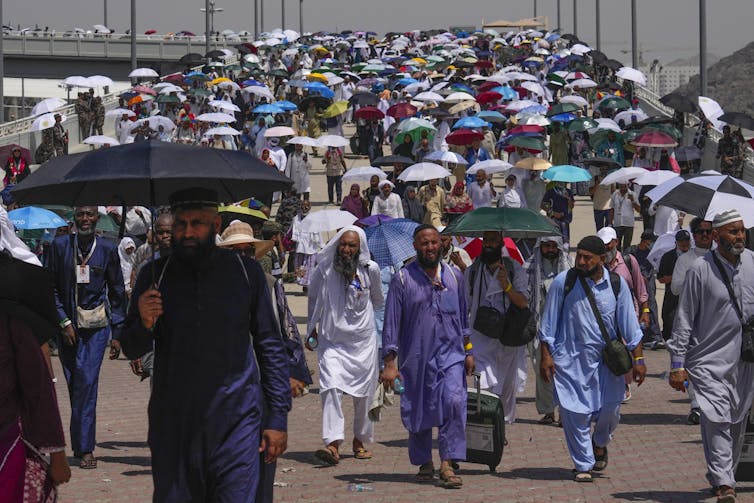
A large number of people in traditional clothing covering them from their necks to their wrists and ankles walk on wide pathway, some carrying umbrellas for shade.
Muslim pilgrims spent hours outside in extreme temperatures and humidity during the Hajj in June 2024 in Saudi Arabia. Over 1,000 people died in the heat. AP Photo/Rafiq Maqbool

In Greece, where temperatures were over 100 F (38 C) for several straight days in June, at least several tourists died or were feared dead after going hiking in dangerous heat and humidity.

India also faced temperatures around 120 F (49 C) for days in April and May that affected millions of people, many of them without air conditioning.

The climate connection: This isn’t normal

Although heat waves are a natural part of the climate, the severity and extent of the heat waves so far this year are not “just summer.”

A scientific assessment of the U.S. heat wave estimates that heat this severe and long-lasting was two to four times more likely to occur today because of human-caused climate change than it would have been without it. This conclusion is consistent with the rapid increase over the past several decades in the number of U.S. heat waves and their occurrence outside the peak of summer.

These record heat waves are happening in a climate that’s globally about 2.2 F (1.2 C) warmer than it was before the industrial revolution, when humans began releasing large amounts of greenhouse gas emissions that warm the climate.
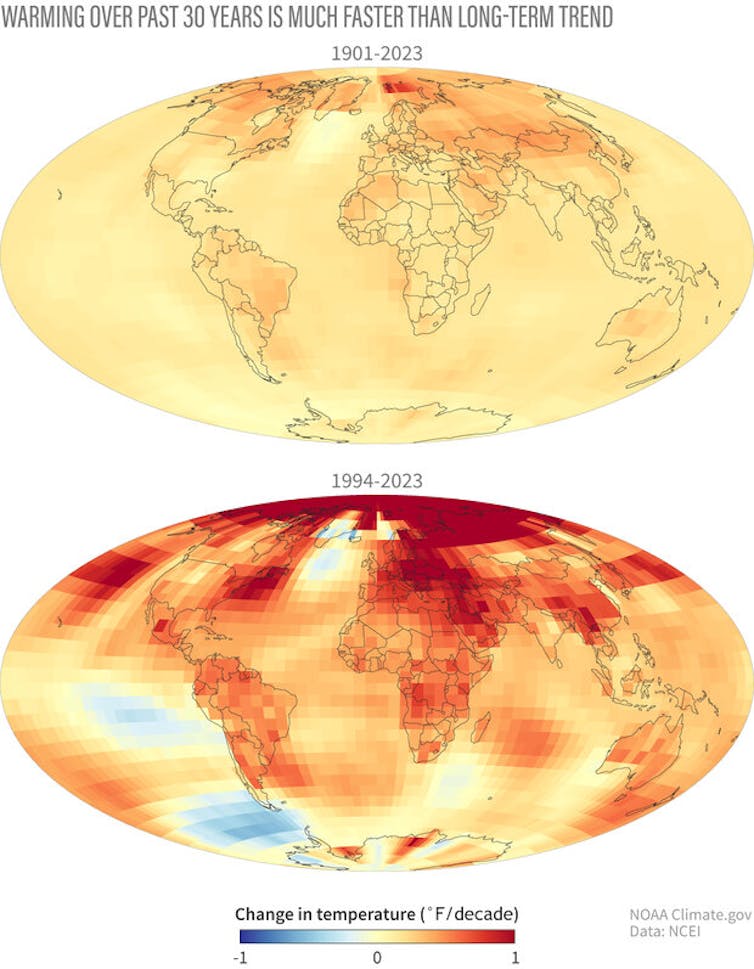
Two global maps show much faster warming per decade over the past 30 years than in the past 120 years.
Global surface temperatures have risen faster per decade in the past 30 years than over the past 120. NOAA NCEI

While a temperature difference of a degree or two when you walk into a different room might not even be noticeable, even fractions of a degree make a large difference in the global climate.

At the peak of the last ice age, some 20,000 years ago, when the Northeast U.S. was under thousands of feet of ice, the globally averaged temperature was only 10.8 F (6 C) cooler than now. So, it is not surprising that 2.2 F (1.2 C) of warming so far is already rapidly changing the climate.

Countries promised in 2015 as part of the Paris Agreement to keep warming well under 2 C, but current government policies around the world won’t meet those goals. Temperatures are on pace to continue rising, with the increase likely to more than double again by the end of the century.

If you thought this was hot

While this summer is likely be one of the hottest on record, it is important to realize that it may also be one of the coldest summers of the future.

For populations that are especially vulnerable to heat, including young children, older adults and outdoor workers, the risks are even higher. People in lower-income neighborhoods where air conditioning may be unaffordable and renters who often don’t have the same protections for cooling as heating will face increasingly dangerous conditions.

Extreme heat can also affect economies. It can buckle railroad tracks and cause wires to sag, leading to transit delays and disruptions. It can also overload electric systems with high demand and lead to blackouts just when people have the greatest need for cooling.

The good news: There are solutions

Yes, the future in a warming world is daunting. However, countries have made significant progress. In the U.S., the 2022 Inflation Reduction Act has the potential to reduce U.S. greenhouse gas emissions by nearly half by 2035.

Switching air conditioners to heat pumps and network geothermal systems can not only reduce fossil fuel emissions but also provide cooling at a lower cost. The cost of renewable energy continues to plummet, and many countries are increasing policy support and incentives.
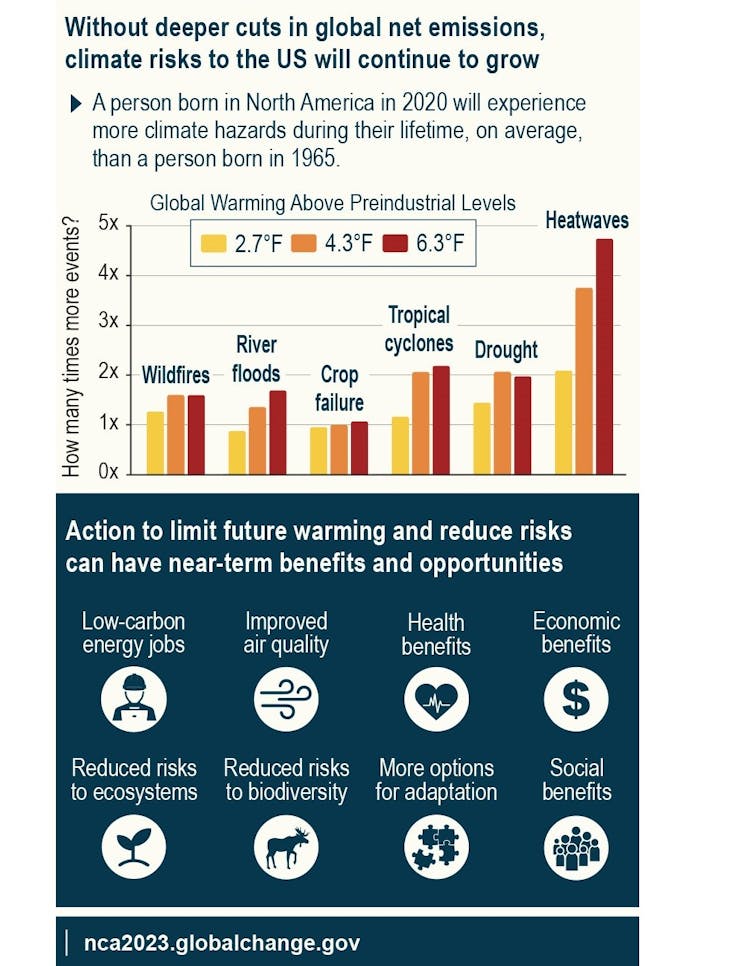
A chart shows heat waves are likely to increase four times in a world 2.7 F warmer and nearly five times in a world 6.3 F warmer. Both scenarios are possible as global emissions rise.
Actions to reduce warming can limit a wide range of hazards and create numerous near-term benefits and opportunities. National Climate Assessment 2023

There is much that humanity can do to limit future warming if countries, companies and people everywhere act with urgency. Rapidly reducing fossil fuel emissions can help avoid a warmer future with even worse heat waves and droughts, while also providing other benefits, including improving public health, creating jobs and reducing risks to ecosystems.The Conversation

Mathew Barlow, Professor of Climate Science, UMass Lowell and Jeffrey Basara, Professor of Meteorology, UMass Lowell

This article is republished from The Conversation under a Creative Commons license. Read the original article.


Acting Gov. McGuire signs bills to invest in schools, safe drinking water and wildfire prevention

Details
Written by: LAKE COUNTY NEWS REPORTS
Published: 04 July 2024
Acting Gov. Mike McGuire signed several pieces of legislation during a ceremony on Wednesday, July 3, 2024. Photo Courtesy of Senate Rules Photography.

On Wednesday night, joined by leaders of the Senate and Assembly, Acting Gov. Mike McGuire signed legislation headed for the November ballot.

These include two bond measures that would provide critical investments for California public schools, and investments to connect communities with clean drinking water, and protect them from floods and the growing threat of wildfires.

The bond measures focus on modernizing classrooms and school campuses, which would benefit millions of California students, and investing in wildfire prevention and recovery, clean water, and better preparing the Goln State for the impacts of climate change.

“These historic bond measures passed by the Legislature are critical investments for our kids, they’ll make our communities more wildfire safe and connect tens of thousands of homes in every corner of the Golden State with clean drinking water,” said McGuire, who is president pro tempore of the State Senate. His North Coast district includes Lake County.

“Even in the richest economy in America, tens of thousands of kids attend schools not up to 21st century standards,” McGuire said. “The education bond will ensure California’s students attend safe and modern schools free of lead paint, lead pipes, and free of leaky roofs. The safe drinking water and wildfire prevention bond will sustain and enhance quality of life in the Golden State by providing communities the resources they need to protect themselves from the growing threat of wildfires and floods, and help protect them from the impacts of extreme heat. We’re grateful to the legislative leaders who worked so incredibly hard to get these life-changing measures across the finish line.”

SB 867, the Safe Drinking Water, Wildfire Prevention, Drought Preparedness, and Clean Air Bond Act of 2024, would provide $10 billion to help communities avoid and recover from the impacts of wildfire, flood, drought, and other climate-related events.

The strategic investments include funding for safe drinking water and drought, flood, and water resilience, as well as investments in wildfire and forest resilience, sea-level rise, extreme heat mitigation, clean air, and protecting biodiversity and promoting natural solutions.

If approved by voters, the clean water and wildfire bond would be the single largest investment in public funding for climate resilience in California’s history.

AB 247, the Kindergarten Through Grade 12 Schools and Local Community College Public Education Facilities Modernization, Repair, and Safety Bond Act of 2024, would provide $10 billion in bond funding for education facilities modernization, repair and safety, and would be split between K-12 schools ($8.5 billion) and California Community Colleges ($1.5 billion). The funding would be designated for improvements that include new construction, modernization of schools, career technical education, heating and energy efficiency grants, and other needs.

Acting Governor McGuire also signed AB 440, an omnibus bill containing three provisions necessary to complete work on the 2024 General Election ballot, including moving ACA 13 to the 2026 General Election, ensuring the bond measures will be before voters in November, and assigning ballot numbers.

Adams fire prompts Lower Lake evacuations

Details
Written by: LAKE COUNTY NEWS REPORTS
Published: 04 July 2024
A Cal Fire copter picks up water from a private pond along Highway 29 to fight the Adams fire in Lower Lake, California, on Wednesday, July 3, 2024. Photo courtesy of Samantha Chance Colton.

LAKE COUNTY, Calif. — A fast-moving fire in Lower Lake prompted evacuations on Wednesday afternoon.

The Adams fire was reported in the 16000 block of Main Street in Lower Lake.

Shortly after 4:30 p.m., the Lake County Sheriff’s Office issued an evacuation order for an area south of downtown Main Street.

A short time later, the sheriff’s office issued evacuation warnings for more areas south of Lower Lake.

However, shortly before 6:30 p.m., the evacuation warnings were lifted and the evacuation order ended by 9:15 p.m.

The fire was reported to have burned a total of 16 acre.
  1. Public fireworks displays planned for Independence Day holiday
  2. Fire chief orders temporary closure of Vista Point due to fire risk
  3. Cal Fire maintains zero tolerance for illegal fireworks
  • 626
  • 627
  • 628
  • 629
  • 630
  • 631
  • 632
  • 633
  • 634
  • 635
How to resolve AdBlock issue?
Refresh this page