How to resolve AdBlock issue?
Refresh this page
How to resolve AdBlock issue?
Refresh this page
Lake County News,California
  • Home
    • Registration Form
  • News
    • Education
    • Veterans
    • Community
      • Obituaries
      • Letters
      • Commentary
    • Police Logs
    • Business
    • Recreation
    • Health
    • Religion
    • Legals
    • Arts & Life
    • Regional
  • Calendar
  • Contact us
    • FAQs
    • Phones, E-Mail
    • Subscribe
  • Advertise Here
  • Login
How to resolve AdBlock issue?
Refresh this page

News

How to protect your home from wildfires – here’s what fire prevention experts say is most important

Details
Written by: Bryce Young, University of Montana and Chris Moran, University of Montana
Published: 17 July 2024


Extreme heat has already made 2024 a busy wildfire year. More acres had burned by mid-July than in all of 2023, and several communities had lost homes to wildfires.

As fire season intensifies across the West, there are steps homeowners can take to make their homes less vulnerable to burning and increase the likelihood that firefighters can protect their property in the event of a wildfire.

We research wildfire risk to homes and communities. Here’s what decades of research suggest homeowners in high-fire-risk areas can do to protect their properties.
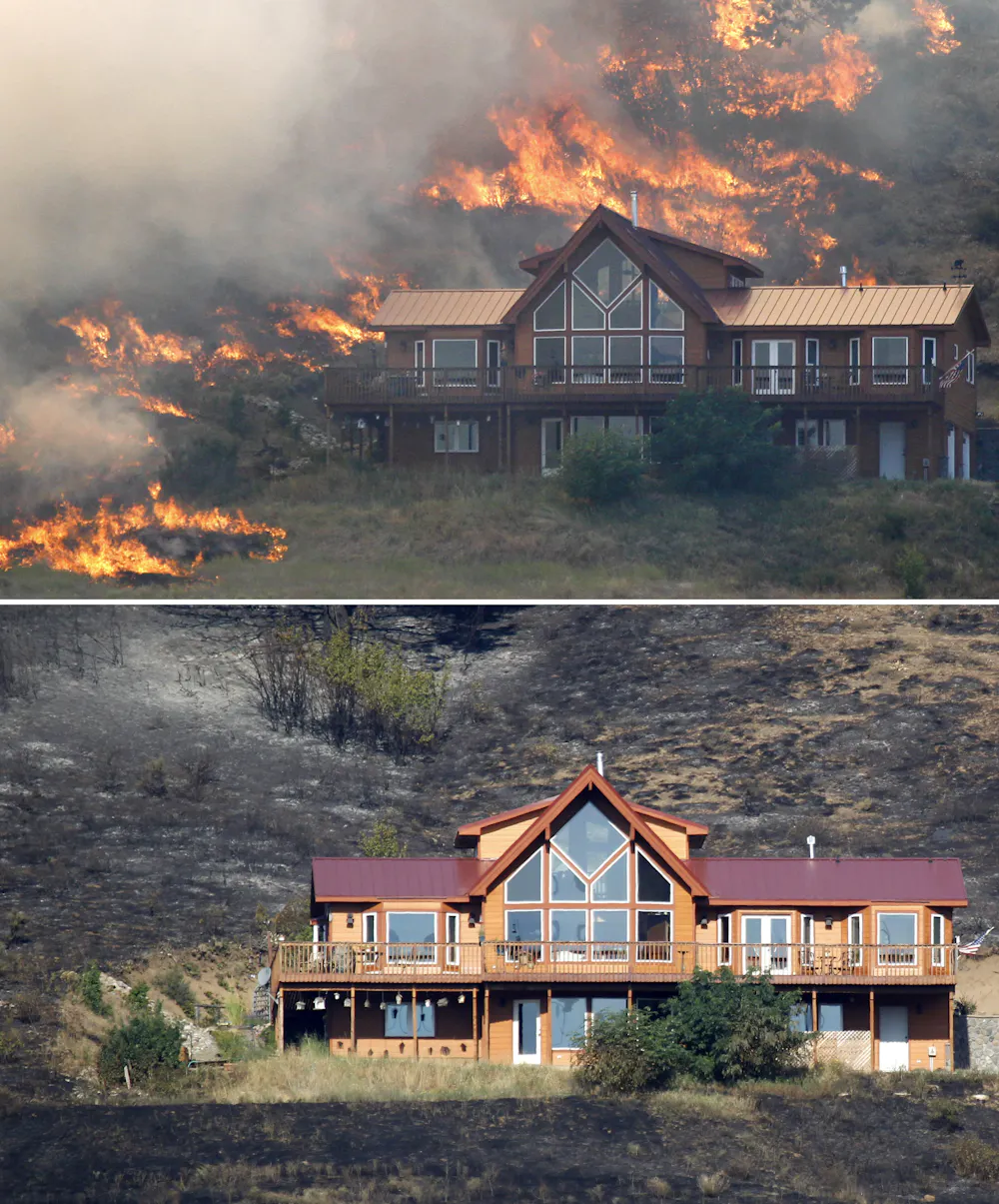
Two photos show the house with the fire behind it and after the fire, with burned land around it but the house untouched.
This house near Cle Elum, Wash., survived a 2012 wildfire because of the defensible space around the structure, including a lack of trees and brush close the house, according to state officials. AP Photo/Elaine Thompson

Small improvements make big differences

A structure’s flammability depends on both the materials that were used to build it and the design of the building. In general, the vulnerability of a house is determined by its weakest point.

The roof, windows, siding and vents are all vulnerable points to pay attention to.

Roof: The roof provides a landing pad where airborne embers can accumulate like snowflakes. Roofs with lots of valleys can collect pine needles and leaves, which can be ignited by flying embers. This is why it’s important for the roof itself to be made of Class A non-flammable material like clay tiles or asphalt shingles, and why roof maintenance, including cleaning gutters, is important. Embers can easily find their way under peeling shingles, through gaps of clay tiles, or into gutters where pine needles and leaves can accumulate.

Windows: If windows are exposed to heat, they can shatter and allow fire inside the home, where curtains can easily ignite. Even double-paned windows can be shattered by the heat of a burning shed 30 feet away, unless the window glass is tempered, making it stronger. Fire-resistant shutters made of metal, if closed before a fire arrives, can offer additional protection.

A life-size test with blowing embers at IBHS’s fire lab shows ways homes are at risk form a nearby fire.

Siding: Materials like stucco are non-flammable, while cedar shake siding will burn. Your exterior siding should be non-flammable, but the siding is only as strong as its weakest point. If there are holes in the siding, plug them with caulk to prevent embers from reaching the wooden frame in your walls. Ideally, there will be a 6- to 12-inch concrete foundation between the ground and the bottom of your siding material.

Vents: Reducing risk from vents is easy and affordable and can drastically reduce the flammability of your home. Make sure that one-eighth inch or finer metal mesh is installed over all vents to keep embers out of your attic and your home’s interior.

Controlling your home ignition zone

A home’s vulnerability also depends on the area around it, referred to as the home ignition zone.

The risk in your home ignition zone depends on things such as the slope of your land and the ecosystem surrounding your home. Here are a few guidelines the National Fire Protection Association recommends, both to reduce the chance of flames reaching your home and make it easier for firefighters to defend it.

Zone 1 – Within 5 feet

From the home’s exterior to 5 feet away, you want to prevent flames from coming in contact with windows, siding, vents and eaves. The gold standard is to have only non-flammable material in Zone 1.

The most common risks are having flammable mulch, plants, firewood, lawn furniture, decks and fences. These items have been a primary reason homes burned in many wildfires, including the 2018 Camp Fire that destroyed much of Paradise, California, and the 2012 Waldo Canyon Fire near Colorado Springs, Colorado.

An illustration of a house with rings at different distances around it and advice for each ring.
Fire protection guidelines take into consideration the surrounding ecosystem. Here some examples based on the National Fire Protection Association’s guidelines. Bryce Young, CC BY

Replacing mulch with gravel or pavers and having only short, sparse plants that don’t touch the house can help reduce the risk.

Wooden decks and fences can burn even if they are well-maintained. Replacing them with non-flammable materials or installing a thin sheet of metal on the house where the siding touches a wooden deck or fence can help protect the home. Mesh screens can prevent the accumulation of debris and embers under the deck.

Zone 2 – 5 to 30 feet away

In the next ring, between 5 and 30 feet from the home, the lawn should be green and short. This is Zone 2.

Be sure to rake up pine needles and leaves and take care to prune the lowest tree branches at least 6 feet high.

There should be about 18 feet of space between trees on a flat slope, and the spacing should increase with slope because steeper terrain drives faster, more intense fires. Walks, pathways, patios, decks and firewood can be kept in this zone.

Zone 3 – 30 to 100 feet away

Beyond Zone 2 and out to about 100 feet from the home is Zone 3. In this area, be sure to give sheds and propane tanks their own defensible space, just like around the house, and prune all low branches to 6 feet.

You can contact your local emergency management office or community wildfire nonprofit to learn more about grant funding that can offset the costs of pruning and removing trees on a forested property.

Beyond 100 feet may extend past your property boundary, but the adjacent house can still be fuel for a wildfire. That’s why it’s smart to plan with your neighbors as you’re reinforcing your own home. Once one house catches fire, house-to-house fire spread is facilitated by closer distances between buildings.

Be prepared

While most U.S. government spending aims to mitigate wildfire hazard on national forests, it is up to residents and communities themselves to reduce their vulnerability to a wildfire disaster.

Following the guidelines required by your community or state and those outlined above can help. Communities can also take steps to reduce fire risk and make fires easier to control by developing a community wildfire protection plan, exploring their wildfire risk, and adopting wildfire-specific building codes.

As the nation rolls into fire season, make sure your property is prepared. And when the call to evacuate comes, know where to go and get the heck out.The Conversation

Bryce Young, Graduate Student Researcher, Fire Center, University of Montana and Chris Moran, Post-doctoral Researcher, Fire Center, University of Montana

This article is republished from The Conversation under a Creative Commons license. Read the original article.
Governor signs Sen. Dodd’s wildfire safety bill

Details
Written by: Lake County News reports
Published: 17 July 2024
Sen. Bill Dodd, D-Napa, announced Tuesday that Gov. Gavin Newsom has signed his legislation to help California prevent and prepare for wildfires by improving operations of the State Board of Fire Services, the advisory panel to the California State Fire Marshal.

“California faces more destructive and frequent climate-driven wildfires, so it’s essential that we mount a swift and robust response,” Sen. Dodd said. “Now, with the signing of this bill, we can act without delay to address the most pressing needs such as the deployment of firefighting resources. I appreciate Gov. Newsom for recognizing the importance of this bill and making it the law.”

Sen. Dodd is a leader in wildfire legislation, authoring more than a dozen bills that are now in state statute.

This year he continued that advocacy with more proposals, including Senate Bill 1215, which improves the operation of the 18-member State Board of Fire Services.

SB 1215 allows ex-officio members of the board responsible for advancing the state’s fire safety efforts to serve as proxies on the board when a regular member is unavailable to attend.

This addresses difficulties in securing quorums, protecting against imminent threats to life and property.

SB 1215, sponsored by California Professional Firefighters, was signed by the governor late Monday.

“SB 1215 from Sen. Dodd fixes an unintentional chaptering error impacting the important work of the State Board of Fire Services and its ability to obtain a quorum and advise on critical issues such as regulations, certifications and training standards for California’s fire service,” said Brian K. Rice, president of California Professional Firefighters. “CPF is grateful to Sen. Dodd, the Legislature and the governor for working swiftly to address this error and ensuring that the board can operate smoothly and effectively.”

Dodd represents Senate District 3, which includes all or portions of Napa, Yolo, Sonoma, Solano, Sacramento and Contra Costa counties. He previously served Lake County in the State Assembly.

San Joaquin Avenue fire prompts evacuations; second fire reported on Dam Road

Details
Written by: Elizabeth Larson
Published: 16 July 2024
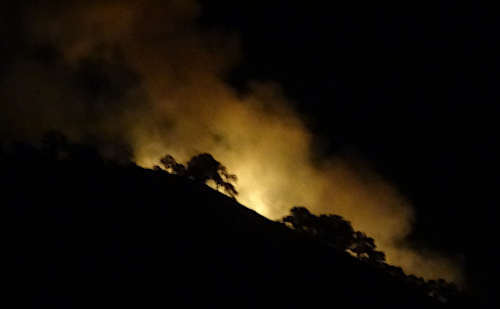
The San Joaquin Avenue fire in Clearlake, California, on Monday, July 15, 2024. Photo courtesy of Mark Burkdoll.

CLEARLAKE, Calif. — A wildland fire late Monday night prompted evacuations in the outskirts of Clearlake, and was followed early Tuesday morning by a second fire.

The fire, in the 12000 block of San Joaquin Avenue at Palomar Drive, was first reported just after 10 p.m.

Following the initial dispatch, a firefighter reported over the radio that he could see it from Adventist Health Clear Lake Hospital across town.

Within minutes of dispatch Lake County Fire Chief Willie Sapeta called over the radio for law enforcement to respond as he said there would be the need for evacuations.

At that point, Sapeta also requested that the Mendocino National Forest send an engine and a water tender to assist.

Radio reports said there were multiple structures threatened in the fire area.

The Clearlake Police Department sent an email alert about the fire at 10:15 p.m., asking people to avoid the area and reporting mandatory evacuations for Carter Lane and advisory evacuations for Mendocino Avenue.

Minutes later, firefighters reported that people were blocking the road on San Joaquin, making it so that equipment couldn’t get through.

Cal Fire’s helicopter from the Boggs Helitack did reconnaissance over the area. In addition, dispatch requested a night vision helicopter respond from Napa.

Based on radio traffic, firefighters made good progress quickly, and before 11 p.m. they reported that hose line was all around the fire. At that time, the Napa helicopter was canceled just after it had lifted off.

At 12:10 a.m. Tuesday, Clearlake Police sent a followup message to the community reporting that the evacuation warning for the Mendocino Avenue area had been lifted, but that the evacuation order for Carter Lane would remain in effect until 4 a.m.

Police also asked that people avoid the area due to fire personnel working at the site for the remainder of the night.

The fire was reported contained at 12:26 a.m. Tuesday, with incident command starting to release resources about 15 to 20 minutes later.

At the time of containment, a final size wasn’t reported.

At about 12:45 a.m. Tuesday, a new fire was reported near the Cache Creek Apartments on Dam Road.

Some units, including Chief Sapeta, were released from the San Joaquin fire to respond to the new start.

Units arriving on scene found that a tree was on fire and spreading into the vegetation.

Saptea reported over the radio that the fire was about 30 feet by 30 feet in size, with a slow rate of spread.

The Dam Road fire, which burned an estimated one-eighth of an acre, was reported to be out just before 2 a.m.

Email Elizabeth Larson at This email address is being protected from spambots. You need JavaScript enabled to view it.. Follow her on Twitter, @ERLarson, or Lake County News, @LakeCoNews.

Clearlake City Council to consider fire mitigation fee, school resource officer agreement

Details
Written by: Elizabeth Larson
Published: 16 July 2024
CLEARLAKE, Calif. — The Clearlake City Council this week will discuss a fire mitigation fee program, an agreement for a school resource officer, and updates to management staff benefits and salary schedule.

The council will meet at 6 p.m. Thursday, July 18, in the council chambers at Clearlake City Hall, 14050 Olympic Drive.

The agenda can be found here.

The meeting will be broadcast live on the city's YouTube channel or the Lake County PEGTV YouTube Channel.

Community members also can participate via Zoom. The webinar ID is 893 9230 7654, the pass code is 379358. One tap mobile is available at +16694449171,,85482512914#, or join by phone at 669-444-9171 or 253-205-0468.

On Thursday, the council will meet one of July’s adoptable dogs, will host a swearing-in of new police department employees, receive the 2023 annual tourism report and present a proclamation declaring July 2024 as Parks Make Life Better! Month.

Under business, the council will discuss a mitigation fee program on behalf of the Lake County Fire Protection District.

The council also will consider a memorandum of understanding with the Konocti Unified School District for a full-time school resource officer for the 2024-25 school year.

Police Chief Tim Hobbs’ report said that, under the proposed MOU, Konocti Unified will pay $160,992.62 to fund the cost of the full-time school resource officer, which includes salary, benefits, overtime, training and vehicle usage costs.

“The City can also recover additional overtime costs for other officers used at school events,” Hobbs said.

In other business, Finance Director Kathy Wells will ask the council to consider updates to the city’s management classification and benefits plan and city salary schedule.

Wells said the council is being asked to consider providing a 3% cost of living adjustment to management, as was provided to other bargaining groups beginning July 1.

“It should be noted that over the past five years, prior to Fiscal Year 22-23 the CPI provided to management had fallen behind the COLA provided to all other units, which resulted in increasing compaction of salaries over time,” Wells wrote. “In 22-23 Council voted to approve a 6% COLA to bring management to a level increase over time matching the City’s other bargaining units. Staff recommends Council consider a 3% increase, consistent with other agreements for this year.”

Also on Thursday’s agenda is consideration of holding the first reading of Ordinance No. 270-2024, which amends Section 2-3.7 of the Clearlake Municipal Code to authorize the city manager to sign documents as specified in Government Code Section 40602.

“These documents may include warrants, contracts, conveyances, or any documents requiring the city seal, such as resolutions or ordinances,” Administrative Services Director/City Clerk Melissa Swanson said in her staff report.

Swanson explained that the California Department of Housing and Community Development requested the change due to updates in Government Code sections 40601 and 40602.

On the meeting's consent agenda — items that are considered routine in nature and usually adopted on a single vote — are warrants; minutes of the June 12 Lake County Vector Control District Board meeting; authorization of an amendment of contract with Square Signs LLC for the Digital Marquee Signs Project in the amount of $48,583.75; consideration of amendment to agreement with OpenGov Inc. to expand services to include OpenGov/Cartegraph Suite; continuation of director of emergency services/city manager proclamation declaring a local emergency for winter storms; and notice of expiring committee appointments.

The council also will have a closed session to discuss the liability claims by Gina Doidge and Jeffrey Dryden; labor negotiations with the city’s unrepresented management employees; the city’s lawsuit against Highlands Mutual Water Co.; and the Koi Nation of Northern California’s lawsuit against the city that’s moved to the California Court of Appeal.

Email Elizabeth Larson at This email address is being protected from spambots. You need JavaScript enabled to view it.. Follow her on Twitter, @ERLarson, or Lake County News, @LakeCoNews.
  1. Clearlake City Council member nomination period opens
  2. Ryan selected as next Cal Fire Sonoma-Lake-Napa Unit chief
  3. Supervisors to hear presentation on homebuyer assistance program
  • 613
  • 614
  • 615
  • 616
  • 617
  • 618
  • 619
  • 620
  • 621
  • 622
How to resolve AdBlock issue?
Refresh this page
