How to resolve AdBlock issue?
Refresh this page
How to resolve AdBlock issue?
Refresh this page
Lake County News,California
  • Home
    • Registration Form
  • News
    • Education
    • Veterans
    • Community
      • Obituaries
      • Letters
      • Commentary
    • Police Logs
    • Business
    • Recreation
    • Health
    • Religion
    • Legals
    • Arts & Life
    • Regional
  • Calendar
  • Contact us
    • FAQs
    • Phones, E-Mail
    • Subscribe
  • Advertise Here
  • Login
How to resolve AdBlock issue?
Refresh this page

News

Space News: Tiny, compact galaxies are masters of disguise in the distant universe − searching for the secrets behind the Little Red Dots

Details
Written by: Fabio Pacucci, Smithsonian Institution
Published: 14 September 2024


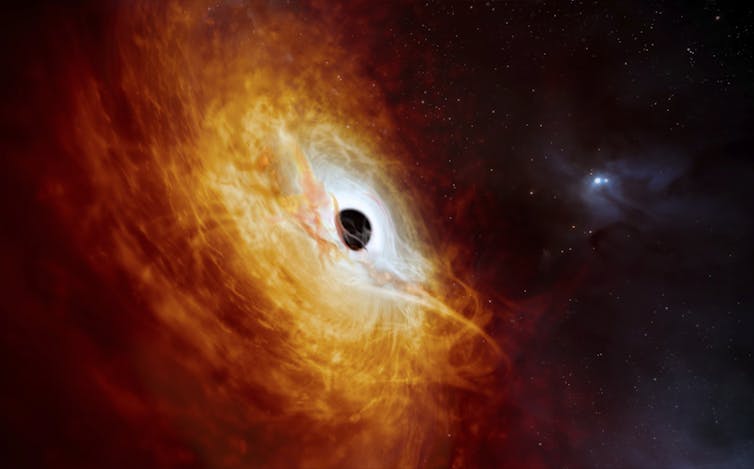
Supermassive black holes grow by pulling in matter around them. M. Kornmesser/ESO via AP

Astronomers exploring the faraway universe with the James Webb Space Telescope, NASA’s most powerful telescope, have found a class of galaxies that challenges even the most skillful creatures in mimicry – like the mimic octopus. This creature can impersonate other marine animals to avoid predators. Need to be a flatfish? No problem. A sea snake? Easy.

When astronomers analyzed the first Webb images of the remote parts of the universe, they spotted a never-before-seen group of galaxies. These galaxies – some hundreds of them and called the Little Red Dots – are very red and compact, and visible only during about 1 billion years of cosmic history. Like the mimic octopus, the Little Red Dots puzzle astronomers, because they look like different astrophysical objects. They’re either massively heavy galaxies or modestly sized ones, each containing a supermassive black hole at its core.

However, one thing is certain. The typical Little Red Dot is small, with a radius of only 2% of that of the Milky Way galaxy. Some are even smaller.

As an astrophysicist who studies faraway galaxies and black holes, I am interested in understanding the nature of these little galaxies. What powers their light and what are they, really?

Many galaxies, indicated as small, bright dots, shown against a dark backdrop.
The universe is full of countless galaxies, and the Webb telescope has helped astronomers study some of them. NASA, ESA, CSA, STScI

The mimicking contest

Astronomers analyze the light our telescopes receive from faraway galaxies to assess their physical properties, such as the number of stars they contain. We can use the properties of their light to study the Little Red Dots and figure out whether they’re made up of lots of stars or whether they have a black hole inside them.

Light that reaches our telescopes ranges in wavelength from long radio waves to energetic gamma rays. Astronomers break the light down into the different frequencies and visualize them with a chart, called a spectrum.

Sometimes, the spectrum contains emission lines, which are ranges of frequencies where more intense light emission occurs. In this case, we can use the spectrum’s shape to predict whether the galaxy is harboring a supermassive black hole and estimate its mass.

Similarly, studying X-ray emisson from the galaxy can reveal a supermassive black hole’s presence.

As the ultimate masters of disguise, the Little Red Dots appear as different astrophysical objects, depending on whether astronomers choose to study them using X-rays, emission lines or something else.

The information astronomers have collected so far from the Little Red Dots’ spectra and emission lines has led to two diverging models explaining their nature. These objects are either extremely dense galaxies containing billions of stars or they host a supermassive black hole.

The two hypotheses

In the stars-only hypothesis, the Little Red Dots contain massive amounts of stars – up to 100 billion stars. That’s approximately the same number of stars as in the Milky Way – a much larger galaxy.

Imagine standing alone in a huge, empty room. This vast, quiet space represents the region of the universe in the vicinity of our solar system where stars are sparsely scattered. Now, picture that same room, but packed with the entire population of China.

This packed room is what the core of the densest Little Red Dots would feel like. These astrophysical objects may be the densest stellar environments in the entire universe. Astronomers aren’t even sure whether such stellar systems can physically exist.

Then, there is the black hole hypothesis. The majority of Little Red Dots display clear signs of the presence of a supermassive black hole in their center. Astronomers can tell whether there’s a black hole in the galaxy by looking at large emission lines in their spectra, created by gas around the black hole swirling at high speed.

Astronomers actually estimate these black holes are too massive, compared with the size of their compact host galaxies.

Black holes typically have a mass of about 0.1% of the stellar mass of their host galaxies. But some of these Little Red Dots harbor a black hole almost as massive as their entire galaxy. Astronomers call these overmassive black holes, because their existence defies the conventional ratio typically observed in galaxies.

Animation illustrating the James Webb Space Telescope’s discovery of overmassive black holes in the distant Universe. Credit: Timothy Rauch.

There’s another catch, though. Unlike ordinary black holes, those presumably present in the Little Red Dots don’t show any sign of X-ray emission. Even in the deepest, high-energy images available, where astronomers should be able to easily observe these black holes, there’s no trace of them.

Few solutions and plenty of hopes

So are these astrophysical curiosities massive galaxies with far too many stars? Or do they host supermassive black holes at their center that are too massive and don’t emit enough X-rays? What a puzzle.

With more observations and theoretical modeling, astronomers are starting to come up with some possible solutions. Maybe the Little Red Dots are composed only of stars, but these stars are so dense and compact that they mimic the emission lines typically seen from a black hole.

Or maybe supermassive – even overmassive – black holes lurk at the cores of these Little Red Dots. If that’s the case, two models can explain the lack of X-ray emissions.

First, vast amounts of gas could float around the black hole, which would block part of the high-energy radiation emitted from the black hole’s center. Second, the black hole could be pulling in gas much faster than usual. This process would produce a different spectrum with fewer X-rays than astronomers usually see.

The fact that the black holes are too big, or overmassive, might not be a problem for our understanding of the universe, but rather the best indication of how the first black holes in the universe were born. In fact, if the first black holes that ever formed were very massive – about 100,000 times the mass of the Sun – theoretical models suggest that their ratio of black hole mass to the mass of the host galaxy could stay high for a long time after formation.

So how can astronomers discover the true nature of these little specks of light that are shining at the beginning of time? As in the case of our master of disguise – the octopus – the secret resides in observing their behavior.

Using the Webb telescope and more powerful X-ray telescopes to take additional observations will eventually uncover a feature that astronomers can attribute to only one of the two scenarios.

For example, if astronomers clearly detected X-ray or radio emission, or infrared light emitted from around where the black hole might be, they’d know the black hole hypothesis is the right one.

Just like how our marine friend can pretend to be a starfish, eventually it will move its tentacles and reveal its true nature.The Conversation

Fabio Pacucci, Astrophysicist, Smithsonian Institution

This article is republished from The Conversation under a Creative Commons license. Read the original article.

Clearlake City Council ratifies Boyles fire emergency declaration

Details
Written by: Elizabeth Larson
Published: 13 September 2024
LAKE COUNTY, Calif. — During a short special Thursday afternoon meeting, the Clearlake City Council got an update on the Boyles fire and voted to ratify a local emergency declaration.

City Manager Alan Flora gave the council a rundown on the fire, which burned 81 acres and led to the evacuation of 4,000 people, with more than 9,000 people being without power at one point.

He said they were able to repopulate nearly all of the fire area — with the exception of a small area by Woodland Community College’s Lake County Campus — as of 7 p.m. Wednesday.

Flora said the fire’s evacuation center, which was set up at Twin Pine Casino in Middletown, closed at 7 a.m. Thursday.

He also gave the council the final damage assessment numbers for the fire:

• 25 completely destroyed dwellings;
• Three damaged dwellings;
• 32 destroyed or damaged accessory buildings;
• 64 buildings damaged or destroyed;
• 79 vehicles were destroyed.

The damage estimate for both public and private property submitted to the California Governor’s Office of Emergency Services on Thursday night totaled $15 million, Flora said.

Flora said the city’s top priority is providing short-term housing for those who have damaged or destroyed homes. He said North Coast Opportunities, which handled case management for short-term housing during the 2021 Cache fire, has received $200,000 from the city to do the same work for this fire.

As of shortly before the Thursday meeting, NCO had served more than 20 people since midday on Wednesday, Flora said.

The next priority, Flora said, is getting the hazardous waste cleanup completed on the lots with damaged homes.

“That's the next thing that really needs to happen before folks have, ultimately, access back to the property,” he said.

Flora said the state Office of Emergency Services has approved that cleanup, now the city is waiting on scheduling from the Department of Toxic Substances Control.

He said the city was told the cleanup won’t happen this week, but he hoped it would happen next week.

In the meantime, Flora said they will stress that people should not be accessing or sifting through debris until the household hazardous waste cleanup is done. He said it’s not expected that there will be any cost to homeowners for that first phase of cleanup.

Flora thanked city employees for their efforts to respond to the situation. The city has a small staff and, unfortunately, it also has experience in these types of incidents.

“I’ve been extraordinarily proud of the response and the commitment to the community that our staff have shown,” Flora said.

He offered a big thank you to the many fire departments that responded to support the city and the various mutual aid partners, including the cities of Lakeport and Ukiah which sent staff, the Lake County Community Development Department and Lake County Sheriff’s Office of Emergency Services Manager Leah Sautelet, who Flora said has been extraordinarily helpful.

City Clerk/Administrative Services Director Melissa Swanson gave a brief report on the plans for a local assistance center, or LAC, which will be set up at the Clearlake Youth Center from 10 a.m. to 7 p.m. Monday, Tuesday and Wednesday.

Swanson said they have commitments to have a presence at the LAC from many county departments including the Assessor-Recorder’s Office, In-Home Supportive Services, the Department of Social Services, Cal Fresh, Public Services and Environmental Health, along with Cal OES, the Department of Motor Vehicles, Adventist Health, American Red Cross, Hope City, NCO, Salvation Army and the Lake Area Rotary Club Association.

There also will be religious organizations sending chaplains, gift cards and supplies, Swanson said.

Vice Mayor Joyce Overton asked where people were staying. Flora said the effort has been to get them into hotels. Some also are being placed at the top of waiting lists for affordable housing. There also have been offers for rentals. NCO is working on that housing piece.

“This is a little different situation than the Cache fire,” said Flora, explaining that fire three years ago impacted areas such as mobile home parks where the majority of residents were retirees, and a park property owner was incentivized to rebuild.

In the case of the Boyles fire, Flora said most of those impacted are working class families who had means and accommodations.

At the end of the discussion, Councilman Dirk Slooten moved to ratify the declaration of a local emergency for the fire that Flora, in his capacity as the city’s director of emergency services, issued.

As part of that action, the city is requesting that Gov. Gavin Newsom proclaim a state of emergency in response to the fire, which will help the city with its recovery efforts.

Overton seconded the motion, which was approved 5-0.

The Lake Area Rotary Club Association, or LARCA, which has been active in the recovery for past fires, is now taking donations for the Boyles fire on its website.

Email Elizabeth Larson at This email address is being protected from spambots. You need JavaScript enabled to view it.. Follow her on Twitter, @ERLarson, or Lake County News, @LakeCoNews.

Lake County Behavioral Health Services to host community support event

Details
Written by: Lake County News reports
Published: 13 September 2024
LAKE COUNTY, Calif. — Lake County Behavioral Health Services, in partnership with Community Behavioral Health, is pleased to announce a resource distribution and community support event to lift up those affected by the Boyles fire.

The event will take place Tuesday, Sept. 17, from 11 a.m. to 2 p.m. at La Voz de la Esperanza, 14092 Lakeshore Drive, Clearlake.

This is an opportunity for residents to come together, receive support and connect with others.

Lunch will be provided for all attendees, and Community Behavioral Health will be handing out care bags filled with essential items.

Lake County Behavioral Health Services understands the Boyles fire has been unsettling, indeed life-changing, for many. They want to help those who have been impacted by the fire get through this time.

If you are in crisis or need immediate support, please reach out to the agency’s 24/7 mobile crisis team at 1-800-900-2075.

All are encouraged to join, whether you have been directly affected by the Boyles fire or are looking to offer support to your neighbors.

“Together, we can strengthen our community, and that sense of mutual support will help make our recovery more meaningful and enduring,” Behavioral Health said.

For more information, please contact Megan Morgan, Lake County Behavioral Health Services’ community liaison, at This email address is being protected from spambots. You need JavaScript enabled to view it..

Clearlake Animal Control: ‘Rose’ and the dogs

Details
Written by: Elizabeth Larson
Published: 13 September 2024
Photo courtesy of Clearlake Animal Control.


CLEARLAKE, Calif. — Clearlake Animal Control has dozens of great dogs waiting to be adopted this week.

The shelter has 35 adoptable dogs listed on its website.

This week’s dogs include “Rose,” a 4-year-old Labrador retriever-Rottweiler mix with a red and white coat.

Shelter staff said Rose loves everything from long walks to lying in bed relaxing. She would do well with any family, regardless of activity level.

“Rose is a very easy going sweet girl. She is fully vaccinated, microchipped and spayed,” staff said.

The shelter is located at 6820 Old Highway 53. It’s open from 9 a.m. to 6 p.m. Tuesday through Saturday.

For more information, call the shelter at 707-762-6227, email This email address is being protected from spambots. You need JavaScript enabled to view it., visit Clearlake Animal Control on Facebook or on the city’s website.

This week’s adoptable dogs are featured below.

Email Elizabeth Larson at This email address is being protected from spambots. You need JavaScript enabled to view it.. Follow her on Twitter, @ERLarson, or Lake County News, @LakeCoNews.


  1. Is now the time for a new COVID-19 shot?
  2. Boyles fire fully contained; repopulation started, schools to plan reopening
  3. Lake County declares local emergency following Boyles fire
  • 548
  • 549
  • 550
  • 551
  • 552
  • 553
  • 554
  • 555
  • 556
  • 557
How to resolve AdBlock issue?
Refresh this page