 How to resolve AdBlock issue?
News
- Details
- Written by: Elizabeth Larson
The shelter has 39 adoptable dogs listed on its website.

This week’s dogs include “Rain,” a 3-month-old female American pit bull terrier mix with a gray and white coat.
The shelter is located at 6820 Old Highway 53. It’s open from 9 a.m. to 6 p.m. Tuesday through Saturday.
For more information, call the shelter at 707-762-6227, email
This week’s adoptable dogs are featured below.
Email Elizabeth Larson at
- Details
- Written by: LAKE COUNTY NEWS REPORTS
All 13 cases are Central Valley individuals who had direct contact with infected dairy cattle and were confirmed after additional testing by the Centers for Disease Control and Prevention, or CDC.
Beginning next week, CDPH will report newly confirmed cases on its bird flu website. The website will be updated three times a week on Monday, Wednesday, and Friday.
Given the amount of exposure individuals with bird flu infections have with infected cows, evidence continues to suggest only animal-to-human spread of the virus in California.
Additionally, based on CDC’s genomic sequencing of three California bird flu cases, there is no evidence to suggest an increased ability for the virus to infect or spread between people and no known reduced susceptibility to antiviral medications.
All individuals have experienced mild symptoms, including eye redness or discharge (conjunctivitis), and have been treated according to CDC guidance. None of the individuals have been hospitalized.
While the risk to the general public remains low, additional, sporadic human cases of bird flu are expected to be identified and confirmed in California among individuals who have regular contact with infected dairy cattle.
CDPH continues to work closely with local health jurisdictions to identify, track, test, confirm, and treat possible and confirmed human cases of bird flu.
Additional Information on bird flu
Risk remains low: The risk to the general public remains low, but people who interact with infected animals, like dairy or poultry farm workers, are at higher risk of getting bird flu. CDPH recommends that personal protective equipment, or PPE, such as eye protection (face shields or safety goggles), respirators (N95 masks), and gloves be worn by anyone working with animals or materials that are infected or potentially infected with the bird flu virus. Wearing PPE helps prevent infection. Please see CDPH’s Worker Protection from Bird Flu for full PPE guidance.
Pasteurized milk and dairy products continue to be safe to consume, as pasteurization is fully effective at inactivating the bird flu virus. As an added precaution, and according to longstanding state and federal requirements, milk from sick cows is not permitted in the public milk supply.
What CDPH is doing: CDPH has helped coordinate and support outreach to dairy producers and farm workers on preventive measures that have helped keep human cases low in other states with bird flu outbreaks. CDPH continues to support local health departments in distributing PPE from state and federal stockpiles directly to affected dairy farms, farmworker organizations, poultry farm workers, those who handle raw dairy products, and slaughterhouse workers. To protect California farm workers from bird flu, during the last four months CDPH has distributed more than 400,000 respirators, 1.4 million gloves, 170,000 goggles and face shields, and 168,000 bouffant caps.
In addition, CDPH is working closely with local public health laboratories and local health departments to provide health checks for exposed individuals and ensure testing and treatment are available when needed. As one of the 14 states with infected dairy herds, California also received 5,000 additional doses of seasonal flu vaccine for farm workers from the CDC. Those doses will go to local health departments with the highest number of dairy farms.
CDPH has been tracking bird flu and making preparations for a possible human infection since the state’s first detection in poultry in 2022. CDPH partners closely with the California Department of Food & Agriculture (CDFA) on a broad approach to protect human and animal health. CDPH and the CDC use both human and wastewater surveillance tools to detect and monitor for bird flu, and work closely with local health departments to prepare, prevent, and lessen its impact on human health.
What Californians can do: People exposed to infected animals should monitor for the following symptoms for 10 days after their last exposure: eye redness (conjunctivitis), cough, sore throat, runny or stuffy nose, diarrhea, vomiting, muscle or body aches, headaches, fatigue, trouble breathing, and fever. If they start to feel sick, they should immediately isolate, notify their local public health department, and work with public health and health care providers to get timely testing and treatment.
CDPH recommends that all Californians — especially workers at risk for exposure to bird flu — receive a seasonal flu vaccine. Although the seasonal flu vaccine will not protect against bird flu, it can decrease the risk of being infected with both viruses at the same time and reduce the chance of severe illness from seasonal flu.
For the latest information on the national bird flu response, see CDC’s Bird Flu Response Update.
- Details
- Written by: DENNIS FORDHAM

A decedent’s child is his or her heir, along with any surviving spouse/registered domestic partner, and as an heir may — or may not — be entitled to a portion of their deceased parent’s estate.
California law does not require a parent to include a child as a beneficiary under the parent’s estate planning.
However, in the absence of effective estate planning (that is, without executing a valid will, trust and death beneficiary forms) a child may be entitled to a portion of the deceased parent’s estate.
Estate planning documents, of course, may alter that situation. An omitted child may then choose to litigate whether they are entitled to a share of the estate.
A disinheritance clause is included in an attorney drafted will and a trust instrument to show the decedent’s intention to exclude any unintended surviving heirs, including children, from inheriting under the decedent’s will or trust.
A general disinheritance provision is legally sufficient to disinherit any heirs, even though the heirs’ names are not specifically mentioned as being disinherited (Rallo v. O’Brien (2020), 52 CA5th 997).
California law, however, does provide certain protections for surviving children who are omitted in a will or trust, but provides for much stronger protection for those omitted children who were born or adopted after the execution (signing) of the will or trust; unless such instrument was later updated after the child’s birth. That is, after born and adopted omitted children are generally entitled, unless an exception applies, to receive a share in the decedent’s estate (section 21620 of the Probate Code).
This is why people are advised to update their estate planning after the birth or adoption of a child to specifically provide for or disinherit such children.
Children who were already alive when the decedent executed their estate planning documents, however, only receive some minimal protection in California. That narrow protection only applies, “… if the decedent failed to provide for a living child solely because the decedent believed the child to be dead or was unaware of the birth, then the child shall receive a share in the estate … (Section 61622 Probate Code).”
Recently, in Carla Montgomery versus Benita Williams, the Fourth Appellate District on Aug. 24, 2024, ruled in a case where the decedent’s will only benefited the decedent’s two children from his two marriages but did not include his four other biological children, including one child, the plaintiff Carla Montgomery, whom the decedent did not even know he had fathered when he signed his will. The court found that Carla had failed to show that her biological father had failed to provide for Carla “solely because …. [the father] was unaware of her birth.”
Even though the will did not include a “Disinheritance Clause,” the court strictly interpreted section 62622.
Looking at the facts, the court held that, “Benjamin’s omission of four known pretermitted children and his naming as beneficiaries only the two children resulting from his marriage shows his intent that only those two children should receive a share of his estate.”
Regardless of whether an omitted child was born before or was born after the decedent executed the testamentary documents, an omitted child will not receive an inheritance if any of the following apply: (1) the decedent’s failure to include the child was intentional and apparent from the testamentary instrument; (2) the decedent left substantially all of their estate to the other parent of the omitted child; and (3) the decedent otherwise provided for the omitted child outside of the estate passing under the testamentary instrument and the decedent’s intention for such other gift(s) to be in lieu of an inheritance under the testamentary instrument is shown by statements of the decedent, evident from the amount of the transfer, or otherwise evident (Section 61621 Probate Code).
The foregoing each requires a facts and circumstances analysis which may lead to litigation.
The foregoing is not legal advice. Anyone confronting the issues addressed should consult with a qualified attorney.
Dennis A. Fordham, attorney, is a State Bar-Certified Specialist in estate planning, probate and trust law. His office is at 870 S. Main St., Lakeport, Calif. He can be reached at
- Details
- Written by: NATIONAL AERONAUTICS AND SPACE ADMINISTRATION
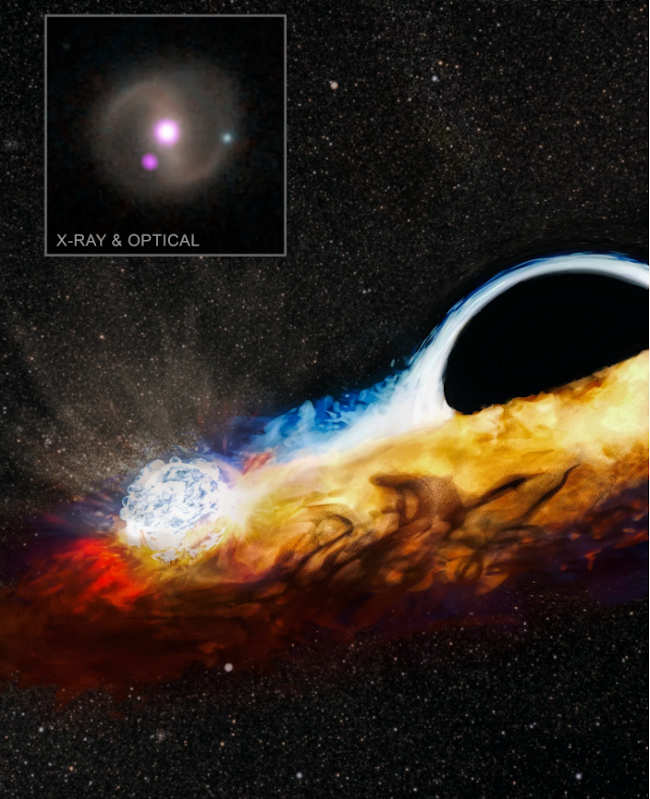
NASA’s Chandra X-ray Observatory and other telescopes have identified a supermassive black hole that has torn apart one star and is now using that stellar wreckage to pummel another star or smaller black hole, as described in our latest press release.
This research helps connect two cosmic mysteries and provides information about the environment around some of the bigger types of black holes.
This artist’s illustration shows a disk of material (red, orange, and yellow) that was created after a supermassive black hole (depicted on the right) tore apart a star through intense tidal forces. Over the course of a few years, this disk expanded outward until it intersected with another object — either a star or a small black hole — that is also in orbit around the giant black hole. Each time this object crashes into the disk, it sends out a burst of X-rays detected by Chandra. The inset shows Chandra data (purple) and an optical image of the source from Pan-STARRS (red, green, and blue).
In 2019, an optical telescope in California noticed a burst of light that astronomers later categorized as a “tidal disruption event”, or TDE. These are cases where black holes tear stars apart if they get too close through their powerful tidal forces. Astronomers gave this TDE the name of AT2019qiz.
Meanwhile, scientists were also tracking instances of another type of cosmic phenomena occasionally observed across the Universe. These were brief and regular bursts of X-rays that were near supermassive black holes. Astronomers named these events “quasi-periodic eruptions,” or QPEs.
This latest study gives scientists evidence that TDEs and QPEs are likely connected. The researchers think that QPEs arise when an object smashes into the disk left behind after the TDE. While there may be other explanations, the authors of the study propose this is the source of at least some QPEs.
In 2023, astronomers used both Chandra and Hubble to simultaneously study the debris left behind after the tidal disruption had ended. The Chandra data were obtained during three different observations, each separated by about 4 to 5 hours. The total exposure of about 14 hours of Chandra time revealed only a weak signal in the first and last chunk, but a very strong signal in the middle observation.
From there, the researchers used NASA’s Neutron Star Interior Composition Explorer (NICER) to look frequently at AT2019qiz for repeated X-ray bursts. The NICER data showed that AT2019qiz erupts roughly every 48 hours. Observations from NASA’s Neil Gehrels Swift Observatory and India’s AstroSat telescope cemented the finding.
The ultraviolet data from Hubble, obtained at the same time as the Chandra observations, allowed the scientists to determine the size of the disk around the supermassive black hole. They found that the disk had become large enough that if any object was orbiting the black hole and took about a week or less to complete an orbit, it would collide with the disk and cause eruptions.
This result has implications for searching for more quasi-periodic eruptions associated with tidal disruptions. Finding more of these would allow astronomers to measure the prevalence and distances of objects in close orbits around supermassive black holes. Some of these may be excellent targets for the planned future gravitational wave observatories.
The paper describing these results appears in the October 9, 2024 issue of the journal Nature. The first author of the paper is Matt Nicholl (Queen’s University Belfast in Ireland) and the full list of authors can be found in the paper, which is available online at: https://arxiv.org/abs/2409.02181
NASA’s Marshall Space Flight Center manages the Chandra program. The Smithsonian Astrophysical Observatory’s Chandra X-ray Center controls science operations from Cambridge, Massachusetts, and flight operations from Burlington, Massachusetts.
Learn more about the Chandra X-ray Observatory and its mission at https://www.nasa.gov/chandra and https://chandra.si.edu.