How to resolve AdBlock issue?
Refresh this page
How to resolve AdBlock issue?
Refresh this page
Lake County News,California
  • Home
    • Registration Form
  • News
    • Education
    • Veterans
    • Community
      • Obituaries
      • Letters
      • Commentary
    • Police Logs
    • Business
    • Recreation
    • Health
    • Religion
    • Legals
    • Arts & Life
    • Regional
  • Calendar
  • Contact us
    • FAQs
    • Phones, E-Mail
    • Subscribe
  • Advertise Here
  • Login
How to resolve AdBlock issue?
Refresh this page

News

Drinking plenty of water may actually be good for you

Details
Written by: Elizabeth Fernandez
Published: 01 December 2024
Public health recommendations generally suggest drinking eight cups of water a day. And many people just assume it’s healthy to drink plenty of water.

Now researchers at UC San Francisco have taken a systematic look at the available evidence. They concluded that drinking enough water can help with weight loss and prevent kidney stones, as well as migraines, urinary tract infections and low blood pressure.

“For such a ubiquitous and simple intervention, the evidence hasn’t been clear, and the benefits were not well established, so we wanted to take a closer look,” said Benjamin Breyer, MD, MAS, the Taube Family Distinguished Professor and chair of the UCSF Department of Urology.

Besides aiding in weight loss, drinking water can help:

• prevent kidney stones;
• prevent migraines and recurring headaches;
• avoid urinary tract infections;
• control diabetes and blood glucose levels;
• control low blood pressure.

“The amount of rigorous research turned out to be limited, but in some specific areas, there was a statistically significant benefit,” said Breyer, the senior author of the study. “To our knowledge, this is the first study assessing the benefits of water consumption on clinical outcomes broadly.”

The study, which analyzed 18 randomized controlled trials, appears Nov. 25 in JAMA Network Open.

The researchers found the most evidence in favor of drinking water to prevent kidney stones and to help people lose weight.

Drinking eight cups of water a day significantly decreased the likelihood of getting another kidney stone.

Several studies found that drinking about six cups of water a day helped adults lose weight. But a study that included adolescents found that drinking a little more than eight cups of water a day had no effect.

Still, the authors said that encouraging people to drink water before meals would be a simple and cheap intervention that could have huge benefits, given the increased prevalence of obesity.

Other studies indicated that water can help prevent migraines, control diabetes and low blood pressure, and prevent urinary tract infections.

Adults with recurrent headaches felt better after three months of drinking more water.

Drinking about four more cups of water a day helped diabetic patients whose blood glucose levels were elevated.

Drinking an additional six cups a day of water also helped women with recurrent urinary tract infections. It reduced the number of infections and increased the amount of time between them.

And drinking more water helped young adults with low blood pressure.

“We know that dehydration is detrimental, particularly in someone with a history of kidney stones or urinary infections,” Breyer said. “On the other hand, someone who suffers from frequent urination at times may benefit from drinking less. There isn’t a one size fits all approach for water consumption.”

Authors: From UCSF, co-authors are Nizar Hakam, MBBS; Jose Luis Guzman Fuentes; Architha Sudhakar; Kevin D. Li; Catherine Nicholas; Jason L. Lui, MD; Peggy Tahir, MLIS; Charles P. Jones, MD; and Stephen Bent, MD. From Weill Cornell Medicine, Behnam Nabavizadeh, MD.

Elizabeth Fernandez writes for UC San Francisco.

Space News: NASA’s Europa Clipper — millions of miles down, instruments deploying

Details
Written by: Jet Propulsion Laboratory
Published: 01 December 2024
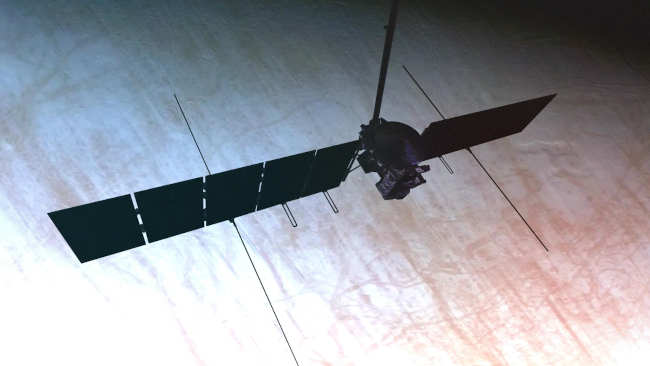
An artist’s concept of NASA’s Europa Clipper shows the spacecraft in silhouette against Europa’s surface, with the magnetometer boom fully deployed at top and the antennas for the radar instrument extending out from the solar arrays. NASA/JPL-Caltech.

NASA’s Europa Clipper, which launched Oct. 14 on a journey to Jupiter’s moon Europa, is already 13 million miles (20 million kilometers) from Earth.

Two science instruments have deployed hardware that will remain at attention, extending out from the spacecraft, for the next decade — through the cruise to Jupiter and the entire prime mission.

A SpaceX Falcon Heavy rocket launched it away from Earth’s gravity, and now the spacecraft is zooming along at 22 miles per second (35 kilometers per second) relative to the Sun.

Europa Clipper is the largest spacecraft NASA has ever developed for a planetary mission. It will travel 1.8 billion miles (2.9 billion kilometers) to arrive at Jupiter in 2030 and in 2031 will begin a series of 49 flybys, using a suite of instruments to gather data that will tell scientists if the icy moon and its internal ocean have the conditions needed to harbor life.

For now, the information mission teams are receiving from the spacecraft is strictly engineering data (the science will come later), telling them how the hardware is operating. Things are looking good. The team has a checklist of actions the spacecraft needs to take as it travels deeper into space. Here’s a peek:

Boom times

Shortly after launch, the spacecraft deployed its massive solar arrays, which extend the length of a basketball court. Next on the list was the magnetometer’s boom, which uncoiled from a canister mounted on the spacecraft body, extending a full 28 feet (8.5 meters).

To confirm that all went well with the boom deployment, the team relied on data from the magnetometer’s three sensors. Once the spacecraft is at Jupiter, these sensors will measure the magnetic field around Europa, both confirming the presence of the ocean thought to be under the moon’s icy crust and telling scientists about its depth and salinity.

On the radar

After the magnetometer, the spacecraft deployed several antennas for the radar instrument. Now extending crosswise from the solar arrays, the four high-frequency antennas form what look like two long poles, each measuring 57.7 feet (17.6 meters) long. Eight rectangular very-high-frequency antennas, each 9 feet (2.76 meters) long, were also deployed — two on the two solar arrays.

“It’s an exciting time on the spacecraft, getting these key deployments done,” said Europa Clipper project manager Jordan Evans of NASA’s Jet Propulsion Laboratory in Southern California. “Most of what the team is focusing on now is understanding the small, interesting things in the data that help them understand the behavior of the spacecraft on a deeper level. That’s really good to see.”

Instrument checkout

The remaining seven instruments will be powered on and off through December and January so that engineers can check their health.

Several instruments, including the visible imager and the gas and dust mass spectrometers, will keep their protective covers closed for the next three or so years to guard against potential damage from the Sun during Europa Clipper’s time in the inner solar system.

Mars-bound

Once all the instruments and engineering subsystems have been checked out, mission teams will shift their focus to Mars.

On March 1, 2025, Europa Clipper will reach Mars’ orbit and begin to loop around the Red Planet, using the planet’s gravity to gain speed. (This effect is similar to how a ball thrown at a moving train will bounce off the train in another direction at a higher speed.) Mission navigators already have completed one trajectory correction maneuver, as planned, to get the spacecraft on the precise course.

At Mars, scientists plan to turn on the spacecraft’s thermal imager to capture multicolored images of Mars as a test operation. They also plan to collect data with the radar instrument so engineers can be sure it’s operating as expected.

The spacecraft will perform another gravity assist in December 2026, swooping by Earth before making the remainder of the long journey to the Jupiter system. At that time, the magnetometer will measure Earth’s magnetic field, calibrating the instrument.

More about Europa Clipper

Europa Clipper’s three main science objectives are to determine the thickness of the moon’s icy shell and its interactions with the ocean below, to investigate its composition, and to characterize its geology. The mission’s detailed exploration of Europa will help scientists better understand the astrobiological potential for habitable worlds beyond our planet.

Managed by Caltech in Pasadena, California, JPL leads the development of the Europa Clipper mission in partnership with the Johns Hopkins Applied Physics Laboratory in Laurel, Maryland, for NASA’s Science Mission Directorate in Washington. APL designed the main spacecraft body in collaboration with JPL and NASA’s Goddard Space Flight Center in Greenbelt, Maryland, NASA’s Marshall Space Flight Center in Huntsville, Alabama, and Langley Research Center in Hampton, Virginia.

The Planetary Missions Program Office at Marshall executes program management of the Europa Clipper mission. NASA’s Launch Services Program, based at Kennedy, managed the launch service for the Europa Clipper spacecraft.

Find more information about Europa Clipper here: https://science.nasa.gov/mission/europa-clipper.

Employment bounced back faster for private industry than for state and local governments

Details
Written by: Dylan Maloney
Published: 30 November 2024


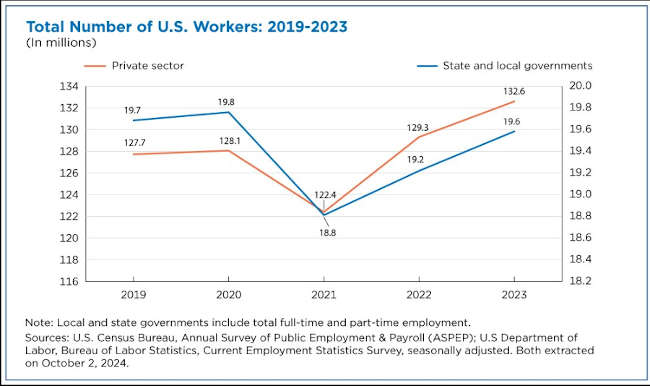
Since the economic downturn caused by the COVID-19 pandemic, total full- and part-time employment in state and local governments has never fully bounced back.

In March 2022, while private industry had surpassed its level of employment from March 2019, state and local governments still had not fully regained their March 2019 employment levels.

The number of state and local government employees took less of a hit than those in private industry, but the belt-tightening by state and local governments has not loosened up enough to return to pre-pandemic employment levels as of 2023.

What happened?

From March 2019 to March 2023, the number of state and local government jobs declined by 101,000 or 0.5% to 19.6 million, according to U.S. Census Bureau statistics from the Annual Survey of Public Employment & Payroll, or ASPEP.

By contrast, private industry experienced a smaller percentage drop in employment and in March 2022 had rebounded beyond pre-pandemic levels with more employees (seasonally adjusted) than in March 2019.

Private industry employment in 2022 reached a total of 129.3 million jobs, according to the Bureau of Labor Statistics, up over 1.2% (nearly 1.6 million jobs) from 127.7 million jobs in 2019 despite the pandemic downturn during that period.

In March 2022, while private industry had surpassed its level of employment from March 2019, state and local governments still had not fully regained their March 2019 employment levels.

Government services hit the hardest

Overall, state and local government employment declined 4.8% from 2020 to 2021, losing just under 948,000 employees.

Elementary and secondary education saw the largest job losses by far – 5.7% or 447,000 employees, close to half of all government jobs lost during this period.

This was followed by losses in higher education (8.5% or 282,000 jobs); and parks and recreation (13.9% or 59,000 jobs).

Growth since the turnaround

Several areas in state and local employment grew but had not rebounded to pre-pandemic levels in 2023. Overall, state and local government employment increased 4.1% from 2021 to 2023, adding just under 772,000 employees, still short about 176,000 jobs from 2020 levels.

Elementary and secondary education, which experienced the largest numeric loss during the downturn in March of 2021, also experienced the largest numeric increase during the recovery, adding just over 452,000 employees or 6.1% in 2023, just surpassing 2020 levels by nearly 6,000 employees.

Higher education employment rose 4.8%, adding nearly 147,000 jobs. Parks and recreation also gained 17.0% or just over 62,000 jobs from 2021 to 2023. Both are still below March 2019 employment levels.

The Annual Survey of Public Employment & Payroll provides more information on state and local government employees and the services they offer through annual statistics on the number of state and local government civilian employees and their gross payrolls for the month of March.

Dylan Maloney is a survey statistician for the Census Bureau’s Economy-Wide Statistics Division.

Light exercise can yield significant cognitive benefits, new research shows

Details
Written by: Jonathan G. Hakun, Penn State
Published: 30 November 2024


Everyday physical activity, like going for a short walk or playing with the kids, may provide short-term benefits for cognitive health, equivalent to reversing four years of cognitive aging. That was a key finding for my colleagues and me in our new study, which was published in the journal Annals of Behavioral Medicine.

Prior to enrollment into a study of diet and dementia risk, we asked a diverse sample of 204 middle-aged adults to check in five times per day for a period of nine days, via a smartphone application.

Each check-in involved completing a brief survey that asked about their mood, dietary choices and whether they engaged in any physical activity in the roughly three and a half hours leading up to the survey. In addition, participants completed a few brief brain games – meaning performance-based cognitive assessments that lasted about one minute each – to assess mental speed and short-term memory.

My team found that performance on our measure of cognitive processing speed improved during check-ins when participants reported being physically active in the time leading up to the survey. While we didn’t see improvements in our measure of working memory, the time taken to complete the memory task mirrored what we saw for the measure of processing speed.

We observed these improvements in speed regardless of whether the activity was lighter intensity or moderate-to-vigorous intensity. This led us to conclude that movement, whether it took the form of intentional exercise or part of a daily routine, was the essential ingredient for achieving this benefit.

Why it matters

As a rule, we get slower, both physically and mentally, as we age. While research on exercise and living a healthy lifestyle has demonstrated the long-term cognitive and brain health benefits of remaining physically active, much of this work has focused on the moderate- to vigorous-intensity physical activity – or what most of us think of as exercise – recommended by the Physical Activity Guidelines for Americans.

Still, these guidelines and other experts recommend that adults move more and sit less.

My colleagues and I are interested in understanding how moving more can improve our cognitive health or reduce our risk of dementia as we age, at what timescale these benefits show up, and what types of movement qualify.

Exercise promotes blood circulation and the growth of neurons.

What still isn’t known

Our study relied on participants to report whether they had been physically active during the time between each check-in. Even though participants were provided training on how to think about the intensity levels, it’s possible that each participant had a slightly different perception of their activities.

For example, a participant may not have believed their recent walk actually qualified as a moderate-intensity activity. Physical activity monitors that can dissociate time and intensity might help future research unravel these associations more clearly.

What’s next

It isn’t yet clear whether these short-term benefits accumulate over time to result in long-term improvements in brain health and dementia risk reduction. Research efforts are underway by our team to better understand these associations over broader timescales.

My research involves data collection via smartphones and wearable devices to help us better understand how health-promoting behaviors and cognitive health interact as we age. This type of digital approach allows my team to pursue questions about how everyday behavior and experience influence cognition in daily life and represents a significant methodological advancement in the dementia risk and prevention research space.

Using these tools, we aim to better identify individuals at risk for negative cognitive outcomes and new targets for dementia prevention.The Conversation

Jonathan G. Hakun, Assistant Professor of Neurology, Psychology, & Public Health Sciences, Penn State

This article is republished from The Conversation under a Creative Commons license. Read the original article.

  1. Estate Planning: Medi-Cal without the asset test
  2. Space News: Discovery alert — a ‘Hot Neptune’ in a tight orbit
  3. Elections office nears completion of total ballot count
  • 464
  • 465
  • 466
  • 467
  • 468
  • 469
  • 470
  • 471
  • 472
  • 473
How to resolve AdBlock issue?
Refresh this page