How to resolve AdBlock issue?
Refresh this page
How to resolve AdBlock issue?
Refresh this page
Lake County News,California
  • Home
    • Registration Form
  • News
    • Education
    • Veterans
    • Community
      • Obituaries
      • Letters
      • Commentary
    • Police Logs
    • Business
    • Recreation
    • Health
    • Religion
    • Legals
    • Arts & Life
    • Regional
  • Calendar
  • Contact us
    • FAQs
    • Phones, E-Mail
    • Subscribe
  • Advertise Here
  • Login
How to resolve AdBlock issue?
Refresh this page

News

Wells Fargo awards $300,000 Grant to California Finance Consortium

Details
Written by: LAKE COUNTY NEWS REPORTS
Published: 03 December 2024
Wells Fargo has awarded a $300,000 grant to the California Finance Consortium, or CFC, to enhance small business technical assistance and lending services across 13 Northern California counties.

The announcement on the funding said, “This funding underscores Wells Fargo’s commitment to empowering local communities and fostering economic growth by supporting small businesses.”

The targeted counties include Butte, Del Norte, Glenn, Humboldt, Lake, Mendocino, Modoc, Shasta, Siskiyou, Sutter, Tehama, Trinity and Yuba.

CFC will deploy these services through its regional partners: 3CORE, North Edge (formerly Arcata Economic Development Corp.), Superior California Economic Development Inc. and Yuba-Sutter Economic Development Corp.

Key benefits of the grant include:

Enhanced technical assistance: Small businesses will receive comprehensive support in developing robust business plans, financial projections, and operational strategies to ensure sustainability and growth.

Increased lending capacity: The grant will bolster lending capabilities, providing more small businesses with access to necessary capital.

Regional economic growth: By supporting small businesses, the grant will help stimulate job creation and economic development within the 13 counties.

"We are thrilled to partner with Wells Fargo Bank N.A. to support the entrepreneurial spirit of Northern California," said Brynda Stranix, president of California Finance Consortium. "This grant will significantly enhance our ability to provide small businesses with the tools and resources they need to thrive, ultimately contributing to the economic vitality of our communities. Our collaboration with 3CORE, North Edge, Superior California Economic Development, and Yuba-Sutter Economic Development Corp. will ensure these services are effectively delivered throughout the region."

This grant builds on Wells Fargo’s commitment to small business growth and the recent success of its Open for Business Fund, a national small business recovery effort.

New economic impact data shows that effort helped small business owners keep or sustain roughly 461,000 jobs nationwide, and technical assistance played a key role in propelling small businesses forward.

“We recognize the crucial role small businesses play in driving economic growth and creating jobs,” said Kären Woodruff, senior vice president, community relations, Wells Fargo. “Our support of the California Finance Corporation is a testament to our commitment to helping small businesses succeed and our dedication to strengthening the economic fabric of Northern California.”

Taxpayers spend 22% more per patient to support Medicare Advantage – the private alternative to Medicare that promised to cost less

Details
Written by: Grace McCormack, University of Southern California and Erin Duffy, University of Southern California
Published: 03 December 2024


Medicare Advantage was supposed to find efficiencies, but instead is costing taxpayers an extra $83 billion a year. Ariel Skelley/DigitalVision via Getty Images

Medicare Advantage – the commercial alternative to traditional Medicare – is drawing down federal health care funds, costing taxpayers an extra 22% per enrollee to the tune of US$83 billion a year.

Medicare Advantage, also known as Part C, was supposed to save the government money. The competition among private insurance companies, and with traditional Medicare, to manage patient care was meant to give insurance companies an incentive to find efficiencies. Instead, the program’s payment rules overpay insurance companies on the taxpayer’s dime.

We are health care policy experts who study Medicare, including how the structure of the Medicare payment system is, in the case of Medicare Advantage, working against taxpayers.

Medicare beneficiaries choose an insurance plan when they turn 65. Younger people can also become eligible for Medicare due to chronic conditions or disabilities. Beneficiaries have a variety of options, including the traditional Medicare program administered by the U.S. government, Medigap supplements to that program administered by private companies, and all-in-one Medicare Advantage plans administered by private companies.

Commercial Medicare Advantage plans are increasingly popular – over half of Medicare beneficiaries are enrolled in them, and this share continues to grow. People are attracted to these plans for their extra benefits and out-of-pocket spending limits. But due to a loophole in most states, enrolling in or switching to Medicare Advantage is effectively a one-way street. The Senate Finance Committee has also found that some plans have used deceptive, aggressive and potentially harmful sales and marketing tactics to increase enrollment.

Baked into the plan

Researchers have found that the overpayment to Medicare Advantage companies, which has grown over time, was, intentionally or not, baked into the Medicare Advantage payment system. Medicare Advantage plans are paid more for enrolling people who seem sicker, because these people typically use more care and so would be more expensive to cover in traditional Medicare.

However, differences in how people’s illnesses are recorded by Medicare Advantage plans causes enrollees to seem sicker and costlier on paper than they are in real life. This issue, alongside other adjustments to payments, leads to overpayment with taxpayer dollars to insurance companies.

Some of this extra money is spent to lower cost sharing, lower prescription drug premiums and increase supplemental benefits like vision and dental care. Though Medicare Advantage enrollees may like these benefits, funding them this way is expensive. For every extra dollar that taxpayers pay to Medicare Advantage companies, only roughly 50 to 60 cents goes to beneficiaries in the form of lower premiums or extra benefits.

As Medicare Advantage becomes increasingly expensive, the Medicare program continues to face funding challenges.

In our view, in order for Medicare to survive long term, Medicare Advantage reform is needed. The way the government pays the private insurers who administer Medicare Advantage plans, which may seem like a black box, is key to why the government overpays Medicare Advantage plans relative to traditional Medicare.

Paying Medicare Advantage

Private plans have been a part of the Medicare system since 1966 and have been paid through several different systems. They garnered only a very small share of enrollment until 2006.

The current Medicare Advantage payment system, implemented in 2006 and heavily reformed by the Affordable Care Act in 2010, had two policy goals. It was designed to encourage private plans to offer the same or better coverage than traditional Medicare at equal or lesser cost. And, to make sure beneficiaries would have multiple Medicare Advantage plans to choose from, the system was also designed to be profitable enough for insurers to entice them to offer multiple plans throughout the country.

To accomplish this, Medicare established benchmark estimates for each county. This benchmark calculation begins with an estimate of what the government-administered traditional Medicare plan would spend on the average county resident. This value is adjusted based on several factors, including enrollee location and plan quality ratings, to give each plan its own benchmark.

Medicare Advantage plans then submit bids, or estimates, of what they expect their plans to spend on the average county enrollee. If a plan’s spending estimate is above the benchmark, enrollees pay the difference as a Part C premium.

Most plans’ spending estimates are below the benchmark, however, meaning they project that the plans will provide coverage that is equivalent to traditional Medicare at a lower cost than the benchmark. These plans don’t charge patients a Part C premium. Instead, they receive a portion of the difference between their spending estimate and the benchmark as a rebate that they are supposed to pass on to their enrollees as extras, like reductions in cost-sharing, lower prescription drug premiums and supplemental benefits.

Finally, in a process known as risk adjustment, Medicare payments to Medicare Advantage health plans are adjusted based on the health of their enrollees. The plans are paid more for enrollees who seem sicker.
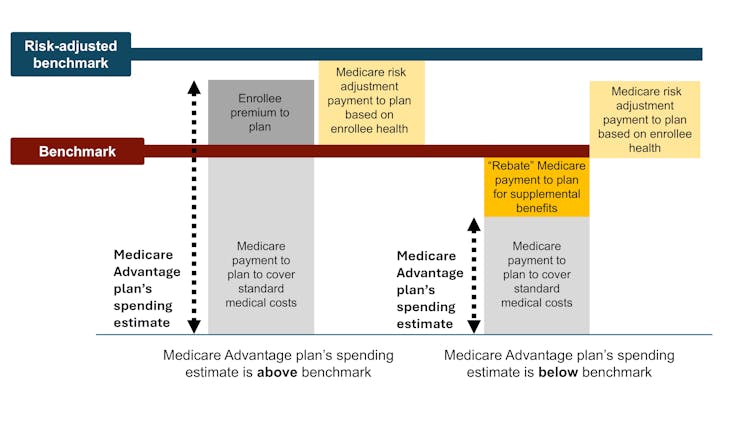
Two sets of stacked boxes sit below a vertical bar labeled Risk-Adjusted Benchmark. A vertical line bisecting the boxes is labelled what Medicare would actually spend on an enrollee in traditional Medicare
The government pays Medicare Advantage plans based on Medicare’s cost estimates for a given county. The benchmark is an estimate from the Centers for Medicare & Medicaid Services of what it would cost to cover an average county enrollee in traditional Medicare, plus adjustments including quartile payments and quality bonuses. The risk-adjusted benchmark also takes into consideration an enrollee’s health. Samantha Randall at USC, CC BY-ND

Theory versus reality

In theory, this payment system should save the Medicare system money because the risk-adjusted benchmark that Medicare estimates for each plan should run, on average, equal to what Medicare would actually spend on a plan’s enrollees if they had enrolled in traditional Medicare instead.

In reality, the risk-adjusted benchmark estimates are far above traditional Medicare costs. This causes Medicare – really, taxpayers – to spend more for each person who is enrolled in Medicare Advantage than if that person had enrolled in traditional Medicare.

Why are payment estimates so high? There are two main culprits: benchmark modifications designed to encourage Medicare Advantage plan availability, and risk adjustments that overestimate how sick Medicare Advantage enrollees are.

Two sets of stacked boxes with dotted arrows on the left side of each labeled Medicare Advantage Plan Bid sit below vertical bars labeled Benchmark and Risk-Adjusted Benchmark.
High risk-adjusted benchmarks lead to overpayments from the government to the private companies that administer Medicare Advantage plans. Samantha Randall at USC, CC BY-ND

Benchmark modifications

Since the current Medicare Advantage payment system started in 2006, policymaker modifications have made Medicare’s benchmark estimates less tied to what the plan spends on each enrollee.

In 2012, as part of the Affordable Care Act, Medicare Advantage benchmark estimates received another layer: “quartile adjustments.” These made the benchmark estimates, and therefore payments to Medicare Advantage companies, higher in areas with low traditional Medicare spending and lower in areas with high traditional Medicare spending. This benchmark adjustment was meant to encourage more equitable access to Medicare Advantage options.

In that same year, Medicare Advantage plans started receiving “quality bonus payments” with plans that have higher “star ratings” based on quality factors such as enrollee health outcomes and care for chronic conditions receiving higher bonuses.

However, research shows that ratings have not necessarily improved quality and may have exacerbated racial inequality.

Even before fully taking into account risk adjustment, recent estimates peg the benchmarks, on average, as 8% higher than average traditional Medicare spending. This means that a Medicare Advantage plan’s spending estimate could be below the benchmark and the plan would still get paid more for its enrollees than it would have cost the government to cover those same enrollees in traditional Medicare.

Overestimating enrollee sickness

The second major source of overpayment is health risk adjustment, which tends to overestimate how sick Medicare Advantage enrollees are.

Each year, Medicare studies traditional Medicare diagnoses, such as diabetes, depression and arthritis, to understand which have higher treatment costs. Medicare uses this information to adjust its payments for Medicare Advantage plans. Payments are lowered for plans with lower predicted costs based on diagnoses and raised for plans with higher predicted costs. This process is known as risk adjustment.

But there is a critical bias baked into risk adjustment. Medicare Advantage companies know that they’re paid more if their enrollees seem more sick, so they diligently make sure each enrollee has as many diagnoses recorded as possible.

This can include legal activities like reviewing enrollee charts to ensure that diagnoses are recorded accurately. It can also occasionally entail outright fraud, where charts are “upcoded” to include diagnoses that patients don’t actually have.

In traditional Medicare, most providers – the exception being Accountable Care Organizations – are not paid more for recording diagnoses. This difference means that the same beneficiary is likely to have fewer recorded diagnoses if they are enrolled in traditional Medicare rather than a private insurer’s Medicare Advantage plan. Policy experts refer to this phenomenon as a difference in “coding intensity” between Medicare Advantage and traditional Medicare.

Human figure with arrows to two boxes. Left box has two plus symbols labelled  recorded diagnoses and one dollar sign. Right box has five symbols and three dollar signs.
The same person is likely to be documented with more illnesses if they enroll in Medicare Advantage rather than traditional Medicare – and cost taxpayers more money. Samantha Randall at USC, CC BY-ND

In addition, Medicare Advantage plans often try to recruit beneficiaries whose health care costs will be lower than their diagnoses would predict, such as someone with a very mild form of arthritis. This is known as “favorable selection.”

The differences in coding and favorable selection make beneficiaries look sicker when they enroll in Medicare Advantage instead of traditional Medicare. This makes cost estimates higher than they should be. Research shows that this mismatch – and resulting overpayment – is likely only going to get worse as Medicare Advantage grows.

Where the money goes

Some of the excess payments to Medicare Advantage are returned to enrollees through extra benefits, funded by rebates. Extra benefits include cost-sharing reductions for medical care and prescription drugs, lower Part B and D premiums, and extra “supplemental benefits” like hearing aids and dental care that traditional Medicare doesn’t cover.

Medicare Advantage enrollees may enjoy these benefits, which could be considered a reward for enrolling in Medicare Advantage, which, unlike traditional Medicare, has prior authorization requirements and limited provider networks.

However, according to some policy experts, the current means of funding these extra benefits is unnecessarily expensive and inequitable.

It also makes it difficult for traditional Medicare to compete with Medicare Advantage.

Traditional Medicare, which tends to cost the Medicare program less per enrollee, is only allowed to provide the standard Medicare benefits package. If its enrollees want dental coverage or hearing aids, they have to purchase these separately, alongside a Part D plan for prescription drugs and a Medigap plan to lower their deductibles and co-payments.

Page from text document
Medicare Advantage plans offer extras, but at a high cost to the Medicare system – and taxpayers. Only 50-60 cents of a dollar spent is returned to enrollees as decreased costs or increased benefits. AP Photo/Pablo Martinez Monsivais

The system sets up Medicare Advantage plans to not only be overpaid but also be increasingly popular, all on the taxpayers’ dime. Plans heavily advertise to prospective enrollees who, once enrolled in Medicare Advantage, will likely have difficulty switching into traditional Medicare, even if they decide the extra benefits are not worth the prior authorization hassles and the limited provider networks. In contrast, traditional Medicare typically does not engage in as much direct advertising. The federal government only accounts for 7% of Medicare-related ads.

At the same time, some people who need more health care and are having trouble getting it through their Medicare Advantage plan – and are able to switch back to traditional Medicare – are doing so, according to an investigation by The Wall Street Journal. This leaves taxpayers to pick up care for these patients just as their needs rise.

Where do we go from here?

Many researchers have proposed ways to reduce excess government spending on Medicare Advantage, including expanding risk adjustment audits, reducing or eliminating quality bonus payments or using more data to improve benchmark estimates of enrollee costs. Others have proposed even more fundamental reforms to the Medicare Advantage payment system, including changing the basis of plan payments so that Medicare Advantage plans will compete more with each other.

Reducing payments to plans may have to be traded off with reductions in plan benefits, though projections suggest the reductions would be modest.

There is a long-running debate over what type of coverage should be required under both traditional Medicare and Medicare Advantage. Recently, policy experts have advocated for introducing an out-of-pocket maximum to traditional Medicare. There have also been multiple unsuccessful efforts to make dental, vision, and hearing services part of the standard Medicare benefits package.

Although all older people require regular dental care and many of them require hearing aids, providing these benefits to everyone enrolled in traditional Medicare would not be cheap. One approach to providing these important benefits without significantly raising costs is to make these benefits means-tested. This would allow people with lower incomes to purchase them at a lower price than higher-income people. However, means-testing in Medicare can be controversial.

There is also debate over how much Medicare Advantage plans should be allowed to vary. The average Medicare beneficiary has over 40 Medicare Advantage plans to choose from, making it overwhelming to compare plans. For instance, right now, the average person eligible for Medicare would have to sift through the fine print of dozens of different plans to compare important factors, such as out-of-pocket maximums for medical care, coverage for dental cleanings, cost-sharing for inpatient stays, and provider networks.

Although millions of people are in suboptimal plans, 70% of people don’t even compare plans, let alone switch plans, during the annual enrollment period at the end of the year, likely because the process of comparing plans and switching is difficult, especially for older Americans.

MedPAC, a congressional advising committee, suggests that limiting variation in certain important benefits, like out-of-pocket maximums and dental, vision and hearing benefits, could help the plan selection process work better, while still allowing for flexibility in other benefits. The challenge is figuring out how to standardize without unduly reducing consumers’ options.

The Medicare Advantage program enrolls over half of Medicare beneficiaries. However, the $83-billion-per-year overpayment of plans, which amounts to more than 8% of Medicare’s total budget, is unsustainable. We believe the Medicare Advantage payment system needs a broad reform that aligns insurers’ incentives with the needs of Medicare beneficiaries and American taxpayers.

This article is part of an occasional series examining the U.S. Medicare system.

Past articles in the series:

Medicare vs. Medicare Advantage: sales pitches are often from biased sources, the choices can be overwhelming and impartial help is not equally available to allThe Conversation

Grace McCormack, Postdoctoral researcher of Health Policy and Economics, University of Southern California and Erin Duffy, Research Scientist and Director of Research Training in Health Policy and Economics, University of Southern California

This article is republished from The Conversation under a Creative Commons license. Read the original article.

Lakeport City Council to consider final approval of tobacco retailers ordinance

Details
Written by: Elizabeth Larson
Published: 02 December 2024
LAKEPORT, Calif. – The Lakeport City Council this week will consider approving the final step in adopting a new ordinance to establish a tobacco retail license program.

The council will meet Tuesday, Dec. 3, at 6 p.m. in the council chambers at Lakeport City Hall, 225 Park St.

The agenda can be found here.

If you cannot attend in person, and would like to speak on an agenda item, you can access the Zoom meeting remotely at this link or join by phone by calling toll-free 669-900-9128 or 346-248-7799.

The webinar ID is 973 6820 1787, access code is 477973; the audio pin will be shown after joining the webinar. Those phoning in without using the web link will be in “listen mode” only and will not be able to participate or comment.

Comments can be submitted by email to This email address is being protected from spambots. You need JavaScript enabled to view it.. To give the city clerk adequate time to print out comments for consideration at the meeting, please submit written comments before 3:30 p.m. on Tuesday, Dec. 3.

On Tuesday, the council will hold a public hearing to adopt an ordinance to the municipal code requiring the licensure of tobacco retailers, regulating the sale of tobacco products, and determining that this ordinance is not subject to the California Environmental Quality Act.

The council approved the first reading during a public hearing held at its Nov. 19 meeting.

City Manager Kevin Ingram’s report explained, “Lake County faces significant health challenges, including a high rate of tobacco use,” adding that tobacco use and vaping are prevalent among even younger populations and are “a significant problem in our school system.”

At its Aug. 16 meeting, the Board of Supervisors adopted its own tobacco retail ordinance.

The council began considering the ordinance in September, when its members heard an in-depth presentation from Lake County Public Health regarding its recently adopted ordinance
establishing a tobacco retail license program. At that time, the majority of the council signaled support for moving forward with such regulations.

“During that meeting, the City Council expressed support for establishing local tobacco retail regulations and partnering with Lake County Public Health to develop an enforcement program with a specific focus on reducing sales to minors,” Ingram said.

He said the city of Lakeport has discussed creating consistent tobacco retailer regulations that can be implemented countywide by Lake County Public Health with both county officials and the city of Clearlake.

“The proposed ordinance before the Council aligns closely with the County's ordinance but includes additional flexibility for enforcement responsibilities. Specifically, the ordinance designates the City Manager as responsible for enforcement. This designation allows the City Manager to delegate enforcement authority to any agency, department, or individual as approved by the City Council,” Ingram wrote.

“The ordinance also explicitly permits the City Council to enter into agreements with the County or other agencies to perform enforcement duties,” Ingram continued. “City staff recommends contracting with Lake County Public Health to enforce and administer the ordinance. However, should the City choose to alter this arrangement in the future, the ordinance ensures that enforcement authority remains clearly under the City's jurisdiction. This proposed approach provides flexibility while maintaining the necessary structure to effectively regulate tobacco retail activities and protect public health.”

Also on Tuesday, the council will conduct a second reading and hold a public hearing to consider the addition of a section to the Lakeport Municipal Code establishing a procedure requiring the exhaustion of administrative remedies for individuals or entities challenging fees, charges, and assessments on real property levied by the City of Lakeport,” said Finance Director and Assistant City Manager Nick Walker in his report to the council.

Under business, the council will discuss and review observed trends in received traffic safety related complaints as part of its bi-annual traffic safety report.

On the consent agenda — items considered noncontroversial and usually accepted as a slate on one vote — are ordinances; minutes of the City Council’s regular meeting on Nov. 19; approval of the continuation of the proclamation declaring a local state of emergency due to severe weather conditions including heavy rain, and extreme wind; adoption of the resolution accepting the Potable Water Backup Power Project; adoption of the resolution accepting the exchange of granulated activated carbon, Bid No., 24-08, and authorize the filing of the notice of completion; and adoption of the resolution rescinding Resolution 2957 (2024) and revising the Master Pay Schedule in conformance with California Code of Regulations, Title 2, Section 570.5.

The council also will hold a closed session to discuss negotiations with the Big Valley Band of Pomo Indians for city-owned property at 3665 State Highway 175, with Wine Country Compressors for a city-owned property at 910 Bevins St., and with the Lake County Tax Collector’s Office for four properties.

Email Elizabeth Larson at This email address is being protected from spambots. You need JavaScript enabled to view it.. Follow her on Twitter, @ERLarson, and on Bluesky, @erlarson.bsky.social. Find Lake County News on the following platforms: Facebook, @LakeCoNews; X, @LakeCoNews; Threads, @lakeconews, and on Bluesky, @lakeconews.bsky.social.

Board of Supervisors to discuss lease revenue bonds for sheriff’s headquarters remodel

Details
Written by: Elizabeth Larson
Published: 02 December 2024
LAKE COUNTY, Calif. — The Board of Supervisors this week will consider lease revenue bonds to fund the new sheriff’s headquarters, and hear presentations on the county’s opioid settlement funds and on flood insurance.

The‌ ‌board will meet beginning ‌at‌ ‌9‌ ‌a.m. Tuesday, Dec. 3, in the board chambers on the first floor of the Lake County Courthouse, 255 N. Forbes St., Lakeport.

The‌ ‌meeting‌ ‌can‌ ‌be‌ ‌watched‌ ‌live‌ ‌on‌ ‌Channel‌ ‌8, ‌online‌ ‌at‌ ‌https://countyoflake.legistar.com/Calendar.aspx‌‌ and‌ ‌on‌ ‌the‌ ‌county’s‌ ‌Facebook‌ ‌page. ‌ ‌Accompanying‌ ‌board‌ ‌documents, ‌the‌ ‌agenda‌ ‌and‌ ‌archived‌ ‌board‌ ‌meeting‌ ‌videos‌ ‌also‌ ‌are‌ ‌available‌ ‌at‌ ‌that‌ ‌link. ‌ ‌

To‌ ‌participate‌ ‌in‌ ‌real-time, ‌join‌ ‌the‌ ‌Zoom‌ ‌meeting‌ ‌by‌ ‌clicking‌ ‌this‌ ‌link‌. ‌ ‌

The‌ ‌meeting‌ ‌ID‌ ‌is‌ 865 3354 4962, ‌pass code 726865.‌ ‌The meeting also can be accessed via one tap mobile at +16694449171,,86533544962#,,,,*726865#. The meeting can also be accessed via phone at 669 900 6833.

At 9:05 a.m., the board will hold a public hearing to consider approving lease revenue bonds of up to $25 million to remodel the former Lakeport National Guard Armory facility into the Lake County Sheriff’s Office headquarters.

The staff report for the discussion said the remodel’s construction agreement is expected to be brought before the board on Dec. 17. It calls for a 16-month construction timeframe.

At 9:45 a.m., the board will hear a presentation on the county's opioid settlement funds expenditure plan and consider approving a letter of support for Lake County Behavioral Health Services' Behavioral Health Continuum Infrastructure Program grant application.

At 10:15 a.m., the supervisors also will hear a presentation on the National Flood Insurance Program.

The full agenda follows.

CONSENT AGENDA

5.1: Adopt resolution approving agreement No. 23-0529-016-SF with California Department of Food Agriculture for Glassy-Winged Sharpshooter (GWSS) program of $28,257.75 for July 1, 2024, through June 30, 2025.

5.2: Adopt resolution approving agreement No. 24-0388-025-SF with the California Department of Food and Agriculture for compliance with the Sudden Oak Death quarantine program for the period July 1, 2024, through June 30, 2025, in the amount of $2,809.91.

5.3: Approve closure of the Auditor-Controller/Clerk Office from 1 p.m. to 5 p.m. on Friday, Dec. 13.

5.4: Approve continuation of emergency proclamation declaring a shelter crisis in the County of Lake.

5.5: Approve continuation of proclamation of the existence of a local emergency due to pervasive tree mortality.

5.6: Approve continuation of proclamation declaring a Clear Lake hitch emergency.

5.7: Approve continuation of local emergency by the Lake County Sheriff/OES director for the 2024 late January, early February winter storms.

5.8: Approve continuation of proclamation of a local health emergency by the Lake County health officer for the Boyles Fire.

5.9: Approve continuation of a local emergency by the Lake County Sheriff/OES director for the 2024 Boyles Fire.

5.10: Approve continuation of local emergency proclamation by the Lake County Sheriff/OES director for the Glenhaven Fire.

5.11: Approve Board of Supervisors minutes for June 20 to 21, Oct. 22 and Nov. 5, 2024.

5.12: Authorize closure of the Community Development Department to the public on Wednesday, Dec. 11, from 12 p.m. to 5 p.m. for all-staff training.

5.13: Approve SafeRx grant application for the California Overdose Prevention Network Coalition funding for $75,000 per year for three years.

5.14: Approve request to close the Probation Department on Thursday, Dec. 12, from 10:30 a.m. to 5 p.m. for all-staff training.

5.15: Approve the qualified list from the request for qualifications for on-call civil engineering services.

5.16: Accept the offers of dedication and adopt the resolution approving the final subdivision map — Valley Oaks Subdivision Village PDC II Phase I.

5.17: Adopt resolution expressing support for the Lower Lake HoliDAZE Street Fair and temporarily authorizing a road closure, prohibiting parking, and authorizing removal of vehicles and ordering the Department of Public Works to post signs.

5.18: Approve the purchase of one vehicle from Pape’ Kenworth in the amount of $244,728.49 for the heavy equipment fleet and authorize the Public Works director/assistant purchasing agent to sign the sales order.

5.19: Approve amendment two to the engineering services agreement for staff augmentation between the county of Lake and Coastland Civil Engineering LLC, increasing the not-to-exceed amount to $750,000, and authorize the chair to sign amendment two.

5.20: Authorize the Department of Public Works to apply for an FY 2025 Rebuilding American Infrastructure with Sustainability and Equity (RAISE) grant for the South Main Street/Soda Bay Road project and authorize the chair to sign a letter of support.

5.21: Adopt resolution authorizing the department head of Lake County Department of Social Services to apply for and accept the County Allocation Award under Round 6 of the Transitional Housing Program and Round 3 of the Housing Navigation and Maintenance Program.

5.22: Sitting as the Lake County Sanitation District, Board of Directors, approve purchase of a submersible pump assembly to replace the pump at Lift Station No. 2 in the Northwest Wastewater System from DXP Enterprises Inc. in the amount not to exceed $120,372.40.

5.23: Sitting as the Lake County Sanitation District Board of Directors, adopt resolution revising the fiscal year 2024-2025 adopted budget of the County of Lake by closing out Fund 702 State Revolving Loan Fund Northwest and appropriating unanticipated revenues to Lake County Sanitation District Northwest Regional Capital Improvement Reserve designation, in the amount of $2,521,281, to make appropriations in the Budget Units 8355, Object Code 783.18-00, 783.61-60, and 783.62-74 for multiple capital improvement projects.

5.24: Approve agreement between the county of Lake on behalf of CSA No. 2 Spring Valley, CSA No. 6 Finley, CSA No. 13 Kono Tayee, CSA No. 20 Soda Bay, CSA No. 21 North Lakeport, Kelseyville County Water Works District No. 3, and Lake County Sanitation District and Brelje & Race Consulting Engineers and LACO Associates for on-call civil engineering and design services, award the identified task orders, and authorize the chair to sign.

TIMED ITEMS

6.2, 9:03 a.m.: Pet of the Week.

6.3, 9:05 a.m.: Public hearing, (a) consideration of lease financing by the county of Lake and Lake County Public Financing Authority to provide financing for certain public capital improvements (seated as the Lake County Board of Supervisors and Board of Directors for Lake County Public Financing Authority). (b) Seated as the Lake County Board of Supervisors, consideration of resolution of the county of Lake approving proceedings by the Lake County Public Financing Authority for the issuance of lease revenue bonds in an initial aggregate principal amount not to exceed $25,000,000. (c) Seated as the Board of Directors for Lake County Public Financing Authority, consideration of resolution of the Lake County Public Financing Authority authorizing the issuance of lease revenue bonds in an initial aggregate principal amount not to exceed $25,000,000.

6.4, 9:45 a.m.: (a) Presentation of the county of Lake's opioid settlement funds expenditure plan; and (b) approve letter of support for Lake County Behavioral Health Services' Behavioral Health Continuum Infrastructure Program grant application.

6.5, 10:15 a.m.: Presentation of the National Flood Insurance Program.

6.6, 11:15 a.m.: Public hearing, consideration of resolution adopting the Title VI implementation plan.

6.7, 11:30 a.m.: Consideration of a lease agreement between the county of Lake and Lakeport Plaza LLC, for office space at 55 1st St., Lakeport.

UNTIMED ITEMS

7.2: Consideration of advanced salary step appointment of Danielle Dizon to Health Services administrative manager.

7.3: (a) Consideration of contract change order No. 1 to the construction contract between Lake County and Stewart Engineering Inc., for the construction of the Chalk Mountain Bridge Replacement Project (Federal Project No. BRLO-5914(094)) in the amount of $25,270.77, increasing the original contract amount of $6,176,906 to a new contract amount of $6,202,176.77, and authorize the chair to sign the change order. (b) Consideration of contract change order No. 2 to the construction contract between Lake County and Stewart Engineering, Inc., for the construction of the Chalk Mountain Bridge Replacement Project (Federal Project No. BRLO-5914(094)) in the amount of $52,668, increasing the contract amount from $6,202,176.77 to a new contract amount of $6,254,844.77, and authorize the chair to sign the change order.

7.4: (a) Consideration of contract change order No. 1 to the construction contract between Lake County and Greg Simpson Trucking Inc., for the construction of the Socrates Mine Road landslide repair project (Federal Project No. FEMA-4308-DR-CA) in the amount of $9,722.10, increasing the original contract amount of $491,864.53 to a new contract amount of $501,586.63, and authorize the chair to sign the change order. (b) Consideration of contract change order No. 2 to the construction contract between Lake County and Greg Simpson Trucking Inc., for the construction of the Socrates Mine Road landslide repair project (Federal Project No. FEMA-4308-DR-CA) in the amount of $139,200.25, increasing the contract amount from $501,586.63 to a new contract amount of $640,786.88, and authorize the chair to sign the change order.

CLOSED SESSION

8.1: Public employee evaluation: Public Works director.

8.2: Conference with legal counsel: Significant exposure to litigation pursuant to Gov. Code section 54956.9(d)(2), (e)(1) – One potential case.

Email Elizabeth Larson at This email address is being protected from spambots. You need JavaScript enabled to view it.. Follow her on Twitter, @ERLarson, and on Bluesky, @erlarson.bsky.social. Find Lake County News on the following platforms: Facebook, @LakeCoNews; X, @LakeCoNews; Threads, @lakeconews, and on Bluesky, @lakeconews.bsky.social.
  1. Americans face an insurability crisis as climate change worsens disasters – a look at how insurance companies set rates and coverage
  2. Purrfect Pals: This week’s shelter cats
  3. Helping Paws: More new holiday puppies
  • 462
  • 463
  • 464
  • 465
  • 466
  • 467
  • 468
  • 469
  • 470
  • 471
How to resolve AdBlock issue?
Refresh this page