How to resolve AdBlock issue?
Refresh this page
How to resolve AdBlock issue?
Refresh this page
Lake County News,California
  • Home
    • Registration Form
  • News
    • Education
    • Veterans
    • Community
      • Obituaries
      • Letters
      • Commentary
    • Police Logs
    • Business
    • Recreation
    • Health
    • Religion
    • Legals
    • Arts & Life
    • Regional
  • Calendar
  • Contact us
    • FAQs
    • Phones, E-Mail
    • Subscribe
  • Advertise Here
  • Login
How to resolve AdBlock issue?
Refresh this page

News

How to avoid the latest generation of scams this holiday season

Details
Written by: Shaila Rana, Purdue University and Nelly Mulleneaux, Purdue University
Published: 24 December 2024


Imagine this: Two days before your family holiday party, you get a text about an online order you placed a week ago, saying the package is at your door. It comes with a photo – of someone else’s door. When you click the attached link, it takes you to the online store, where you enter your username and password. Somehow that doesn’t work, even though you answered your security questions.

Frustrated, you call customer service. They tell you not to worry since your package is still on the way. You receive your package a day later and forget all about the earlier hassle. In the end, it was just a mistake.

You are unaware of the terrifying thing happening in the background.

You’ve fallen for a classic package-delivery scam, and a form of “smishing,” or SMS phishing. And you’re not alone. One in three Americans have fallen victim to cybercrime, according to a 2023 poll. That’s up from 1 in 4 in 2018. As cybersecurity researchers, we want to spread the word to help people protect themselves.

Old-fashioned threats haven’t disappeared – identity thieves still steal wallets, dumpster dive for personal information and skim cards at ATMs – but the internet has made scamming easier than ever.

Digital threats include phishing attacks that use fake emails and websites, data breaches at major companies, malware that steals your information, and unsecured Wi-Fi networks in public places.

A whole new world of scams

Generative AI – which refers to artificial intelligence that generates text, images and other things – has improved dramatically over the past few years. That’s been great for scammers trying to make a buck during the holiday season.

Consider online shopping. In some cases, scammers craft deepfake videos of fake testimonials from satisfied “customers” to trick unsuspecting shoppers. Scam victims can encounter these videos on cloned versions of legitimate sites, social media platforms, messaging apps and forums.

Scammers also generate AI-cloned voices of social media influencers appearing to endorse counterfeit products and create convincing but fraudulent shopping websites populated with AI-generated product photos and reviews. Some scammers use AI to impersonate legitimate brands through personalized phishing emails and fake customer service interactions. Since AI-generated content can appear remarkably authentic, it’s become harder for consumers to distinguish legitimate online stores from sophisticated scam operations.

But it doesn’t stop there. “Family emergency scams” exploit people’s emotional vulnerability through deepfake technology. Scammers use AI to clone the voices of family members, especially children, and then make panic-inducing calls to relatives where they claim to be in serious trouble and need immediate financial help.

Some scammers combine voice deepfakes with AI-generated video clips showing the “loved one” in apparent distress. These manufactured emergency scenarios often involve hospital bills, bail money or ransom demands that must be paid immediately. The scammer may also use AI to impersonate authority figures like doctors, police officers and lawyers to add credibility to the scheme.

Since the voice sounds authentic and the emotional manipulation is intense, even cautious people can be caught off guard and make rushed decisions.

How to protect yourself

Protecting yourself against scams requires a multilayered defense strategy.

When shopping, verify retailers through official websites by checking the URL carefully – it should start with the letters “HTTPS” – and closely examining the site design and its content. Since fake websites often provide fake contact information, checking the “Contact Us” section can be a good idea. Before making purchases from unfamiliar sites, cross-reference the business on legitimate review platforms and verify their physical address.

It’s essential to keep all software updated, including your operating system, browser, apps and antivirus software. Updates often include security patches that fix vulnerabilities hackers could exploit.

For more information on the importance of software updates and how to manage them, check out resources like StaySafeOnline or your device manufacturer’s official website. Regular updates are a crucial step in maintaining a secure online shopping experience.

Make sure you only provide necessary information for purchases – remember, no one needs your Social Security number to sell you a sweater. And keeping an eye on your bank statements will help you catch any unauthorized activity early. It may seem like another chore, and it probably is, but this is the reality of our digital world.

To protect against family emergency scams, establish family verification codes, or a safe word, or security questions that only real family members would know. If you do get a distressed call from loved ones, remain calm and take time to verify the situation by contacting family members directly through known and trusted phone numbers. Educate your relatives about these scams and encourage them to never send money without first confirming the emergency with other family members or authorities through verified channels.

If you discover that your identity has been stolen, time is critical. Your first steps should be to immediately contact your banks and credit card companies, place a fraud alert with the credit bureaus, and file a report with the Federal Trade Commission and your local police.

In the following days, you’ll need to change all passwords, review your credit reports, consider a credit freeze, and document everything. While this process can be overwhelming – and extremely cumbersome – taking quick action can significantly limit the damage.

Staying informed about AI scam tactics through reputable cybersecurity resources is essential. Reporting suspected scams to relevant authorities not only protects you, but it also helps safeguard others. A key takeaway is that staying vigilant is critical to defending against these threats.

Awareness helps communities push back against digital threats. More importantly, it’s key to understand how today’s scams aren’t like yesteryear’s.

Recognizing the signs of scams can provide stronger defense during this holiday season. And as you develop your threat identification techniques, don’t forget to share with your family and friends.

Who knows? You could save someone from becoming a victim.The Conversation

Shaila Rana, Professor of Information Technology, Purdue Global, Purdue University and Nelly Mulleneaux, Faculty, School of Business and Information Technology, Purdue Global, Purdue University

This article is republished from The Conversation under a Creative Commons license. Read the original article.
Researchers: One vape is the same as smoking 30 cigarettes

Details
Written by: Laura López González
Published: 24 December 2024

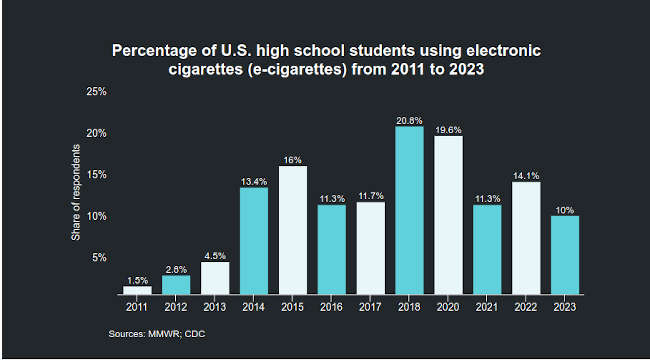
Percentage of U.S. high school students using electronic cigarettes (e-cigarettes) from 2011 to 2023: 2011, 1.5%; 2012, 2.8%; 2013, 4.5%; 2014, 13.4%; 2015, 16%; 2016, 11.3%; 2017, 11.7%; 2018, 20.8%; 2020, 19.6%; 2021, 11.3%; 2022, 14.1%; 2023, 10%.


More than 1.6 million U.S. middle and high school students reported vaping in 2023, and nearly 90% used flavored vapes. But America’s youth vaping epidemic may be no accident.

UC San Francisco Professor of Medicine Pamela Ling, MD, MPH, is the director of the UCSF Center for Tobacco Control Research and Education.

The center studies tobacco, including industry marketing to understand how its tactics shape people’s health. Big tobacco owns many of the top vape manufacturers.

Ling explains why vapes are more addictive than ever before — and why regulating them is so tough.

How potent are vapes?

Almost a decade ago, the average vape cartridge had the nicotine content of about a pack of cigarettes or 20 cigarettes. These days, popular vapes can easily have the nicotine content of three cartons or 600 cigarettes.

To make it possible to inhale such strong concentrations of nicotine, vape maker Juul Labs added acids to its vapes in 2015 to make “nicotine salts.” The salts reduce adverse reactions like throat burning and coughing. Today, the most popular disposable vapes use that technology, so vapes are stronger than ever.

Is vaping safer than smoking cigarettes?

We don’t know for sure. I think we can feel pretty confident that vaping exposes you to fewer chemicals and toxins than smoking cigarettes.

Observational studies have found that for lung disease, the risk associated with vaping does seem to be reduced when compared to cigarettes. But for cardiovascular disease the risks were no different than smoking.

And we don’t have definitive data on whether vaping causes less lung cancer than cigarettes. We hope that it does, but it takes 10 to 20 years for someone to develop lung cancer, so it’s too soon to have this kind of data.

Why are so many people worried about vaping in kids and young adults?

In the U.S., rates of vaping are higher among youth than older adults. We’re concerned about adolescents or kids vaping in part because we know vapes deliver nicotine exceptionally efficiently. The earlier you are exposed to nicotine, the more likely you are to become addicted – and that’s true of all substances because your brain is still developing up until 25 years old.

Percentage of U.S. high school students using electronic cigarettes (e-cigarettes)Percentage of U.S. high school students using electronic cigarettes (e-cigarettes) from 2011 to 2023. 2011, 1.5%. 2012, 2.8%. 2013, 4.5% 2014, 13.4%. 2015, 16%. 2016, 11.3%. 2017, 11.7%. 2018, 20.8%. 2020, 19.6%. 2021, 11.3%. 2022, 14.1%. 2023, 10%.

How does vaping affect young people’s health?

Teens who vape are 3 to 5 times more likely to start smoking cigarettes than their peers. They also have higher rates of asthma-like respiratory symptoms and report more mental health challenges.

You study how marketing shapes vaping in America. What makes vapes so attractive to kids and young adults?

For decades, cigarette ads were designed to appeal to targeted audiences like women, people of color and young people. Cigarette companies would sponsor concerts and sporting events so that young people would associate smoking with social life. Today, thanks to regulation, cigarette brands can’t sponsor those types of events. But because vapes are not cigarettes, they’ve been able to do sponsorships, giveaways and other kinds of really appealing advertising that’s no longer allowed for cigarettes.

And vapes, for a long time, have been marketed like pieces of technology to escape the negative connotations young people have towards traditional cigarettes.

Lastly, a lot of vapes are advertised on social media, where it’s very hard to regulate. Juul is a great example: That company deliberately sought out social media influencers to talk about their products and use them; the company gave away thousands of free Juuls at parties – they manufactured a trend.

Why are flavored vapes bad?

Vapes come in thousands of flavors, and some are really appealing, like bubble gum, crème brûlée, and chicken and waffles. Even if teens aren’t interested in nicotine, just curiosity about the flavors can be enough to entice them. Because vapes deliver nicotine efficiently, it doesn’t take long to get addicted.

How has the FDA tried to reduce kids’ access to vapes?

Currently, the U.S. Supreme Court is grappling with the latest in a string of court cases brought by vape and e-cigarette makers to challenge the Food and Drug Administration’s (FDA) ability to regulate the products.

When the FDA started regulating tobacco in 2009, it had no authority over electronic cigarettes. It took until 2016 for the FDA to gain the authority to regulate the sale, advertising and distribution of e-cigarettes.

Technically, the FDA must approve all vapes before they can be marketed. But the FDA has only approved 34 vape products out of the hundreds publicly available.

The FDA sends warning letters to companies doing particularly bad things, like those selling vapes that looked like toys, video games and highlighter markers. But it’s challenging because there are so many kinds of vapes. Companies exploit loopholes in regulations, and regulations haven’t kept up.

UCSF is home to the Truth Tobacco Industry Documents, the world’s largest archive of previously secret Big Tobacco papers. How are researchers using these to uncover new insights into tobacco industry tactics?

Right now, the Center for Tobacco Control Research and Education is one of the first research bodies to begin digging into the recently acquired Juul documents. We’re looking at those papers and other companies’ collections housed in the archive to uncover how companies’ tactics exacerbate health inequalities using targeted marketing or attempts to influence community leaders.

We’re also examining papers to see how the industry influenced scientific research and policies and how that impacted communities that are already disproportionately affected by tobacco’s health impacts.

Laura López González writes for UC San Francisco.

State Water Project allocation increases following recent storms in Northern California

Details
Written by: LAKE COUNTY NEWS REPORTS
Published: 24 December 2024
On Monday, the Department of Water Resources announced an update to the State Water Project allocation forecast for 2025.

The allocation has increased to 15 percent of requested supplies, up from the initial allocation forecast of 5 percent announced earlier this month. The SWP provides water to 29 public water agencies that serve 27 million Californians.

Strong storms in late November and early December have helped boost statewide precipitation to just above average for this time of year. Reservoir levels have also increased because of the storms.

The initial allocation forecast announced on Dec. 2 had not accounted for these storms because the data was not yet available to water managers. Prior to the second half of November, the start of the water year had been dry and warm.

“The past several weeks has brought welcome rain and snow to Northern California and these improved conditions have allowed the State Water Project to increase the allocation forecast to the benefit of millions of Californians,” said DWR Director Karla Nemeth. “While we typically wait to provide an update until January, we felt it important to let our State Water Contractors know of the increase as soon as possible to allow them to better plan their water supply for the year ahead.”

State water managers will continue to monitor precipitation and snowpack conditions as well as account for dry soils that may soak up some of the spring runoff following record heat this past summer. Additionally, Southern California remains very dry and has not benefited from the atmospheric rivers experienced so far this season.

“California is still in the early months of our wet season and as recent history has shown, conditions can change quickly,” said Dr. Michael Anderson, State Climatologist. “While Northern California has benefitted from early season storms, dry conditions in the new year can leave us with below average totals when warmer weather arrives."

Each year, DWR provides SWP allocation forecasts based on available water storage, projected water supply, and water demands. Allocations are updated monthly as snowpack, rainfall, and runoff information is assessed, with a final allocation typically determined in May or June. As the winter progresses, if California sees an increase in rain and snowfall, the allocation forecast may increase.

"The Department of Water Resources’ updated 15% allocation for the State Water Project demonstrates a responsive approach to California’s evolving climate challenges,” said Jennifer Pierre, general manager of the State Water Contractors. “We appreciate DWR making this early adjustment to reflect the benefits of recent storms not factored into their initial allocation. While the increase is encouraging, allocations remain conservative, and this situation underscores the precarious balance of our water supply system in the face of unpredictable weather patterns.”

Pierre continued, “This reality highlights the limitations of our current infrastructure and regulatory framework. Modest increases in supply can bring cautious optimism, but the need for greater resilience is clear. Investments in modern infrastructure, such as the Delta Conveyance Project, along with updates to regulatory processes through initiatives like the Agreements to Support Healthy Rivers and Landscapes, are critical. These efforts will equip us with the tools to better manage water resources for homes, farms, businesses, and the environment, even amid California’s rapidly shifting climate.”

She said the contractors are grateful for the incoming storms and look forward to further storms and allocation adjustments in January, “but long-term solutions require decisive action now."

The next update will likely come in January and will use information from the first snow surveys of the season.

The allocation forecast notice to State Water Contractors and historical data on SWP allocations are available at https://water.ca.gov/programs/state-water-project/management/swp-water-contractors.

Lake County unemployment up slightly in November, state rate remains unchanged

Details
Written by: Elizabeth Larson
Published: 23 December 2024
LAKE COUNTY, Calif. — Lake County saw a small increase in its unemployment rate in November, while the state rate remained unchanged and the national rate ticked up slightly.

The California Employment Development Department’s report on the jobless rate said the state’s unemployment rate was 5.4% in November, the same rate as October. The November 2023 rate was 4.9%.

Lake County’s jobless rate in November was 6.2%, compared to 6.1% in October and 6% in November 2023.

Nationwide, the Bureau of Labor Statistics said the November unemployment rate was 4.2%. The October rate was 4.1% and November 2023 rate was 3.7%.

The report said California gained 11,100 nonfarm payroll jobs in November, with a year-to-date gain of 167,000 jobs.

The job market expansion reached 55 months in November 2024, with the report also noting that California gained 3,182,400 jobs — averaging 57,862 per month — since April 2020.

EDD records showed that Lake County gained 160 jobs from October to November — growing from 17,380 to 17,540. However, at the same time, the civilian labor force grew from 28,400 to 28,770 individuals, a growth of 370 people.

The report said that five of California's 11 industry sectors gained jobs in November with private education and health services, with a gain of 13,100 jobs, leading the way with significant gains in healthcare-related industry groups. Lake County showed a 2.9% growth rate in that industry.

The EDD said that for the ninth consecutive month, trade, transportation and utilities showed an increase of 5,700 jobs, with many of its gains happening in retail, and couriers and messengers, as holiday hiring ramped up and activity increased at California ports. In Lake County, that industry grew by 2.1%.

Statewide, financial activities showed the largest month-over reduction with a loss of 4,400 jobs due to weakness in the real estate and rental and leasing subsector as well as in some financial investment-related fields. Lake County, however, showed a 6.1% growth in this sector in November.

Other key industries and their growth or declines statewide and Lake County include the following:

• Professional and business services: 2,600 jobs added; 10% growth in Lake County.
• Information: 2,100 jobs added; no growth in Lake County.
• Mining and logging: 100 jobs; no growth in Lake County.
• Leisure and hospitality: -400 jobs; 1.7% growth in Lake County.
• Manufacturing: -600 jobs; -5.3% decline in Lake County.
• Government: -1000 jobs; 0.2% growth in Lake County.
• Other services: -3,300 jobs; no growth in Lake County.

Lake County’s jobless rate ranked it No. 43 of California’s 58 counties.

Lake’s neighboring county jobless rates and ranks in November were: Colusa, 11.9%, No. 57; Glenn, 5.9%, No. 38; Mendocino, 5.1%, No. 23; Napa, 4.3%, No. 10; Sonoma, 4.1%, No. 8; and Yolo, 5.2%, No. 26.

Email Elizabeth Larson at This email address is being protected from spambots. You need JavaScript enabled to view it.. Follow her on Twitter, @ERLarson, and on Bluesky, @erlarson.bsky.social. Find Lake County News on the following platforms: Facebook, @LakeCoNews; X, @LakeCoNews; Threads, @lakeconews, and on Bluesky, @lakeconews.bsky.social.
  1. CHP plans Christmas Maximum Enforcement Period
  2. December the most wonderful time of the year for many businesses
  3. Purrfect Pals: Cats and kittens for the holidays
  • 439
  • 440
  • 441
  • 442
  • 443
  • 444
  • 445
  • 446
  • 447
  • 448
How to resolve AdBlock issue?
Refresh this page
