 How to resolve AdBlock issue?
News
- Details
- Written by: LAKE COUNTY NEWS REPORTS
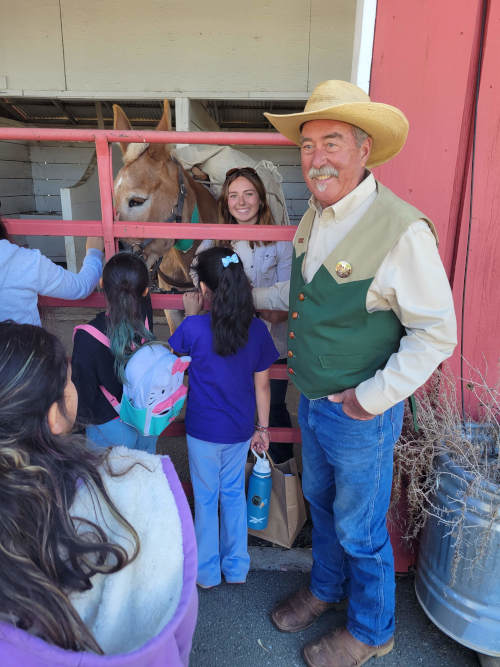
LAKEPORT, Calif. — Schoolchildren from around the community once again had the chance to see up close the working of Lake County’s agriculture industry.
On Wednesday, May 7, the sixth annual Lake County Ag & Natural Resources Day was held at the Lake County Fairgrounds in Lakeport.
Since its inception in 2017, this unique educational event has welcomed K–6 grade students from across Lake County, offering them a hands-on opportunity to learn about the importance of agriculture and natural resources in our community.
This year, organizers said they hosted more than 600 students, along with their teachers and chaperones, for a day of discovery and interactive learning.
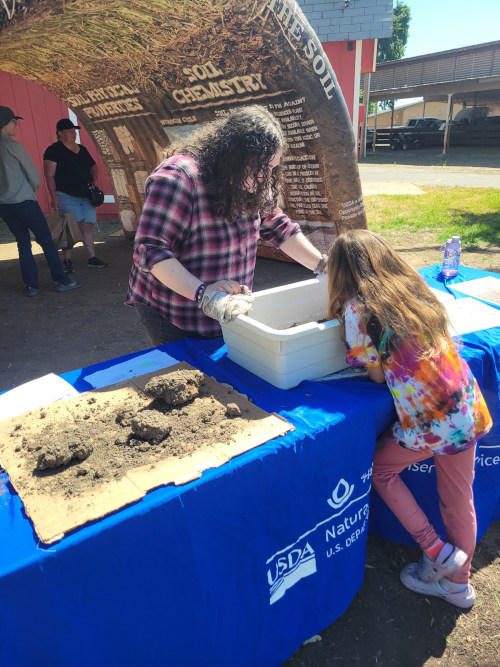
The goal of Ag & Natural Resources Day is to provide engaging, hands-on educational experiences for local students, highlighting the importance of agriculture and natural resources, as well as the science and technology driving these industries in our community.
Organizers said they aim to inspire curiosity and awareness, planting the seeds for the next generation of agriculture and natural resource enthusiasts.
This event is the result of a strong collaborative effort among the Lake County Fair Foundation, the Lake County Farm Bureau, the Lake County 4-H Program and the Lake County Fairgrounds.
Thanks is offered to the 2025 sponsors for their generous support. They are Redwood Credit Union, Reynolds Systems Inc., American AgCredit and Adventist Health. Organizers said their contributions make this impactful event possible.

- Details
- Written by: Elizabeth Larson
The California Employment Development Department’s latest jobless report said Lake County had a 6.8% rate in April, down from 7.3% in March. The April 2024 rate was 6.5%.
On the state level, unemployment remained unchanged at 5.3%, the Employment Development Department said.
The Bureau of Labor Statistics, which tracks the national unemployment picture, said unemployment remained at 4.2% in April, the same rate as reported in March.
In Lake County, industries and employment sectors that showed growth in April included the federal government, 7.1%; mining, logging and construction, 6.3%; leisure and hospitality, 3.5%; financial activities, 2.9%; and other services.
Sectors showing the most decline over the month were total farm, down 21.3%, durable goods, -14.3%; and manufacturing, -3%. The total farm category also is down 30% from where it was a year ago.
Lake County’s jobless rate ranked it No. 44 out of California’s 58 counties, tying it with neighboring Glenn County.
Lake’s neighboring county jobless rates and ranks last month were: Colusa, 14.2%, No. 57; Glenn, 6.8%, No. 44; Mendocino, 5.5%, No. 29; Napa, 3.8%, No. 6; Sonoma, 4%, No. 10; and Yolo, 5.2%, No. 27.
Statewide, payroll jobs rose from 17,982,400 in March 2025 to 18,000,100 in April, the Employment Development Department said.
The number of Californians employed in April was 18,699,200, an increase of 39,300 persons from March’s total of 18,659,900 and up 118,700 from the employment total in April 2024. At the same time, the Employment Development Department said the number of unemployed Californians was 1,055,000 in April, an increase of 400 over the month, and up 41,800 in comparison to April 2024.
Since April 2024, California’s unemployment rate has increased by 0.1 percent, compared to the national unemployment rate, which has increased by 0.3 percent over the same period, according to the report.
In the five years since the state started rebounding from the COVID-19 pandemic in April 2020, the Employment Development Department said California has gained 3,080,300 jobs, an average of 51,338 per month.
Five of California's 11 industry sectors gained jobs in April, with private education and health services (+9,400) posting a gain for the 39th straight month, the state reported.
The largest gains in health care and social assistance (+8,100) subsectors include job increases in fields like nursing, partly due to California’s aging population, which has driven more demand for medical services, the Employment Development Department said.
Government (+4,500) also posted a month-over job gain with the largest increase coming from Local Government (+3,400). State government (+1,300) also increased, while Federal Government (-200) lost jobs in April, based on the report.
Professional and business services (-2,400) posted the state’s largest month-over loss with the majority of the losses coming from employment services, which typically represents a slowdown in the hiring of temporary workers.
The Employment Development Department said the number of jobs in the agriculture industry decreased from March by 10,800 to a total of 414,300 jobs in April. The agriculture industry had 4,900 more farm jobs in April 2025 than it did in April of last year.
In related data that figures into the state’s unemployment rate, the Employment Development Department said there were 402,004 people certifying for Unemployment Insurance benefits during the April 2025 sample week.
That compares to 424,213 people in March and 411,413 people in April 2024. Concurrently, 42,222 initial claims were processed in the April 2025 sample week, which was a month-over increase of 1,229 claims from March and a year-over decrease of 2,914 claims from April 2024.
Email Elizabeth Larson at
- Details
- Written by: LAKE COUNTY NEWS REPORTS
AAA projects about 45.1 million people will travel at least 50 miles from home beginning Thursday, May 22 to Monday, May 26.
This represents an increase of 1.4 million travelers compared to last year, surpassing the previous record set in 2005 with 44 million people. More than 5.8 million of those travelers will be from California, marking a 4 percent increase over 2024 and setting a new record for the state.
Travelers are choosing to vacation in the Bay Area this year with AAA booking data listing San Francisco in the top 10 for Memorial Day destinations.
Many Americans say they’re taking advantage of the long weekend to spend time with loved ones, even if they are staying closer to home amid concerns over travel costs.
Memorial Day travelers by mode of transportation
By car: Driving is the preferred mode of transportation during holiday travel periods with 87% of Memorial Day travelers choosing to take road trips. AAA projects 39.4 million people will travel by car nationwide over Memorial Day weekend with more than 4.8 million being from California. This year, drivers have the benefit of cheaper gas prices thanks to lower crude oil prices.
By air: AAA projects 3.61 million air passengers, a nearly 2% increase over last year when 3.55 million travelers took to the skies. Of those, about 622,000 will be Californians. AAA booking data shows the cost for domestic flights are up 2% compared to last year.
By other modes: AAA projects 2.08 million people will travel by train, bus, or cruise nationwide over Memorial Day weekend, an 8.5% increase over last year. About 424,000 travelers will be Californians. Travelers are turning to cruises in record numbers. AAA projects a record 19 million people plan to take cruises in 2025.
- Details
- Written by: California Department of Fish and Wildlife
The Wolf Location Automated Mapping System, available to the public on CDFW’s website, shows the approximate location of GPS collared wolves across the state.
The goal of the map is to better enable livestock producers to understand the movement of collared wolves near their properties and to assist them in mitigating wolf-livestock conflicts.
“California’s rural livestock producers living near wolves have faced real challenges as the wolf population grows in California. This is one more tool in our shared toolkit to protect their herds from wolf-livestock conflict,” said Charlton H. Bonham, CDFW director. “CDFW is focused on transparency, best practices, and ensuring impacted communities have the knowledge they need to help prevent conflict. We will continue to partner with ranchers and communities to navigate a positive path forward.”
CDFW already provides regular and timely updates to livestock producers, law enforcement offices, and local officials regarding the movement of collared wolves near their communities, but this is the first time CDFW is providing automated data on wolf movements to the public.
CDFW’s GPS collars collect wolf location data roughly four times a day and transmit those locations to CDFW each morning. When received, the location data will be automatically transmitted to the online map.
The most recently received location of an individual wolf is shown as a hexagonal cell and, when clicked, provides information about the wolf’s pack, the general area they are in, and the last transmission date.
As wolves regularly travel hundreds of miles across the state, information on their location can be a critical tool for ranchers to protect their property and livelihoods.
“Knowing where California’s collared wolf population is means that ranchers have access to critical information,” said California Farm Bureau President Shannon Douglass. “We appreciate CDFW’s focus on transparency to help farmers and ranchers navigate the growing number of wolves in the state.”
The map provides information exclusively on collared wolves, a subset of the overall gray wolf population. As of May 2025, 14 wolves across California have GPS collars. Collaring wolves with GPS devices helps CDFW and the state better understand wolf populations, movement, and habitats.
“As wolves increase in number and range, California ranchers are in dire need of additional tools to protect the animals under their care. Knowledge is power, and this mapping tool will empower ranchers throughout wolf territory to better understand where wolves might threaten their livestock, enabling them to increase human presence and adjust their herd management as necessary to deter wolf attacks,” said Kirk Wilbur, vice president of government affairs, California Cattlemen’s Association. “CCA appreciates the department’s communication and transparency, which we hope will ease the burdens borne by cattle ranchers who steward California’s wolf habitat.”
The location of a wolf on the map is approximate and not reflective of the exact or current location of any individual wolf or pack. Generalizing the location data helps protect California’s gray wolf population, classified as both federally and state endangered, from potential harm, a crime punishable by law. It also helps prevent trespassing on private property.
Data from specific areas, such as at known den sites where wolf pups are believed to be present, will not be available during certain times of the year.
CDFW reserves the right to modify or discontinue the publication of the mapping tool if it is believed to result in any harassment of gray wolves or other wildlife or trespassing on private property.
For additional questions about this mapping tool, head to CDFW’s website.