How to resolve AdBlock issue?
Refresh this page
How to resolve AdBlock issue?
Refresh this page
Lake County News,California
  • Home
    • Registration Form
  • News
    • Education
    • Veterans
    • Community
      • Obituaries
      • Letters
      • Commentary
    • Police Logs
    • Business
    • Recreation
    • Health
    • Religion
    • Legals
    • Arts & Life
    • Regional
  • Calendar
  • Contact us
    • FAQs
    • Phones, E-Mail
    • Subscribe
  • Advertise Here
  • Login
How to resolve AdBlock issue?
Refresh this page

News

USDA announces new presidential appointee to serve rural California

Details
Written by: LAKE COUNTY NEWS REPORTS
Published: 27 May 2025

U.S. Secretary of Agriculture Brooke Rollins announced Bryan Anguiano is appointed by President Donald Trump to serve as the USDA Rural Development state director for the state of California. 

“When America’s farming communities prosper, the entire nation thrives. This new group of USDA appointees will ensure President Trump’s America First agenda is a reality in rural areas across the country. I am grateful for the leadership of these new state directors and look forward to their work reorienting the agency to put Farmers First again,” said Secretary Rollins.

“California farmers and ranchers feed America, and it’s time we give them the support and service they deserve to make our country strong,” Director Anguiano said. “I am so honored to serve as President Trump’s appointee to USDA Rural Development for the golden state. Together, we’ll work to support rural communities in all corners of California, so they may thrive and be prosperous for generations to come.”

Before being appointed to USDA, Anguiano served as California state director for the Republican National Committee and President Trump’s campaign. 

During his tenure with the RNC, he oversaw the RNC’s investment for four years and three election cycles, including the 2022 midterms, 2024 presidential elections and the California gubernatorial recall.

State directors serve as the chief executive officer of USDA Rural Development in the states and territories and are tasked with leading teams to carry out the mission of Rural Development to the benefit of all rural Americans. 

In conjunction with the guidance and support of the national office, state directors are responsible for advancing the key priorities and initiatives of the presidential administration, the secretary of agriculture and the deputy under secretary for rural development. 

State directors also provide key leadership to foster a mission-driven, accountable, and high-performing workforce focused on operational excellence, public trust, and responsible stewardship of taxpayer resources.

To learn more about USDA Rural Development’s leadership and programs, view www.rd.usda.gov. 


US solar manufacturers lag skyrocketing market demand

Details
Written by: Mojtaba Akhavan-Tafti, University of Michigan
Published: 27 May 2025


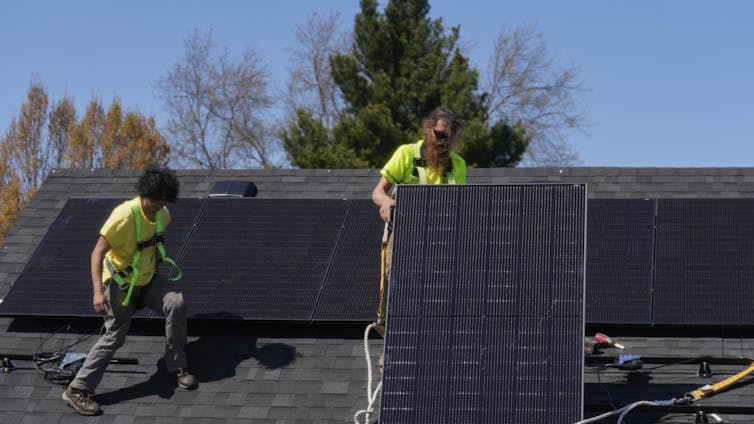
Americans continue to want solar energy. AP Photo/Sue Ogrocki

U.S. consumer demand for renewable energy continues to grow, with more solar panel capacity installed in 2024 than in 2023, which saw more than in 2022. But U.S. trade policy is in flux, and high tariffs have been imposed on imported solar panels, which may cause shortages.

I am a scholar who studies the Sun, as well as an entrepreneur who is working to harness its power here on Earth by creating new designs for generating solar electricity. As part of that effort, I’ve studied market trends and manufacturing capabilities in the U.S. and abroad. Right now, U.S. manufacturers do not produce enough solar panels to meet the nation’s demand, but industry investments and federal tax incentives have been making progress, though recent federal moves have created uncertainty.

In 2024, U.S. installers put up enough solar panels to generate 50 gigawatts of electricity – enough to power New York City for a year.

U.S. manufacturers made only a small fraction of that – 4.2 GW of solar modules in the first half of 2024. That was a big boost, though – a 75% increase compared with the same period in 2023. And the prices were roughly three times the cost of imports.

A look at recent imports

In 2024, the U.S. imported far more panels than the country needed, suggesting developers may be stockpiling panels for future projects.

Most of those imported panels were made in Asia, particularly Malaysia, Vietnam and Thailand. In fact, nearly all of the U.S.-made panels used at least some components from overseas. China currently makes about 97% of the world’s supply of photovoltaic wafers, which are building blocks of solar panels.

The effects of proposed U.S. trade policies on the solar industry remain unclear. Through 2024, manufacturing continued a yearslong ramp-up to take advantage of government policies favoring domestic manufacturing. And imported panels seem slated to suffer from ever-increasing tariffs, which drive up costs.

Domestic production rises

Since 2010, U.S. solar panel production has increased about eightfold. But U.S.-made panels are more expensive than imported alternatives. In 2024, U.S.-made panels typically cost 31 cents per watt, but imported panels, even including tariffs that existed before President Donald Trump’s second term, cost about one-third of that: 11 cents per watt.

But domestic manufacturers are bringing costs down by ramping up production while relying on the government to maintain or increase tariffs on imports, which may make U.S. panels more competitive domestically in the future.

Reliance on overseas sources

Despite that increase in domestic production, U.S. demand for solar panels has grown even faster. To meet demand, the U.S. imports a substantial portion of its solar photovoltaic modules.

Tariffs, including a 30% tariff on solar cells and solar panels starting in 2018, aimed to boost domestic manufacturing.

But those tariffs and falling global prices made solar installations more costly in the U.S. than in the rest of the world. The average global cost of installed solar systems dropped from $1.15 per watt in 2012 to $0.72 per watt in 2016, nearly half that of U.S. installations.

The 2018 tariffs, as well as earlier rounds in 2012 and 2014, have shifted the source of U.S. imports of solar panels – from China and Taiwan to Malaysia and South Korea. Manufacturers are also building solar panels in Singapore and Germany to maintain access to the U.S. market. And Chinese companies are even investing in U.S. solar manufacturers to take advantage of federal incentives and avoid tariffs.

New tariffs emerge

Trump’s proposal for new tariffs on foreign-made solar goods, including panels and components, particularly target Chinese-owned companies in Southeast Asia.

They could include a potential 375% tariff on Thai products – nearly quadrupling prices – and a 3,500% tariff on products from Cambodia.

In contrast, U.S.-made solar panels will be cheaper. But a reduced supply of solar panels will raise prices even of domestic-made panels, at least until U.S. manufacturing can catch up with the demand. Some developers have begun to delay or cancel solar installations to address rising costs.

Domestic investment

Due in large part to the Biden administration’s Inflation Reduction Act, enacted in 2022, the U.S. solar panel industry has seen significant investments.

Since the law’s enactment, more than 95 GW of manufacturing capability have been added across the solar supply chain in the U.S., including new facilities that in a year can construct enough solar panels to produce nearly 42 GW, beyond existing manufacturing levels. This growth in manufacturing capabilities is largely located in Texas and Georgia.

Still, the new administration’s shifting priorities and trade policies make the landscape uncertain. Before Trump began discussing various solar-related trade policies, the industry projected it would install an average of 45 GW of solar panels every year for the next decade.The Conversation

Mojtaba Akhavan-Tafti, Associate Research Scientist, University of Michigan

This article is republished from The Conversation under a Creative Commons license. Read the original article.

Lake County Animal Care and Control to take part in free adoption event June 7

Details
Written by: Elizabeth Larson
Published: 26 May 2025
A large variety of dogs and cats will be available for adoption during Lake County Animal Care and Control’s free adoption event on Saturday, June 7, 2025. Courtesy photos.


LAKE COUNTY, Calif. — An upcoming free adoption event will offer the chance to empty out the shelter at Lake County Animal Care and Control.

Animal Care and Control announced that it is participating in the second annual free adoption event put on by the ASPCA and San Francisco SPCA.

The event will take place from 11 a.m. to 3 p.m. Saturday, June 7, at the shelter, 4949 Helbush Drive in Lakeport.

The adoptions will include spay/neuter surgeries, microchips, rabies vaccinations, heartworm testing and licensing.

Shelter staff invites the public to come and find a new companion to add to their family as they attempt to empty the shelter of the many dogs and cats waiting there.

To get a preview of the available pets, visit the shelter’s website.

For more information, call the shelter at 707-263-0278.

Email Elizabeth Larson at This email address is being protected from spambots. You need JavaScript enabled to view it.. Follow her on Twitter, @ERLarson, and on Bluesky, @erlarson.bsky.social. Find Lake County News on the following platforms: Facebook, @LakeCoNews; X, @LakeCoNews; Threads, @lakeconews, and on Bluesky, @lakeconews.bsky.social. 

Caltrans District 1 ceremony honors fallen highway workers

Details
Written by: LAKE COUNTY NEWS REPORTS
Published: 26 May 2025
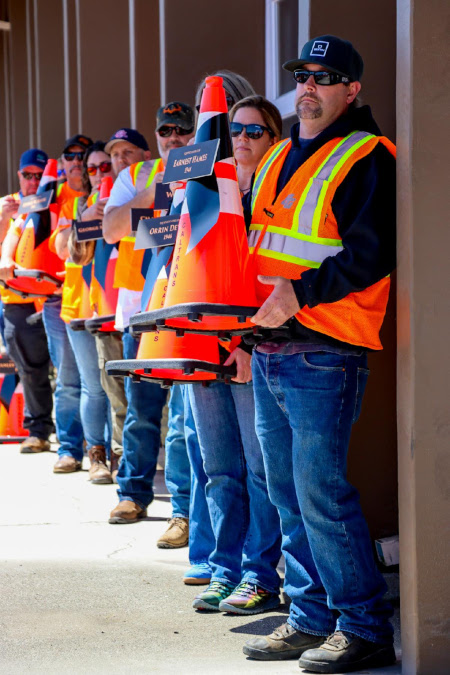
Caltrans Equipment Operator Jory Fry holds a cone in honor of Earnest Hames, a Maintenance worker who died in the line of duty on Aug. 9, 1944. Courtesy photo.


NORTH COAST, Calif. — At the annual Workers’ Memorial in Eureka on Wednesday, Caltrans District 1 staff and local officials gathered to honor highway workers who lost their lives in the line of duty. 

Caltrans District 1 serves approximately 940 miles of coastal and inland state highways in Humboldt, Del Norte, Lake and Mendocino counties.

With work zone fatalities and serious injuries on the rise in California since 2010, the event underscored the critical need for increased safety awareness among workers and motorists alike. Workers put their lives at risk every day to ensure roads and bridges remain safe for the traveling public.

“It’s always a solemn reminder when we gather to honor those who have made the ultimate sacrifice to protect others on state highways,” said Caltrans District 1 Director Matt Brady. “Safety has always been, and will continue to be, our top priority. This ceremony enables us to reinforce our focus on safety and providing the public with vital information on potential hazards.”

Motorists are reminded to slow down, stay alert, avoid distractions, and move over when they see amber flashing lights — simple actions that help protect highway workers. 

Since 1921, 194 Caltrans employees statewide have lost their lives while working on California's state highway system.

A moment of silence was observed during the ceremony, followed by a tribute in which Caltrans staff presented 17 orange cones as District 1 Maintenance Manager Paul Johnson read the names of the fallen workers from the district.

Alongside Brady, featured speakers included Acting Division Chief of Maintenance Bobi Hettick, Deputy District 1 Director Tom Fitzgerald, North Region Construction Manager Sebastian Cohen, Humboldt County Second District Supervisor Michelle Bushnell and Ukiah Area California Highway Patrol Commander Lt. Gabe Parker.

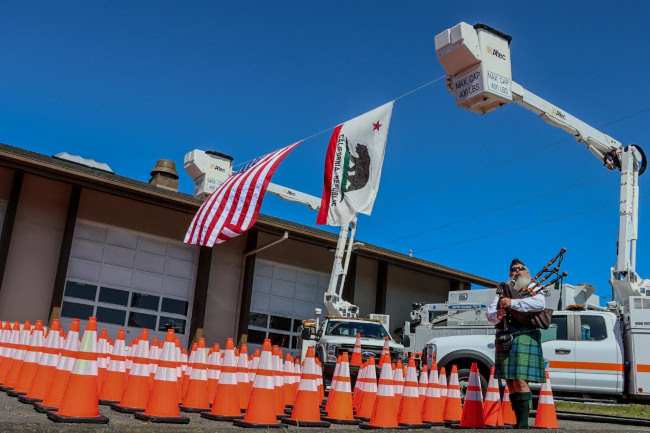
Roddy Ross performs Amazing Grace at the annual Workers' Memorial in Eureka, California, on Wednesday, May 21, 2025. Courtesy photo.
  1. Research: Yes, social media might be making kids depressed
  2. Making eye contact and small talk with strangers is more than just being polite − the social benefits of psychological generosity
  3. New bench honors work of Mike and Kim Riley at Highland Springs Reservoir
  • 277
  • 278
  • 279
  • 280
  • 281
  • 282
  • 283
  • 284
  • 285
  • 286
How to resolve AdBlock issue?
Refresh this page