How to resolve AdBlock issue?
News
- Details
- Written by: Lake County News reports
The CHP Registration Enforcement and Guidance, or CHP REG, program replaces the Californians Help Eliminate All The Evasive Registration Scofflaws, or CHEATERS, program.
Since the program’s inception in 2004, the CHP has recovered approximately $26 million in registration fees.
In 2018, the CHP surpassed $3.2 million in recovered fees from residents avoiding California registration.
“California loses millions of dollars in revenue every year from vehicles being unlawfully registered in other states or countries,” CHP Commissioner Warren Stanley said. “This program relies on the public’s input to support our investigators in returning funding to the state. Recovered registration fees are important to the California economy and are invested back into local communities.”
The CHP REG program focuses on residents who register their vehicles out-of-state while living or working in California and operate those vehicles on California’s roadways.
The primary goal of the program is to obtain voluntary registration compliance through education, but, when necessary, enforcement action is taken.
California vehicle registration through the Department of Motor Vehicles is required within 20 days of establishing residency and for all vehicles primarily operated in the state.
The CHP encourages members of the public to report vehicles driven on a regular basis on California roadways with out-of-state registration to the CHP REG program Web site at https://www.chp.ca.gov/Notify-CHP/CHP-REG-(Out-of-State-Registration-Violators) .
When reporting a suspected violator, it is important to include: state of the plate, license plate number, date and time observed, where observed, make, model, vehicle color, and any additional identifying comments.
In 2018, more than 24,000 tips were reported to the website, leading directly to cases investigated by CHP personnel and dedicated senior volunteers.
The mission of the CHP is to provide the highest level of safety, service and security.
- Details
- Written by: Hunt Allcott, New York University; Jean-Pierre Dubé, University of Chicago, and Molly Schnell, Northwestern University

In the U.S., rich people tend to eat a lot healthier than poor people.
Because poor diets cause obesity, Type II diabetes and other diseases, this nutritional inequality contributes to unequal health outcomes. The richest Americans can expect to live 10-15 years longer than the poorest.
Many think that a key cause of nutritional inequality is food deserts – or neighborhoods without supermarkets, mostly in low-income areas. The narrative is that folks who live in food deserts are forced to shop at local convenience stores, where it’s hard to find healthy groceries. If we could just get a supermarket to open in those neighborhoods, the thinking goes, then people would be able to eat healthy.
The data tell a strikingly different story.
Negligible change
We recently studied the impact of opening supermarkets in food deserts in research conducted with fellow economists Rebecca Diamond, Jessie Handbury and Ilya Rahkovsky.
From 2004 to 2016, over 1,000 supermarkets opened in neighborhoods around the country that previously had been food deserts. We analyzed the grocery purchases of a sample of 10,000 households living in those neighborhoods.
Did they start to buy healthier food after the supermarket opened nearby?
Although many people began shopping at the new local supermarket after it opened, they generally didn’t buy healthier food. We can statistically conclude that the effect on healthy eating from opening new supermarkets was negligible at best. We calculated that local access to supermarkets explains no more than about 1.5% of the difference in healthy eating between low- and high-income households.
How could this be?
Why food deserts aren’t the problem
The food desert narrative suggests the lack of supply of healthy foods is what causes reduced demand for them.
But in the modern economy, stores have become amazingly good at selling us exactly the kinds of things we want to buy. Our research suggests the opposite narrative: Lower demand for healthy food is what causes the lack of supply.
Furthermore, local neighborhood conditions don’t matter much, since we regularly venture outside our neighborhoods. We calculate that the average American travels 5.2 miles to shop. Low-income households aren’t that different: They travel 4.8 miles.
Given that we’re willing to travel that far, we tend to shop in supermarkets even if there isn’t one down the street. We found that even people who live in ZIP codes without a supermarket still buy 85% of their groceries from supermarkets.
Tax sugar, subsidize produce
In other words, people don’t suddenly go from shopping at an unhealthy convenience store to shopping at the new, healthy supermarket. In reality, people go from shopping at a faraway supermarket to shopping at a new supermarket that offers the same types of groceries.
To be clear, new grocery stores do provide many benefits. In many neighborhoods, new retail can bring jobs, a place to see neighbors and a sense of revitalization. People who live nearby get more options and don’t have to travel as far to shop.
But the data show that healthier eating is not one of those benefits.
Instead, we would recommend tweaking prices as a better approach to encouraging healthier habits. Taxes on sugary drinks can discourage their consumption, while food-stamp programs could be modified to make fruits and vegetables cheaper.
And, given that we develop long-term eating habits as children, parents and schools can encourage kids to eat healthier.
Health inequality is one of our society’s most important problems. We hope that this research can direct efforts toward ideas that can materially improve health – and away from ideas that do not.

Hunt Allcott, Associate Professor of Economics, New York University; Jean-Pierre Dubé, Sigmund E. Edelstone Professor of Marketing, University of Chicago, and Molly Schnell, Assistant Professor of Economics, Northwestern University
This article is republished from The Conversation under a Creative Commons license. Read the original article.
- Details
- Written by: LAKE COUNTY NEWS REPORTS

LOWER LAKE, Calif. – More than 250 people visited Anderson Marsh State Historic Park during the 30th annual “Christmas at the Ranch” open house on Saturday, Dec. 14.
Santa was on hand to greet children of all ages, guests sang Christmas carols accompanied by local musicians and were treated to hot drinks and baked goodies, all courtesy of the Anderson Marsh Interpretive Association.

AMIA is the nonprofit association cooperating with the California Department of Parks and Recreation to promote educational activities at the park.
For information about Anderson Marsh State Historic Park, AMIA and how you can help, go to www.andersonmarsh.org or contact AMIA at either

- Details
- Written by: US Geological Survey
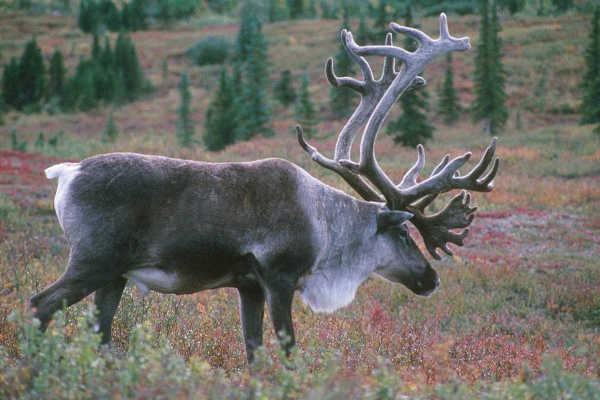
Caribou, North America’s wild reindeer, have lives apart from their famous role on Christmas Eve.
To learn more about how these Arctic antler-bearers spend the other 364 days of the year, we talked to USGS caribou expert Dr. Layne Adams, who has studied these animals for more than 35 years.
Caribou, North America’s wild reindeer, are much more interesting than their famous holiday role suggests. Reindeer and caribou (Rangifer tarandus) are large, cold-adapted, herding herbivores related to deer, elk and moose.
To learn more about the biology behind these not-so “mythical” Arctic creatures, we turn to our colleagues at the USGS Alaska Science Center who conduct a wide variety of earth- and ecological-science surveys throughout our northernmost state.
We asked USGS caribou (and large mammal) expert Layne Adams, Ph.D., about the lives of caribou during the other 364 days of the year not known as Christmas. Adams has studied caribou, other hoofed animals, and their predators in Denali National Park and elsewhere in Alaska for more than 35 years, helping land managers understand the best ways to manage these important species. Adams, a wildlife biologist, did an online chat with the Washington Post a few years ago that we wanted to share with you:
Here are other questions about reindeer that Dr. Adams answered.
Why are reindeer sometimes called caribou and caribou sometimes called reindeer?
“Reindeer” and “caribou” are two common names for the same species - Rangifer tarandus, which occurs throughout the circumpolar North.
“Reindeer” is the common name for Rangifer in Europe and Asia, whereas “caribou” is the North American name.
The name “caribou” is a French derivative of a Native American word that means snow shoveler, which is a reference to the fact that caribou are often pawing through the snow to find food underneath.
What are reindeer or caribou?
Caribou and reindeer are part of the deer family — related to deer, moose, and elk. They are the only deer species where males and females both grow antlers. Females and young males have antlers that are similar in size, but males older than 2 or 3 years have much larger antlers.
Caribou and reindeer have been around for more than a million years; their ancestors lived at the same time as now-extinct woolly mammoths and saber-toothed cats.
Caribou are migratory and widely distributed across northern North America, ranging from Alaska and the Canadian High Arctic islands to the mountains and boreal forests of the Canadian southern provinces.
What are domesticated reindeer?
Reindeer were domesticated across northern Europe and Asia several thousand years ago and became the basis of herding cultures in those regions.
Domesticated reindeer are also found in Alaska and Canada. A little more than a century ago, 1300 reindeer were imported from Siberia to northwest Alaska in an attempt to establish a herding economy among the Native people in the region. At the time, caribou were scarce along the northwest coast of Alaska.
Reindeer herding expanded widely across the west and north coasts of Alaska, as well as into northern Canada, such that around 600,000 domesticated reindeer were present throughout Alaska by the 1930s. During the Great Depression, the reindeer industry in Alaska collapsed and retracted primarily to the Seward Peninsula of northwest Alaska where it continues today.
While the main purpose of domesticated reindeer has been to provide meat and hides to local people, reindeer have been trained to pull sleds by some cultures.
What do they eat?
Caribou forage on a variety of plants throughout the year. During winter, lichens are their most frequently sought food, with shrubs and grass or sedges making up the rest.
On alpine and Arctic tundra ranges, caribou primarily feed on terrestrial lichens, sometimes called reindeer moss, that occur within the low-growing grasses and shrubs that make up the tundra vegetation.
In southern mountain or boreal forest ranges, where caribou winter in deep snow, arboreal lichens that grow on trees are the predominant caribou forage.
During summer, caribou shift to eating a wide variety of green plants including grasses or sedges, growing shrubs, and a variety of small forbs or flowering plants. In some regions, abundant late-summer mushrooms are an important food for caribou.
What do caribou do in the fall and winter?
In the fall, some caribou herds start migrating to their winter ranges. The timing of migration is dictated by cues in changing day length in combination with the onset of snowfall as the long winter begins. Fall is also the breeding season when mature bulls compete for opportunities to breed with females, as the females become receptive.
Arctic caribou generally migrate south to winter ranges along the northern fringe of the boreal forest or onto tundra winter ranges where terrestrial lichens are abundant. Some larger caribou herds migrate long distances of 300-400 miles between their winter ranges and their calving and summer ranges.
Smaller mountain populations migrate out of the higher mountains onto lower elevation tundra and forest ranges, while small boreal forest populations are generally sedentary throughout the year. Once on their winter range, caribou remain there from about early October to late April.
How do they thrive in such cold temperatures?
Caribou are well adapted to living in cold regions and thrive in areas where winter temperatures can reach 70 or 80 degrees below zero. These animals are well insulated with a dense haircoat made up of wooly underfur and hollow guard hair over their entire body (except the very tip of their nose). They also have relatively large, wide hooves for walking and digging through snow.
What do caribou do in the summer?
After the females give birth, caribou generally gather together in large groups to help them better avoid predators and to escape incredibly bothersome mosquitoes and parasitic flies that are abundant in early summer.
The different herds of caribou stay together in the high mountains and along the Alaskan seacoasts, where the winds and cooler temperatures help protect them from summer heat and those pesky insects.
After the number of insects declines in mid-summer, the caribou herds scatter into smaller groups. This is an important time for caribou — they use the time before winter arrives to feed as much as possible on remaining green grasses and sedges, willow leaves, and even mushrooms to gain weight.
How big are calves?
We’ve weighed quite a few newborn calves in Denali and on average they weigh about 17 pounds. Calves are born in May and early June throughout Alaska, with most calves being born in any herd within about a 10-day period.
Caribou cows produce one calf each year and generally begin producing calves when they are 2 to 4 years old depending on their nutritional status.
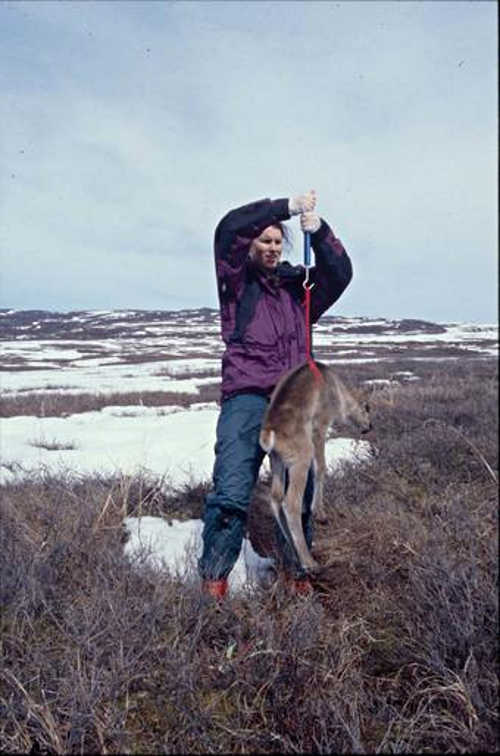
In small herds, such as the Denali Caribou Herd, calves are subject to intense predation primarily by wolves and grizzly bears — fewer than half survive beyond 2 weeks of age.
In the large, migratory populations, early calf survival is markedly higher because the huge number of calves born over a brief interval overwhelms local predators’ ability to kill as many.
How big are adult caribou?
In Denali National Park, mature adult males average about 500 pounds but can weigh more than 600 pounds. Adult females are about half as big, averaging about 240 pounds (225- to 320-pound range).
In large migratory herds, caribou are smaller, with adult males and females averaging about 400 pounds for males and 200 pounds for females.
How many herds are in Alaska?
There are 32 caribou herds recognized in Alaska, with 7 large migratory populations each numbering from 15,000 to 260,000 animals. These herds currently total about 700,000 animals and account for about 97 percent of the caribou in the State. The remaining 25 herds are much smaller, ranging from about 30 to 3500 animals each, adding up to about another 20,000 caribou.
Overall, Alaska’s caribou population was relatively low in the mid-1970s, numbering around 250,000 statewide. Caribou numbers increased to about 950,000 by the mid-1990s, as a couple of the large herds grew to historically high numbers. Since then, caribou numbers have declined to around 720,000 today. Such wide fluctuations in caribou numbers over the time scale of decades are not unusual.
Can you talk a little more about predators — what eats caribou?
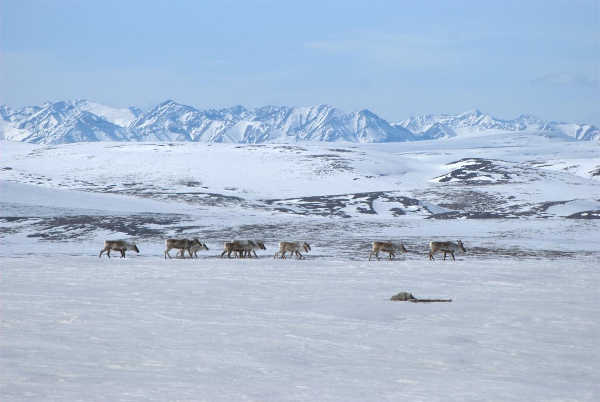
In general, the primary predators of caribou in Alaska are grizzly bears and wolves. Grizzly bears are very effective at killing young caribou calves less than a couple of weeks old, although they also kill older caribou on occasion. Wolves are important predators of both young calves and older caribou. Other caribou predators include black bears, golden eagles, wolverine, and coyotes.
Humans are also important predators of caribou. Caribou are a mainstay of local subsistence in Bush Alaska, and they are a sought-after quarry for other Alaskan residents and sport hunters from all over the world. On average, people harvest about 22,000 caribou each year in Alaska.
Predation affects the number of caribou, particularly in the smaller, more sedentary populations. The large, migratory herds are able to reduce the negative effects of predation to some degree just due to their sheer numbers; the tradeoff is that they are more likely to be affected by the nutritional limitations of their ranges compounded by competition with their herd mates.
Caribou are more vulnerable in deep snow
A main goal of my research has been to understand the interrelationships of caribou and wolves in Denali National Park. For caribou, an important factor that affects how many are killed by wolves is the amount of snow during winter.
In years with less snow, caribou have large expanses of wind-blown, snow-free land to seek their food, and they commonly make it through the winter in good shape. They can also more easily evade wolves because they can run unimpeded across the bare, frozen tundra. During such times, wolves primarily kill caribou that are old, injured, not in good shape, or just plain unlucky. During low snow years, when caribou are more evasive, we’ve found that wolf packs tend to be smaller.
But the balance shifts in favor of wolves when there is a lot of snow.
Caribou then have a harder time finding enough to eat because they have to dig through deep or crusted snow or must seek food on wind-blown high mountain ridges where there is little snow, but also little food.
The caribou also have a harder time escaping from wolves in deep snow. In fact, wolves will sometimes chase caribou into areas with deep snow where the caribou are very vulnerable even if they are in good shape.
In heavy snow years, wolf packs tend to be bigger and some packs produce more pups. In contrast, our caribou research shows that after severe winters, not only are young (2-4 years old) and very old cows (≥ 14 years old) less likely to breed, but calves born are lighter, grow more slowly, and are more likely to be killed by predators in the weeks after they are born.
Is climate change affecting caribou?
We know from our studies that weather may be the most important factor affecting the yearly cycles of caribou and their predators.
However, the longer-term effects of climate change are much more complex. Unlike polar bears, which are highly dependent on sea ice that is declining due to warming temperatures, caribou are likely influenced by a wide variety of factors that will be affected by a warming climate, and some effects will be positive and some negative.
For example, with a warming climate, we expect the growing season to be longer and provide caribou with green, nutritious forage earlier and for a longer period of time for a positive effect. Our recent studies on Alaska’s Arctic Coastal Plain have been geared toward understanding how a warming climate is affecting the plants that caribou eat during summer; this information will help managers forecast how future habitat conditions might affect the well-being of these large herbivores.
However, we have also done research that indicates that with increasing temperatures we can expect more fires on boreal forest winter ranges for caribou that will likely result in a reduced availability of lichen, their primary winter forage, which tends to not grow back for about 70 to 80 years after a fire.
The overall effect of a warming climate on caribou will be dependent on how these and many other climate-related effects interact and that is very difficult to predict. Further, responses to climate change are likely to differ among the various caribou populations across North America.
What does the current caribou research conducted by USGS focus on?
We are currently investigating how caribou select summer habitat based upon forage quality and weather on Alaska’s Arctic Coastal Plain. This information is important for evaluating the effects of current and proposed oil development there, as well as improving our understanding of the potential responses of those caribou populations to a warming climate.