 How to resolve AdBlock issue?
News
- Details
- Written by: Mary K. Hanson
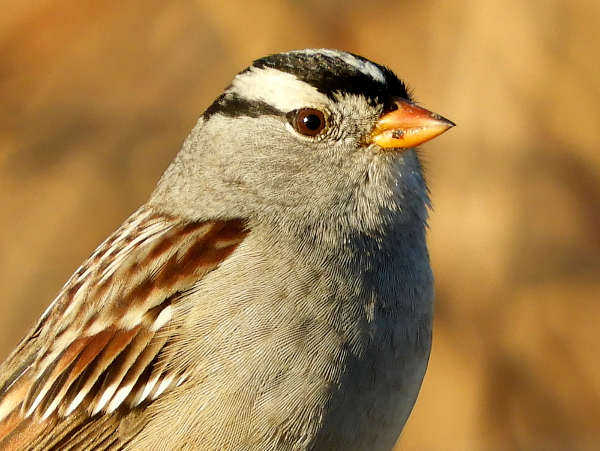
NORTHERN CALIFORNIA – Along with the waterfowl migrating into and through the region now, we’re also seeing an influx of songbirds and sparrows that will winter here and then fly off toward their breeding grounds in the spring.
Three of the easiest ones to spot are the golden-crowned sparrow, the white-crowned sparrow and the dark-eyed junco.
Some populations of these birds migrate great distances, stopping over in our part of the state to rest before they move on.
The white-crowned sparrows (Zonotrichia leucophrys), for example can travel over 2,500 miles from Alaska to Southern California. Other species simply move up and down from one elevation to another.
Adult white-crowns are very easy to identify when you see them in the field. Their bright white-and-black striped heads are unmistakable. The juveniles have similar markings, but those stripes are tinted a diluted tan and brown.
A fun fact about these birds is that the males learn their songs from the areas where they are born rather than from their parents. And because many of them stick close to their natal sites when they’re breeding, flocks of the birds develop regional “dialects”.
Golden-crowned sparrows (Zonotrichia atricapilla ) are aptly named for the bright golden stripe found in the center of the head of the adults that shifts to gray at the back of the head. In juveniles, the golden color is less pronounced.
Not a lot is known about the golden-crowned sparrow because no in-depth scientific studies have been done on it. Most of we understand about these birds, therefore, comes from naturalists’ field journals – which exemplifies just how valuable these hand-written journals and the observations they contain really are.
Modern naturalist training programs, like those taught annually by Tuleyome in Woodland, teach modern-day naturalists how to collect data in field journals and then take that hand-written data and enter it into online applications like iNaturalist.
iNaturalist is one of the many online community science projects through which members of the public can collect and report data in the field and upload it for use by scientists all over the globe.
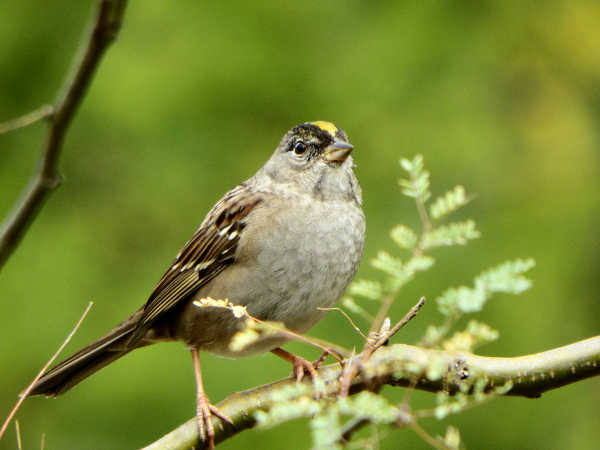
Because the golden-crowned sparrow hasn’t been studied a great deal, we don’t know very much about its breeding habits, except that it leaves our area to breed in the tundra areas up north in the summer months. These the birds are believed to be monogamous.
Another community science project, the Christmas Bird Counts, also seems to suggest that its populations are increasing throughout the United States. They’re usually the first migrants to show up in our region, and the last ones to leave.
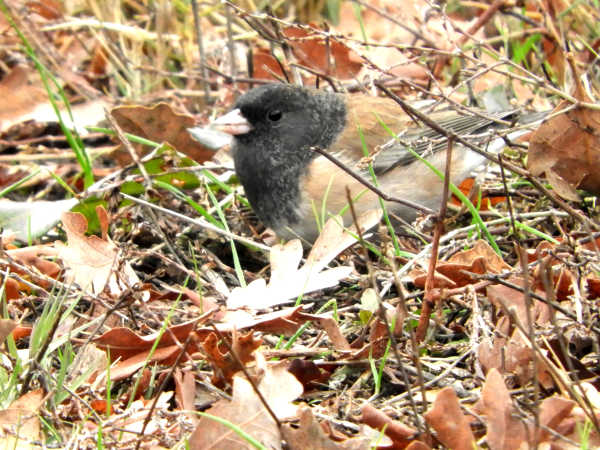
Like the white- and golden-crowned sparrows, dark eyed juncos (Junco hyemalis) are also sparrows and are actually considered to be the most abundant species in North America. They come in a broad variety of color morphs.
The color type we see most often in our region is the “Oregon” color pattern, but other colors include slate, pink-sided, white-winged, red-backed and gray-headed. Juncos with the Oregon color have a dark head, brownish-gray wings and a rusty-to-pink blush on the sides. Its beak is pale (usually pink or off-ivory).
At first, scientists believed that the different colors denoted different species, but recent studies seem to indicate that the color variations we’re seeing in the birds right now is actually the result of the process of evolution happening in real time. Many of the Juncos interbreed, so it’s not known which color morphs will survive and which ones will vanish over time.
Although they are not considered threatened or endangered at this time, the populations of dark-eyed juncos have decreased by 50 percent since 1966. What’s causing the decline isn’t yet fully understood.
Most of these sparrows will come to your wintertime birdfeeders to augment their diet, so set out feeders and suet for them where you can. White-crowns like sunflower seeds, juncos like millet, and golden-crowns will eat just about anything including seeds, flower buds and fruit.
Mary K. Hanson is a Certified California Naturalist, author and nature photographer. She developed and helps to teach the naturalist program at Tuleyome, a 501(c)(3) nonprofit conservation organization based in Woodland. For more information, visit http://tuleyome.org/.
- Details
- Written by: LAKE COUNTY NEWS REPORTS

Phosphorus is an essential nutrient for plants and animals.
However, excessive phosphorus in surface water can cause explosive growth of aquatic plants and algae.
This can lead to a variety of water-quality problems, including low dissolved oxygen concentrations, which can cause fish kills and harm other aquatic life.
Rivers connect our terrestrial landscape with downstream lakes, reservoirs, and coastal environments.
High phosphorus concentrations and associated water-quality degradation are a key water-quality concern in many of our nation’s rivers and streams.
A team of US Geological Survey scientists recently published a paper that investigates the potential sources of phosphorus that contribute to degraded river water quality.
Here’s what the lead author, Sarah M. Stackpoole, had to say about the study.
Q: What question were you trying to answer with your recent study?
Stackpoole: The link between agriculture, excess phosphorus, and excess algal growth in freshwater ecosystems is well established.
Management efforts to reduce the movement of excess agricultural phosphorus to surface waters have been in place for decades, but we have not seen widespread improvements in water quality.
This may be because the source of phosphorus leading to degraded water-quality conditions may not actually be linked to the manure and fertilizer currently being applied to nearby farms and fields.
Phosphorus contributions to current river water-quality degradation can also come from older, historical manure and fertilizer inputs that have built up in soils, and sometimes these phosphorus sources can be more than 20 years old.
We wanted to determine if historical phosphorus was a nutrient source to rivers and whether it was masking the effects of current conservation efforts.
Q: What’s unique about this study?
Stackpoole: Previous studies that have looked at current and historical phosphorus sources and their effects on water quality have been more limited in either space (number of watersheds) or time (period of analysis). Our study looked at water quality at 143 river sites for a 20-year time period, 1992–2012.
Q: What insights did you gain about current agricultural phosphorous management?
Stackpoole: The way we evaluated current agricultural phosphorus management was called an agricultural phosphorus balance, defined by phosphorus inputs and outputs. Two key inputs were fertilizer and manure applications to soils. One key watershed phosphorus output is crop uptake and removal of crop plant material in harvest.
You can think about the agricultural phosphorus balance in a similar way as a bank balance. Based on how many dollars that you put in compared to how many dollars you take out, you can have a deficit, a zero balance, or a surplus (also called a savings).
The difference between your bank balance and an agricultural phosphorus balance is that you usually want a surplus in your bank account, but most conservation efforts have been trying to reduce the surplus of phosphorus on the landscape and are aiming toward a zero balance.
We found that 7 percent of the river sites had deficits, meaning that the inputs were less than what was taken up by the plants, 25 percent were balanced, meaning that the inputs were equal to what was taken up by the plants. However, 68 percent of the river sites had surpluses, meaning that inputs were greater than outputs.
Q. What insights did you gain about historical phosphorus sources?
Stackpoole: We documented that historical phosphorus was a source of river phosphorus at 49 of 143 sites. The agricultural balances at these sites showed us that older legacy phosphorus sources, probably manure and fertilizer inputs from the 1980s, were still having an effect today as a source of river phosphorus.
The study documented increased phosphorus transport by the Kansas River at Desoto, Kansas, between 1992 and 2012.
Q: Did you see any indication that current conservation efforts are working?
Stackpoole: Yes, there is some good news in our story. At 43 river sites, where the agricultural balance has decreased over time, the water quality improved.
Q. What insights did you gain about current agricultural phosphorus management and water quality?
Stackpoole: Agricultural management efforts to reduce non-point P sources have been effective in improving water quality in some watersheds. However, additional strategies are needed to promote the adoption of nutrient-conserving practices without compromising agricultural yields.
Because of legacy sources, reductions in agricultural phosphorus inputs alone may not be enough to reduce phosphorus. The most effective management actions will be system-specific and account for both the long-term effects of total historical P storage and reductions in contemporary surpluses.
- Details
- Written by: Richard Gunderman, Indiana University
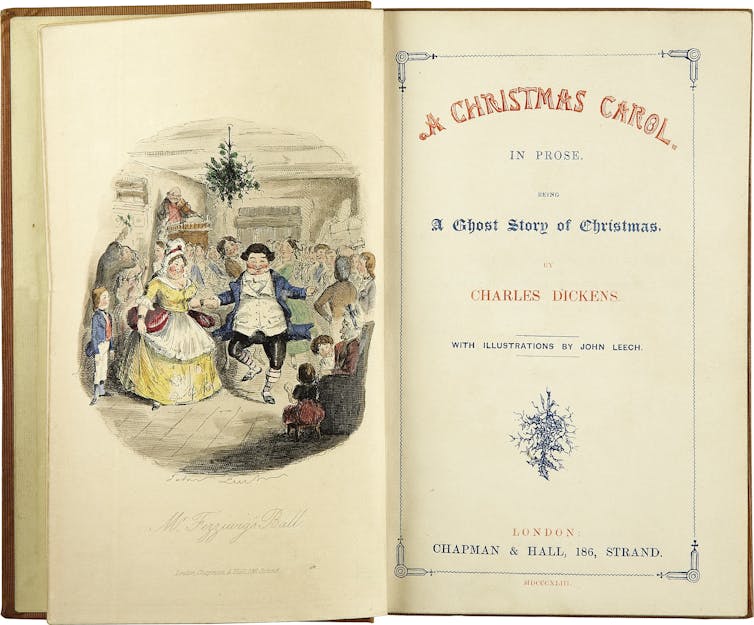
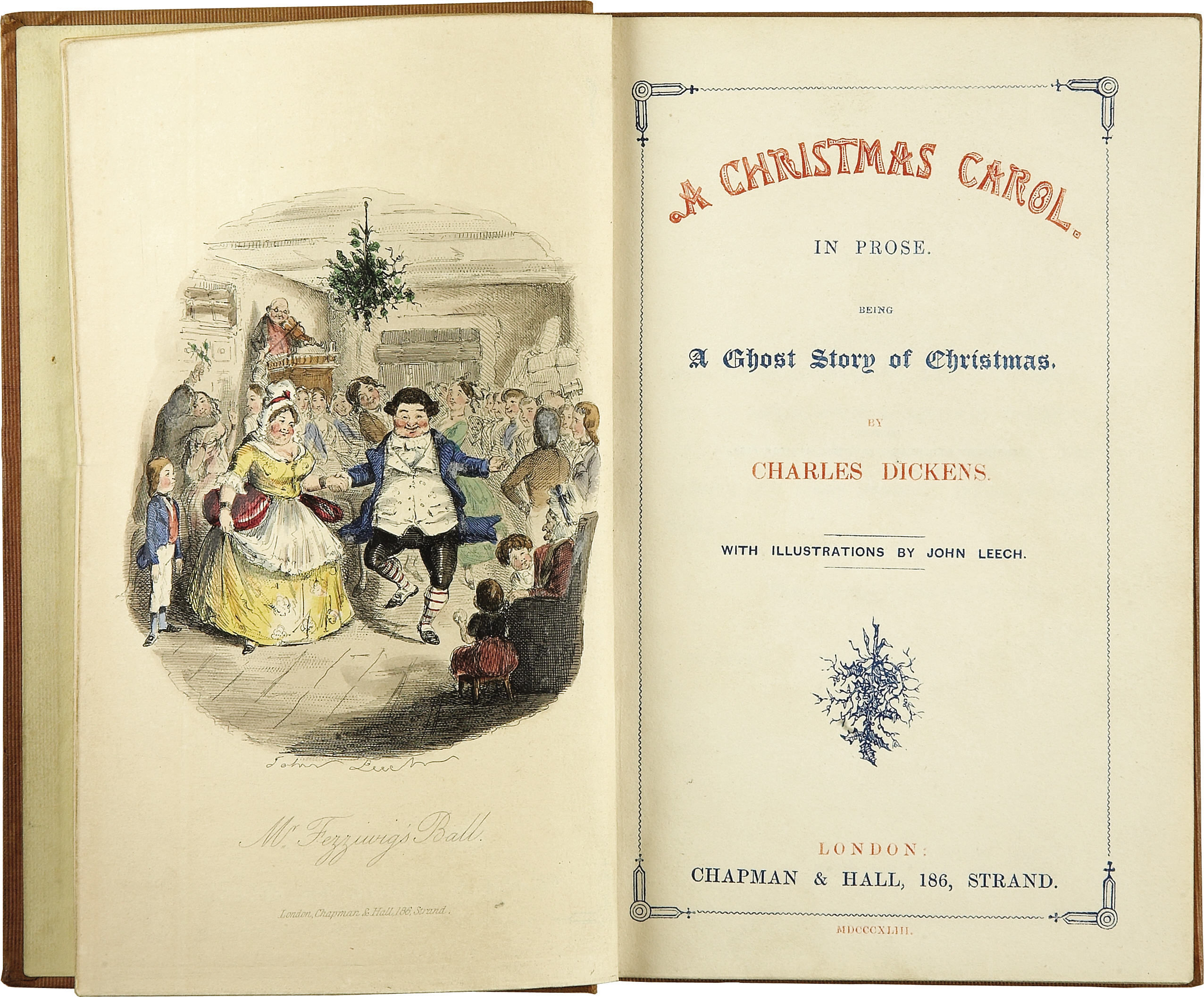
Though today regarded as the literary titan of the Victorian age, in late 1843 the 31-year-old Charles Dickens worried that his popularity was fading. His latest novel was not selling well, his finances were strained and his wife was pregnant with their fifth child.
Dickens had recently visited the industrial city of Manchester, an experience that left him deeply moved by the plight of the poor. He understood their circumstances on a personal level – as a boy, Dickens had been humiliated when his father was forced into debtors’ prison.
Initially intending to voice his concerns about the poor as a pamphleteer, Dickens instead crafted a story about the redemption of an old miser, believing that it would garner more public attention and support.
Today that story remains perhaps Dickens’ most celebrated work, A Christmas Carol. Adapted in many forms, it has never been out of print. I take students in my course on philanthropy to see a stage production of the work each Christmas season.
Three ghosts, three lessons
The story begins on Christmas Eve. The “grasping, scraping, clutching, covetous old sinner” Ebenezer Scrooge is toiling in his office, where he turns away two fundraisers seeking to provide for the poor, rudely rebuffs his nephew Fred’s invitation to Christmas dinner and berates his underpaid clerk, Bob Cratchit, for expecting to get Christmas Day off with pay.
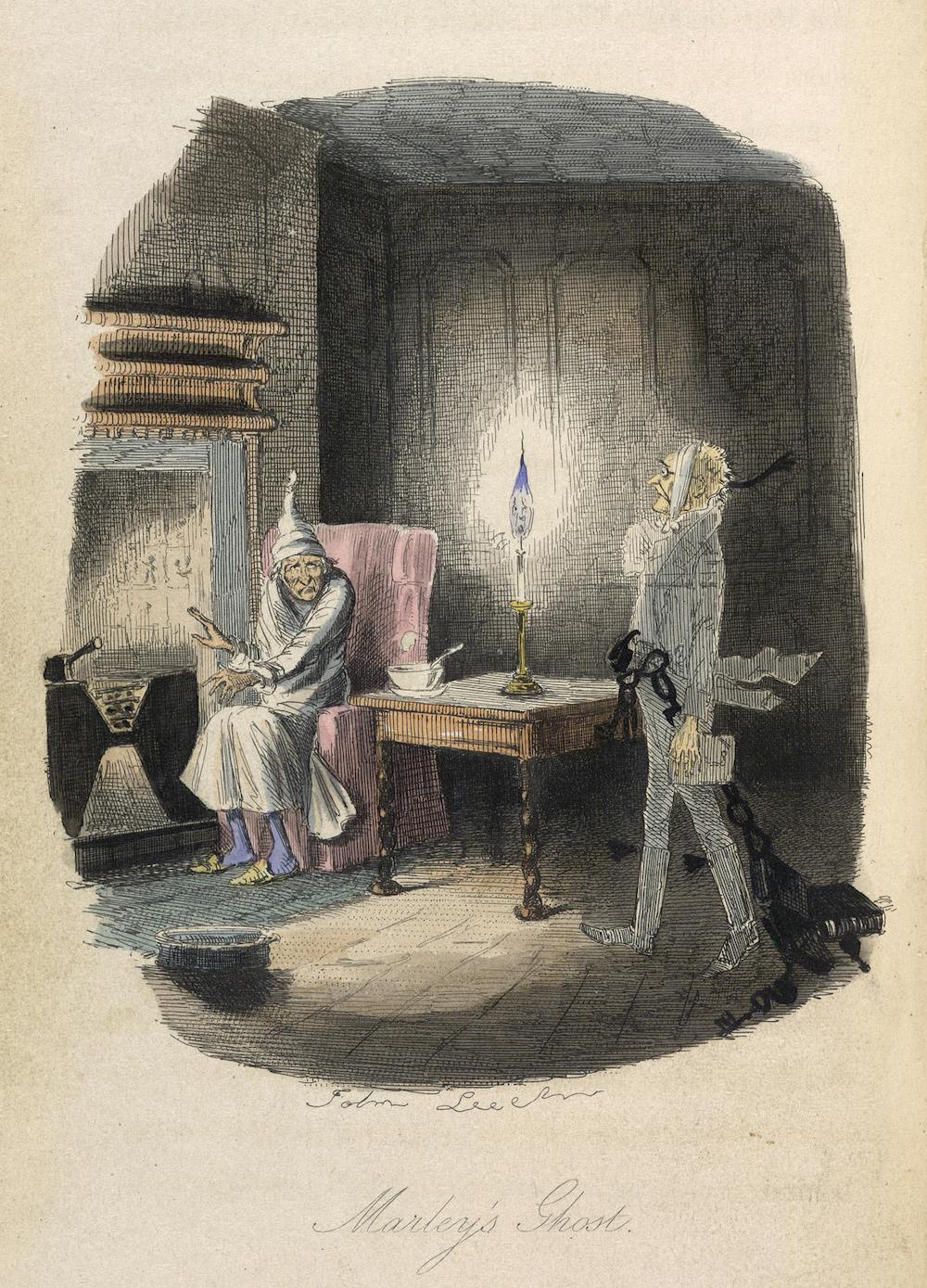
At home that night, Scrooge is visited by the ghost of his partner Jacob Marley, who “died seven years ago, this very night.” Now wandering the earth dragging heavy chains forged by his own avarice, Marley warns Scrooge that he will meet the same fate if he does not listen to the three spirits who will visit him during the night.
The first of the spirits, the Ghost of Christmas Past, takes Scrooge to scenes from his earlier life, where he is reminded that he was once a kinder and gentler person.
At his old school, he reexperiences what it is like to be lonely at the holidays until he is rescued by his sister. He then visits the holiday party of his employer, Mr Fezziwig, who despite modest means embodies the spirit of celebration.
He then sees his younger self with his fiancée Belle, to whom he intended to devote the rest of his life, until he was gradually overmastered by the love of money. Belle eventually breaks their engagement and marries another man, whose large and happy family Christmas the ghost takes Scrooge to witness.
The Ghost of Christmas Present whisks Scrooge to celebrations of Christmas in different settings throughout the land. They then travel to the home of Fred, who valiantly defends his uncle against criticism, choosing to pity rather than condemn him. Then Scrooge finds himself at the modest holiday feast of the Cratchit family, where he meets Tiny Tim, their ailing youngest child, and learns that unless the course of events changes, this will be the boy’s last Christmas. Finally, the ghost shows Scrooge two starving children, Ignorance and Want, mocking Scrooge’s expressions of concern with his own words from earlier in the day, “Are there no prisons? Are there no workhouses?”
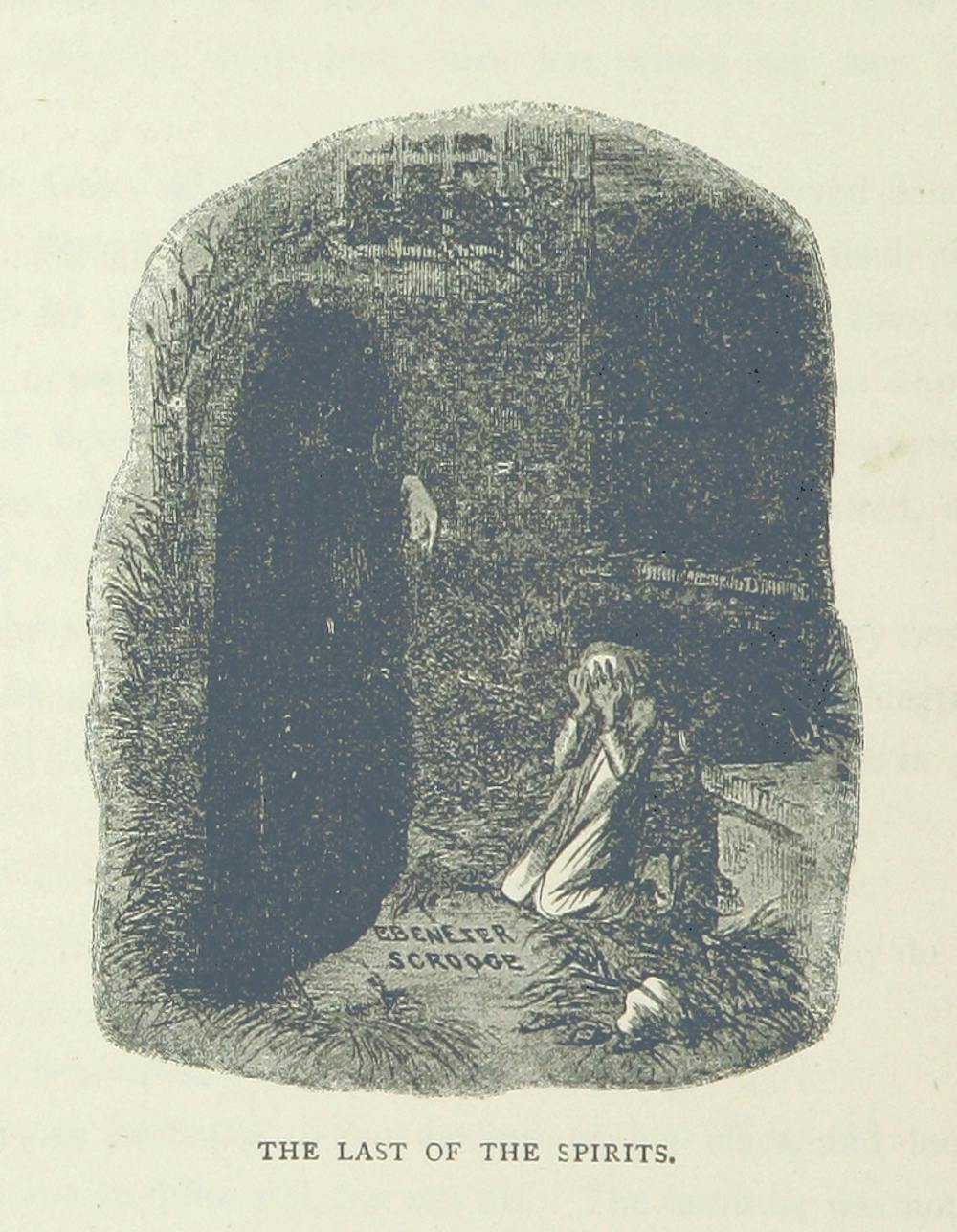
The ghost of Christmas Yet to Come transports Scrooge to the holiday one year later, where he witnesses the reactions of various people to the recent death of a “wretched man.” A businessman states that he will attend the funeral only if a lunch is provided, and various people sell stolen items from the dead man’s estate to a fence. The only people who feel any emotion at his passing are debtors who now have more time to repay their loans. After returning to the Cratchit home, where Scrooge sees the family mourning the passing of Tiny Tim, he is taken to a neglected grave, where to his horror, he sees the name Ebenezer Scrooge.
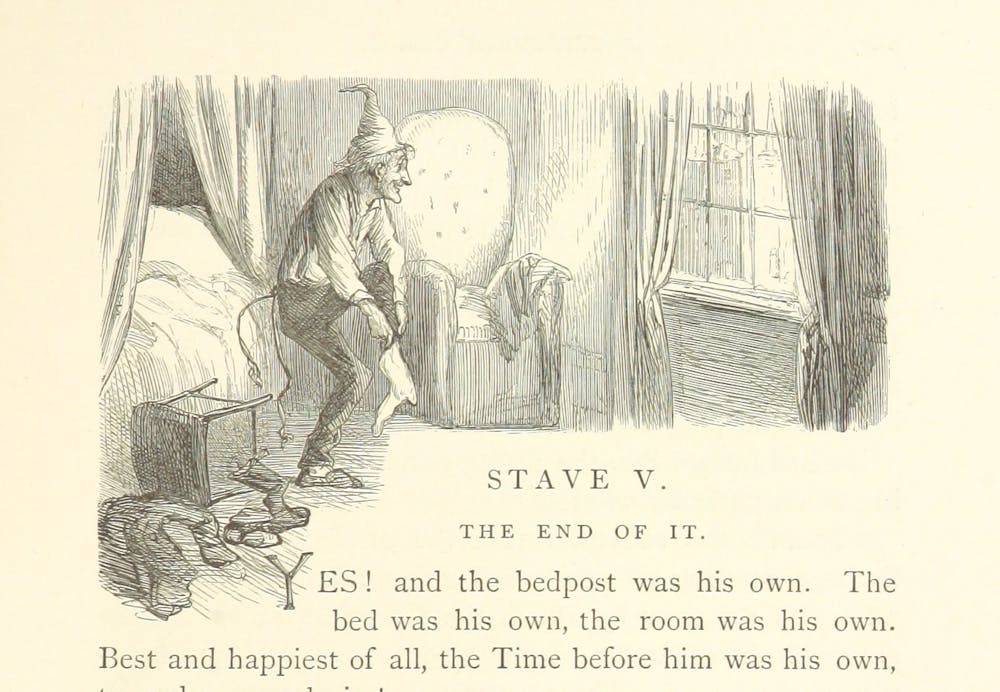
Awakening on Christmas morning, Scrooge realizes there is still time to act. He sends a prize turkey to the Cratchits, gives Bob a raise and becomes a “second father” to Tiny Tim. Once a miserable old miser from whose heart “no steel had ever struck out generous fire,” Scrooge becomes “as a good a friend, as good a master, and as good a man, as the good old city knew.” Some laughed at the alteration in him, but he was happy to let them laugh, “and it was always said of him, that he knew how to keep Christmas well, if any man alive possessed the knowledge. May that be truly said of us, and all of us. And so, as Tiny Tim observed, God bless us, every one!”
The wonder of an open heart
A Christmas Carol is a tale of redemption. Scrooge is blessed by a series of spiritual visitations that enable him to obey the Socratic injunction, “Know yourself,” from multiple different spatial and temporal points of view.
Having glimpsed in so short a time the course of his whole life, Scrooge is able, for the first time, to perceive its true trajectory. He realizes that, despite his growing wealth, his greed is alienating everyone around him, making him a boon to no man and a curse to many. Hoping against hope to write a different final chapter, Scrooge embarks on a new life.
In attempting to capture a new spirit of Christmas, Dickens reminds us of the power of the past and the future to change the way we see the present. In confronting Scrooge with the stark contrast between the spirit of generosity in his youth and the isolated, desolate circumstances of his death, Dickens invites readers to contemplate our own life trajectories and begin redrafting our own eulogies while there is still a chance to make changes. Perhaps we, like Scrooge, can rediscover the wonder of an open heart, recognizing that warmth and vitality lie not in the accumulation of wealth but in the dedication of time, talent and treasure to others.
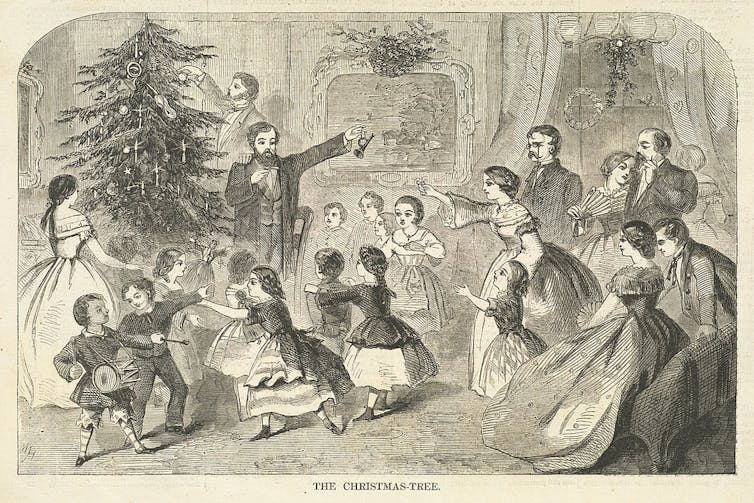

Some historians credit Dickens with helping to establish many of the patterns that mark the contemporary observance of Christmas. Some two centuries before, Oliver Cromwell had attempted to refocus the holiday away from elaborate celebrations to a time of strict piety and prayer.
In Dickens’ hands, however, Christmas is restored to a time for gathering with family, celebrating the spirit of generosity, and feasting. Above all, the Christmas season is an opportunity to tune in to a higher frequency and to lend our voices to the chorus chanting one of the oldest and best tunes of all – the song of love’s redemptive power.
Richard Gunderman, Chancellor's Professor of Medicine, Liberal Arts, and Philanthropy, Indiana University
This article is republished from The Conversation under a Creative Commons license. Read the original article.
- Details
- Written by: UNIVERSITY OF HOUSTON

Joanna Clark has been interested in geology ever since she was a child.
Today, the University of Houston doctoral student is turning that curiosity into a career and getting noticed by NASA, which awarded her a $285,000 grant to develop a technique that could one day be used to better understand past climate conditions on Mars.
"We hope to have samples from Mars one day and when we do, we need to be ready to evaluate them. This could help give us a better understanding of how the planet has changed over millions of years," said Clark, who is studying the geochemistry of Mars.
For now, Clark's research will focus on creating silica minerals in the laboratory to discover how they form in subzero temperatures, such as those on Mars. Silica minerals, including quartz, are commonly found in Earth surface sediment, but silica was also detected in rocks and sediment on Mars by NASA's Curiosity Rover.
The initial experiments have begun. "I am working on how to get the silica out of solution as a solid with all the right chemistry. Once I am able to do that, I will take the solid and analyze it for oxygen isotopes," explained Clark, who has done previous studies on cryogenic opal-A, which is silica that forms in brine veins between growing water ice crystals.
Tom Lapen, Clark's research advisor and chair of the Department of Earth and Atmospheric Sciences in the UH College of Natural Sciences and Mathematics, said silica might be able to preserve the conditions under which it actually precipitated, or became a solid, from a liquid. In other words, silica found on Mars is a potential source of past climate information.
Lapen and Clark are working with Zach Sharp, who runs the Center for Stable Isotopes at the University of New Mexico. Sharp developed the analytical technique and Clark will build upon it by investigating silica samples formed below zero degrees Celsius.
"Joanna is competing with some of the best scientists in the country. Most of them are professors and researchers who have been doing this a long time," said Lapen, referring to Clark's NASA grant. "It indicates that the community views this project on really high merits and if successfully accomplished, it could have a big impact."
Other project collaborators are Henry Chafetz, UH professor of geology and Elizabeth Rampe, an exploration mission scientist in the Astromaterials Research and Exploration Science Division at the Johnson Space Center.