 How to resolve AdBlock issue?
News
- Details
- Written by: LAKE COUNTY NEWS REPORTS
The report contains an analysis of the approximately 1.8 million stops conducted by California’s eight largest law enforcement agencies during the second half of 2018.
The report also examines civilian complaint data and provides recommendations law enforcement can utilize to enhance their policies, procedures, and trainings on topics that intersect with bias and racial and identity profiling.
In addition to the board’s new report, the California Department of Justice is announcing the launch of a new online dashboard to give researchers, legislators, journalists and all members of the public greater access to RIPA data.
“For the first time ever, Californians have comprehensive racial and identity data on each stop and search conducted by police officers at the largest law enforcement agencies in the state,” said Co-Chair of the Board and Associate Director of Litigation and Policy at Neighborhood Legal Services of Los Angeles Sahar Durali. “This is a critical first step in the fight to end racial profiling. The findings of this data as laid out in the 2020 Board report highlight the need for the policy recommendations of the board. We encourage law enforcement agencies to work with their communities and utilize the RIPA data to make meaningful changes to their policies, practices, and operations. The board looks forward to partnering with agencies, community members, and advocacy groups in those efforts.”
“As co-chair to the board, I would like to thank California Department of Justice staff and my fellow board members for their professionalism throughout the past year,” said Co-Chair of the Board and Kings County Sheriff Dave Robinson. “Many continually express support and appreciation for the difficult job the men and women of California law enforcement do every day. The report is just the beginning of information that will allow even greater transparency for law enforcement and our communities – allowing us to grow together working on local and statewide areas of concern. And finally, to the men and women who have embraced the challenges of the data collection and reporting: we thank you. Your commitment is appreciated.”
“Good data is a critical component of making good policies,” said California Attorney General Xavier Becerra. “The California Department of Justice’s new online dashboard will help make important criminal justice information more accessible to everyone in California. Here at the California Department of Justice, we’re committed to doing our part to increase transparency and accountability to help strengthen trust between law enforcement and communities across our state.”
The information collected under RIPA includes data on peace officers’ perceptions of the demographics of stopped individuals.
The purpose of collecting information on officer perceptions is to attempt to systematically document and analyze stops and searches to determine whether disparities can be found across demographics.
The perceived demographic information collected includes a number of characteristics such as race or ethnicity, gender, age, disability status, English fluency, and LGBT identity.
There are a number of methodologies to analyze stop data that can help determine if bias may exist, and the report relies on several well-established methods as reference points.
However, there are important limitations and caveats for each methodology that should be kept in mind when interpreting the data.
The report goes into further detail on many of those considerations. Some of the key findings from the first round of RIPA data include:
Reason for Stop: Across all racial and ethnic groups, the most common reason peace officers reported for initiating a stop was a traffic violation (84.4%) and the next most common reason was reasonable suspicion of criminal activity (11.4%). People who were perceived as Black had the highest proportion of stops for reasonable suspicion while those who were perceived as Middle Eastern or South Asian had the lowest.
– Perceived as Black: 19.5 percent
– Perceived as Middle Eastern or South Asian: 3.6 percent
Weighted residential population compared to stop data: Using data from the 2017 American Community Survey, people who were perceived as Black were overrepresented in the stop data and people perceived as Asian were underrepresented as compared to population estimates.
– Perceived as Black: +8.8 percent
– Perceived as Asian: -6.4 percent
Veil of darkness analysis: This method compares the proportion of individuals stopped during daylight hours across racial or ethnic groups. Having a higher proportion of stops occur in daylight compared to people perceived as White may indicate bias. People perceived as Pacific Islander or Native American had the highest proportion of their stops in daylight compared to those perceived as White, whereas people perceived as Black or Middle Eastern or South Asian had the lowest.
– Perceived as Pacific Islander: +7 percent
– Perceived as Native American: +4.5 percent
– Perceived as Middle Eastern or South Asian: -0.05 percent
– Perceived as Black: -1.2 percent
Search rates: Search rates refer to the proportion of stops that resulted in a search. People who were perceived as Black were searched at 2.9 times the rate of people perceived as White. The proportion of stops that resulted in a search was highest for people who were perceived as Black and lowest for people who were perceived as Middle Eastern or South Asian.
– Perceived as Black: 18.7 percent
– Perceived as Middle Eastern or South Asian: 2.8 percent
Search yield rates: Search yield rate refers to the proportion of individuals that officers searched who were found to be in possession of contraband or evidence. All racial or ethnic groups of color had lower yield rates of contraband or evidence than White individuals, meaning that officer searches of these groups tended to be less successful at finding contraband or evidence.
The proportion of searched individuals that officers found to be in possession of contraband or evidence was highest for people who were perceived as White and lowest for people who were perceived as Middle Eastern or South Asian.
– Perceived as White: 24.3 percent
– Perceived as Middle Eastern or South Asian: 18.8 percent
New dashboard offered
For more on the first round of RIPA data, members of the public are encouraged to review the new online dashboard.
The dashboard provides a unique look at the data and gives the public unprecedented access to information on stops and searches conducted by California’s eight largest law enforcement agencies collected from July 1, 2018 through Dec. 31, 2018.
RIPA requires California law enforcement agencies to collect and maintain demographic data on all stops and searches.
As part of the 2015 law, the board was formed in July 2016 to analyze the data, develop policy, and make recommendations through yearly public reports.
By April 2023, all agencies that employ peace officers in California will be required to submit RIPA data to the California Department of Justice.
The California Legislature charged the board with an ambitious purpose – to eliminate racial and identity profiling and improve diversity and racial and identity sensitivity in law enforcement.
The board unites a diverse group of individuals from across different sectors – law enforcement, civil and human rights organizations, community groups, and academia – to work toward improving law enforcement-community relations in California through collaboration, transparency, and accountability.
The eight law enforcement agencies included in the first round of data collection are the California Highway Patrol, Los Angeles Police Department, Los Angeles County Sheriff’s Department, Riverside County Sheriff’s Department, San Bernardino County Sheriff’s Department, San Diego Police Department, San Diego County Sheriff’s Department and the San Francisco Police Department.
A copy of the report is available here. A fact sheet on the 2020 RIPA report is available here. A copy of the supplemental technical report is available here. More information about the board is available here.
- Details
- Written by: Elizabeth Larson
Agricultural Commissioner Steve Hajik presented the “crop report plus” for 2018 to the Board of Supervisors in December.
As in past years, the report did not include or attempt to quantify the value of cannabis growing in Lake County. Cannabis was legalized in California for medical use in 1996 and for recreational use in 2016.
Hajik previously reported to the supervisors that while cannabis is expected to eventually be included in crop reports, not including it in the reports now is due to it not being recognized as a crop by state and federal officials.
He said that he commissioned a report for 2018 that determined the economic contributions of agriculture in the county based on the 2017 crop report.
Dr. Jeff Lanholz and Dr. Fernando DePaolis of Agricultural Impacts Associates, a consulting firm specializing in agricultural economics, conducted the study on which the latest crop report is based.
Hajik said the report quantifies agriculture’s total economic contributions through food production, local food processing, and employment and economics multiplier effects.
The report said the gross value of agricultural production in Lake County for 2018 was $111,470,311, an 8-percent decrease from 2017 when the total estimated value was $120.8 million.
The report doesn’t represent gross agricultural receipts nor the production costs or net income to producers, Hajik said.
The gross values included in the report represent the value of each commodity at the time of harvest, with the exception of pears. The gross value of pears given is for after they are packed and processed.
Hajik said the crop report plus shows that agriculture has a broader role in sustaining a thriving local economy.
He said that, according to the study, Lake County agriculture contributed $339.2 million to the local economy in 2017 and supported 2,202 jobs.
“To put this in perspective, Lake County agriculture contributes $929,212 per day or $38,717 per hour,” Hajik said in his report to the supervisors.
Hajik said the report found that $241 million came from direct economic output and $98.2 million in additional economic output, specifically, “multipliers” include business-to-business supplier purchases – such as purchasing farm equipment and seed – and consumption spending, such as for groceries and housing, by owners and their employees of agricultural businesses.
There also were 2,061 jobs associated with direct economic output and 141 additional jobs attributed to multiplier effects.
“One in 12 jobs in Lake County are directly attributed to the various agricultural industries. That is 8.5 percent of the county workforce,” Hajik reported to the board.
Hajik said the 8-percent decrease in production value from 2017 to 2018 is attributed to decreases in the value of the winegrape, pear and walnut industries, Lake County’s three main agricultural commodities.
Winegrapes, Lake County’s No. 1 commodity, had a gross value of $81,469,587 in 2018, a decrease of 4 percent from 2017. Total tonnage was 46,426, with total grape acreage at 9,680 acres, an increase of 172 acres. The report said that the tons per acre decreased by 9 percent and the average price decreased by 2 percent.
For pears, the No. 2 commodity, the gross value for 2018 was $21,174,763. Pears shows the largest single decrease of any agricultural product, 21 percent, compared to 2017, according to the report.
The report said total pear production decreased by 8,480 tons and the price per ton also decreased by 2 percent.
While pear acreage remained the same at 2,034 acres, some orchards were removed following the 2018 harvest, the report explained.
For the No. 3 commodity, walnuts, the gross value was $3,450,150, down 6 percent.
The report said that walnut production actually increased in 2018 by 3 percent, but the price per ton decreased by 10 percent and acreage was down by 200 acres.
For the smaller commodities, the report showed a number of increases, including nursery production, 9 percent; livestock production, 15 percent; vegetable production, 19 percent; and miscellaneous fruits and nuts, 2 percent.
The largest single commodity increase was in timber, which saw a 61-percent rise, based on the report.
Among the smaller commodities, there were decreases, including a 6 percent drop for livestock and poultry products and 4 percent reduction for field and seed crops.
Email Elizabeth Larson at
2018 Crop Report for Lake County, California by LakeCoNews on Scribd
- Details
- Written by: Jan Cook
January is a perfect time to catch up on all those great books you’ve been eager to read by challenging yourself to read more through the library this winter.
Everyone can participate – babies, toddlers, children, teens and adults are all welcome in the challenge.
If your children don’t read on their own yet, you can still sign them up and read with them. If you don’t have a library card, it’s easy to get one by bringing your photo ID to your nearest library branch.
Children who sign up will receive reading logs from the library. When they return their library books, the library staff will log the reading points. Every page read counts as one point toward the challenge goal of 1,000 points. Kids get stickers for their reading logs and they receive small prizes as they hit reading milestones.
Adults and teens can sign up and start reading library books. When they return the books, they get credit for pages read, and for every 200 pages they get tickets for the raffle jar. Contestants can read eBooks or listen to audiobooks to participate in the reading challenge.
If you complete the 1,000 point challenge you get to pick out a brand new book donated by the Friends of the Lake County Library, sign your name in it, and be the first person to check it out.
Each branch library will award a raffle prize for teens and one for adults. The raffle drawings will take place at the end of the program and the winners will be announced on March 3. Raffle baskets contain books and cold-weather treats for adults. Teens get candy bouquets.
For more information about the Winter Reading Challenge can be found at http://library.lakecountyca.gov under Events.
The Lake County Library is on the Internet at http://library.lakecountyca.gov and Facebook at www.facebook.com/LakeCountyLibrary.
Jan Cook is a library technician for the Lake County Library.
- Details
- Written by: Elizabeth Larson
The kennels also have many dogs that need to be reunited with their owners. To find the lost/found pet section, click here.
The following dogs are ready for adoption.
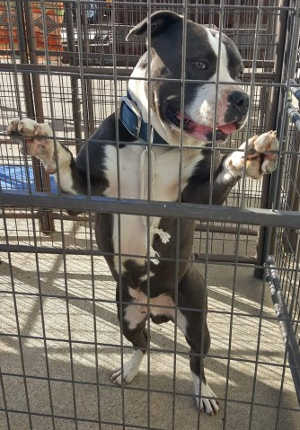
‘Blue’
“Blue” is a male Staffordshire Bull Terrier mix with a short blue and white coat.
He has been neutered.
He is dog No. 2420.
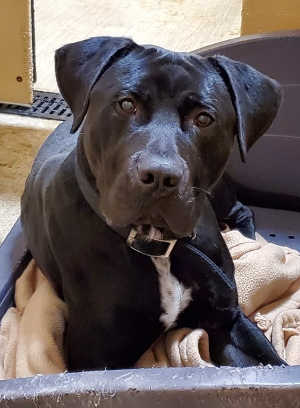
‘Burke’
“Burke” is a male Labrador Retriever with a short black coat with white markings.
He has been neutered.
He is dog No. 2628.
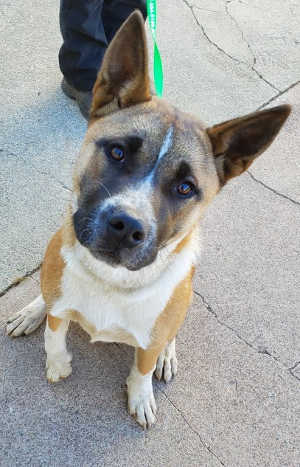
‘Charlotte’
“Charlotte” is a female Akita mix.
She is dog No. 3040.
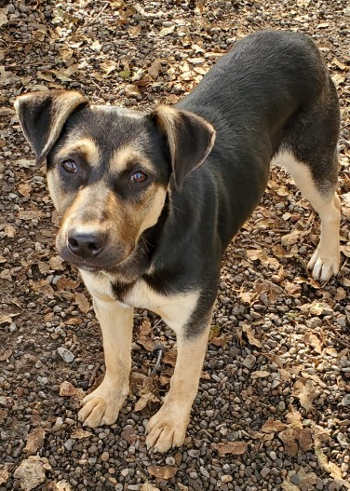
‘Clarice’
“Clarice” is a female German Shepherd mix puppy.
She has been spayed.
She is dog No. 3402.

‘Deejay’
“Deejay” is a female German Shepherd mix with a short tan and white coat.
She is dog No. 3413.
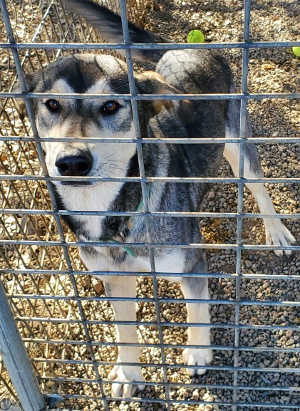
‘Fable’
“Fable” is a female Alaskan Malamute mix with a brown and buff coat.
She is dog No. 3044.
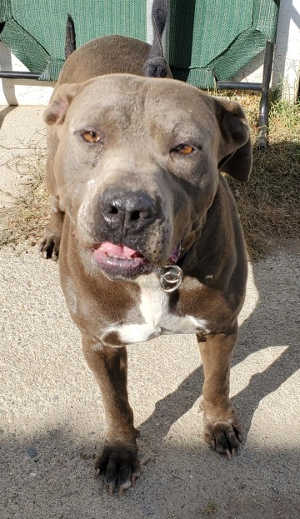
‘Linus’
“Linus” is a male Staffordshire Bull Terrier mix with a short gray and white coat.
He is dog No. 3255.
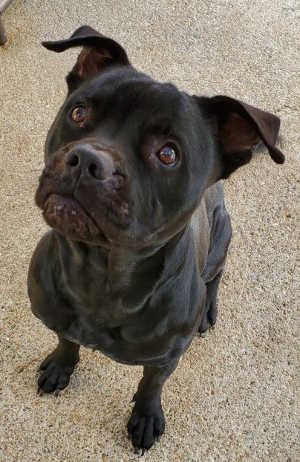
‘Precious’
“Precious” is a female Staffordshire Bull Terrier with a short black coat.
She is dog No. 3268.

‘Tempest’
“Tempest” is a female German Shepherd mix with a medium-length black and tan coat.
She is dog No. 3429.
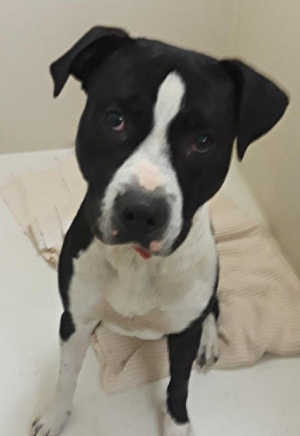
‘Woodrow’
“Woodrow” is a male Staffordshire Bull Terrier with a black and white coat.
He is dog No. 3281.
Clearlake Animal Control’s shelter is located at 6820 Old Highway 53, off Airport Road.
Hours of operation are noon to 4 p.m. Tuesday through Saturday. The shelter is closed Sundays, Mondays and major holidays; the shelter offers appointments on the days it’s closed to accommodate people.
Call the Clearlake Animal Control shelter at 707-273-9440, or email
Visit Clearlake Animal Control on Facebook or at the city’s Web site.
Email Elizabeth Larson at