 How to resolve AdBlock issue?
News
- Details
- Written by: Elizabeth Larson
Northshore Fire firefighters along with Cal Fire and Lakeport Fire were dispatched to the incident in the 1800 block of Clover Valley Road shortly before 7:30 p.m. Saturday, according to radio reports.
Firefighters responding to the scene reported that they could see the fire up on a ridge from as far away as Robinson Rancheria.
They also were unsure of how to access the fire initially until the homeowner called to give them the address on Clover Valley Road, which was accessed off of Bambi Lane, according to radio reports.
Units arriving on scene reported that a two-story wood structure was fully involved. Pacific Gas and Electric also was asked to respond to the property.
The firefighting effort continued late into the night, with the Northshore Fire Support Team requested to respond.
The support team returned to quarters shortly after 11:30 p.m. and fire units continued to clear the scene after 12 a.m. Sunday.
Additional information on the fire was not immediately available.
Email Elizabeth Larson at
- Details
- Written by: Elizabeth Larson
Dogs available for adoption this week include mixes of bluetick coonhound, bull terrier, pit bull, Rhodesian Ridgeback, Shiba Inu, shepherd, spaniel and treeing walker coonhound.
Dogs that are adopted from Lake County Animal Care and Control are either neutered or spayed, microchipped and, if old enough, given a rabies shot and county license before being released to their new owner. License fees do not apply to residents of the cities of Lakeport or Clearlake.
If you're looking for a new companion, visit the shelter. There are many great pets hoping you'll choose them.
The following dogs at the Lake County Animal Care and Control shelter have been cleared for adoption (additional dogs on the animal control Web site not listed are still “on hold”).

Bull terrier-shepherd
This young male bull terrier-shepherd has a short black and white coat.
He is in kennel No. 2, ID No. 13417.

Female pit bull terrier
This female pit bull terrier has a short black and white coat.
She has been spayed.
She is in kennel No. 4, ID No. 13406.

Female Shiba Inu
This female Shiba Inu has a medium-length black and tan coat.
She is in kennel No. 12a, ID No. 13362.
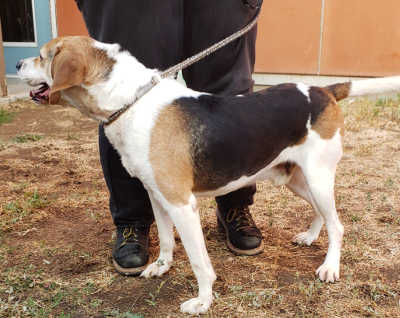
‘Max’
“Max” is a male bluetick coonhound-treeing walker coonhound with a short tricolor coat.
He is in kennel No. 25, ID No. 13289.
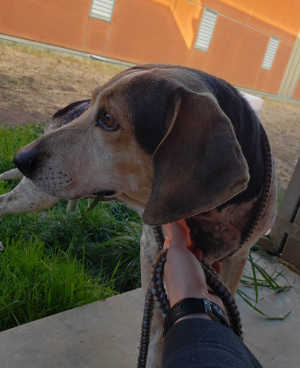
‘Daisey’
“Daisey” is a female treeing walker coonhound/bluetick coonhound mix with a short tricolor coat.
She is in kennel No. 29, ID No. 13291.

‘Betty Boo’
“Betty Boo” is a female spaniel with a short black and white coat.
She has been spayed.
She’s in kennel No. 30, ID No. 13227.
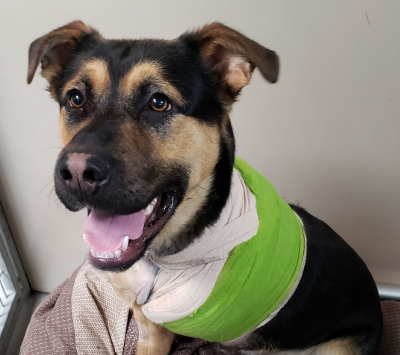
Male shepherd mix
This male shepherd mix has a short black and brown coat.
He is in kennel No. 32, ID No. 13386.
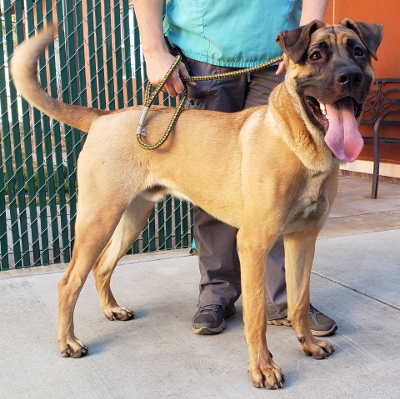
‘Goofy’
“Goofy” is a young male Rhodesian Ridgeback with a short tan and black coat.
Shelter staff said this boy is great with other dogs, although he is high energy and would benefit from obedience training. He would love to go jogging every day, he is very food motivated and willing to learn new things.
Goofy has been at the shelter since Nov. 5. He was originally taken from someone in Upper Lake and found on the highway in Clearlake. If anyone has any information on his owner please contact the shelter.
He’s in kennel No. 33, ID No. 13210.
Lake County Animal Care and Control is located at 4949 Helbush in Lakeport, next to the Hill Road Correctional Facility.
Office hours are Monday through Friday, 11 a.m. to 5 p.m., and 11 a.m. to 3 p.m., Saturday. The shelter is open from 11 a.m. to 4 p.m., Monday through Friday and on Saturday from 11 a.m. to 3 p.m.
Visit the shelter online at http://www.co.lake.ca.us/Government/Directory/Animal_Care_And_Control.htm.
For more information call Lake County Animal Care and Control at 707-263-0278.
Email Elizabeth Larson at
- Details
- Written by: Dudley L. Poston, Jr., Texas A&M University

The U.S. has just entered the new decade of the 2020s.
What does our country look like today, and what will it look like 10 years from now, on Jan. 1, 2030? Which demographic groups in the U.S. will grow the most, and which groups will not grow as much, or maybe even decline in the next 10 years?
I am a demographer and I have examined population data from the U.S. Census Bureau and from the Population Division of the United Nations.
Projections show that whites will decline; the number of old people will increase; and racial minorities, mainly Hispanics, will grow the most, making them the main engine of demographic change in the U.S. for the next 10 years and beyond.
1. There will be more of us
The U.S. population today, at the start of 2020, numbers just over 331 million people.
The U.S. is the third largest country in the world, outnumbered only by the two demographic billionaires, China and India, at just over 1.4 billion and just under 1.4 billion, respectively.
Ten years from now, the U.S. population will have almost 350 million people. China and India will still be bigger, but India with 1.5 billion people will now be larger than China, with 1.46 billion.
2. The population will get older.
The U.S. is getting older and it’s going to keep getting older.
Today, there are over 74.1 million people under age 18 in the U.S. country. There are 56.4 million people age 65 and older.
Ten years from now, there will almost be as many old folks as there are young ones. The numbers of young people will have grown just a little to 76.3 million, but the numbers of old people will have increased a lot – to 74.1 million. A lot of these new elderly will be baby boomers.
For example, take the really old folks – people over the age of 100. How many centenarians are in the U.S. population today and how many are there likely to be 10 years from now?
According to demographers at the U.S. Census Bureau, the number of centenarians in the U.S. grew from over 53,000 in 2010 to over 90,000 in 2020. By 2030, there will most likely be over 130,000 centenarians in the U.S.
But this increase of centenarians by 2030 is only a small indication of their growth in later decades. In the year of 2046, the first group of surviving baby boomers will reach 100 years, and that’s when U.S. centenarians will really start to grow. By 2060 there will be over 603,000. That’s a lot of really old people.
I sometimes ask my undergraduate students how many of them have ever actually seen a person 100 years old or older. In my classes of 140 or more students, no more than maybe six raise their hands. Lots more college students will be raising their hands when they are asked that question in 2060.
3. Racial proportions will shift.
In 2020, non-Hispanic white people, hereafter called whites, are still the majority race in the U.S., representing 59.7% of the U.S. population.
In my research with the demographer Rogelio Saenz, we have shown that the white share of the U.S. population has been dropping since 1950 and it will continue to go down.
Today, after whites, the Hispanic population is the next biggest group at 18.7% of the U.S., followed by blacks and Asians.
What will the country look like racially in 2030? Whites will have dropped to 55.8% of the population, and Hispanics will have grown to 21.1%. The percentage of black and Asian Americans will also grow significantly.
So between now and 2030, whites as a proportion of the population will get smaller, and the minority race groups will all keep getting bigger.
Eventually, whites will become a minority, dropping below 50% of the U.S. population in around the year of 2045.
However, on the first day of 2020, whites under age 18 were already in the minority. Among all the young people now in the U.S., there are more minority young people than there are white young people.
Among old people age 65 and over, whites are still in the majority. Indeed white old people, compared to minority old people, will continue to be in the majority until some years after 2060.
Hispanics and the other racial minorities will be the country’s main demographic engine of population change in future years; this is the most significant demographic change Americans will see.
I’ve shown above how much older the U.S. population has become and will become in the years ahead. Were it not for the racial minorities countering this aging of the U.S. population, the U.S. by 2030 and later would have become even older than it is today and will be in 2030.
[ Deep knowledge, daily. Sign up for The Conversation’s newsletter. ]
Dudley L. Poston, Jr., Professor of Sociology, Texas A&M University
This article is republished from The Conversation under a Creative Commons license. Read the original article.
- Details
- Written by: Supriya Chakrabarti, University of Massachusetts Lowell

Perhaps you remember the opening scene of “Harry Potter and the Sorcerer’s Stone” that took place on Privet Drive. A bearded man pulled a mysterious device, called a deluminator, from his dark robe and one by one the lights from the street lamps flew into it.
For the last decade or more, Muggles around the world – including me – have been busy designing and perfecting a similar device called a coronagraph. It blocks light from stars so scientists can take pictures of planets orbiting them – the exoplanets.
More than 500 years ago Italian friar Giordano Bruno postulated that stars in the night sky were like our Sun with planets orbiting them, some of which likely harbored life. Starting in the 1990s, using ground-based and satellite observations astronomers have gathered evidence of the existence of thousands of extra-solar planets or exoplanets. The discovery of exoplanets earned the 2019 Nobel Prize in Physics.
The next major milestone in exoplanetary research is imaging and characterizing Jupiter-sized exoplanets in visible light because imaging Earth-size planets is much more difficult. However, imaging exo-Jupiters would show that astromomers have all necessary tools to image and characterize Earth-size planets in the habitable zones of nearby stars, where life might exist. Space missions capable of imaging exo-Earths in their habitable zones, such as Habitable Exoplanet Observatory or HabEx and Large UV/Optical/IR Surveyor or LUVOIR, are currently being designed by scientists and engineers around the globe and are at least a decade away from their flight.
In preparation for these flagship-class missions, it is critical that key technologies and software tools are developed and validated. A coronagraph is essential to all of these imaging efforts.
I am a professor of physics and lead a research group that has designed many experiments that have flown on NASA missions. For the last decade or so, our team has been developing technologies needed to directly image and characterize exoplanets around nearby stars and test them aboard rockets and balloons before they can be selected for flight on major space missions.

Imaging exoplanets in visible light
Even though we know about the existence of over 4,000 exoplanets, most were detected using indirect methods such as the dimming the light of the parent star when a planet passes in front and blocks some of its light – just like the recent transit of Mercury. This is the technique employed by the Kepler and Transiting Exoplanet Survey Satellite or TESS missions. The 2019 Nobel Prize winners used another indirect method, that relies on the measurement of minute and periodic motion of stars caused by planets orbiting them. But a photograph of an exoplanet, with characteristics similar to those in our Solar System, has not yet been taken.
Imaging exoplanets is hard. For example, even a huge planet like Jupiter is a billion times dimmer than the Sun. And when seen from far away, the Earth is 10 times dimmer than Jupiter. But the difficulty of imaging exoplanets is not because they are dim – large telescopes including the Hubble Space Telescope have imaged much fainter objects.
The challenge of imaging exoplanets has to do with taking a picture of a very faint object that is close to a much brighter one. Since the stars and their planets are far away, when photographed they appear as one bright spot in the sky, just like the headlights of a car look like one bright light from a distance. So, the challenge of imaging even the nearest exoplanet is akin to a person in California taking a picture of a fly 10 feet away from the bright light of a lighthouse in Massachusetts.
My research group recently flew a high-altitude balloon experiment named Planetary Imaging Concept Testbed Using a Recoverable Experiment – Coronagraph (PICTURE-C) that tested the coronagraph’s ability to work in space to image exoplanets and their environments.

Key components of PICTURE-C instrument
PICTURE-C’s coronagraph creates artificial eclipses to dim or eliminate starlight without dimming the planets that the stars illuminate. It is designed to capture faint asteroid belt like objects very close to the central star.
While a coronagraph is necessary for direct imaging of exoplanets, our 6,000 pound device also includes deformable mirrors to correct the shape of the the telescope mirrors that get distorted due to changes in gravity, temperature fluctuations and other manufacturing imperfections.
Finally, the entire device has to be held steady in space for relatively long periods of time. A specially NASA-designed gondola called Wallops Arc Second Pointer (WASP) carried PICTURE-C and got us part way. An internal image stabilization system designed by my colleagues provided the “steady hand” necessary.
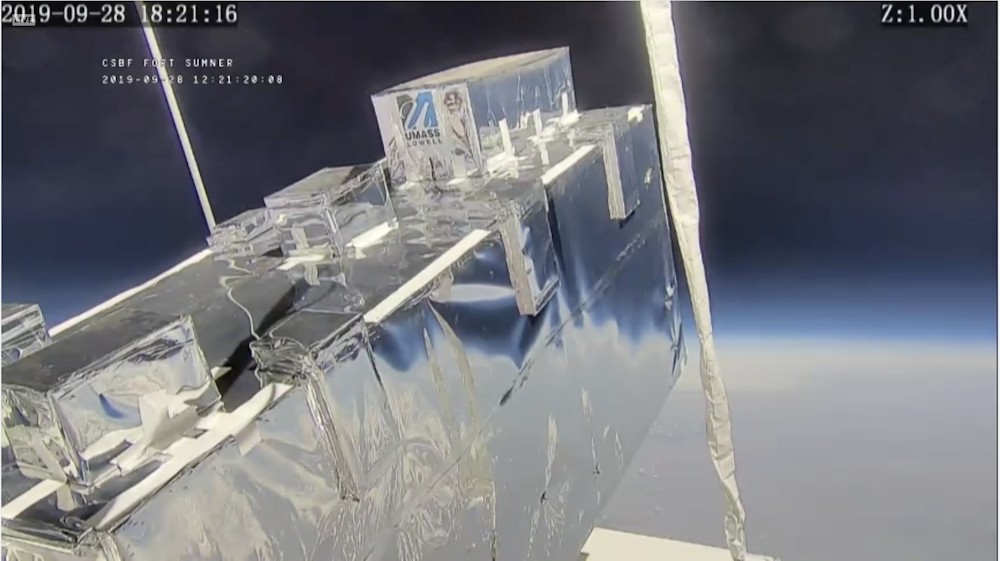
The maiden flight of PICTURE-C
After many tests to demonstrate that all systems were ready for flight our team launched PICTURE-C on the morning of September 29, 2019 from Ft. Sumner, New Mexico.
After the 20-hour test flight confirming that all systems worked well, PICTURE-C returned to the Earth using its parachute to land softly. The experiment has been recovered and returned to our laboratory. PICTURE-C wasn’t supposed to actually discover any exoplanets on its first test run. But it will fly again on another balloon when it will photograph several stars to explore if any of them have asteroid belts. These would be easier to see, and if we are lucky, it will snap a shot of a Jupiter-sized planet in September 2020.

Supriya Chakrabarti, Professor of Physics, University of Massachusetts Lowell
This article is republished from The Conversation under a Creative Commons license. Read the original article.