 How to resolve AdBlock issue?
Recreation
- Details
- Written by: Editor
The California Department of Fish and Wildlife, or CDFW, encourages all Californians to give fishing a try for free on July 1 and Sept. 2.
CDFW annually offers two Free Fishing Days, typically around the Fourth of July and Labor Day weekends.
On these two days, people can fish without having to buy a sport fishing license.
Free Fishing Days also provide an easy opportunity for licensed anglers to introduce non-angling friends and children to fishing and the outdoors.
All fishing regulations, such as bag and size limits, gear restrictions, report card requirements and fishing hours and stream closures, remain in effect.
Every angler must have an appropriate report card if they are fishing for steelhead, sturgeon, spiny lobster or abalone anywhere in the state, or for salmon in the Smith and Klamath-Trinity river systems.
Anglers residing in urban areas also have opportunities to fish close to home. Some CDFW regions also offer Fishing in the City, a program that allows children to learn to fish in major metropolitan areas.
For more information on the Fishing in the City program, please visit www.wildlife.ca.gov/fishing-in-the-city .
All anglers should also check the rules and regulations at www.wildlife.ca.gov/regulations for the waters they plan to fish because wildlife officers will be on duty to enforce them.
In addition, information on fish planting is available at https://nrm.dfg.ca.gov/fishplants and a fishing guide can be viewed at www.wildlife.ca.gov/fishing/guide .
For more information on Free Fishing Days, please visit www.wildlife.ca.gov/licensing/fishing/free-fishing-days .
- Details
- Written by: Editor
The California Department of Fish and Wildlife (CDFW) is accepting applications for 31 elk hunting opportunities offered through the Shared Habitat Alliance for Recreational Enhancement, or SHARE, Program.
The hunts will occur at various times between Aug. 15 and Dec. 24 on 28 select properties in Colusa, Del Norte, Humboldt, Mendocino and Siskiyou counties.
Specific details for all 31 elk hunts can be found at www.wildlife.ca.gov/Hunting/SHARE#elk . CDFW will be accepting applications through Monday, July 24.
The SHARE program was created to provide additional hunting, fishing and other recreational access on private lands in California by offering incentives to private landowners.
Participating landowners receive liability protection and compensation for providing public access to or through their land for wildlife-dependent recreational activities.
“CDFW has been working to increase private lands access for California hunters. In the last year, we’ve enrolled two new elk hunting properties – one in Colusa County, the other in Siskiyou County,” said Victoria Barr, CDFW’s SHARE program coordinator. “We’re now up to 31 different elk hunts, which demonstrates great progress for the program.”
All elk tags will be distributed through a random draw process. While hunters may take only one elk per year in California, these hunts offer additional opportunities beyond those issued through the general Big Game Drawing.
SHARE hunt applications can be purchased by anyone with a valid 2017 California big game hunting license from any CDFW license office or online at www.ca.wildlifelicense.com/InternetSales .
An $11.37 nonrefundable application fee will be charged for each hunt application.
Applicants may look up their draw results and download their hunt packets on July 28 by entering their customer information on CDFW’s Web site at www.ca.wildlifelicense.com/InternetSales .
- Details
- Written by: Editor
KELSEYVILLE, Calif. – On Saturday, June 17, at 9 a.m. State Park volunteer Val Nixon will lead a walk on the Indian Nature Trail at Clear Lake State Park.
Nixon will point out the flora and fauna along the trail and discuss how the local American Indians used the native vegetation in their everyday lives.
The trail is about half a mile long and has a moderately strenuous grade.
The walk will start at 9 a.m. at the entrance station to the park and will last about a half hour to an hour.
All participants should dress appropriately for the summer mornings and wear sturdy shoes and bring sunscreen, mosquito repellent, binoculars and water. Rain will cancel the walk.
Clear Lake State Park Volunteers will lead nature walks on the first and third Saturdays during the summer. Remember to mark your calendars and plan on attending a free nature walk.
Clear Lake State Park is located at 5300 Soda Bay Road, Kelseyville, and entry into the park is free for those attending the walk.
Anyone having special needs should contact the Clear Lake State Park Sector Office Tuesday through Thursday between 8 a.m. and 5 p.m. at 707-279-2267.
For further information on California State Parks go to www.parks.ca.gov .
- Details
- Written by: Carrie Wilson
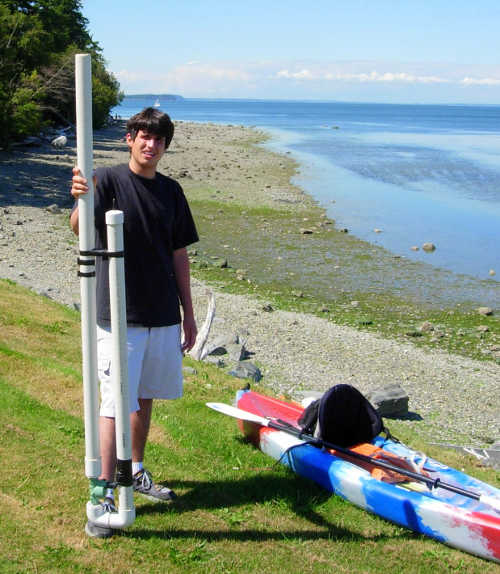
Bait launching with a DIY spud gun?
Question: Is the use of bait launchers legal in California?
I have seen many videos and DIY plans showing how to build fishing bait launchers. They look pretty much like a potato gun but are used only for propelling the bait past the surf for a chance at the larger fish. They are made of PVC pipe and filled with air, probably from a bike pump.
Its only purpose is for getting the fishing bait out farther than one can cast. I would imagine that certain areas would be opposed to their use, but in general, are these legal to use? (Daniel N.)
Answer: Potato-style guns like you are referring to are legal under federal law. However, under state law, potato guns that use combustion (instead of compressed air) to launch the projectile are “firearms,” and one with a bore of over 0.5 inches is a destructive device.
Pneumatic potato guns that use compressed air are legal as long as they are not used like a weapon (e.g. shot at a person, etc.), so this line launching device would be legal under state and federal laws.
However, you should check for local city and county ordinances because some local governments prohibit use of any devices that propel projectiles.
If you intend to use this line launching device on a state beach, you may also want to consult State Parks. And if you plan to use it to fish within a National Marine Sanctuary, I suggest you check in with that Sanctuary office to be sure they do not prohibit these types of devices.
As far as using it to cast a fishing line, nothing in the Fish and Game Code or its implementing regulations prohibit using this compressed air launcher as long as the fishing line remains attached to a rod and reel, or the person is brave enough to hold the other end of line in their hands!
Catching crabs both inside and outside San Francisco Bay
Question: Let’s say I’m in the ocean at Baker Beach in San Francisco and I catch a Dungeness crab.
Then I want to go fishing and crabbing nearby at Ft. Point Pier (just inside the bay) or Aquatic Park.
Basically, I don’t want to leave my crabs in the car for hours, and I have one bucket with an aquarium pump to keep all the crabs in.
Can I bring the bucket with the crab onto that pier or will a California Department of Fish and Wildlife (CDFW) warden presume I caught it there? And similarly, would leaving it in the parked car be allowed or would they presume it was from that area? (Fred D.)
Answer: “Dungeness crab may not be taken from or possessed if taken from San Francisco Bay and San Pablo Bay, plus all their tidal bays, sloughs and estuaries between the Golden Gate Bridge and Carquinez Bridge” (California Code of Regulations Title 14, section 29.85(a)).
Based upon the scenario you describe of having Dungeness crabs in possession in a prohibited area, you could get into trouble if you have Dungeness crabs on the pier with you or while returning from a prohibited area with fishing equipment.
As per Fish and Game Code, section 2000(b): Possession of a bird, mammal, fish, reptile, amphibian, or part of any of those animals, in or on the fields, forests, or waters of this state, or while returning therefrom with fishing or hunting equipment, is prima facie evidence the possessor took the bird, mammal, fish, reptile, or amphibian, or part of that animal.
CDFW recommends that you first fish in the more restrictive area (the Bay), then move outside the Bay to fish for Dungeness crab to avoid any misunderstandings or extra scrutiny by wildlife officers.
But, what you describe is not prohibited, and experienced local wildlife officers will be able to tell the difference between freshly caught crab and those that have been in your bucket for hours.
Transporting a compound bow
Question: What are the requirements to legally transport a compound bow? (Antoine R.)
Answer: “No person may nock or fit the notch in the end of an arrow to a bowstring or crossbow string in a ready-to-fire positon while in or on any vehicle” (CCR Title 14, section 354(i)).
Lost fishing license
Question: I purchased a fishing license a couple of months ago but now cannot find it. I do have a picture of it. How can I get a copy of my original? (Dee D.)
Answer: Go to any License Agent or CDFW License Sales Office to buy a duplicate sport fishing license. A small fee is charged for each duplicate validation.
If you lose your Abalone Report Card or Sturgeon Fishing Report Card, you can obtain a duplicate from CDFW license sales offices only.
You must complete an Abalone Report Card Affidavit (PDF Form) and pay the duplicate fee to replace an Abalone Report Card.
You must complete a Sturgeon Fishing Report Card Affidavit (PDF Form) and pay the duplicate fee to replace a Sturgeon Fishing Report Card. Duplicate fees are listed on the license description page.
Carrie Wilson is a marine environmental scientist with the California Department of Fish and Wildlife. While she cannot personally answer everyone’s questions, she will select a few to answer each week in this column. Please contact her at