 How to resolve AdBlock issue?
Recreation
- Details
- Written by: California Department of Fish and Wildlife
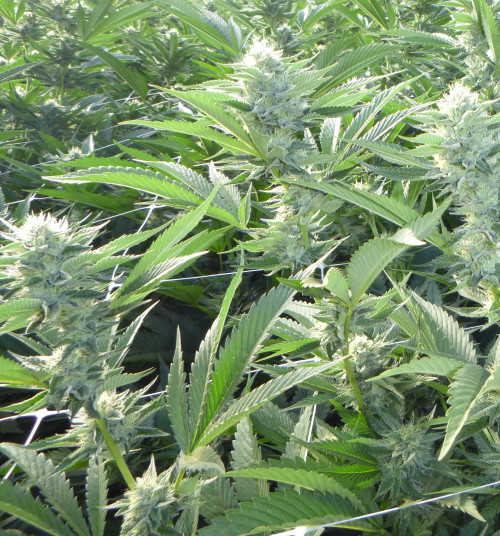
Fish, wildlife and ... cannabis?
Question: I follow the California Department of Fish and Wildlife's social media pages, and it seems like recently there have been a lot of posts promoting cannabis growing workshops and other cannabis activity. This makes no sense to me. Your department regulates fish and wildlife, not marijuana! Isn't this the responsibility of the Bureau of Cannabis Control? (Bill)
Answer: At the heart of CDFW is a mission to protect California's natural resources. Like other farming activities, commercial cannabis cultivation has the potential to harm fish and wildlife through water diversions, alterations to rivers, lakes and streams, habitat destruction and pesticide use.
With the passage of Proposition 64, thousands of new and existing commercial-size cultivators are entering the legal cannabis market. Many are unaware that seemingly harmless farming activities can have big impacts to the environment.
In California, all commercial-size cannabis activity is regulated by three state agencies. The Bureau of Cannabis Control is responsible for licensing retailers, the California Department of Public Health's Manufactured Cannabis Safety Branch licenses all manufacturing of cannabis products and the California Department of Food and Agriculture (CalCannabis) oversees commercial cannabis cultivation.
While CDFW does not directly issue a license for commercial cannabis activities, any CalCannabis commercial license application must include either a CDFW issued Lake or Streambed Alteration (LSA) Agreement or written verification that an LSA Agreement is not needed. Cultivation activities that alter the bed, channel or bank of a river, stream or lake may require an LSA Agreement to protect fish and wildlife resources. Each grow is unique and specific compliance requirements may vary accordingly.
CDFW has been partnering with CalCannabis, the State Water Resources Control Board and other state agencies that regulate commercial cannabis cultivation by holding workshops for those trying to navigate the regulatory and licensing process.
At these workshops, state agencies are on hand to provide information and answer project questions so cannabis cultivators can succeed in this newly regulated industry. Social media is one of many tools used to promote these important outreach events.
CDFW supports the regulated cannabis market and appreciates those cultivators who obtain county permits, apply for commercial cannabis licenses and take steps to reduce environmental impacts. Visit www.wildlife.ca.gov/cannabis to learn more about CDFW's role in commercial cannabis regulation.
Shutting down illegal grows
Question: How does CDFW decide what illegal marijuana grows to shut down? (Anonymous)
Answer: CDFW has a long history of combatting illegal marijuana grows on public lands where some of the state's worst environmental violations have been documented. The biggest concerns with illegal marijuana grows are water diversions, pesticide use, poaching, pollution and habitat destruction.
Today, CDFW focuses on illegal grows found on both private and public lands and uses a variety of tools when prioritizing enforcement efforts.
For illegal marijuana grows on private property, CDFW usually focuses on sites having the most environmental damage and areas with a history of illegal cultivation.
Parcels near sensitive watersheds and areas with threatened or endangered species are usually a big priority. Before a parcel is targeted for a search warrant, a thorough records check is conducted with CalCannabis and the county to verify what steps may or may not have been taken to obtain a commercial cannabis license.
During an enforcement action on private land, wildlife officers will document any state law violations and may eradicate any illegal plants. CDFW science staff will document environmental violations. From there, the case may be referred to the county District Attorney's office or state Attorney General's Office for prosecution. CDFW may also file a complaint for civil penalties. It's up to the property owner to remediate the damage to the land. County officials may also step in and require a clean-up depending on the circumstances.
With public land marijuana grows (federal, state or county property), CDFW works with several allied agencies to determine what resources are available. Public land grows are a huge safety risk on properties that can be accessed by CDFW staff or the public. Illegal grows are usually guarded by armed individuals who will do what they feel is necessary to protect the plants.
Many grows are also found in once-secluded, pristine areas, now decimated by huge amounts of garbage, land clearing and banned pesticides. Many of California's threatened and endangered species are victims of this egregious behavior.
Remediation efforts to restore the land are handled by various government agencies which can take days or weeks to complete and cost thousands of taxpayer dollars.
That said, it's a huge task to combat illegal grows. CDFW takes immense pride on the efforts to protect California's fish and wildlife, and the habitats they depend upon to live and thrive.
If you have a question for the California Department of Fish and Wildlife, email
- Details
- Written by: California Department of Fish and Wildlife
White sturgeon anglers who are already familiar with the requirement to purchase an annual Sturgeon Report Card know that by Jan. 31 of the following year, they must return their card (by mail) or report their card information (online).
Anglers must report even if no sturgeon were caught or if the angler did not go sturgeon fishing. Card data are extremely valuable, providing fisheries scientists with information about seasonal and geographic catch and harvest along with a measure of fishing effort.
But anglers should also be on the lookout for White Sturgeon carrying a disc tag. Every year between August and October, CDFW fisheries biologists conduct a survey of White Sturgeon. Fish are captured by net, counted and measured.
A small plastic disc tag is affixed to White Sturgeon that are between approximately 3 to 6 feet in length. The tag is placed at the base of the dorsal fin, and the sturgeon is then released. Information collected from returned disc tags allows CDFW fisheries staff to produce more accurate population metrics.
CDFW currently offers rewards of $50, $100 or $150 per disc tag, although older fish with a $20 tag are sometimes caught. Tags must be physically returned to CDFW to be counted and the reward claimed; photographs cannot be accepted.
However, the tags will be returned to the angler upon request. Anglers will also receive a commendation card with information about the fish, along with the specified reward amount.
Anglers can submit reward disc tags by filling out CDFW's fish tag recovery form and mailing it to California Department of Fish and Wildlife, Attn: Sportfish Unit, 2109 Arch-Airport Road, Suite 100, Stockton, CA 95206.
Please make a note on the form if you would like the tag returned to you.
Anglers can also report Sturgeon Report Card information online or return the cards by mail to California Department of Fish and Wildlife, Sturgeon Fishing Report Card, P.O. Box 944209, Sacramento CA 94244-2090.
CDFW reminds all anglers that no white sturgeon larger than 68 inches, and no green sturgeon of any size, should be removed from the water. CDFW appreciates anglers' assistance in managing California's white sturgeon population.
- Details
- Written by: California Department of Fish and Wildlife
Deer hunt permit holders will be the only ones allowed on the wildlife area during the first week of the A Zone deer season. No other public use is permitted. The area reopens to all users Saturday, Aug. 17.
The special lottery draw deer hunt was initiated for the first time this year to limit the number of hunters on the popular public hunting area for safety purposes and to improve the quality of the hunting experience for permit holders.
Only hunters whose names are listed on the hunt permit may participate in the hunt. Anyone not listed specifically on the hunt permit, including non-hunters, helpers and assistants, will not be permitted on the wildlife area during the hunt period.
- Details
- Written by: Nadine Strauss

MADERA, Calif. – The third 2019 appearance of the North State Modified Series and another large field of Madera Late Models will highlight Saturday’s Children’s Hospital Kids Night at Madera Speedway.
An action-packed night of stock car racing will also include the North State Hobby Stock Challenge, Toyota Sedans, Modified Super Toyotas, and a Junio Late Model exhibition race.
Medford, Oregon’s Randy Houston led the North State Modifieds across the finish line in April before Robbie Knittel won his first career series victory in June.
Series points leader Cameron Austin finished third in the April event and second in June. He has a perfect season of podium finishers bolstered by back-to-back wins in July at Roseville and Eureka.
Austin’s summer performances have boosted him to a 20-point lead over Knittel, who has used fill-in driver Scott Winters for the last two events.
Three-time series champion Darrin Knight of Kelseyville ranks third followed by Darrin Sullivan and Terry Deal.
A second-place finish and a fourth-place finish places Jason Philpot of Sacramento sixth in the standings. Sixty laps of open wheel Modified excitement are on tap.
The accompanying North State Hobby Stock Challenge versus the Madera Speedway Hobby Stocks has seen both features won by Madera regulars.
Howard Holden narrowly topped 2018 champion Steve Schermerhorn in April before Schermerhorn grabbed the top spot in June. Drivers from up north to as far south as Bakersfield are expected for Saturday’s 50-lap race.
Saturday’s program begins with pit gates opening at 12:30 p.m. Practices run from 1:45 p.m. to 2:55 p.m. with qualifying and heat races to follow. Opening ceremonies are planned for 6 p.m.