 How to resolve AdBlock issue?
Recreation
- Details
- Written by: California Department of Fish and Wildlife
The California Wildlife Officers Foundation will recognize one grand-prize winner with a lifetime California hunting license with a bird hunting privilege package valued at up to $1,250. Second and third place winners will also be selected and prize packages will be awarded.
This year's contest challenges kids to answer the questions, "What can CDFW do to get more people involved in hunting? And what can you do, personally, to get more people involved in hunting?"
CDFW is actively expanding its efforts to recruit, retain and reactivate anglers and hunters in California. These efforts – known as the "R3 program" – are currently a high priority of the department, and the Hunter Education Program in particular.
"It will be interesting to read about the R3 ideas these young hunters present in their essays," said CDFW Hunter Education Program Administrator Capt. Robert Pelzman.
The essay contest is open to all junior hunting license holders, as well as youths under 18 who have earned a hunter education certificate. Essays should be no more than 500 words, double spaced.
Entries should be submitted via email to Capt. Pelzman at
Along with their essay, entrants must also provide their date of birth, place of residence and a contact telephone number and email address.
Essays will be reviewed and scored by CDFW wildlife officers and other CDFW representatives. The winners will be notified by telephone on or near Dec. 24.
The grand prize will be awarded during a special ceremony at the International Sportsmen's Exposition show scheduled in Sacramento on Saturday, Jan. 18, 2020, at 11:30 a.m.
Contest winners must be present and accompanied by a parent or guardian.
For information on becoming a Hunter Education Instructor to help "Pass on the Tradition" to others, please visit www.wildlife.ca.gov/hunter-education .
- Details
- Written by: California Department of Fish and Wildlife
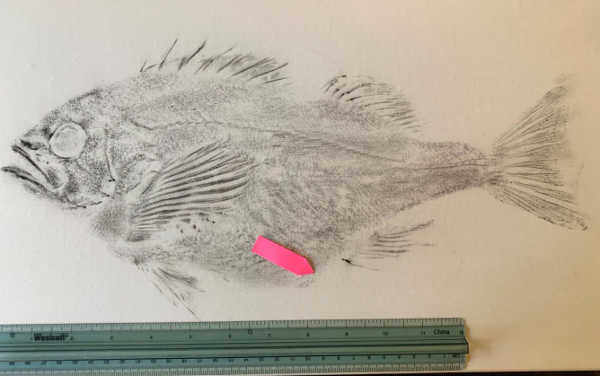
This ‘mystery mass’ is pretty fishy
Question: I speared a 15" blue rockfish at Ocean Cove over Labor Day weekend. It had a large belly but no eggs or anything extraordinary within stomach or fillets.
Within the gut cavity, attached to the end of the intestine (near the anus), there was a 3.5 cm white mass with a black tip at the free end. It was very hard and calcified.
I cut it in half longways and found that the translucent white skin came off easily, but the black mass inside was very dense. The black mass also seems to rub off and stain anything it touched, like a gummy charcoal.
I took pictures, with pink arrow on Gyotaku print of this fish marking the approximate location and orientation within gut cavity. Is this some kind of parasite, or just a calcified gonad/kidney stones? Would this mass give any reason to avoid eating the fillets? (TL)
Answer: What a vivid description you provided! And the photos are very helpful for reference. The condition you've described is caused by a parasitic copepod called Sarcotaces. Copepods are arthropods and are in the same taxonomic group of animals as crabs and insects.
The juvenile Sarcotaces can be found in the water column in hopes of finding a host. In this case, the host was the rockfish you caught.
Sarcotaces inserts its head into the skin of a fish and is eventually encapsulated by the fish's flesh, except for the last body-segment which maintains connection with the outside seawater.
This parasite is commonly found in rockfish, usually located near the vent where the surrounding intestinal tissue forms a sac-like protuberance inside the abdominal cavity.
Sarcotaces feed on blood from the fish, and the digested blood becomes a dark fluid or paste inside the sac. When the parasite dies, the tissue forms a closed cyst, which is what you found during filleting.
There are no human health concerns with a fish infected with Sarcotaces, although if the fillets become tainted with the dark fluid from a ruptured sac they may become visually unappealing to eat. Careful removal of the parasitic sac and handling of the fish as usual is recommended.
Sharing a video with CalTIP?
Question: I took a video of what I think is a wildlife crime in progress. I know you have a tip line, but how can I submit the video? (Anonymous)
Answer: With modern phones being capable of taking high definition video and photographs, the California Department of Fish and Wildlife is seeing an increase in the number of CalTIP reports that include video or photographs. You can submit a video or photograph to CalTIP in one of four ways.
First, you can send your tip and video or photograph to CalTIP by SMS text message, by texting "CALTIP", followed by a space and the message, to 847411 (tip411). You can attach a media file to the SMS text message as you normally would if you were texting with a friend.
You can also use the CalTIP app, which can be downloaded for free via the Google Play Store and iTunes App Store. The app gives you the option to attach a video or photograph before you submit your report.
If you choose to report through the CalTIP website, select "Report a Violation online." This will take you to an online reporting form where you will have the option of attaching a file, including a video or photograph.
Lastly, you can attach the file to an email and send it to
Any time you make a report with CalTIP, please be prepared to provide as many incident details as you can – time of occurrence, location, vehicles involved (including license plate numbers, when possible), physical description of the suspects, the species targeted and what you believe the violation to be. The more details you provide to our wildlife officers, the faster they can put a stop to any illegal activity.
Carcass removal?
Question: Who can I call about a dead bear on my property? (Beverly)
Answer: With some exceptions, removal and disposal of wildlife carcasses is not a service that CDFW provides. If you believe the bear may have been poached, please report it to CalTIP, 1-888-334-2258, and a wildlife officer will contact you. If the bear has an ear tag, please contact the closest regional office to speak with a biologist.
Otherwise, your local or city authorities may offer options, such as pickup and transport to a rendering plant.
If you have a question for the California Department of Fish and Wildlife, email
- Details
- Written by: California Department of Fish and Wildlife
California Department of Fish and Wildlife hatchery workers will open the gates in the ladder at 10:30 a.m. and will take more than a half-million eggs during the first week alone in an effort to ensure the successful spawning return of fall-run Chinook salmon.
The three major state-run hatcheries in the Central Valley – Nimbus Fish Hatchery in Sacramento County, and hatcheries on the Feather River in Butte County and the Mokelumne River in San Joaquin County – will take approximately 24 million eggs over the next two months to produce Chinook salmon for release next spring.
Each hatchery has a viewing area where visitors can watch the spawning process. The visitors’ center at Nimbus Hatchery includes a playground with replicas of giant salmon.
Nimbus Hatchery is open to the public free of charge from 8 a.m. to 3 p.m. on weekdays and 9 a.m. to 3 p.m. on weekends.
For more information about spawning schedules and educational opportunities at each hatchery, please visit the CDFW website at www.wildlife.ca.gov/fishing/hatcheries.
There are eight state-run salmon and steelhead hatcheries, all of which will participate in the salmon spawning effort.
These spawning efforts were put in place over the past half century to offset fish losses caused by dams that block salmon from historic spawning habitat.
Once the young salmon reach 2 to 4 inches in length, one-quarter of the stock will be marked and implanted with a coded wire tag prior to release.
CDFW biologists use the information from the tags to chart their survival, catch and return rates.
- Details
- Written by: Elizabeth Larson
The change in hours, which began on Monday, Oct. 28, will be from 9 a.m. to 3 p.m. until Nov. 8.
Remember that many services, including purchasing maps and permits, are available through the forest website at www.fs.usda.gov/mendocino/ .
Intermittent PG&E power outages are affecting Mendocino National Forest offices from time to time. Forest officials advise the public to call before traveling to the area to ensure our offices are open.
For more information, please call 530-934-3316.