 How to resolve AdBlock issue?
Recreation
- Details
- Written by: CARRIE WILSON
Why no abalone diving/picking before 8 a.m.?
Question: Why are abalone divers and pickers now required to wait until 8 a.m. to begin?
Can divers still go spear fishing at the normal legal start time or take early morning photos, then switch over to abalone diving at 8 a.m.? (Anonymous)
Answer: The new 8 a.m. start time is an abalone conservation measure.
It reduces the number of low-tide days people will be able to take abalone by rock picking (searching amongst rocks for abalone at low tide). During the spring, many low tides occur much earlier than 8 a.m.
This regulation change originated from the concerns of wardens who were witnessing large numbers of fishermen coming each and every low tide and taking large numbers of abalone. People were removing numerous undersized abalone while trying to find legal ones.
Because undersized abalone often do not survive being removed and returned, they are likely to die. Thus, the impact on the fishery when this happens is probably much greater than the estimated legal catch (over 200,000 abalone annually in recent years).
Some people were also using the dim light before dawn to hide illegal activities. Wardens believe a later start time will ease their biggest concerns, and the Fish and Game Commission decided to choose that option.
Divers wanting to go out before 8 a.m. to spearfish or do underwater photography can do this as long as they don't have the means of taking abalone or are searching for abalone before the official state time. If their activities appear to a warden to be taking or searching for abalone before 8 a.m., then they can be cited.
How to stop people who are not obeying the rules?
Question: I was watching two boys catch a lot of trout (at least 40) and they were handling these fish after landing them in the dirt. They would pick and choose which ones to keep and throw back the small ones, most of which soon died.
I was appalled by their lack of respect and sportsmanship, and when I approached their father his reply was, “Who are you to say how many we have? We don’t have a full basket!”
The last time I needed to call law enforcement to this county park they couldn’t find the park until after the offenders had left.
How can we stop these types of people from ruining the opportunities for others? (Gerry)
Answer: The best thing you can do is to record as much information about the location, situation and descriptions of people and the vehicle(s) they are driving (including make, model, color and license plate number).
Provide all of this information at your earliest convenience to our CalTIP hotline at 1-888-334-CalTIP(2258). Leave a message if need be, with contact information, and a warden will receive this information.
If officers are in the area when you call, they will come. If they are not able to arrive in time to catch the people who are breaking the laws, they will be aware of the situation and looking for the offenders the next time around.
Problems with crows and ravens – depredation permit an option?
Question: Why is there such a limited season on hunting crows? I suspect they are covered under the Migratory Bird Treaty Act, but they are a nuisance species.
I run into a number of landowners who have problems with crows with regards to crop damage, etc. Many of these landowners say that based on size, they also have ravens which are also damaging.
I know there is a crow hunting season, but what about ravens? I also know “corvids” are very problematic predators for song birds and marbled murrelets on the coast.
Can landowners get a depredation permit for either species, and if so, where? (Patrick R., Santa Rosa)
Answer: You just missed the hunting season for American crows, which runs from Dec. 7 through April 9. Ravens cannot be hunted.
The regulations allow for landowners to destroy (shoot) crows that are damaging farm fields or other crops (CCR Title 14, section 472(d)).
Lifetime license holder moves out of state
Question: If, while a California resident, I purchase either a lifetime fishing or hunting license, will that license still be valid if I subsequently establish residency in another state? (Greg L., Mission Viejo)
Answer: Yes. You must be a resident to purchase the license, but after it is purchased, it will be valid for use in California for the rest of your life, regardless of where you reside.
Carrie Wilson is a marine environmental scientist with the California Department of Fish and Wildlife. While she cannot personally answer everyone’s questions, she will select a few to answer each week in this column. Please contact her at
- Details
- Written by: Editor
NORTHERN CALIFORNIA – The Blue Ridge-Berryessa Partnership (Partnership), a group of regional stakeholders working together to conserve and steward the Blue Ridge-Berryessa Natural Area, announces a public field tour of the Eticuera Creek Stewardship Project on April 26.
The field tour, which is free and open to the public, will take place from 9 a.m. to noon at the historic Knoxville townsite off Morgan Valley Road.
To attend the field tour, RSVP to Mary Adelzadeh at
An RSVP is required as detailed directions to the meeting location will be sent via email to registered participants.
The field tour will feature collaborative efforts to control invasive species and restore native plants along Eticuera Creek and its tributaries. Representatives from the UC Davis McLaughlin Reserve, Gamble Ranch, California Department of Fish and Wildlife, and UC Cooperative Extension will discuss project methods, successes, and challenges, and also highlight the benefits of collaborative stewardship. Following presentations, a ridge hike will be offered.
The Eticuera Creek watershed encompasses 34,000 acres at the north end of Lake Berryessa in the Putah Creek watershed and includes Knoxville Creek, Zim Zim Creek, Adams Creek and the Toll Canyon sub-watershed.
More than 20,000 acres of the watershed are in the Department of Fish and Game’s Knoxville Wildlife Area; the remainder includes land managed by the Bureau of Land Management, the University of California’s McLaughlin Reserve, Homestake Mining Company, and other private ranches and properties.
Founded in 1997, the Partnership provides a forum for the public and private land managers to meet and discuss stewardship activities, interests, and challenges.
The group has since grown to more than 100 members, including federal and state agencies, counties and other public entities, local businesses, non-profit organizations and conservation-minded landowners – all with the common goal of supporting collaborative stewardship of the natural and working landscape of the Blue Ridge-Berryessa Natural Area.
The Blue Ridge-Berryessa Natural Area (BRBNA) is approximately 785,000 acres of the upper Putah and Cache Creek watersheds, both tributaries to the Sacramento River basin.
- Details
- Written by: Carrie Wilson
Do surfperch fry count toward the daily limit?
Question: In Santa Barbara a surf fisherman was seen last week eating baby perch squeezed from a gravid female. How do live fry from perch relate to a daily limit in possession if consumed?
Also, if dead fry are expelled from a dying gravid female in an ice chest, do they count toward the daily possession limit of ten?
If fish are consumed by surf fisherman while they fish is there a requirement to save the carcass to verify minimum size for species and daily catch limit?
The surfperch babies squeezed directly into the upturned mouth is a bit disturbing and prompted me to pose these questions. Thanks. (Hills S., Ventura)
Answer: Disturbing, indeed. The law says the limit is 10 of any one species. Surfperch are livebearers and it is legal for a person to have fish still inside a livebearing species. Technically, fry are not considered individual fish until they are born, so they do not count toward the limit.
However, if the fry are outside the body, then they technically count as a fish. If a female expels fry in a cooler or boat and puts a person over the limit, please return the fry to the water immediately. This will keep you from being over limit and maybe even save a fry or two … or 40.
Shooting barnyard pigeons
Question: What is the law when it comes to shooting common or barnyard pigeons? After discussing this with a number of friends and hunters, no one seems to have a definitive answer. Can you help? (Jeff S.)
Answer: Barnyard pigeons or “rock doves” are the feral progeny of domesticated pigeons, and their take is not regulated by the Fish and Game Code.
While there is no limit for barnyard pigeons, don’t confuse them with bandtail pigeons or racing pigeons.
If someone hunting barnyard pigeons outside the bandtail pigeon season accidentally kills a registered racing pigeon, they could be in trouble and cited with a misdemeanor (Fish and Game Code, section 3680). The chance of this happening is very low though.
Automatic fishing pole
Question: Can a person use an automatic hook set fishing pole? It would be similar to the action of a mouse trap but with an electric latch that would be activated by the user of the pole holder via a push button switch.
The electric latch would unhook and that would cause the pole to spring up and hook the fish. The pole holder would be attended to the whole time and the electric latch would have wires to a switch that a person would have in his hands to activate the latch when a bite is noticed, thus having it in hand and fully in control when the latch is released.
Does this sound OK? (Roy D.)
Answer: Sure, give it a whirl! There’s nothing in the Fish and Game Code or Title 14 that prohibits the use of an automatic hook set fishing pole as you have described.
Felon as a hunting chaperone
Question: My wife loves to hunt almost as much as I do. She especially loves duck hunting but is not confident enough to be out there on her own.
The problem is I have a felony on my record which prohibits me from being in possession of a firearm. Can I legally just chaperone her as long as I don't have access to the firearm? (Richard W.)
Answer: I think the answer lies with either your probation officer or the courts. California Fish and Wildlife laws do not address this issue.
The best thing you can do is contact either your probation officer or refer to the court documents related to your case for information regarding any restrictions that may apply to you.
Slingbow for bowfishing?
Question: Is it legal to use a slingbow for bowfishing? (Leng M.)
Answer: Yes, a slingbow is legal to use to take a limited number of fish species in freshwater and the ocean. For fishing purposes, the arrow must have a line attached to be legal (California Code of Regulations Title 14, section 1.23).
In ocean waters, the slingbow can be used for skates, rays and sharks (CCR Title 14, section 28.95). In freshwater systems, the slingbow may only be used for certain species and in specific areas (CCR Title 14, section 2.25).
Carrie Wilson is a marine environmental scientist with the California Department of Fish and Wildlife. While she cannot personally answer everyone’s questions, she will select a few to answer each week in this column. Please contact her at
- Details
- Written by: Editor
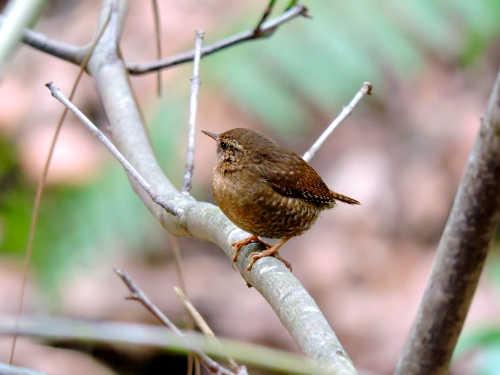
BOGGS MOUNTAIN, Calif. – The Friends of Boggs Mountain will be offering an intermediate-level bird hike on Saturday, April 12, at 8:30 a.m.
They will not only be looking for birds but will be listening for their songs as well.
There will be a good chance of hearing the bubbling spring song of the diminutive Pacific Wren and the raucous call of the forest’s pileated woodpeckers, as well as seeing many of the early spring migrants.
So, do come enjoy a hike, get some exercise and delight in the bird life of Boggs Mountain.
It will be a moderately-paced two-mile hike that should take approximately two hours led by Peg Landini and Darlene Hecomovich.
Wear sturdy shoes, dress appropriately for weather conditions, and bring your binoculars, water and enthusiasm.
Meet at the parking lot kiosk promptly at 8:30 a.m.
The forest entrance is located off Highway 175 just one and a half miles north of Cobb Village. Turn at the blue State Fire Station/Boggs Mountain Forest sign.
For further information phone Darlene at 707-928-5591 or email at