 How to resolve AdBlock issue?
Recreation
- Details
- Written by: Carrie Wilson
Can gifted fish get you a ticket?
Question: My husband and some friends and I were fishing in the Eastern Sierras the second day of the trout opener and we all caught some nice fish.
As we were leaving the lake to return to our car, one of our friends who had a long drive ahead didn’t want to keep his fish and offered them to us.
We already had our limits but he said, “You can have two limits in your possession so just say you caught mine yesterday.”
We took the fish but didn’t feel right about it. Was this actually OK? (Mark S., Torrance)
Answer: No, not the way you did it. While you both were allowed to catch a limit of trout on the opening day and another limit on the second day and then have two limits in possession, by accepting his fish like you did, you could have been cited. Here’s why …
Your friend was within his rights to gift you his fish, and you were within your rights to accept them. However, without proof that these fish were actually taken legally by another licensed angler, any wildlife officer you might meet in the parking lot or along the way that you showed your fish to would determine that you and your husband were in possession of an overlimit.
To avoid a misunderstanding like this, the best way to have handled it would have been to ask the angler giving you his additional fish to write you a note clearly stating this.
The note should contain the date, his name, address, telephone number and fishing license number so that the note and your story could be verified, if necessary.
Otherwise, you would likely be cited for being in possession of too many fish.
Fundraising dinners to the highest bidder?
Question: What is the regulation regarding charity fundraisers and abalone dinners?
We are being asked to offer an abalone dinner for six people at a fundraiser and the highest bidder wins.
Although different than actually charging a set price for an abalone dinner, is it illegal to accept a “donation” from the highest bidder? (Scott E., Walnut Creek)
Answer: You can sell a dinner to the highest bidder, but it can’t be sold as an abalone dinner. You cannot advertise or sell a dinner to someone or through an auction that gives the buyer or bidder an expectation they will receive abalone for the money they spend.
Even if the money is a donation to charity or to a nonprofit organization, promising abalone (in any form) for money is not legal. Sport-caught abalone (or other fish and game) cannot be bought, sold, traded or bartered.
You cannot commercialize sport-caught abalone in any way. If you were to buy abalone from a commercial abalone farm, then you could advertise and promote it as an “abalone dinner.”
The only way to legally do what you are proposing is to make the entire dinner “a donation.” As long as everyone going through the meal line is not “required to pay” there is no prohibition from calling it an abalone dinner.
Fishing licenses on mobile phones?
Question: I understand that some fishermen are taking pictures of their fishing licenses with their mobile phone.
If a person forgot to bring his or her license, would a picture be acceptable proof of a license? (Les E.)
Answer: No. California law does not recognize an electronic copy or a picture of a sport fishing license. You are required to have your actual sport fishing license in possession while fishing (California Code of Regulations Title 14, section 700 and Fish and Game Code, Sections 1054.2 and 7145(a)) and to present your actual license upon request to any wildlife officer who asks (FGC, section 2012).
Fishing and hunting licenses are printed on special waterproof paper to prevent fraudulent duplication. A scanned or digital version of your license on your phone could be easily altered from its original image.
While every angler must have a valid sport fishing license in possession while fishing in California, the law does allow a person diving from a boat to keep the license on the boat, and a person diving from shore may keep the license on shore within 500 yards.
Tree squirrel hunting rifle?
Question: I have question regarding the type of rifle that is allowed to hunt tree squirrels. Can a Benjamin Discovery PCP air rifle be used to hunt tree squirrels during the open season? (Anonymous)
Answer: Yes, any air rifles may be used for all species of resident small game in California (CCR Title 14, section 311(f).) The only restriction is for turkey where the rifle must be at least .177 caliber.
Carrie Wilson is a marine environmental scientist with the California Department of Fish and Wildlife. While she cannot personally answer everyone’s questions, she will select a few to answer each week in this column. Please contact her at
- Details
- Written by: Editor
NORTHERN CALIFORNIA – Recreational ocean salmon fishing in the Klamath Management Zone (KMZ), the area between the Oregon/California state line and Horse Mountain (40° 05’ 00” N. latitude), will open May 10 and continue through Sept. 7 with a 24-inch minimum size limit.
KMZ-area anglers should be conscious of closures at the mouths of the Klamath and Smith rivers throughout the season, as well as a closure at the mouth of the Eel River during August and September.
Fishery biologists predict moderately large numbers of Klamath and Sacramento River fall Chinook salmon along California’s coastal waters, providing substantial fishing opportunity.
In areas south of Horse Mountain, the recreational ocean salmon season opened on April 5 and continues through Nov. 9 in the Fort Bragg and San Francisco areas. In the Monterey-south area, the season ends Oct. 5.
“Along the Central Coast, ocean anglers have experienced some good fishing up until this point,” said Marci Yaremko, CDFW Environmental Program Manager with the Marine Region. “Many of the sport anglers that fished in Monterey Bay on opening weekend had their limits by 9 a.m.”
Statewide, the daily bag limit is two salmon of any species except coho. New this season, the salmon possession limit has been changed to two daily bag limits when on land; however when on a vessel in ocean waters, no person shall possess or bring ashore more than one daily bag limit.
Anglers should be aware that minimum size limits differ among management areas. In the Fort Bragg area, which extends from Horse Mountain to Point Arena (38° 57’ 30” N. latitude), there is a 20-inch minimum size limit.
In the San Francisco area, which extends from Point Arena to Pigeon Point (37° 11’ 00” N. latitude), there is a 24-inch minimum size limit through the end of June, and a 20-inch minimum size limit thereafter.
For areas south of Pigeon Point, including the Monterey Bay area, there is a 24-inch minimum size limit throughout the season.
North of Point Conception (34° 27’ 00” N. latitude), not more than two single-point, single-shank barbless hooks shall be used and no more than one rod per angler is allowed when fishing for salmon or fishing from a boat with salmon on board. When fishing with bait by any means other than trolling between Horse Mountain and Point Conception, barbless circle hooks are required.
These seasons and minimum size and bag limits were adopted by the California Fish and Game Commission and the Pacific Fishery Management Council during their public meetings held in April.
For complete ocean salmon regulations, please visit the ocean salmon Web page at www.dfg.ca.gov/marine/oceansalmon.asp or call the Ocean Salmon Regulations Hotline, 707-576-3429.
- Details
- Written by: Editor
NORTH COAST, Calif. – Similar to the “CSI” television series, California Department of Fish and Wildlife and university researchers have used a multidisciplinary approach they call “forensic genomics” to investigate a mysterious die-off of red abalone and other species along the Sonoma Coast in Northern California.
A paper describing this new approach was published in the April 16 issue of the scientific journal Nature Communications.
In 2011, large numbers of red abalone, sea stars, sea urchins and other marine invertebrates were found dead along 62 miles of Sonoma County coastline.
The die-off, which occurred in relatively shallow water, did not affect fish.
Like CSI detectives, environmental scientists Laura Rogers-Bennett of CDFW and Pierre De Wit of Stanford University collaborated with others to determine exactly what caused the die-off.
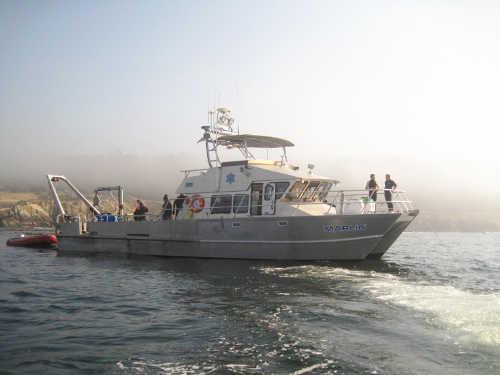
CDFW wildlife officers collected samples of the first dead abalone that washed ashore, and CDFW biologists, who had just completed abalone monitoring dives for the year, gathered forces to complete a new set of reconnaissance dives to assess the damage and collect water samples from the area.
CDFW Environmental Scientist Kristin Hubbard nets a plankton sample.
CDFW Senior Environmental Scientist Laura Rogers-Bennett prepares a plankton sample for testing.
An unprecedented red tide, or algae bloom, that coincided with the die-off was suspected of playing a role in the event.
At the time, Rogers-Bennett noted that, “If the cause of the die-off is linked to a harmful algae bloom, it would be the first scientifically confirmed report of such an occurrence off the Sonoma Coast.”
Samples from the dead abalone tested negative for the usual algae bloom-related suspects that occur along the California coast, including domoic acid and paralytic shellfish toxin.
Researchers did notice that Gonyaulax algae, which can sometimes produce toxins, was abundant in water samples.
However, the single time Gonyaulax toxin had been previously detected in California waters, it did not cause a die-off.
De Wit had joined Rogers-Bennett only a few months before the die-off to gather red abalone samples at Fort Ross.
The two planned to use the samples to sequence the red abalone’s whole transcriptome, genetic material that tells where genes are turned on or off at the time of sampling.
Neither researcher could have realized at the time that the transcriptome would play a key role in identifying the culprit behind the die-off.
Because scientists know which genes turn on or off when exposed to various natural toxins, they can identify the toxins that cause an animal’s illness or death through genetic examination.
After the die-off, the two researchers took samples from surviving abalone at Fort Ross, and De Wit compared the transcriptomes of abalone sampled before and after the event.
His genetic comparison showed that the surviving abalone had all been exposed to Gonyaulax toxin.
De Wit found that the genes known to be affected by the toxin were “turned on” in those abalone, said Rogers-Bennett. No other toxic fingerprints were found.
The new genetic testing provided a powerful method to finally establish the cause of the die-off, supported by other findings such as the traces of Gonyaulax toxin found in the gut tracts of dead abalone and the abundance of the algae in the water.
“Looking forward, the key to using forensic genomics successfully is to gather baseline genetic information from wildlife populations before the next mass mortality event,” said Rogers-Bennett.
Being able to identify the cause will help CDFW marine fishery managers respond to die-offs with the most appropriate regulatory adjustments.
Forensic genomics holds promise as a method for tracking not only other natural toxin events caused by algal blooms, but also tracking the effects of low-oxygen and acidification events and ocean warming.
- Details
- Written by: Editor
COBB, Calif. – The 2013 Dogs at Boggs was a bow-wowing, tail-wagging success, so Friends of Boggs Mountain is welcoming dog lovers and leashed, friendly dogs to the second annual Dogs at Boggs on Saturday, May 10, from 10 a.m. to 12:30 p.m.
A fun morning of hiking at Boggs Mountain Demonstration State Forest in beautiful Lake County will include 30 minutes of dog handling tips specifically for forest visitors.
Hiking guides will then lead an informative, leisurely 1.5-mile exploration of Boggs trails.
The theme for this year’s hike will be, “The Edible Forest.” No leaf will remain unsniffed.
Children are welcome at this free event. Canine participants will receive an “I’m a Boggs Dog” button and a bag of delicious additive-free treats provided by co-sponsor Evanger’s Dog and Cat Food Co. Inc. Refreshments will be provided for humans.
Dogless? If you would enjoy a slow dog-centered hike without bringing a dog, you are also welcome. RSVP is required. RSVP early, as space is limited, by calling Karen at 707-321-4964.
The forest is located about 1.5 miles north of Cobb off State Hwy 175. For a map and directions visit www.boggsmountain.org .
Also, the first edition Boggs Mountain Coloring Book will be offered for sale for the first time at Dogs at Boggs.
Designed and illustrated by Karen Rhoads and published by Friends of Boggs Mountain, the 7-inch by 8.5-inch booklet includes eight plant, bird, and butterfly species from Boggs Mountain Demonstration State Forest, identified by common and Latin names.
The coloring book is printed on acid-free art paper rather than commercial printing paper, and is suitable for crayons, colored pencil, light watercolor, pen and ink, and other media.