 How to resolve AdBlock issue?
Health
- Details
- Written by: Lake County News Reports
“Eating disorders are serious conditions that are potentially life-threatening and have a great impact on our physical and emotional health,” Sen. Dodd said. “We must improve the public’s understanding of the causes, encourage early intervention and lay to rest the stigma of this pervasive affliction. As someone who’s had a loved one suffer from an eating disorder, I know how difficult it can be, but with support recovery is possible.”
Sen. Dodd’s resolution raises awareness of a range of disorders affecting men and women across all backgrounds. Conditions include anorexia, bulimia and binge-eating disorders.
This year’s theme, “Come as You Are: Hindsight is 20/20,” will focus on alerting the public to environmental and biological causes as well as empowering people to reduce personal risk factors for developing eating disorders.
California Treasurer Fiona Ma is a co-sponsor. Supporters include the National Eating Disorders Association, American Nurses Association-California, Cielo House and the Eating Disorders Resource Center.
“For too long the media has focused on women being beautiful and thin, which can affect the eating habits of impressionable girls and young women,” said Treasurer Fiona Ma. “I developed eating disorders when I went off to college. Complications to my body forced me to look inward and correct unhealthy habits. We need to talk more openly about this illness and not let eating disorders define us.”
Sen. Bill Dodd represents the Third Senate District, which includes all or portions of Napa, Yolo, Sonoma, Solano, Sacramento and Contra Costa counties.
- Details
- Written by: Lake County News Reports
Many children and adolescents’ mental health needs could be effectively managed in a primary care setting, but their pediatric primary care providers currently lack the specialized training and resources they need.
This bill utilizes existing health technology and collaboration between providers to solve the problem.
“Too many of our children are in crisis, and the lack of trained mental health professionals is an enormous contributor,” said Aguiar-Curry. “We must continue efforts to recruit and train new specialty mental health professionals, but we must also act now to connect children’s primary care providers with mental health experts. By using telehealth and provider-to-provider consultation, we can make children’s mental health services accessible throughout California today.”
Specifically, AB 2464 creates a competitive grant program to identify ten children’s hospitals and community-based mental health providers to serve as telehealth “hubs” of expertise for their region.
These centers of expertise would leverage telehealth and tele-consult technology to connect primary care providers with pediatric mental health specialists to help them manage children’s mental health needs in a primary care setting when possible, and to provide direct services when a higher level of care is required but unavailable in the community.
The bill would prioritize working with community providers that predominantly serve low-income, rural, and underserved populations.
Once established, these regional hubs would be sustained by reimbursements from both public and commercial payers for telehealth consultations and clinical services.
This is possible because of the telehealth reimbursement law that Aguiar-Curry authored and the Governor signed last year in her bill, AB 744. These services may also be eligible for federal matching funds when provided to Medi-Cal beneficiaries.
Ann-Louise Kuhns, President and CEO of the California Children’s Hospital Association, added: “We thank Assemblymember Aguiar-Curry for bringing forward this common-sense solution that will increase access to mental health services for children throughout the state, and provide valuable resources and support to pediatricians and other primary care providers who are on the frontline of the state’s mental health crisis.”
Half of all lifetime cases of mental illness begin by age 14 and three-quarters begin by age 24. In fact, as many as 1.8 million California children may be living with a mental health diagnosis, and our current system for serving children struggling with depression, anxiety, and other mental health conditions is insufficient.
By strategically expanding the use of telemedicine and tele-consults, our state’s pediatricians and mental health experts can collaborate to deliver direct care to patients who currently lack access.
According to Aguiar-Curry, “We must admit and address our failure to step up and bring mental health resources to our children. Ignoring the critical situation will damn this generation of young people to mental health conditions that can lead to lifelong challenges, increased mortality, joblessness, homelessness, and enormous long-term state costs. If we act to create a statewide provider network today, we can bring the benefits of mental health care to children and their families. It is the right thing to do to make care accessible so every child can realize their potential, and furthermore, it’s also the responsible thing to do.”
AB 2464 brings together the existing health and technology resources in our state to make access to mental health care for children and adolescents a reality, regardless of where a child and their family lives.
Aguiar-Curry represents the 4th Assembly District, which includes all of Lake and Napa Counties, parts of Colusa, Solano and Sonoma counties, and all of Yolo County except West Sacramento.
- Details
- Written by: California Department of Public Health
Each local health jurisdiction awardee shall receive $750,000 in funding over three consecutive fiscal years from June 1, 2020, to June 30, 2022.
“California has more aging people than any other state in the nation, including more people living with Alzheimer’s, other age-related brain dementias, and the people who care for them,” said former first lady, Maria Shriver.
“The Healthy Brain Initiative will help reveal critical and factual insights on how communities throughout the state can prioritize brain health and caregiving. As the chair of Gov. Gavin Newsom’s Task Force on Alzheimer’s Prevention, Preparedness and a Path Forward, we are excited about this initiative and look forward to collaborating as we lead the way to become a cognitively healthy country at every stage of life,” Shriver said.
“There are about 670,000 people in California who are living with Alzheimer’s dementia, with very mild to advanced symptoms,” said Dr. Sonia Angell, California Department of Public Health director and state public health officer. “Their needs and those of the families and caregivers who help support them varies across a spectrum. The time is now to work with communities and partners to find durable solutions. These awards reflect an important investment towards that goal.”
The funding, made available through the California Healthy Brain Initiative State and Local Public Health Partnerships program, will support activities in these four categories:
– Monitoring data and evaluating programs to contribute to evidence-based practice.
– Education and empowerment of the public with regard to brain health and cognitive aging.
– Mobilizing public and private partnerships to engage local stakeholders in effective community-based interventions and best practices.
– Ensuring a competent workforce by strengthening the knowledge, skills, and abilities of health care professionals who deliver care and services to people with Alzheimer's disease and other dementias and their family caregivers.
The following local health jurisdictions were awarded grants:
– County of Los Angeles, Department of Public Health, Area: Urban and Coastal.
– County of Placer, Public Health Division, Area: Urban and Inland.
– County of Sacramento, Department of Health Service, Division of Public Health, Area: Urban and Inland.
– County of San Diego, Department of Health Service, Division of Public Health, Area: Urban and Coastal.
– County of Santa Clara Public Health Department, Area: Urban and Inland.
– Shasta County Health and Human Services Agency, Area: Urban and Inland
For more information visit www.cdph.ca.gov.
- Details
- Written by: Elizabeth Larson
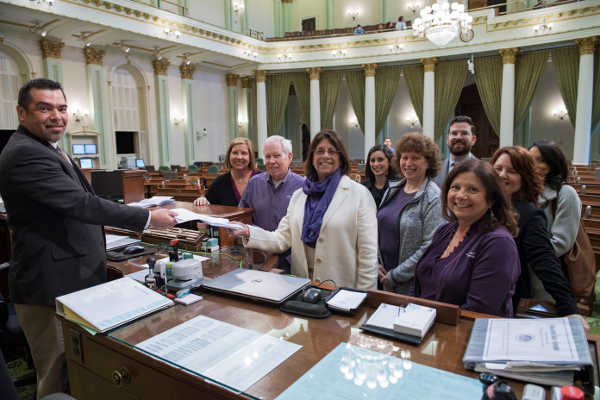
SACRAMENTO – On Monday, Assemblymembers Cecilia Aguiar-Curry (D-Winters) and Monique Limón (D-Santa Barbara) introduced Assembly Bill 2047 and Assembly Bill 2048, flanked on the floor of the State Assembly by advocates from the Alzheimer’s Association.
These two companion bills would promote greater awareness and earlier diagnosis of Alzheimer’s and dementia.
The bills provide seniors, providers, and caregivers with the tools they need to recognize and plan for an Alzheimer’s diagnosis, and lay the groundwork for treatment strategies later in the life of Alzheimer’s and dementia patients.
Alzheimer’s disease is a growing public health crisis. It is a progressive, neurodegenerative disease, which results in memory loss, impaired cognitive function, and ultimately death. The over-65 population in California is projected to grow to 8.6 million by 2030, and though Alzheimer’s is not a normal part of growing old, aging is the greatest known risk factor for developing the disease.
According to the California Department of Public Health, deaths in California due to Alzheimer’s disease increased 243% from 2000 to 2015, and in 2015 Alzheimer’s was the third leading cause of death.
AB 2047, authored by Assemblymember Aguiar-Curry, directs the Consortium of California Alzheimer's Disease Centers to widely disseminate and implement the “Assessment of Cognitive Complaints Toolkit” to healthcare providers.
The consortium has already completed the work to develop this provider toolkit, using state budget funding from 2016.
However, the toolkit resource has not been made widely available beyond the expert urban academic medical centers that collaborated to develop it.
“There is a critical need for increased and early diagnosis of Alzheimer’s and Dementia,” said Aguiar-Curry. “Receiving an Alzheimer’s diagnosis can be devastating, but now we have the tools to ensure that individuals and families receive timely and accurate information. If we fully deploy these tools, we can save families valuable time to find and access benefits and develop a plan for their loved ones’ care. For every moment saved through early diagnosis, we will extend quality of life and rescue moments for Alzheimer’s patients to meaningfully interact with friends and loved ones.”
AB 2048, authored by Assemblymember Monique Limón creates an informational tool to assist individuals who are experiencing cognitive impairment, and their caregivers, in communicating with health care providers before and after receiving a diagnosis of Alzheimer's disease.
“California has the largest number of people impacted by this disease. This tool would assist individuals and their caregivers navigate the oftentimes difficult conversations with their health care providers”, said Limón. “Understanding the diagnosis, treatment options, and the disease would provide individuals better assurance when making decisions or asking questions.”
"I knew something was wrong and almost everyone kept saying my symptoms were ‘normal.’ But Alzheimer's is not just a normal part of aging." said Pam Montana, member of Gov. Newsom's Alzheimer's Taskforce and former member of the National Alzheimer's Association Board of Directors. "Once I finally received a diagnosis, I started prioritizing things in my life that bring me happiness. We need to fight for everyone with any form of dementia to have that same opportunity."
The U.S. Census Bureau has estimated that approximately one in five Californians will be 65 or older by 2030. Together, AB 2047 and AB 2048 will increase Californians’ quality of life by making sure that seniors, healthcare providers, and caregivers have access to established Alzheimer’s information and tools to support their needs.
Aguiar-Curry represents the Fourth Assembly District, which includes all of Lake and Napa Counties, parts of Colusa, Solano and Sonoma Counties, and all of Yolo County except West Sacramento.
Monique Limón represents the 37th Assembly District, which includes Santa Barbara, Ventura, Goleta, Carpinteria, Ojai, Santa Paula, Fillmore, Buellton, Solvang, Summerland, Isla Vista, Montecito and parts of Oxnard.
- Healthy California for All Commission launches work toward unified financing system in California
- Covered California’s new enrollment surges past last year’s mark; deadline to enroll is Jan. 31
- Aguiar-Curry pushes bill to expand cancer prevention and add HPV treatment to state family planning program