 How to resolve AdBlock issue?
Education
- Details
- Written by: Lake County News Reports
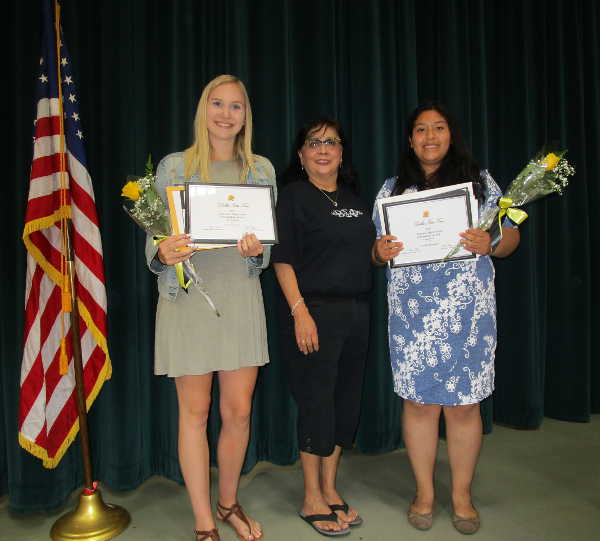
LAKE COUNTY, Calif. – On Wednesday, May 23, at the Clear Lake High Awards presentations, Rosa Bergeron, a member of the Delta Iota Tau Scholarship Committee, presented three $1,000 scholarships.
The scholarships were presented to Valerie Hutton and Jessica Romero. Taylor Buchholz, also a recipient, was not able to be present.
Delta Iota Tau is a Chapter of Beta Sigma Phi International, one of three chapters in Lake County.
Delta Iota Tau is committed to serving our communities through monetary donations to various deserving organizations and individuals.
The group raises funds all year through its See’s Candies sales at North Lake Medical Pharmacy in the Bruno’s Shopping Center, Lakeport.
This year the sorority will be planting gardens at the Lake County Fair and will support other organizations efforts such as the Westside Community Park in Lakeport.
Women who wish to serve their communities find Beta Sigma Phi an excellent resource.
For more information contact Shari James at 707-263-4228.
- Details
- Written by: Mendocino College
Each student correctly solved 28 of the 29 puzzles.
The first runner up was Ari Sunbeam, with 21 correct puzzles.
Mendocino College mathematics instructor Deborah White has been puzzling students with her contest for the past 10 years.
White posts a new puzzle each Monday throughout the school year at www.mendocino.edu/deborah-white and also leaves hard copies posted around the campus.
Powell is a native of Lake County and attended high school at the Rio Linda Adventist Academy in Healdsburg.
She has just finished Mendocino College’s math sequence and will transfer to Chico State in the fall, where she plans to study civil engineering with the goal of working for the international group Engineers Without Borders.
When asked about the contests, Powell said, “I really enjoyed them, particularly the fact that anyone could do them. It brought my friends together, because I shared the puzzles with them, and even people who felt they couldn’t do math got involved.”
Knudson has lived in Lakeport most of his life, attended Clear Lake High School, has just received an Associate of Science degree in mathematics from Mendocino College, and will attend UC Santa Cruz in the fall as a double major in mathematics and physics.
This summer Knudson is doing research at UC Santa Cruz under a National Science Foundation grant. According to Knudson, “The contests were a different kind of math than what we do in class, but I think that they’re really what math is about.”
One of this year’s puzzles reads: If it takes 1,140 digits to number the pages in a book which starts at page one, how many pages are there in the book? (Answer: 416).
- Details
- Written by: California Community Colleges
The launch is part of an ongoing statewide campaign to reach all of the state’s prospective students and their parents and raise awareness of the more than 200 Career Education training programs available to them.
It is estimated that by 2020, 65 percent of all jobs in the U.S. economy will require some form of training beyond high school. Career Education (at both the high school and college level), which includes hands-on training and apprenticeships, is critical to both America’s workers and U.S. economic competitiveness. and helping California maintain its position as the newly ranked fifth largest economy in the world.
Last year the California Community Colleges launched the statewide Career Education campaign to close the growing gap in the state’s skilled workforce.
The campaign communicates to prospective and re-entry students (including high school students and adults who want to gain new skills), parents, counselors, educators and employers the many career training programs available to them.
The statewide campaign includes outreach to California’s diverse populations. The new Spanish-language website will help raise awareness in the Latino community with 38 percent of Californian’s being Spanish-language speakers and 29 percent using Spanish as their primary language at home.
A Spanish-language Career Education online toolkit will also be released soon with marketing materials that can be used by all California community college campuses and their partners.
“The California Community Colleges is a system of access and inclusion,” said California Community Colleges Chancellor Eloy Ortiz Oakley, the first Latino chancellor of the largest higher education system in the nation. “We want all Californians to know that our Career Education programs are a smart, affordable way for Californians to acquire the hands-on, high-quality skills they need for good paying jobs. The Career Education website has plans to expand to other languages beyond English and Spanish to reflect California’s diverse student population.”
Serving 2.1 million students per year, California’s 114-campus community college system is the largest provider of workforce training in the nation.
Career Education programs are developed in partnership with local industries and taught by instructors with direct work experience.
The programs offer hands-on, real-world training in a wide range of career fields including advanced manufacturing, information and communication technologies/digital media, health, global trade and logistics, life sciences/biotech, agriculture, water/environment technologies and many more.
Many financial aid options exist for California community college students through the California Dream Act and other state and federal programs and are available year-round to cover the cost of fees, books, supplies and sometimes even help with the rent.
For more information about Career Education programs, visit the California Career Education English Web site or the California Career Education Spanish Web site.
For a comprehensive list of financial aid available to students applying for or enrolled in a California community college, visit the I Can Afford College English Web site or the I Can Afford College Spanish Web site.
The California Community Colleges, the largest provider of workforce training in the nation, offers Career Education programs at 114 community colleges across the state.
With more than 200 programs taught by instructors and professionals in their field of study, Career Education programs allow students to learn by exploring, collaborating and doing with hands-on training and skills for the jobs of today and the future.
To learn more, please visit www.CaliforniaCareerEducation.com. Visit www.doingwhamatters.cccco.edu or information on the system’s workforce initiative.
- Details
- Written by: Editor
The Teacher Education Assistance for College and Higher Education (TEACH) grant program is run by the U.S. Department of Education and provides up to $4,000 per year for students who intend to become teachers of a high-need field in a low-income area.
Grant recipients must agree to teach full-time for four years and submit documentation of their service to the U.S. Department of Education. Last year, 3,822 students in California received TEACH grants.
Many teachers have found that their TEACH grants have been converted to loans even though they have fulfilled the requirements of the grant program.
Small clerical mistakes, such as a missing signature or date, or a delay in processing paperwork by the servicer, have resulted in grants being converted to thousands of dollars of loans, which must be repaid with interest.
Teachers have reported difficulties in getting these mistakes corrected. After receiving complaints, the U.S. Department of Education announced last week that it is now reviewing the grant program.
“With the TEACH program, the U.S. Department of Education had one job: to provide grants to those who commit to public service by teaching in some of our most underserved communities. Sadly, Education Secretary Betsy DeVos has failed yet another test,” said Attorney General Becerra. “We can’t let Secretary DeVos’ failures discourage aspiring teachers from achieving their dream. The California Department of Justice urges all TEACH grant recipients who have been wronged to know your rights.”
If you believe that your TEACH grant has been incorrectly converted into a loan, you may take the following steps to appeal your case:
First, appeal through your student loan servicer (FedLoan Servicing) by calling 1-888-699-2908, or by sending a secure email through your online account at https://myfedloan.org . Keep notes about your conversation, including with whom you speak and the answers and instructions that you receive.
If FedLoan Servicing denies your appeal, call the Department of Education’s Student Aid Ombudsman at 1-877-557-2575, contact the Department of Education online at https://feedback.studentaid.ed.gov/, or write to U.S. Department of Education, FSA Ombudsman Group, P.O. Box 1843, Monticello, KY 42633.
You can also file a complaint with the Consumer Financial Protection Bureau at https://www.consumerfinance.gov/complaint.
Californians may also contact CA DOJ’s Public Inquiry Unit at 1-800-952-5225 for information on the actions they should take to correct the treatment of their grant.