 How to resolve AdBlock issue?
Education
- Details
- Written by: Editor
The new legislation will save colleges tens-of-thousands of dollars as more modern and efficient services are used, and students will benefit from a streamlined assessment system and will have the ability to request and view their transcripts online.
Chancellor Scott noted that dozens of different standardized assessment tests are currently being used throughout the California community college system to place students into courses.
Many campuses only recognize the test they use and require students who take placement exams at a different community college to be reassessed. This creates an additional hurdle for prospective students and results in costly and duplicative testing by campuses.
“These two pieces of legislation go a long way in saving colleges’ time and money and allowing us to efficiently and seamlessly serve our students,” Scott said. “The centralized assessment system and the new eTranscript infrastructure will help our 2.6 million students achieve their educational goals faster by eliminating redundant practices and using technology to allow our students to access their records online and to share the information quickly with other institutions.”
Signed on Oct. 8, Assembly Bill 743, authored by Marty Block (D-San Diego), requires the Chancellor’s Office to establish uniform assessment tests for English, math, and English as a second language (ESL).
The common assessment tools will be made available to all 112-campuses to use in determining whether individual students should enroll in college-level courses or if they should first take basic skills classes. The use of the common tests will allow students to take their results with them if they enroll at multiple campuses or want to transfer to a different community college.
Assessment is a critical tool for students, many of whom begin their community higher education underprepared for college-level work. Taking an assessment prior to placement in a course is a critical step towards increasing student success.
Colleges that use the new common assessment exams will realize a significant cost savings because the system will purchase the tests in volume and offer them to campuses at little or no cost. This will allow more students to be assessed while the colleges realize cost-savings that they can keep locally and reinvest in other priority programs.
Assembly Bill 743 also allows for the creation of an online pre-test application that students can use to prepare to take the assessments. This will help students to improve their placement scores by allowing them to brush-up on skills they may have forgotten and as a result, enroll in the appropriate classes – thus helping them to succeed faster in degree or certificate completion and/or in transferring to a four-year university.
The California Community Colleges Chancellor’s Office received a one-time allocation of $500,000 from the California Assembly for the common assessment project.
This funding, in addition to grant money from the Hewlett and Gates Foundations, will combine to provide $850,000 in necessary start-up costs for the system-wide initiative.
The bill was supported by multiple community college campuses and districts, the Community College League of California, and the Faculty Association of California Community Colleges. It will take effect in January 2012.
Assembly Bill 1056, authored by Paul Fong (D-Mountain View), requires community colleges to convert from a paper-based transcript process to an electronic system called eTranscripts that is highly efficient and student-friendly.
The conversion to an electronic system will save the colleges $4 to $10 per transcript through reduced paper consumption, fewer staff hours, and decreased postage costs. The simplified process will allow students to request, transmit, track, and download their transcripts and have continuous access. It will also shorten the transmittal time from approximately three weeks to 24-hours when transcripts need to be sent from one campus to another. Many community colleges are already using this system or an alternate e-transcript service. The newly signed legislation will make the practice universal.
The California Community Colleges Chancellor’s Office received a one-time allocation of $500,000 from the state Assembly to help fund the cost of converting from the paper to an electronic transcript system. This funding is estimated to cover the initial conversion costs as specified in the bill. Maintenance expenses will be addressed through savings generated by the use of a more efficient, electronic system.
Assembly Bill 1056 is an important first step for creating even greater efficiencies in the future, according to Scott's office. By investing in this statewide technology, California is building the crucial infrastructure to support future automated projects such as degree audits, around the clock counseling, and the ability to quickly send student transcripts to institutions out of the state.
- Details
- Written by: Editor
AB 131, authored by Assemblymember Gil Cedillo (D-Los Angeles) allows top students who are on the path to citizenship to apply for college financial aid.
“Going to college is a dream that promises intellectual excitement and creative thinking. The Dream Act benefits us all by giving top students a chance to improve their lives and the lives of all of us,” said Gov. Brown.
Under current law, undocumented students pay resident tuition rates if they have graduated from a California high school and affirmed that they are in the process of applying to legalize their immigration status.
Effective Jan. 1, 2013, AB 131 will make this limited pool of students eligible to apply for Cal Grants and other state aid.
The legislation builds on AB 130, also authored by Assemblymember Cedillo, signed into law by Gov. Brown on July 25, 2011.
AB 130 makes financial aid from private sources available to the same pool of students. The two laws are collectively known as the “California Dream Act.”
The California Department of Finance estimates that 2,500 students will qualify for Cal Grants as a result of AB 131, at a cost of $14.5 million.
The overall Cal Grant program is funded at $1.4 billion, meaning that 1 percent of all Cal Grant funds will be potentially impacted by AB 131 when the law goes into effect.
For full text of the bill, visit: http://leginfo.ca.gov/bilinfo.html.
- Details
- Written by: Chrissie Green and Jade Fox

On Sept. 29, Carlé had its back to school night. It started with a site council meeting where the parents, staff and students had a chance to motion and vote on expenditures for this year.
At the meeting principal Dennis To introduced the staff which consists of Barbara Dye, secretary; Pat Howell, tutor; Tom Schaerges, special education; Kim Van Horn, drug and alcohol counseling; Gary Oakes, custodian; Steve Hamann, math; Alan Siegel, civics; Angela Siegel, science; and Dan Maes, history.
The very special Verna Rogers, queen of Carlé and English teacher, wasn't there due to recent surgery. Carlé is happy to report that Verna has recovered and rejoined us this week at school.
Carlé also had some special guests come to the back to school night. The guests were Dr. Bill McDougall, Anita Gordon, Hank Montgomery and Mary Silva. Thanks to all that attended.
At the site council meeting staff, parents and students talked about goals for this year: maintaining and
improving technology and providing incentives and rewards for the students.
In the meeting everybody attending was presented a school wish list that included prices and the available budget. The wish list was comprised of many wonderful opportunities for student and staff alike.
Science teacher Angie Siegel requested DNA necklaces and funding for the Haz-Mat certification course that she teaches once a year.
Verna Rogers, the careers teacher, asked for funding for a field trip to Ashland Oregon for the Shakespeare festival. She also asked for some new computers for the career and English classes.
Funds were earmarked to go towards student incentives, such as gold level trips, attendance awards and CHILY (Carlé High is Liking You) awards.
Near the end of the meeting the students, staff and parents were given the right to vote on the budget. Student Jessica Johns was the first person in approval and it was soon seconded by student Darren Gasperoni, in the end it was a unanimous vote towards the budget.
After the meeting everybody went into the library/music room and enjoyed the wonderful potluck dinner.
Recently Carlé helped set up, serve and cleanup at a dinner at the senior center in the Clearlake Oaks. Many Carlé students came and helped out including Arwen King, Leticia Bowman, Bryan Olmeda, Brandon Wilson, Emily Thompson, Joey Griffin, Jesse Greene and Dennis Warner. Thanks go out for
their time and effort.
The end of the first grading period was Friday, Oct. 7. Super secretary Barbara Dye will crunch all the numbers and have a quick turnaround for report cards. Students will be given their report cards on
Tuesday, Oct. 11, and meet with their advisors to go over them.
Steve did fleet ball on Oct. 7. Definitely a fun game for all the players involved.
The ASVAB, or military aptitude test, will be administered beginning at 8:30 a.m. Wednesday, Oct. 12, at Carlé High School.
During the week of Oct. 7 there was both a gold level trip and a silver level movie for the students who earned their grades in the sixth grading period of the last school year. These two events will be more
extensively covered in next week's issue of the Carlé Chronicle.
Carlé would like to welcome another group of new students this week: Aimee Bradford, Stevie Fallin, Talmadge Jones and Tonya Smith.
Have a wonderful week!
Chrissie Green and Jade Fox are students at Carlé Continuation High School in Lower Lake, Calif.
- Details
- Written by: Editor
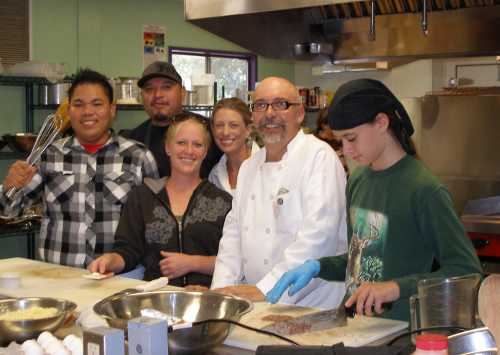
UKIAH, Calif. – The Culinary Arts Management program at Mendocino College, led by newly hired faculty member Nicholas Petti, recently received $500 from the Mendocino Winegrape and Wine Commission.
The program plans to use the funds to purchase equipment for the facility on the Ukiah campus which was built several years ago using a donation from Dennis and Madelyn Yeo and the Mendocino College Foundation.
“The grape growers are natural partners for our program,” said Petti, the college’s first full-time culinary arts instructor. “We’re thrilled that they donated part of the proceeds of their annual wine competition to us.” The other half of the proceeds went to scholarship funds for farmworker families.
According to Petti, “The funds will help the culinary arts program graduate students who will be valuable to area employers. Although some students are enrolled in culinary classes as electives for transfer, the majority of them are working toward their culinary arts certificate.”
Students electing to complete the certificate will possess the skills necessary to succeed in jobs in the foodservice industry.
The two-semester program covers everything from local foods to advanced pastry making.
For more information about the program, visit the Mendocino College Web site, or call Nicholas Petti at 707-467-1052.