 How to resolve AdBlock issue?
Education
- Details
- Written by: Editor
“Our goal for the new year and every year is to make education accessible and effective for all children,” said Torlakson. “These new laws will help ensure children are safer, enter kindergarten at the appropriate age, learn what they need to know to succeed in life and careers, and fulfill the dream of a college education.”
Assembly Bill AB 130 (Cedillo) is the California Dream Act of 2011. This measure exempts California nonresidents who qualify for the AB 540 (Firebaugh, 2001) tuition waiver from paying nonresidential tuition at the University of California, California State University, and California Community College institutions of higher education.
AB 131 (Cedillo) expands the state-administered student financial aid that is available for AB 540 waiver eligible students. For AB 540 waiver students, acquiring federally issued financial aid is prohibited, and opportunities for state-issued financial aid are limited.
“Traditionally, nonresidents who qualify for AB 540 waivers are persons without lawful immigration status or U.S. citizenship, or are permanent residents of another state,” said Torlakson. “However, these persons also have demonstrated a strong commitment to and investment in California personally, economically, and intellectually. Because these students will undoubtedly reinvest their education into California, it is important that our institutions of higher education support their endeavors.”
As part of Torlakson’s Blueprint for Great Schools Initiative to better prepare young students for kindergarten and beyond, he supported Senate Bill SB 1381 (Simitian, 2010), also known as the Kindergarten Readiness Act of 2010, which begins in the 2012-13 school year. This measure changes the required birthday for admission to kindergarten and first grade and establishes a transitional kindergarten program.
Torlakson sponsored the following three measures to help implement the Common Core State Standards (CCSS).
CCSS is a voluntary, state-led effort to develop a national set of standards for mathematics, English-language arts, and literacy in various content areas for students in kindergarten through grade 12.
The effort started in 2009 and is being coordinated by the Council of Chief State School Officers and the National Governors Association Center for Best Practices.
Participants include 45 states, two territories and the District of Columbia.
AB 124 (Fuentes) establishes a process to update, revise, and align the English-Language Development Standards to the CCSS in English-language arts, and would require the State Superintendent and the State Board of Education to present lawmakers with a schedule and implementation plan for integrating the revised English-Language Development Standards into the education system.
AB 250 (Brownley) establishes a structure for the implementation of the CCSS by developing and adopting curriculum frameworks and professional development opportunities that are aligned to the CCSS and are appropriate for all pupils. The bill also requires the State Superintendent, the State Board of Education, and others to develop criteria to guide the development of model professional development programs for teachers and administrators that deepen their understanding of the CCSS.
SB 140 (Lowenthal) requires the California Department of Education to develop a list of supplemental instructional materials for use in kindergarten through seventh grade that are aligned with the CCSS in mathematics, and language arts for kindergarten through eighth grade. This bill also allows governing boards of school districts to approve supplemental instructional materials, other than those approved by the State Board of Education, if the materials are aligned with the CCSS.
Under SB 929 (Evans) children under the age of eight must be properly buckled into a car seat or booster seat in the back seat. In addition, children aged eight or older who are not tall enough for the seat belt to fit properly must ride in a booster or car seat.
The previous law required that children remain in a booster seat until the age of six or until they weighed 60 pounds. The fine for violating this law is significant. For each child under the age of 16 who is not properly secured, parents (if in the car) or the driver can be fined a minimum of $475 and get a point on their driving record.
For more information about car seats, the new law, or help in determining if your child still needs a booster seat, call your local health department or go to the California Department of Public Health’s Web site, www.cdph.ca.gov/programs/Pages/CPSinCalifornia-VOSP.aspx.
- Details
- Written by: Editor
The meeting is scheduled for 3:30 p.m. on Thursday, Jan. 12, 2012, at the district office, 2508 Howard Ave.
The gathering is not a governing board meeting.
Parents, staff and community members are welcome; however, anyone interested in attending is asked to call Janine at 707-262-3000 prior to the meeting date.
- Details
- Written by: Editor
The new hard-copy publication, “A Look at Kindergarten Through Grade Six in California Public Schools: Transitioning to the Common Core State Standards in English Language Arts and Mathematics,” provides information for educators on curriculum planning and professional development in the new standards, which were formally adopted last year.
"The new Common Core standards will truly move what California students learn into the 21st century, with an emphasis on critical thinking and problem-solving," Torlakson said. "That makes it an exciting time in education, but a challenging time as well. We've created this book – and its online counterpart – to give teachers a helping hand."
The new publication includes chapters by grade level. There is an overview of each study area, a summary of what proficient students learned in the previous grade, descriptions about the content area, and the standards.
The document also includes a "Support for English Learners" section in both mathematics and English-language arts that identifies a few of the difficulties English learners may face and some recommendations to help them gain access to the curriculum.
The publication is a valuable tool until new CCSS frameworks and instructional materials are developed.
Fostering 21st century learning in California's schools is a key goal of Torlakson's, which was outlined in the report by his Transition Advisory Team earlier this year, A Blueprint for Great Schools.
The release of the new publication comes as Torlakson works to ease the transition to the new standards on other fronts as well, including three key pieces of legislation signed into law earlier this year.
Assembly Bill 124 requires the Superintendent of Public Instruction, in consultation with the California State Board of Education, to update, revise, and align the English-language development (ELD) standards.
In addition, Assembly Bill 250 reinstates the process for the development of curriculum frameworks aligned to the CCSS in English-language arts and mathematics and mandates the inclusion of the new ELD standards in the next English-Language Arts Curriculum Framework.
Senate Bill 140 requires the state to develop a list of supplemental instructional materials aligned to the CCSS to bridge the gap between existing state-adopted materials and the CCSS.
CCSS is a voluntary state-led effort to develop a national set of standards for mathematics, English-language arts, and literacy in various content areas for students in kindergarten through grade 12.
The effort started in 2009 and is being coordinated by the Council of Chief State School Officers and the National Governors Association Center for Best Practices. Participants include 45 states, two territories, and the District of Columbia.
The goal is to prepare all students with a uniform set of knowledge and skills around the nation that they need to succeed in education and careers after high school. The CCSS was adopted by the California State Board of Education on August 2, 2010. However, it will take several years to implement curriculum, instructional materials, and assessments based on the new standards.
The online publication, from which the new hard-copy publication is excerpted, is entitled, “A Look at Kindergarten Through Grade Six in California Public Schools.” The online resource provides information regarding all areas of study including history–social science, science, physical education, health, visual and performing arts, world languages, school library, as well as English-language arts and mathematics.
The online publication is available through the California Department of Education Web site at http://www.cde.ca.gov/ci/cr/cf/grlevelcurriculum.asp. The online publication is also included as a CD-ROM with the new hard-copy publication.
To order the hard-copy publication of “A Look at Kindergarten through Grade Six in California Public Schools: Transitioning to the Common Core State Standards in English Language Arts and Mathematics,” contact the California Department of Education Press Sales Office at 1-800-995-4099 or by e-mail at
- Details
- Written by: Tammy Serpa
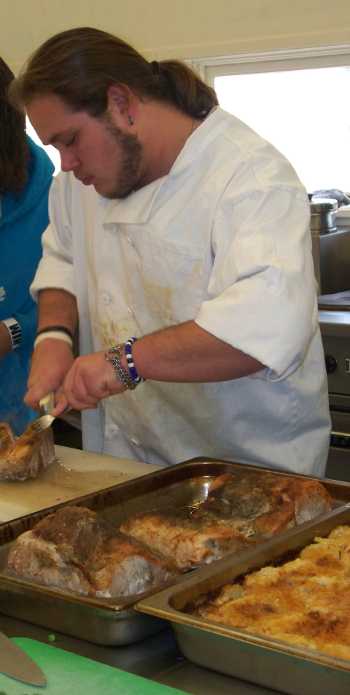
LOWER LAKE, Calif. – Joe Parker has certainly made his mark on the culinary program at Lower Lake High.
What for many years was operated as a mom and pop-style kitchen under Hazel Wohle has had a makeover to a more commercial style kitchen environment.
Parker has transformed not only the looks of the classroom, but with it is transforming the program to make the students employable in the food service industry.
Parker credited Wohle for the development of a quality program and is thankful that she left him well educated advanced students with which he could work.
The culinary arts have always been a passion of Parker’s. He’s taught for 14 years, including six years in Anaheim where he taught home economics/culinary arts to football players.
At Lower Lake, he’s making plans to articulate with the culinary programs at community and junior colleges, including Yuba College of Clearlake.
He’s also encouraging students to participate in community activities, such as the “Iron Chef” event at Steele Winery, which has led students to internships at places like Chic le Chef.
A goal of Parker’s is to incorporate local vendors and supplies into the program to teach students sustainability in the food industry.
Future desires at Lower Lake include the development of a school garden so students can cook with fresh seasonal ingredients, a lunch service restaurant open to the public and the expansion of the program to include a pastry class.
Parker teaches both Beginning Culinary and ROP Advanced Culinary. In the beginning classes, students learn the basics of cooking, tool/equipment identification, safety, food sanitation and menu planning.
The advanced classes work to provide quality meals that are prepared three days a week for sale to employees at the high school, elementary school and Konocti District Office.
Tuesday through Thursday students prepare anywhere from 40 to 70 meals, plus additional for meals for the culinary students to consume as educational enrichment and quality control.
Students in the advanced classes are involved in all aspects of the mini business including menu planning, recipe design, serving, deliveries and, of course, clean up and dishes.
According to senior student Destiny Purdum, Parker allows the students to create the menu on their own with little interference other than staying within the budget.
Students are not only creating marvelous meals such as savory pork roast with steamed vegetables and scalloped potatoes; some are taking their skills to competition.
Last year Jayme Weiper took fourth place in the state Skills USA culinary competition in San Diego. This year, five students in the ROP Culinary classes will be raising funds to attend the regional competition in the spring.
A large majority of the students in the ROP Culinary class plan to continue in the Hospitality and Tourism Pathway upon graduation.
It is hoped that the program at Lower Lake High will lay a strong foundation for them to be both successful and employable in their future endeavors.
If you would like more information on the Hospitality and Tourism Pathway at Lower Lake High, please contact Joe Parker at 707-994-6471 or