 How to resolve AdBlock issue?
Community
- Details
- Written by: Lake County News Reports
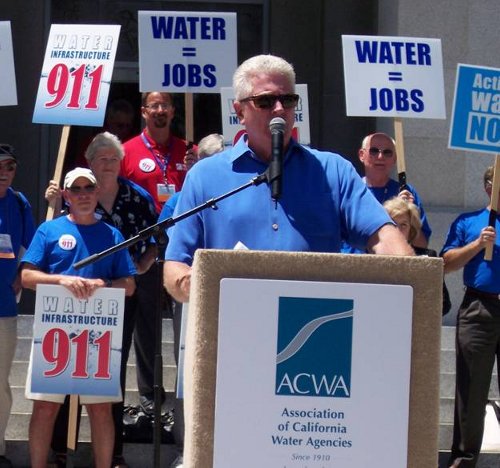
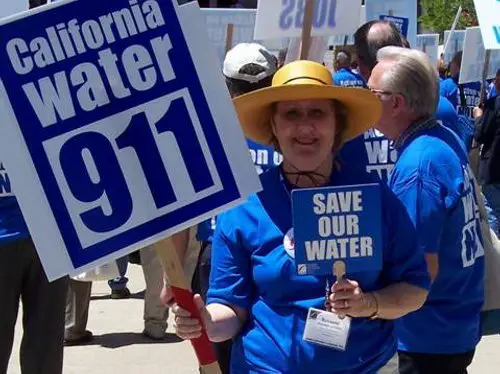
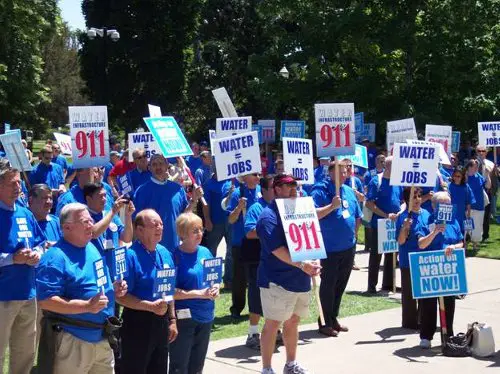
SACRAMENTO – “Action now on water” was the message to legislators late last month when more than 1,600 members of the Association of California Water Agencies (AWCA) rallied under a blistering sun on Sacramento’s capitol steps.
Renowned television host Huell Howser led the rally, attended also by children of farm workers in the Central Valley community of Mendota where unemployment is 40 percent.
“Every economic sector is impacted by the lack of water supply reliability,” said Timothy Quinn, ACWA executive director. “Whether it's farmers forced to abandon fields, agricultural workers losing their jobs, causing economic upheaval for rural communities, or businesses and development threatened by the inability to assure reliable water supplies. We need action now on water.”
The rally coincided with ACWA’s 2009 spring conference in Sacramento where a statewide issue forum discussed the impact of California’s water crisis on the state’s economy. Panelists spoke of the need for a comprehensive, long-term statewide water strategy and immediate action by the legislature and governor.
California Building Industry Association President and CEO Robert Rivinius said the lack of water infrastructure and available water impacts new housing.
“Construction is down 80 percent from 2005, with housing at 44,000 units, the lowest since WW II. Building trades unemployment is down 70 to 80 percent,” he said. “We support an $11 billion water bond to come to grips with California’s water needs.”
According to California Chamber of Commerce President and CEO Allan Zaremberg, the Peripheral Canal must be built. The canal would divert water from the Sacramento River to Central and Southern California.
California voters defeated a ballot initiative to build the Canal in 1982, but the idea of a Peripheral Canal has had a revival.
Water is currently pulled through the San Joaquin-Sacramento River Delta, turning the Delta, originally a fluctuating-salinity estuary, into a freshwater basin. It has also created unnatural north to south flows in the Delta, confusing native species such as the Delta Smelt and disturbing the ecosystem.
“We need safe drinking water. The solution is a bond that provides mitigation funding and public benefit,” said Zaremberg. “But, public distrust for state legislators is so high; I’m concerned a bond wouldn’t pass.”
California farmers were represented by panelist Dave Puglia, senior vice president, governmental affairs and communications, Western Growers Association.
“Farmers are at the front-end of this water crisis with $350 million lost this year. One-hundred-thousand acres went fallow because of a lack of water in 2008, next year it will be worse,” said Puglia. “The west aside of Fresno, Kings and San Joaquin counties is essentially a desert due to the erosion of top soil. It’s becoming another dust bowl.”
He added, “Growers anticipated shortened water deliveries and maximized water efficiencies. They’re resilient and take a lot before walking away from their businesses. It becomes impossible when they no longer can service debt on the water infrastructure they purchased.”
Puglia said agriculture provides fresh food and jobs. “Consumers increasingly get their produce from Mexico as California farmers move operations south.
“Without water, California looses out on local food and economic benefits provided by farmers,” he said.
For more information about AWCA or its 2009 spring conference, see www.acwa.com .
- Details
- Written by: Editor
The Emergency Economic Stabilization Act of 2008 (EESA) and the American Recovery and Reinvestment Act of 2009 (ARRA) created two new tax credits for various types of electric vehicles, which may include what are commonly referred to as neighborhood electric vehicles.
ARRA creates a tax credit for low-speed or two- or three-wheel electric vehicles, such as motor scooters, purchased after Feb. 17, 2009, and before Jan. 1, 2012. The amount of the credit is 10 percent of the cost of the vehicle, up to a maximum credit of $2,500.
To qualify, a vehicle must be either a low-speed vehicle that is propelled to a significant extent by a rechargeable battery with a capacity of at least 4 kilowatt hours or be a two- or three-wheeled vehicle that is propelled to a significant extent by a rechargeable battery with a capacity of at least 2.5 kilowatt hours.
EESA created a tax credit for vehicles that have at least four wheels and draw propulsion using a rechargeable traction battery with at least four kilowatt hours of capacity. For 2009, the minimum credit is $2,500 and the credit tops out at $7,500 to $15,000, depending on the weight of the vehicle and the capacity of the battery.
During 2009, low-speed, four-wheeled vehicles manufactured primarily for use on public streets, roads and highways (neighborhood electric vehicles) may qualify both for the EESA credit and, if purchased after February 17, 2009, for the ARRA credit for low-speed electric vehicles.
A taxpayer may not claim both credits for the same vehicle. Vehicles manufactured primarily for off-road use, such as for use on a golf course, do not qualify for either credit.
The Internal Revenue Service is working on guidance regarding certification procedures for both of these credits.
- Details
- Written by: Editor
The Upper Lake Fire Auxiliary will start the day off right with a pancake breakfast from 7 a.m. to 10 a.m. The street fair vendors will be set up by 9 a.m. and will be there all day for your shopping pleasure. The parade takes off at 10:30 a.m.
There will be costume and bonnet contests with prizes for young and old alike, and all you mountain men gather round to see who has the finest beard.
For those folk who do not get gussied-up, western photo boards will be available for you picture taking pleasure.
At high noon, The Blue Canyon Gang will perform a western skit and throughout the afternoon following the noon skit, the town's barbecue art will be auctioned off with the proceeds going to the Upper Lake High School Stadium Light Project.
The Clearlake Clickers will perform on Main Street in front of the bank for your entertainment. You can kick up your heels to the country music of Lou Derr and Bootleg from 1 p.m. to 4 p.m.
If all this fun gets you hankering for something to eat mosey on over to the tri-tip barbecue sponsored by the Upper Lake Community Council and staffed by the Diamond Shade Ranch from 11 a.m. to 4 p.m.
Join the stampede to Upper Lake on June 6 and start your summer off with a bang at Wild West Day.
- Details
- Written by: Editor
The group will meet at 7 p.m. Friday, June 12, at Station 90, 9420 Main St. in Upper Lake.
Training will follow the meeting.
The meeting time and date was changed due to graduations.
For more information contact team leader Capt John Rodriguez at 707-275-2446.