 How to resolve AdBlock issue?
Opinion
- Details
- Written by: Becky Curry
Residents, especially in Big Sur, have noticed just how few firefighters there seem to be for this blaze, as compared to previous fires in the area. As conservative demands for low taxes and budget cuts have helped slash available fire protection, residents in Big Sur increasingly feel they are on their own, though they appreciate the fire protection they have received.
The legacy of Hurricane Katrina – when nobody came to help New Orleans – has led some residents to refuse to evacuate out of a belief, evidenced by the facts on the ground, that if they don't protect their homes, nobody will.
This frustrating and chaotic situation is the direct product of conservative attacks on basic government services – they want people to fend for themselves.
One of the most high profile Big Sur residents who has stayed behind to protect his property is Kirk Gafill, whose family opened the famous Nepenthe restaurant in 1949.
As he and his employees stayed behind to put out burning embers themselves, he explained to a reporter why he stayed (from an AP report dated July 4): "We know fire officials don't have the manpower to secure our properties," Gafill said. "There are a lot of people in this community not following evacuation orders. Based on what we saw during Katrina and other disasters, we know we can only rely on ourselves and our neighbors."
Such do-it-yourself firefighting led one Big Sur resident to be arrested for setting his own backfires.
Another resident defended that person's actions on the Ventana Wilderness Society's forums, one of the main sources of community information on the fire: ''We have been working on defending Apple Pie from this fire day and night since it started. We watched it grow over the coast ridge, down to the Big Sur River and up over Post Summit. The gov was not going to help defend the ranch even when our homes were about to burn. We didn't think they would either. But they didn't have any problem sending someone to arrest us. Our community just can't accept actions like this. If we didn't do what we did the ranch would be nothing but ashes. I say thank you to everyone who helped us and a thank you for all the firefighters, and pilots who TRIED to stop it from crossing the firebreaks to our homes."
Setting one's own backfires is a desperate and even reckless act – but those who do not believe their government will or wants to help them are likely to resort to desperate measures.
Meanwhile California does not have enough money saved for firefighting efforts. During the last decade, in every year but one, California has had to dip into reserves to pay for firefighting, but this year the SF Chronicle reports the gap is much wider.
"But in the just-completed fiscal year, there was a big gap between the actual cost of firefighting and the budgeted amount. The state had set aside just $82 million for such emergencies, forcing it to spend more than $310 million from the state's general fund cash reserves of $858 million. California will have to continue dipping into its reserves until the Legislature and the governor approve a new budget for the fiscal year that began Tuesday ..."
California has come full circle. Hurricane Katrina became such a human catastrophe because conservative budget and spending cuts left New Orleans residents without adequate protection and aid. Californians in places like Big Sur, mindful of that experience and aware that firefighting is currently understaffed, are making increasingly risky efforts to try and protect themselves. Efforts to provide funding for adequate fire protection are opposed by conservatives who prioritize tax cuts over fire protection and who think schools and hospitals should be closed instead to pay for it.
California firefighting has already been badly neglected by decades of conservatism. It's time we rebuilt our public services so that individuals do not feel the need to risk their lives to defend their property.
Or this is our future as Californians?
The cult-like behavior of the tax-cutting members of the yacht-owning Republican Party and their holy relic of "I've got mine" Reaganism, an unreformed and badly outdated Proposition 13, are holding Californians hostage.
How much longer will Californians allow these radical conservatives to assault our public services and dismantle social protection from risk?
How much longer will we give the No. 1 job of government – protecting the people – to those who don't even believe in government?
I am sick of those who enable these selfish zealots as our state burns.
Becky Curry lives in Kelseyville.
{mos_sb_discuss:4}
- Details
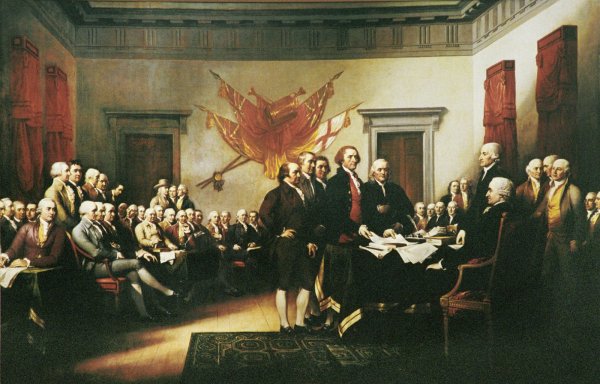
- Written by: The Founding Fathers
- Details
- Written by: Congressman Mike Thompson
We need two solutions and we need them fast: a short-term solution that lowers the price of oil and a long-term solution that reduces our dependence on oil. However, we must be very wary of solutions that are nothing more than choreographed political stunts designed to win elections rather than bring Americans relief. If we’re not careful, we’ll end up with more of the same – no energy policy.
Also, we need to beware of quick-fix proposals being sold by some people who think all we need to do is drill. If drilling operations were expanded into new areas such as the Arctic National Wildlife Refuge in Alaska or off our California coast, any oil found would not reach consumers for eight to ten years. And according to the statistical agency of the U.S. Department of Energy, the impact on gas prices would be negligible, less than a nickel a gallon. Moreover, given the thirst of new oil consumers in China and India, there’s no guarantee Americans would see the additional oil.
Right now, oil companies aren’t utilizing the vast majority of the nearly 90 million acres of federal land they’ve already leased. Nearly 70 million acres have not been touched, despite estimates that they contain 80 percent of oil and gas reserves on federal lands. As energy prices continue to climb, these companies are leaving recoverable oil and gas in the ground so they will appreciate in value.
Oil companies are also not making enough of an investment to build the infrastructure needed to increase the domestic oil supply. Last year, the five largest integrated oil companies used their record-breaking profits to buy back $50 billion in stock rather than investing in infrastructure improvements that would reduce supply disruptions that cause prices to rise.
We also have to deal with oil speculation, which experts estimate is inflating prices by anywhere from $20 to $60 per barrel of oil.
We need both long and short-term energy plans that will put downward pressure on gas prices, start us on a course toward clean renewable energy and sever the strangle-hold that foreign oil-producing countries have on us.
We need to turn down the volume of rhetoric and roll up our sleeves to address this problem. In the short run, we need to:
– Release oil from the Strategic Petroleum Reserve (SPR) into the market. Currently, the SPR is at 97-percent capacity. Drawing down the reserve to 90-percent of capacity would add 50 million barrels of oil to the market and would send a strong message to speculators. This would undoubtedly help ease the significant premium that speculation has added to the price of fuel.
– Crack down on unregulated oil speculation. We need to increase regulation over speculators to prevent market manipulation and ensure no one speculator is allowed to hold enough futures contracts to be able to manipulate prices. We can also increase the amount of money speculators are required to put down on futures and only allow speculators who can actually take delivery of the product in which they are investing. (When companies such as Morgan Stanley own huge quantities of oil, you know there’s trouble.)
– Tell oil companies, “use it or lose it.” Oil companies need to use or lose the land they have already leased for drilling.
And to ensure a sensible energy policy for the future, we should:
– Extend tax incentives for renewable energy technology, such as solar, wind, biomass and cellulosic biofuels;
– Put the development of other energy technologies on the table;
– Encourage the development of more fuel efficient cars and continuing tax credits for individuals who purchase hybrid cars;
– Incentivize the development of filling station infrastructure to support hydrogen fueled vehicles;
– Increase our investments in public transportation to allow for further conservation of fuel; and
– Invest in expanding current refining capacity and requiring diligent development of existing leases that have already been permitted by the federal government for oil drilling.
We have the ingenuity and resourcefulness to achieve these goals. The solutions we reach must be based on what’s best for the next generation, not the next election.
The people of our great country need reasonably-priced energy to grow our food, drive to work, heat and cool our homes and live a productive life. But we must also remember the importance of a healthy environment, particularly in an area like ours that relies on tourism, agriculture, coastal resources and the fishing industry.
Congressman Mike Thompson (D-St. Helena) represents Lake County in the House of Representatives.
{mos_sb_discuss:4}
- Details
- Written by: Sen. Patricia Wiggins
These programs are referred to as the California High-Cost A-Fund and the California High-Cost B-Fund. Their existence helps compel the PUC to meet its stated goal of universal telephone service to all Californians, along with competition in the residential telephone service arena.
The A-Fund provides a source of supplemental revenues to 17 small, rural local telephone companies. Up until 2007, the A-Fund provided them with approximately $37 million in annual subsidies through a 0.21 percent surcharge on telephone bills; that surcharge was reduced to 0.13 percent on Jan. 1. In any case, the subsidy is used to cap residential telephone rates for these companies at not more than 150 percent of the rate charged to residential customers in urban areas.
The B-Fund provides subsidies to telephone carriers of last resort for providing basic local service to residential customers in high-cost areas that are currently served by larger companies (Pacific Bell, Verizon California Inc., Citizens Telecommunications of California and Surewest).
A “carrier of last resort” is obligated to serve customers within its service area – even those in very high-cost areas. The purpose of the subsidies, among other reasons, is to keep basic telephone service affordable in rural and high cost areas and to encourage competition. In 2007, this subsidy provided these companies with approximately $434 million funded by a 2.7 percent surcharge on telephone bills (this surcharge was also reduced, to 0.25 percent, effective Jan. 1 of this year).
The whole of Humboldt, Lake and Mendocino Counties are considered B-Fund areas, as are parts of Napa, Solano and Sonoma counties.
The problem is that both of the high-cost funds are set to expire on January 1, 2009. If they do, many Californians are likely to experience extreme increases in their residential telephone rates.
In fact, people across the North Coast shouldn’t be surprised if their bill for basic phone service doubles or triples after Jan. 1, 2009, when the telecommunications industry is deregulated. For example, according to the PUC, a resident of Humboldt County’s basic phone service costs $68.64 per month, but the customer only pays a rate of $11 a month. The B-Fund pays the rest of the cost of service.
Without an extension of the B-Fund, customers can expect to pay the entire $68.64 on their own. The amount could be higher, depending how much AT&T or Verizon choose to charge for basic phone service next January. And services that customers used to receive for free, such as free incoming calls, free calls to 800 numbers and free access to call 911, could all become things that they are charged for – at a cost that is unregulated.
That’s because in August 2006, the PUC decided that there should be no regulation of rates for telephone services, no examination of costs of service, and no profit regulation on previously-regulated phone companies. In essence, the commission deregulated all telephone rates, allowing rural prices to change independently of urban rates. However, the deregulation of basic service was delayed until 2009, pending an examination (by the PUC) of the high cost fund programs. All other services were deregulated in 2007. If the excessive increases in these services are any indication of what’s to come, folks in rural areas where there is no competition for basic services should be prepared for the worst.
Since 2007, caller ID rates have increased 62 percent, call waiting rates have increased 86 percent, unlisted numbers rates have increased 346 percent, and directory assistance has increased 226 percent.
I introduced Senate Bill 780 to ensure that rural/high cost residents in my Senate district would not be subjected to exorbitant residential telephone rates. SB 780 will extend the A & B funds, and will require the PUC to conduct an affordability study of basic phone rates and factors affecting affordability.
The PUC continues to report statistics about subscribership and universal service, but has not undertaken any analysis, since 2004, of the factors which cause service to become unaffordable for customers. My bill requires the PUC to report the findings of its affordability study to the Legislature by July 1, 2010. And it will enable the Legislature to examine the cost/rates of basic phone service and determine if the rates are affordable or excessive and take the appropriate action.
SB 780 expresses my desire that the high-cost programs be extended, and that they address the continued need for affordable basic telephone service in rural and high-cost areas of the state, particularly where telecommunications competition is limited, and without diminishing the key components of what customers expect as ‘basic telephone service.’
Patricia Wiggins represents California’s 2nd Senate District, made up of portions or all of Humboldt, Lake, Mendocino, Napa, Solano and Sonoma counties.
{mos_sb_discuss:4}
Subcategories