 How to resolve AdBlock issue?
Opinion
- Details
- Written by: Dr. Nicki Thomas
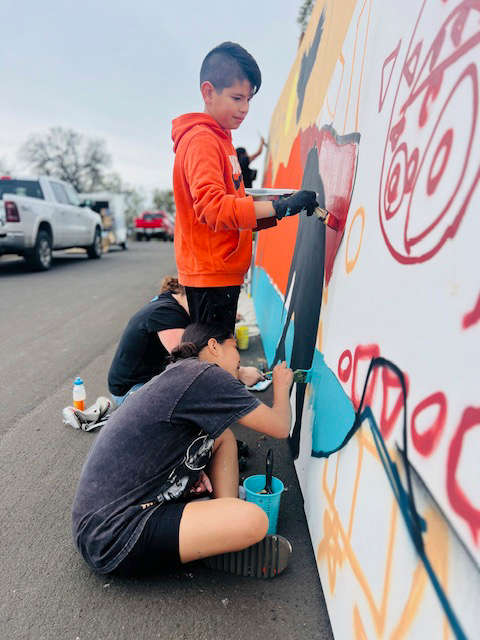
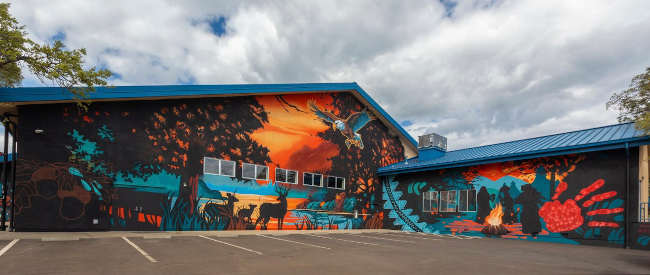
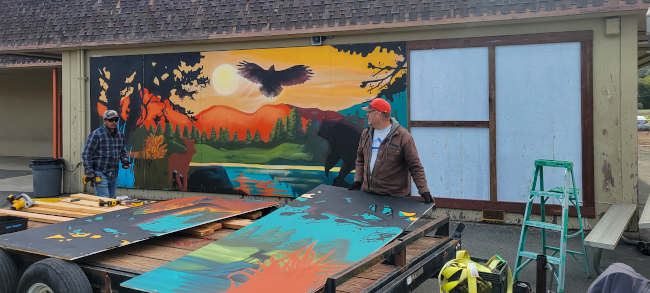
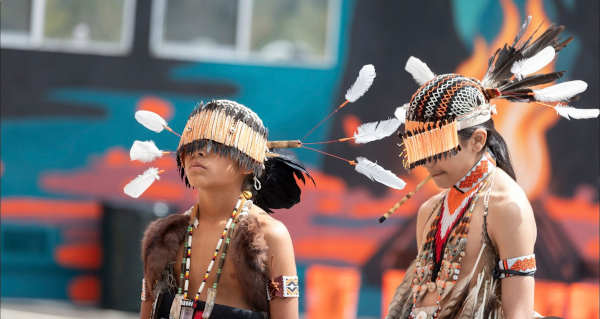
KELSEYVILLE, Calif. — Last month, we unveiled beautiful new murals on the campuses of Kelseyville High School and Kelseyville Elementary School, designed and painted by members of the KHS Native American Club in collaboration with local students and community partners. It was an amazing feat of engineering (these murals are massive), creativity and cooperation.
Artist Shane Grammer, founder of the Hope Through Art Foundation, not only worked with students to help them bring their artistic ideas to life, he also taught them the technical side of things, demonstrating how to safely use the tools and equipment required for such a big project.
Shane works as a fabricator and artist, doing work for places like Disneyland, so he knows what he’s doing.
Shane believes the transformative power of art can serve as a beacon of inspiration and healing for communities grappling with adversity. His foundation not only nurtures the creative talents within these communities, but also fosters a sense of belonging and resilience.
Between Shane and our Native American Club advisor, Katie Ray, students got a master class in how to come together for a purpose bigger than themselves.
If you don’t know Katie, you’re missing out. She is a ball of energy, determination, love and generosity. She leads by example and inspires students to go outside their comfort zone, to try new things, and to make the world a better place — starting with their own community.
Katie began working with Kelseyville Unified School District several years ago when our superintendent at the time, Dave McQueen, told all the principals we needed to listen to her and support her ideas because her goals were so aligned with ours.
Katie not only supports the Native American Club at Kelseyville High School, she also supports similar clubs at Clear Lake High and Upper Lake High, where she and several other advisors help raise funds to give students opportunities they wouldn’t have otherwise.
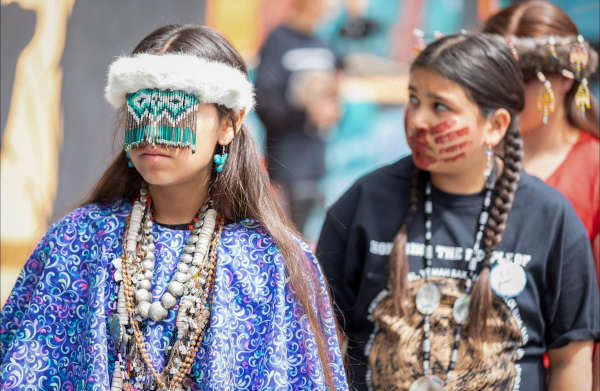
They take students on college tours, collaborate with local tribes to create youth events, do community service, and week after week, they create a space on campus where students can explore their social, emotional, and cultural needs.
She said, “To start our club meetings, we circle up and talk about how students are doing — mentally, emotionally, spiritually and physically. When we first started at Kelseyville, right after COVID, kids came in all covered up with hoodies and masks. They didn’t talk much. We’d ask, ‘How are you doing?’ and they’d say, ‘OK.’ Now we get in-depth answers. We can tell when there’s a lot going on, and we can help them.”
Professionally, Katie works as a victim services program manager, and she says the time she spends with students keeps her grounded.
She loves it when students bring ideas to her, so when they brought up the idea of a mural, she was all in. The project took a lot of planning and the process was really interesting.
With Shane’s guidance, students discussed and then drew their ideas. Keep in mind, these students are not artists. They drew stick figures and rough sketches. Then they planned each wall, or panel.
After that, they created a doodle wall, where they basically got to put up graffiti all over the wall. (A community member saw this and, understandably, was a little alarmed but it was all part of the process.)
The graffiti became the landmarks used to create the mural images. The students took pictures of the doodle wall and overlaid the digital images to figure out where the final art would go. If you’ve ever done art based on a grid, it’s a similar idea.
During spring break, students, their siblings, community members, and even two of our board members, Mary Beth Mosko and Casey Carlson, were out there working and painting.
Shane and another professional artist, Mammoth, did some of the detailed work in the hardest-to-reach places. Mammoth was up on two-story scaffolding, while others were on ladders, and still others were sitting or standing underneath.
Our maintenance team was on campus doing other work, and helped out, too. The whole thing was incredible. Student athletes came before their games, left to go compete, and returned afterwards to keep working on the murals. Younger siblings cleaned brushes and rollers so older students could keep painting. People worked from dawn to dusk. Supporters brought pizza and everything just kept going.
When we unveiled the mural to the community and to the students, it was wonderful to hear all the comments. It was obvious to everyone how much thought and care went into this.
Sometimes, when things feel so adversarial in the world, it’s even more important to have a project that brings people together. It’s amazing what we can accomplish when we are united in a common purpose.
Dr. Nicki Thomas is superintendent of the Kelseyville Unified School District.
- Details
- Written by: Dr. Nicki Thomas
It’s time for parents of 4- and 5-year-olds to enroll their children in either transitional kindergarten, or TK, or kindergarten for the 2024-25 school year.
Students must turn 5 years old by Sept. 1 to enroll in kindergarten and must turn 5 between Sept. 2 and June 2 to enroll in transitional kindergarten.
To support local families with young children, many school districts host annual kindergarten registration events, where parents can come in person to complete registration forms and make sure their child has the required health vaccinations.
Kelseyville Unified School District’s TK/Kindergarten Enrollment Fair is on May 30 from 3 to 6 p.m. in the Kelseyville MUR Building located on the Kelseyville Elementary School campus.
Those who would like their child to receive vaccinations from the Lake County Public Health Department must pre-register for the event by April 26 at https://kvusd.org/district/portal/registration.
TK and kindergartners (and all students new to the district) must present the following documents to enroll: birth certificate, proof of up-to-date immunizations (visit http://shotsforschool.org/ for details), proof of address, a school entry physical examination by a licensed medical provider and an oral health exam by a licensed dental provider.
It’s a good idea to make the medical and dental appointments as early as possible, because everyone is scrambling to get them the week before school starts.
Now is also the time when families with children who want to attend a school that isn’t in their home district must request interdistrict transfers.
Unfortunately, we may not be able to accommodate all requests, especially for those from out of the district who want to attend one of our elementary schools.
Riviera Elementary currently has 300 enrolled students and Kelseyville Elementary has about 600, putting us at or over capacity. Interdistrict transfer requests are due by July 31, 2024.
I am happy to report that we have enough space for all students who live within our district boundaries, but given the addition of a new apartment complex and the number of families moving into town, our schools are filling up fast.
This means that even if a Kelseyville student has been attending an out-of-neighborhood school, there’s no guarantee their intradistrict transfer will be approved again this year. Students must request an intradistrict transfer every year before school starts. (Transfer requests are due May 31, 2024. Forms are available at kvusd.org/portal/registration.)
All transfers are approved or denied based on California Education Code and the criteria outlined in our school board policy.
Once we are sure we have enough room for all the neighborhood students who belong in a school, we look at class sizes.
If we have extra space, we evaluate applications by considering factors like whether a student is experiencing special circumstances that might be harmful or dangerous to them, as well as whether a student has a sibling or parent who works at the school they want to transfer to.
We are thrilled that so many people want their children to attend Kelseyville schools, and we don’t like turning anyone away, but we must follow the laws that govern California public schools and our own board policies.
For additional information about school enrollment at Kelseyville Unified, visit https://kvusd.org/district/portal/registration or email us at
Dr. Nicki Thomas is superintendent of the Kelseyville Unified School District.
- Details
- Written by: Dr. Archana Dubey
April is recognized by the U.S. Department of Health and Human Services as Minority Health Month, an observance that brings awareness to health disparities and encourages action through education, early detection, and disease control.
Part of this work includes raising awareness about the disproportionate health outcomes among people who belong to racial or ethnic minority groups.
The conditions in which we are born, live, learn, work, play, and worship and our age — known as social determinants of health, or SDOH — have important impacts on health.
Differences in SDOH contribute to the stark and persistent chronic disease disparities in the U.S. among racial, ethnic, and socioeconomic groups, systematically limiting opportunities for members of some groups to be healthy.
Cancer
Black/African Americans have the highest mortality rate of any racial or ethnic group for all cancers combined and for most major cancers.
From 2015-2019, African American men were 1.2 times and 1.7 times more likely to be diagnosed with new cases of colon and prostate cancer than non-Hispanic white men.
Although Hispanic men and women generally have lower cancer rates than the non-Hispanic white population, disparities do exist in certain types of cancer. Both Hispanic men and women are almost twice as likely to have and die from liver cancer than non-Hispanic Whites.
Hispanic women are 40% more likely to be diagnosed with cervical cancer, and 30 percent more likely to die from cervical cancer, as compared to non-Hispanic white women.
Mental health
Black females, grades 9-12, were 60% more likely to attempt suicide in 2019, as compared to non-Hispanic white females of the same age.
Suicide attempts for Hispanic girls, grades 9-12, were 30% higher than for non-Hispanic white girls in the same age group, in 2019.
In 2018, Hispanics were 50% less likely to have received mental health treatment as compared to non-Hispanic whites.
Prenatal care
Although overall infant mortality rates have fallen over time, the 2018 infant mortality rate for infants of non-Hispanic Black women was more than twice as high as that for infants of non-Hispanic white and non-Hispanic Asian and Hispanic women.
In 2019, Hispanic mothers were 80% more likely to receive late or no prenatal care as compared to non-Hispanic white mothers.
This awareness month brings light to differences in the health outcomes of various racial and ethnic minority groups.
This awareness can also inform individuals about how groups who have poor social determinants of health and lack of access to high-quality medical care are more likely to be diagnosed with and die from diseases.
Dr. Archana Dubey is chief medical officer for UnitedHealthcare of California.
- Details
- Written by: Shouan Pan
As I write this article in late March 2024, I am completing nine months of serving as Chancellor of Yuba Community College District, or YCCD.
While settling into my new role and becoming acquainted with the community, I have had the opportunity to meet many individuals — nurses, dental hygienists, police officers, as well as elected city and county leaders — who either have personal ties to one of YCCD's two colleges or have relatives who have studied or worked at one.
Each person has a different story, but I hear a consistent theme: Yuba College (YC) or Woodland Community College (WCC) played a vital role in getting them where they are today. I feel honored to be a part of a community college system that is so deeply integrated into our
communities, serving them in countless impactful ways both now and in the future.
I have come to understand that YCCD's strong connections with the diverse communities it serves establish YC and WCC as anchor institutions for the eight counties spanning across rural, north-central California. Like other rural community colleges in California, YCCD’s institutions have their own set of challenges, but they also draw benefits from their strengths.
Unlike their urban counterparts, rural community colleges serve large geographic areas that have low population density, which often means smaller enrollment and budgets.
Additionally, staff take on multiple roles and responsibilities beyond their official titles, and administrators manage branch campuses situated miles apart. That has been the reality for YC and WCC, and the COVID-19 global pandemic exacerbated these challenges. I am relieved and inspired to see that they have not allowed these obstacles to weaken their commitment to serving students and the communities.
YC and WCC continue to embrace new and innovative initiatives. Both are federally designated Hispanic Serving Institutions, reflecting YCCD’s commitment to strive for equitable student success. Both colleges have significantly expanded dual enrollment and currently serve over 3,500 dual-enrolled students. A significant percentage of these students are the first in their families to take college-level courses and come from populations that have been historically underserved.
Building business partnerships is a priority for YC and WCC to fully serve their mission. Last fall, YC collaborated with the Yuba Water Agency to offer a highly sought-after Watershed Management program, resulting in an enrollment of more than sixty students. Upon graduating from the program, they will have the opportunity to work in an exceptional, high-paying career field.
The financial backing provided by the Yuba Water Agency has been instrumental in making this program feasible, with YC taking proactive steps to address a vital need for workforce development within the region.
Similarly, WCC offers the Environmental Technology Program with a specialization in Drinking Water and Wastewater Technology at its Lake County Campus. The program has proven to be a resounding success, providing many post-traditional students with a solid foundation, industry recognition, and the practical skills needed to excel in the dynamic field of environmental technology.
Like sister colleges across the state, YCCD has always prioritized student success. Our faculty, staff, administrators and the governing board focus heavily on raising degree and certificate completion and graduation for all students.
The work we are doing to enhance student support services, streamline processes, improve academic support, and respond to students’ basic needs is paying off. Our completion, transfer, and living wage outcomes significantly exceed state averages.
In a recent study session of the district board of trustees, college and district staff reported that student completion of associate degrees for the district increased by 24%, from 851 degree completers in 2017 to 1,601 degree completers in 2021. For YC, the increase is 16% for the same period, from 624 to 721; for WCC, the increase is 48%, from 229 to 340. This significant boost in student degree completion across YCCD’s two colleges has only been possible due to the faculty and staff’s commitment to equitable student success.
As we recognize Community College Month this April, it is befitting for us to take a moment to celebrate YCCD and the other 114 community colleges across the state and honor our students, faculty, staff, trustees, and supporters.
Each of these institutions has, in its own way, played a vital role in improving California’s educational and economic health and development, one student, one community at a time.
Dr. Shouan Pan is chancellor of the Yuba Community College District.