LAKE COUNTY, Calif. – Lake County Animal Care and Control’s lineup of adoptable dogs has several new members this week.
Dogs available for adoption this week include mixes of bluetick coonhound, Doberman Pinscher, pit bull, Rhodesian Ridgeback, shepherd, Siberian Huskey, terrier and treeing walker coonhound.
Dogs that are adopted from Lake County Animal Care and Control are either neutered or spayed, microchipped and, if old enough, given a rabies shot and county license before being released to their new owner. License fees do not apply to residents of the cities of Lakeport or Clearlake.
If you're looking for a new companion, visit the shelter. There are many great pets hoping you'll choose them.
The following dogs at the Lake County Animal Care and Control shelter have been cleared for adoption (additional dogs on the animal control Web site not listed are still “on hold”).
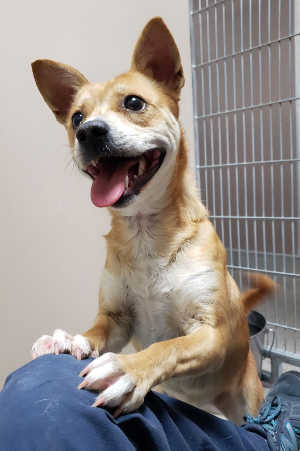
This female terrier is in kennel No. 4, ID No. 13456. Photo courtesy of Lake County Animal Care and Control. Female terrier
This female terrier has a short brown and white coat.
She is in kennel No. 4, ID No. 13456.
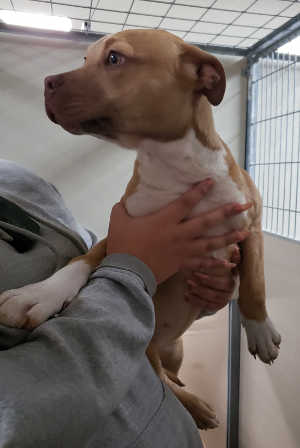
This young female pit bull terrier is in kennel No. 6, ID No. 13464. Photo courtesy of Lake County Animal Care and Control. Female pit bull terrier
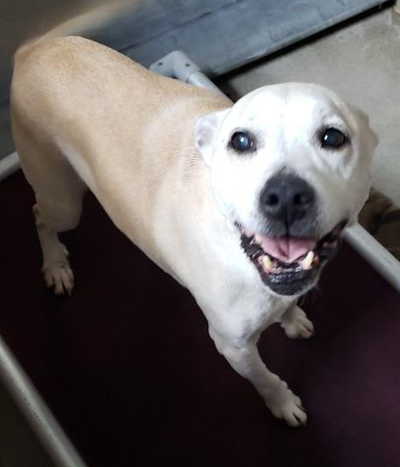
This young female pit bull terrier has a short tan coat.
She is in kennel No. 6, ID No. 13464.
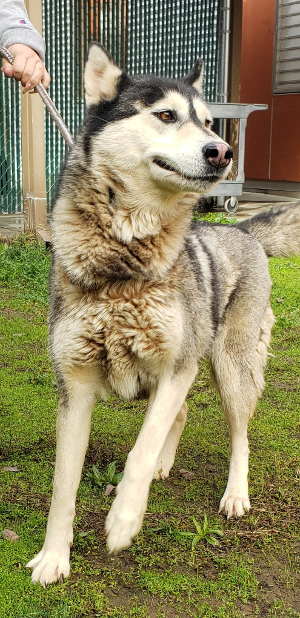
This female Siberian Husky is in kennel No. 8, ID No. 13453. Photo courtesy of Lake County Animal Care and Control. Female Siberian Husky
This female Siberian Husky has a medium-length gray and cream coat.
She is in kennel No. 8, ID No. 13453.
“Bruno” is a male shepherd mix in kennel No. 18, ID No. 13432. Photo courtesy of Lake County Animal Care and Control. ‘Bruno’
“Bruno” is a male shepherd mix with a medium-length tricolor coat.
He is in kennel No. 18, ID No. 13432.
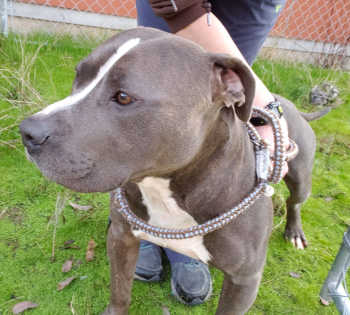
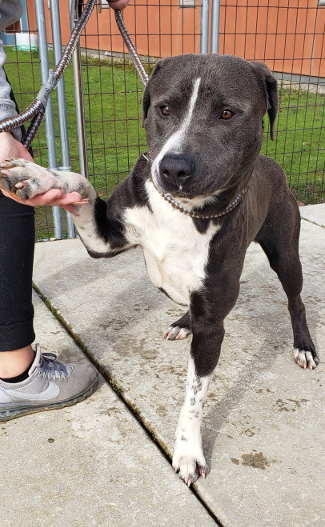
“BamBam” is a young male pit bull terrier mix in kennel No. 20, ID No. 13467. Photo courtesy of Lake County Animal Care and Control. ‘BamBam’
“BamBam” is a young male pit bull terrier mix with a short gray and white coat.
He is in kennel No. 20, ID No. 13467.
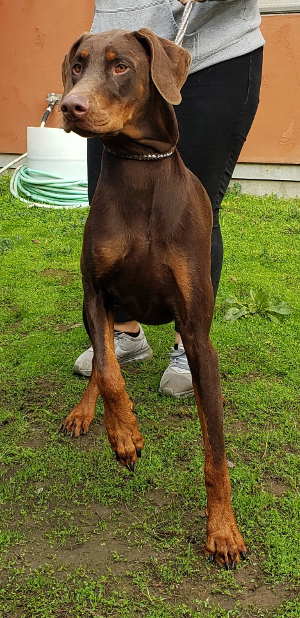
This male Doberman Pinscher is in kennel No. 22, ID No. 13459. Photo courtesy of Lake County Animal Care and Control. Male Doberman Pinscher
This male Doberman Pinscher has a short red and brown coat.
He is in kennel No. 22, ID No. 13459.
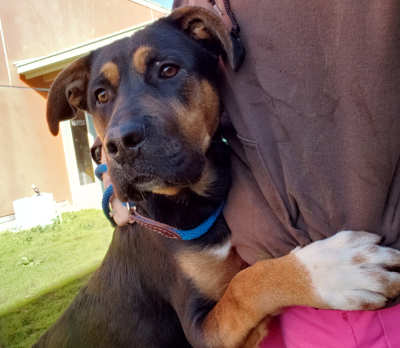
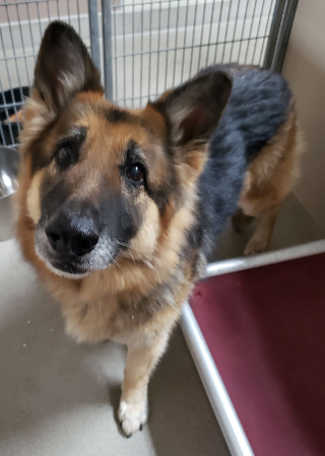
“Oso” is a male shepherd mix in kennel No. 27, ID No. 3173. Photo courtesy of Lake County Animal Care and Control. ‘Oso’
“Oso” is a male shepherd mix with a long black and tan coat.
He has been neutered.
He’s in kennel No. 27, ID No. 3173.
This male Labrador Retriever is in kennel No. 28, ID No. 13408. Photo courtesy of Lake County Animal Care and Control. Male Labrador Retriever
This male Labrador Retriever has a tan coat.
He has been neutered.
He is in kennel No. 28, ID No. 13408.
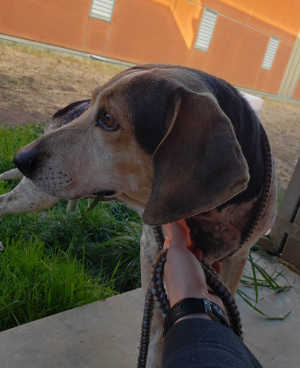
“Daisey” is a female treeing walker coonhound/bluetick coonhound mix in kennel No. 29, ID No. 13291. Photo courtesy of Lake County Animal Care and Control. ‘Daisey’
“Daisey” is a female treeing walker coonhound/bluetick coonhound mix with a short tricolor coat.
She is in kennel No. 29, ID No. 13291.
This male pit bull terrier is in kennel No. 30, ID No. 13448. Photo courtesy of Lake County Animal Care and Control. Male pit bull terrier
This male pit bull terrier has a short blue and white coat.
He is in kennel No. 30, ID No. 13448.
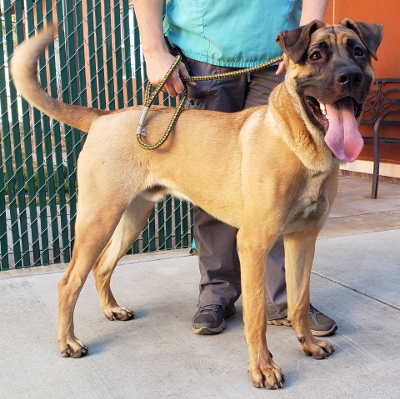
“Goofy” is a male Rhodesian Ridgeback in kennel No. 33, ID No. 13210. Photo courtesy of Lake County Animal Care and Control. ‘Goofy’
“Goofy” is a young male Rhodesian Ridgeback with a short tan and black coat.
Shelter staff said this boy is great with other dogs, although he is high energy and would benefit from obedience training. He would love to go jogging every day, he is very food motivated and willing to learn new things.
Goofy has been at the shelter since Nov. 5. He was originally taken from someone in Upper Lake and found on the highway in Clearlake. If anyone has any information on his owner please contact the shelter.
He’s in kennel No. 33, ID No. 13210.
Lake County Animal Care and Control is located at 4949 Helbush in Lakeport, next to the Hill Road Correctional Facility.
Office hours are Monday through Friday, 11 a.m. to 5 p.m., and 11 a.m. to 3 p.m., Saturday. The shelter is open from 11 a.m. to 4 p.m., Monday through Friday and on Saturday from 11 a.m. to 3 p.m.
For more information call Lake County Animal Care and Control at 707-263-0278.
Email Elizabeth Larson at This email address is being protected from spambots. You need JavaScript enabled to view it.. Follow her on Twitter, @ERLarson, or Lake County News, @LakeCoNews.
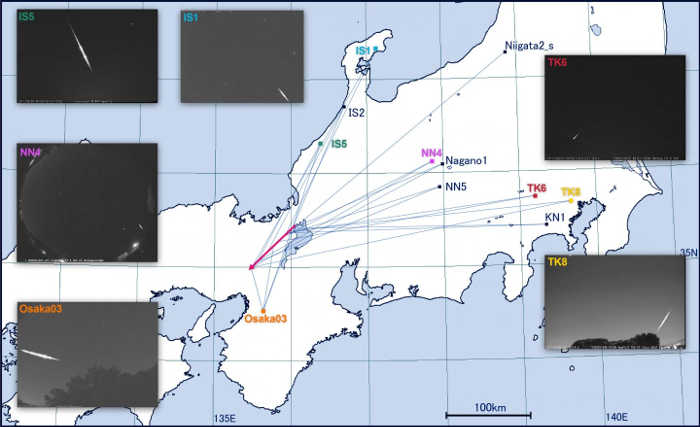
These are images capturing the 2017 fireball from different angles and a map showing where the cameras were located. Credit: Naoj/Kasuga et al. At around 1 a.m. local standard time on April 29, 2017, a fireball flew over Kyoto, Japan.
Compared to other fireballs spotted from Earth, it was relatively bright and slow. Now, scientists have determined not only what the fireball was, but also where it came from.
"We uncovered the fireball's true identity," said Toshihiro Kasuga, paper author and visiting scientist at the National Astronomical Observatory of Japan and Kyoto Sangyo University. "It has a similar orbit to that of the near-Earth asteroid 2003 YT1, which is likely its parent body."
2003 YT1, a binary asteroid first detected in 2003, appears to have been active in the past, meaning it fissured and released dust particles, such as the one responsible for the 2017 fireball. It does not currently show any activity, though, according to Kasuga.
However, the researchers found that the orbit, estimated radiant point, velocity and appearance date of the 2017 fireball are all consistent with dust particles that originated from 2003 YT1.
"The potential break-up of the rock could be dangerous to life on Earth," Kasuga said. "The parent body 2003 YT1 could break up, and those resulting asteroids could hit the Earth in the next 10 million years or so, especially because 2003 YT1 has a dust production mechanism."
The researchers found that this dust production mechanism, or the asteroid's likelihood of releasing dust and rock particles, stems from its rotational instability in a process called the YORP effect.
When the asteroid is warmed by the Sun, the energy results in a small thrust, which can produce a corresponding recoil, depending on the gravitational pull and other physical variables. The recoil can twist the asteroid, introducing a rotational change.
The change can be at physical odds with the gravity and/or other forces, and force the asteroid to physically break – even just a little, a process which produces dust.
"The released particles can enter Earth's atmosphere and appear as fireballs, which is exactly what happened in 2017," said Kasuga.
According to Kasuga, that particular fireball was not a threat to Earth, as it was estimated to only be a few centimeters in size. Something so small would burn up before it reached the surface.
"The 2017 fireball and its parent asteroid gave us a behind-the-scenes look at meteors," said Kasuga. "Next, we plan to further research predictions for potentially hazardous objects approaching the Earth. Meteor science can be a powerful asset for taking advanced steps towards planetary defense."
Other contributors include Mikiya Sato, Masayoshi Ueda, and Yasunori Fujiwara, all of the Nippon Meteor Society. Chie Tsuchiya and Jun-Ichi Watanabe, both of the National Astronomical Observatory of Japan, also co-authored the paper.
CLEARLAKE OAKS, Calif. – On Feb. 1, entries for the 37th annual Catfish Derby will begin to be accepted.
That’s one of the messages derby volunteers will be broadcasting at the International Sportsmen's Expo in Sacramento.
California’s largest outdoor exposition hosts more than 600 exhibitors drawing outdoor sports enthusiasts from throughout the country and beyond.
The expo runs from Jan. 16 to 19.
As in years past, derby volunteers will be traveling to Sacramento to represent the derby and Lake County in general at the Lake County Chamber of Commerce booth.
“The Catfish Derby is the largest of its kind west of the Mississippi, a feature we highlight with the folks that visit our booth,” said Jim Jonas, one of the derby volunteers who represented Lake County at the chamber booth last year.
“We get to talk with lots of anglers. Some, like the returning bass and catfish anglers, know Clear Lake well, he said, and many drop in when they see our sign to reminisce about visits they remember from their youth. But the best part is the excitement that builds when we encounter folks who have yet to experience the bounty of our lake. We talk it up and watch the interest build,” Jonas said.
In addition to Jonas, other derby volunteers will be on hand to promote Lake County, distribute the information rich Lake County Destinations Magazine and hand out sign up information for the derby.
Clearlake Oaks resident Dennis Locke, who is again leading the derby effort, said he expects in the neighborhood of 900 to 1,000 catfishing devotees this year.
“Last year the rain kept some people home, but interestingly enough it was our local numbers that were down, not the out-of-towners,” Locke said.
People like last year’s first-place winner, Ricardo Palayo, who took home $4,000 in prize money for his 27.29-pound catch, said he would definitely be back – rain or shine.
Others, regulars from places as far away as Hood River, Oregon, have attended the derby for many years.
Last year “Team Hood Cats,” a three-generation group, won the Spirit of Lake County award, proclaiming they would return, this time with four generations of catfishing enthusiasts.
Locke said we look forward to seeing them and others, like the Ocheltree family and their friends. “Scarlett, one of the Ocheltree children, landed the largest fish in the 2018 Catfish Derby. They come back year after year,” Locke said.
About 35 percent of the participants are locals. “Of course we love the ongoing participation from our locals. Last year, in the 10 years and under kids division, 7-year-old Blake Re of Nice won $100 for his 22.82-pound catfish. Other locals have made the derby a family tradition, like Mike and Barbara Higman whose family has been fishing in the derby for years,” Locke said.
The Clearlake Oaks-Glenhaven Business Association sponsors the derby.
“It’s our signature fundraiser,” said Camille Gouldberg, president of the association. “Last year we donated $30,000 back to our community; this year’s derby will assure that we can continue to support our schools and sports teams and the many local programs that help our communities thrive.”
“While the majority of our volunteers come from the Oaks and nearby Glenhaven and Clearlake, we have volunteers that live all around the lake that come to help out and enjoy the festivities,” said Locke.
This year, the derby will begin on Friday, May 15, and conclude on Sunday, May 17, with an awards ceremony and barbecue. The Clearlake Oaks Fire Station will again serve as derby headquarters.
Entries will be accepted by mail or in person at Limit Out Bait and Tackle, Clearlake Oaks or Lakeport Bait and Tackle, Lakeport. Entries will also be accepted in person at Derby headquarters beginning at noon on Thursday, May 14.
Locke noted that the entry fees are increasing this year to help offset increasing costs associated with the derby.
“We haven’t increased derby fees in 15 years. This year we felt it was necessary in order to continue a quality event,” he said.
Adult entries are $50, up $10 from last year if received by 11 p.m. Thursday, May 14. Entries received after will be $60. Children’s entries have not been increased and are still $10 every day.
“We have also increased our first prize award in the adult division from $4,000 to $5,000,” Locke said. “As important as the awards are, it’s the camaraderie that builds with each passing year that makes the Annual Catfish Derby a success.”
Locke also said the derby committee and all the volunteers are looking forward to another great event.
To sign up, volunteer or for more information call 707-596-0248 or visit the derby website at www.clearlakeoaks.org/derby.
CLEARLAKE, Calif. – The fourth annual Martin Luther King Day Jr. and Unity Day celebration will be held in Clearlake on Monday, Jan. 20.
The event will take place from 11 a.m. to 1 p.m. at the United Methodist Church, 14521 Pearl Ave.
The celebration will include prayers and music – including African drumming – along with poetry and speeches by Aqeela Markowski and Randall Cole. Faye Porter will read Martin Luther King Jr.’s speech.
NORTHERN CALIFORNIA – The UC Davis School of Medicine has joined with two other universities and a regional health board in a collaborative effort to increase the number of Native Americans practicing health care.
The joint project, called Reimagine Indians into Medicine, or RISE, stands to substantially increase the total number of Native medical and health science students nationwide, which in turn can decrease health disparities and improve public health.
“The UC Davis School of Medicine is firmly committed to reducing health disparities, and one of the most successful ways to achieve that is to matriculate more students from diverse backgrounds,” said Allison Brashear, dean of the UC Davis School of Medicine. “Studies show that students who belong to underrepresented minority groups are drawn to careers in medicine where they can care for underserved populations – which also happen to have the greatest health disparities.”
The Indian Health Service has found native populations suffer disproportionately from heart disease, diabetes, alcoholism, mental health conditions, asthma, chronic liver disease and intrahepatic bile duct cancer.
Among other factors, these health disparities can be attributed to a shortage of native physicians and other health care professionals.
Practitioners with knowledge of and sensitivity to the traditions of these communities can improve the health care that is delivered.
This makes efforts like the new partnership between the Northwest Portland Area Indian Health Board, Oregon Health & Science University, University of California Davis School of Medicine and Washington State University Health Sciences and its Elson S. Floyd College of Medicine critical.
The collaboration is supported by a nearly $1 million, five-year grant from IHS’s Indians Into Medicine Program, as well as more than $1 million in financial and in-kind contributions from project partners.
“This initiative will allow the UC Davis School of Medicine to help identify, prepare, enroll and train a greater number of Native American students, each of whom is likely to make a tangible difference in achieving health equity in their home communities where health disparities continue to persist,” Brashear said.
The project will build on the early success of the OHSU Wy’east Post-Baccalaureate Pathway, a 10-month program that offers citizens of federally recognized tribes a pathway to improve their academic skills and be successful in the medical school admissions process. UC Davis School of Medicine and WSU Elson S. Floyd College of Medicine will join Wy’east, with the three medical schools collectively admitting 18 students to the pathway. Upon successful completion of Wy’east, students will receive conditional acceptance from the medical schools.
Fewer than 1 percent of all working U.S. physicians are Native American. Just 44 of the 21,863 enrolled medical students nationwide this year identified as Native American alone, including two at UC Davis. If all 18 Wy'east students go on to study medicine, they could increase the total number of Natives enrolled in U.S. medical schools by about 40 percent.
Another key aspect of the joint project is creating summer academies, six-week enrichment programs in biomedical sciences and MCAT exam preparation for undergraduate or recently graduated native students wanting to attend medical school.
Project partners will also expand the pre-existing Pacific Northwest American Indian/Alaska Native Medical School Applicant Workshop, which helps the region’s Native students prepare to apply for medical school.
Finally, the four partners also will encourage native youth and adolescents to pursue medical careers through targeted digital and social media outreach, as well as hands-on health profession enrichment activities.
Native youth can text the keyword HEALER to 97779 to receive weekly text messages that include role-model videos, resources, tips and ideas to help them navigate the steps involved in becoming a healer.
Gov. Gavin Newsom has announced new members to serve on the state’s regional Judicial Selection Advisory Committees, or JSACs, which provide preliminary, non-partisan feedback on candidates and help promote a diverse and inclusive nomination process for California’s judiciary.
The governor on Friday named Administrative Presiding Justice of the Sixth District Court of Appeal Mary J. Greenwood to serve on the Bay Area Judicial Selection Advisory Committee; Los Angeles County Public Defender’s Office head deputy-supervisor Irene G. Nunez and Greene, Broillet & Wheeler partner Christine D. Spagnoli to the Los Angeles Judicial Selection Advisory Committee; and former Presiding Judge of the San Diego County Superior Court Peter Deddeh to the San Diego Judicial Selection Advisory Committee.
In keeping with his commitment to increase transparency in government, the Governor last year announced the creation of eight Judicial Selection Advisory Committees – representing the Bay Area, Central Coast, Central Valley, Inland Empire, Los Angeles, Northern California, Orange and San Diego regions – comprised of attorneys and judges who live and work in the regions. For the first time in California history, the individuals who provide important feedback on judicial candidates for nomination and appointment are known to the public.
Committee members convene at the request of Judicial Appointments Secretary Justice Martin Jenkins (Ret.) to provide feedback on candidates’ legal acumen, work ethic, temperament and demonstrated commitment to public service.
They review all candidates before forwarding their names to the governor for review.
All feedback from the JSACs is advisory in nature only, and is considered by the Governor’s Office in combination with evaluations provided by the State Bar of California and county and affinity bar associations.
The JSACs are comprised of attorneys and judges, selected by the Judicial Appointments Secretary, who are in good standing with the State Bar of California and are diverse with respect to race, ethnicity, sexual orientation and gender, as well as substantive legal practice areas.
In identifying potential committee members, the judicial appointments secretary considers suggestions from members of California state and local bar organizations and California affinity bar organizations.
A complete list of committee members, by region, can be found here.
 How to resolve AdBlock issue?