 How to resolve AdBlock issue?
News
March also was rather soggy, continuing the nation’s wet streak for 2020, according to the National Oceanic and Atmospheric Administration's National Centers for Environmental Information.
Tragically, the nation has endured two billion-dollar weather and climate disasters this year, so far – in January and March.
Here are more highlights from NOAA’s latest monthly U.S. climate report.
Climate by the numbers March 2020
The average monthly temperature across the contiguous U.S. was 46.1 degrees Fahrenheit – 4.6 degrees above the 20th-century average – making it the 10th-hottest March on record.
Florida saw its warmest March on record, and 17 other states from Texas to New England tallied a top-10 warmest March.
The average precipitation last month across the contiguous U.S. was 2.83 inches – 0.32 of an inch above average – ranking in the wettest third of the 126-year climate record.
Above-average precipitation fell from the Southwest northeastward into the Great Lakes. Both Oklahoma and Texas had a top-10 wettest March.
Year to date and billion-dollar disasters
The average U.S. temperature for the year to date (January through March) was 39.3 degrees F (4.1 degrees above the 20th-century average), which ranked 8th-warmest on record.
The contiguous U.S. kicked off the year on a soggy note as well, with a year-to-date average rainfall of 8.02 inches — 1.06 inches above average.
Moreover, the U.S. saw two billion-dollar disasters since the beginning of the new year:
– From Jan. 10 to 12, widespread storms and flooding swept from the South to the Midwest, including tornadoes, severe flooding and coastal damage along the Great Lakes.
– During March 2 and 3, overnight tornadoes in and around Nashville, Tenn., killed dozens of people and left a long swath of collapsed buildings and destroyed properties.
More notable climate events in March
– The Bering Sea saw a record ice melt: The Bering Sea’s ice cover started the month above average, but southerly winds pushed warmer water and warmer temperatures into the region causing the largest drop in March ice extent on record.
– A snowy month for parts of Alaska: The Headquarters for Denali National Park and Preserve experienced its snowiest four-day period on record for March, with 32.6 inches of snow falling between March 23 and 26.
– U.S. drought conditions intensified: By the end of March, 14.5 percent of the contiguous U.S. was in drought, up from 11.5 percent at the beginning of the month.

LAKE COUNTY, Calif. – Not your typical bunny, the rabbit that inhabits Lake County is the black-tailed jackrabbit.
But here's the confusing part – jackrabbits are really hares, according to National Geographic.
A hare, which is not a rabbit, is a relative within the mammalian order Lagomorpha.
One of the key differences between a hare and a rabbit is that a hare will freeze in place when threatened, while a rabbit will make a bee-line to its burrow to escape a predator.
The manikin-like pose that the hare assumes lasts until its attacker gets too close for comfort. Then, the hare will make use of its gangly-looking lengthy legs, which are truly lithe and nimble, and will swerve and outmaneuver – if it's lucky – its predator.
Originally jackrabbits were referred to as “jackass rabbits.” In fact, Mark Twain wrote of the subject in his book, “Roughing It.”
After a time, the moniker in the popular lexicon was changed to jackrabbit.
Another term in our lexicon is “harebrained,” meaning silly, juvenile or foolish, which originates from the critters being nervous and agitated when caged.
The saying, “mad as a March hare” came about because of hares' zany antics during their January to August mating season when they jump up, frolic and otherwise become “mad as a March hare.”
A female hare, called a jill, requires that the male, called a jack, chase her for miles to “prove” he is good paternal material. A jill will throw a punch at any male approaching her if she is not yet ready to mate.
Female jackrabbits can birth several litters a year, with between one and six kits, or baby rabbits.
Jackrabbits grow to reach a length of approximately two feet, and weigh in at three to six pounds.
Black-tailed jackrabbits are not the largest of the North American hares, since the antelope jackrabbit, along with the white-tailed jackrabbit hold the distinction of being larger animals.
Our jackrabbits have beige fur, speckled with black along with long, black-edged ears. The elongated ears can track sounds by pivoting like satellite dishes. This fine sense of hearing allows it to tune in more readily on its many predators, like coyote, bobcat and fox.
Jackrabbits work hard to defend themselves against predators by “screaming,” biting and kicking with their powerful hind feet.
They signal danger to other rabbits by thumping their feet, along with flashing the bright, white underside of their tails like a warning light.
Jackrabbits become more active in late afternoon and remain hidden in vegetation during the daylight hours.
Their diet consists mainly of grasses and shrubs. It is in the consumption of all of this plant matter that the jackrabbit obtains enough water to survive, requiring an equivalent water-to-body weight ratio to thrive.
Along with our black-tailed jackrabbits, there are five other species of jackrabbits that thrive in western and central North America.
Be sure to watch for these wild creatures and their Bugs Bunny antics this season.
Kathleen Scavone, M.A., is a retired educator, potter, freelance writer and author of “Anderson Marsh State Historic Park: A Walking History, Prehistory, Flora, and Fauna Tour of a California State Park” and “Native Americans of Lake County.”
The California Highway Patrol’s Clear Lake Area office said the two-car wreck occurred at 3:42 p.m. Thursday.
Faith E. Eyler, 20, was driving a 1997 Honda Civic westbound on Highway 175 west of Matthews Road, with Deanna M. Lambert, 20, of Clearlake in the front right passenger seat, the CHP said.
Michelle A. Baldwin, 59, was traveling eastbound on Highway 175, driving a 2006 BMW X5, according to the CHP report.
The CHP said Eyler allowed her vehicle to travel off the north road edge of the highway. She overcorrected her steering and crossed over the solid double yellow lines as she lost control of her vehicle.
Eyler's vehicle traveled into oncoming traffic, with her Honda colliding head-on with Baldwin’s BMW, the CHP said.
Following the collision, the CHP said all three women were transported via ambulance to Sutter Lakeside Hospital in Lakeport for treatment of major injuries.
The CHP said neither drugs nor alcohol were suspected as factors in this collision.
All three women were wearing seat belts, the CHP said.
Email Elizabeth Larson at

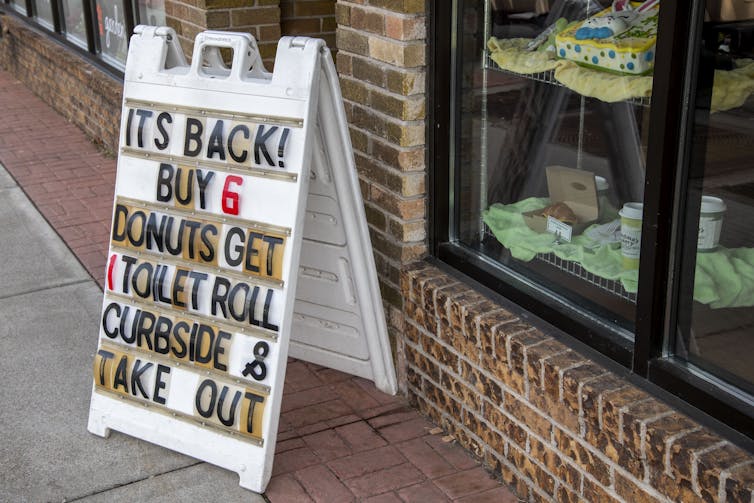
Retailers are frequently running out of everything from flour and fresh meat to toilet paper and pharmaceuticals as supply chains hammered by the coronavirus struggle to keep up with stockpiling consumers.
Although out-of-stock products are usually replenished within a day or two, the sight of bare shelves typically prompts more hoarding as people fear the supply of the goods they need may be cut off. This vicious cycle is a direct result of shortcomings of modern supply chains, which most companies, regardless of industry, now use.
As an expert on supply chain management, I believe three main characteristics of today’s supply chain are largely to blame.
1. Supply chains have become very complex
Fundamentally, a supply chain links a series of companies that make, transport, refine and deliver the finished product you buy at a retailer, restaurant or anywhere else.
Consider a cup of coffee from Starbucks. Your coffee might begin as a pile of coffee beans grown and picked by a farmer in Guatemala. They’re then shipped to a coffee roaster, say in Seattle, who then sends them on to a distributor near where you live, who sells them to your local Starbucks.
A shutdown anywhere along the supply chain in any of these locations stops this flow and could prevent you from enjoying your morning brew.
While a coffee supply chain may be relatively simple and linear, it can quickly get complicated for products that have many parts, such as an Apple iPhone. Apple actually has suppliers in 43 countries, and tracing the journey of any one component is difficult. For example, one of the chips that run an iPhone is designed in California but made in Taiwan, tested in the Philippines and then added to Apple products in China.
And many companies often share the same supplier, such as Intel for processors or Kimberly Clark for the fiber in toilet paper. So a hiccup in one link in the supply chain can have ripple effects across companies around the world.
The result is that the vast majority of global companies don’t fully grasp their risk exposure. Few, if any, have complete knowledge of the locations of all the companies that provide parts to their direct suppliers. Even supply chains for foods like bananas are long and complex, as most produce comes from countries across the globe.
Compounding the complexity is the problem of capacity, which is how much of something each company in a supply chain can produce. Rapidly increasing capacity is hard. Just think about the difference in hosting a dinner party for two guests versus 200. That is exactly why there is a shortage of hand sanitizer. Customers are buying huge amounts, but suppliers are not able to increase available amounts of essential ingredients, such as alcohol, glycerol and hydrogen peroxide.
2. A lean machine
What has made these supply chains even more vulnerable are strategies that rely heavily on “just in time” or lean inventory replenishment. That is, companies maintain only enough stock on hand for a short duration and rely on small deliveries made frequently to keeps costs low.
For example, many companies keep just enough inventory to last a few weeks, confident that products will arrive as they are needed. That system works perfectly well provided there are no disruptions.
However, as companies in a wide variety of industries, including food, retail, high-tech and automotive, have increasingly implemented this strategy, they no longer have the extra inventory or excess capacity to make up for production losses caused by a disruption. As a result, these businesses are highly vulnerable to even a short material-flow problem. When an earthquake shook Taiwan on Sept. 21, 1999, it created a huge disruption for the computer-chip industry, delaying shipping times for some products by more than a week.
Similarly, since lean systems removed most excess inventory, many medical supply chains were not able to respond to disruptions during emergence of the avian influenza, or “bird flu,” in 2005.
Yet those were relatively minor, regional disruptions. The coronavirus pandemic has virtually shut down dozens of economies, with movements of over a third of the global population restricted. This means a surge in demand for any product could easily result in shortages for days or weeks.
Having a lean inventory is a strategy with many benefits and is designed to eliminate waste and cut costs. However, many companies may have taken it too far. In an era of global connectivity, a disruption anywhere can trickle down the entire supply chain.
3. Moving manufacturing offshore
Further exacerbating the problem is the strategy of offshoring, in which companies manufacture their products overseas in countries like China, Vietnam and Malaysia in an effort to cut costs.
On the plus side, this has allowed many companies to reduce the number of links in their supply chains – or at least shrink the distance between them – by relying primarily on a smaller number of sources that are concentrated in a specific geographic area.
But in this quest to lower operating costs, including labor and overhead, more companies have put too many of their “eggs” in one basket. Certain industries have favored certain regions, with the auto, tech and agricultural industries favoring China. India, on the other hand, has become the primary source for generic drugs.
As a result, disruptions in a single country become even more severe. In January, well before the U.S. and countries in Europe had coronavirus outbreaks of their own, Western companies and retailers were already bracing for severe supply chain problems after China’s economy went into lockdown. And the impacts are still being felt several months later on all kinds of products, from toys and TV screens to sponges and ink cartridges, and could even extend into Christmas.
Getting ready for the next crisis
Of course, it makes sense that companies would do all they can to reduce costs and make their supply chains as efficient as possible.
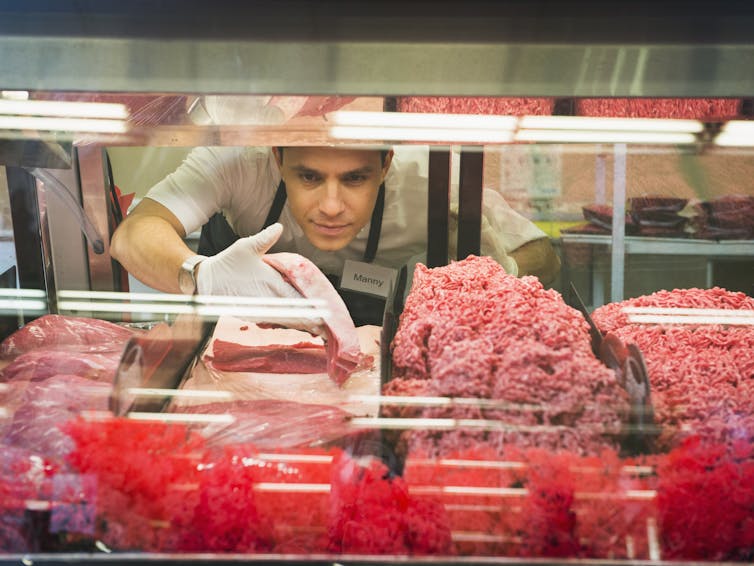
That has made them incredibly vulnerable to disruptions, even minor ones. And the coronavirus pandemic is a disruption like no other, and undoubtedly people will continue to see temporary and longer shortages of essential goods as long as it lasts. My biggest concern is that if COVID-19 continues to spread throughout the U.S., devastating the ranks of large meat packing plants and other factories and farms, Americans will begin to experience severe scarcity of foods and other goods.
While it’s probably too late to do much about the current crisis, I hope companies learn these lessons and adopt better strategies to manage their supply chains risks, such as by putting in place more backup suppliers and building up more inventory.
Maybe then more of them will be ready for the next disruption.
[Get facts about coronavirus and the latest research. Sign up for The Conversation’s newsletter.]
Nada R. Sanders, Distinguished Professor of Supply Chain Management, Northeastern University
This article is republished from The Conversation under a Creative Commons license. Read the original article.
In August, a robotic spacecraft will make NASA’s first-ever attempt to descend to the surface of an asteroid, collect a sample, and ultimately bring it safely back to Earth.
In order to achieve this challenging feat, the OSIRIS-REx mission team devised new techniques to operate in asteroid Bennu’s microgravity environment – but they still need experience flying the spacecraft in close proximity to the asteroid in order to test them.
So, before touching down at sample site Nightingale this summer, OSIRIS-REx will first rehearse the activities leading up to the event.
On Apr. 14, the mission will pursue its first practice run – officially known as “Checkpoint” rehearsal – which will also place the spacecraft the closest it’s ever been to Bennu.
This rehearsal is a chance for the OSIRIS-REx team and spacecraft to test the first steps of the robotic sample collection event.
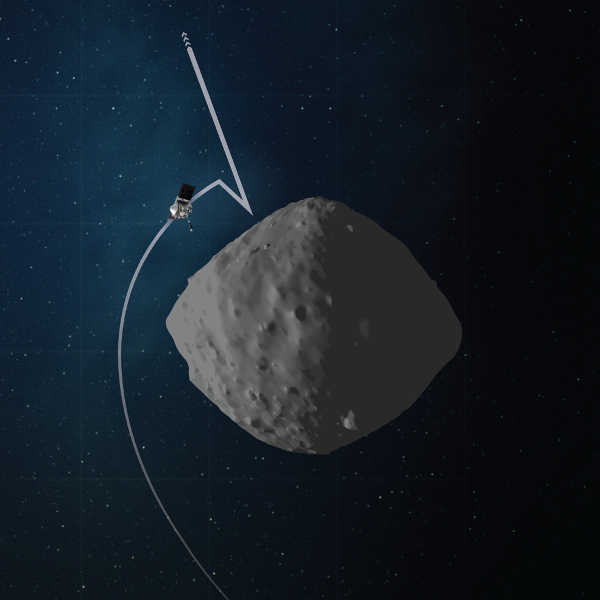
During the full touchdown sequence, the spacecraft uses three separate thruster firings to make its way to the asteroid’s surface.
After an orbit departure burn, the spacecraft executes the Checkpoint maneuver at 410 feet above Bennu, which adjusts the spacecraft’s position and speed down toward the point of the third burn.
This third maneuver, called “Matchpoint," occurs at approximately 164 feet from the asteroid’s surface and places the spacecraft on a trajectory that matches the rotation of Bennu as it further descends toward the targeted touchdown spot.
The Checkpoint rehearsal allows the team to practice navigating the spacecraft through both the orbit departure and Checkpoint maneuvers, and ensures that the spacecraft’s imaging, navigation and ranging systems operate as expected during the first part of the descent sequence.
Checkpoint rehearsal also gives the team a chance to confirm that OSIRIS-REx’s Natural Feature Tracking, or NFT, guidance system accurately updates the spacecraft’s position and velocity relative to Bennu as it descends towards the surface.
Checkpoint rehearsal, a four-hour event, begins with the spacecraft leaving its safe-home orbit, 0.6 miles above the asteroid. The spacecraft then extends its robotic sampling arm – the Touch-And-Go Sample Acquisition Mechanism, or TAGSAM – from its folded, parked position out to the sample collection configuration.
Immediately following, the spacecraft slews, or rotates, into position to begin collecting navigation images for NFT guidance.
NFT allows the spacecraft to autonomously guide itself to Bennu’s surface by comparing an onboard image catalog with the real-time navigation images taken during descent.
As the spacecraft descends to the surface, the NFT system updates the spacecraft’s predicted point of contact depending on OSIRIS-REx’s position in relation to Bennu’s landmarks.
Before reaching the 410-ft (125-m) Checkpoint altitude, the spacecraft’s solar arrays move into a “Y-wing” configuration that safely positions them away from the asteroid’s surface.
This configuration also places the spacecraft’s center of gravity directly over the TAGSAM collector head, which is the only part of the spacecraft that will contact Bennu’s surface during the sample collection event.
In the midst of these activities, the spacecraft continues capturing images of Bennu’s surface for the NFT navigation system. The spacecraft will then perform the Checkpoint burn and descend toward Bennu’s surface for another nine minutes, placing the spacecraft around 243 feet from the asteroid – the closest it has ever been.
Upon reaching this targeted point, the spacecraft will execute a back-away burn, then return its solar arrays to their original position and reconfigure the TAGSAM arm back to the parked position.
Once the mission team determines that the spacecraft successfully completed the entire rehearsal sequence, they will command the spacecraft to return to its safe-home orbit around Bennu.
Following the Checkpoint rehearsal, the team will verify the flight system’s performance during the descent, and that the Checkpoint burn accurately adjusted the descent trajectory for the subsequent Matchpoint burn.
The mission team has maximized remote work over the last month of preparations for the checkpoint rehearsal, as part of the COVID-19 response.
On the day of rehearsal, a limited number of personnel will command the spacecraft from Lockheed Martin Space’s facility, taking appropriate safety precautions, while the rest of the team performs their roles remotely.
The mission is scheduled to perform a second rehearsal on Jun. 23, taking the spacecraft through the Matchpoint burn and down to an approximate altitude of 82 feet. OSIRIS-REx’s first sample collection attempt is scheduled for Aug. 25.
NASA’s Goddard Space Flight Center in Greenbelt, Maryland provides overall mission management, systems engineering, and the safety and mission assurance for OSIRIS-REx. Dante Lauretta of the University of Arizona, Tucson, is the principal investigator, and the University of Arizona also leads the science team and the mission’s science observation planning and data processing.
Lockheed Martin Space in Denver built the spacecraft and is providing flight operations. Goddard and KinetX Aerospace are responsible for navigating the OSIRIS-REx spacecraft. OSIRIS-REx is the third mission in NASA’s New Frontiers Program, which is managed by NASA’s Marshall Space Flight Center in Huntsville, Alabama, for the agency’s Science Mission Directorate in Washington.
For more information on NASA’s OSIRIS-REx mission, visit https://www.nasa.gov/osiris-rex and https://www.asteroidmission.org .
Brittany Enos works for the University of Arizona.

LAKEPORT, Calif. – The city of Lakeport is joining communities across the country to show support and gratitude to first responders, health care and other essential workers on the frontlines of COVID-19.
Blue lights began shining in the downtown area on Friday night and will be on display through the weekend.
The national campaign, “Light It Blue,” originated spontaneously in cities with displays on public buildings, bridges and storefronts, demonstrating appreciation for those who are keeping our communities safe during the global pandemic.
Purple lights will be glowing in California and locally on April 13 and 20, paying tribute to workers in the tourism and hospitality industry. These employers and employees have been hard hit by the ongoing closure of their businesses due to the coronavirus crisis.
The city and the community appreciate all the frontline and behind-the-scenes workers and responders. Residents and businesses are encouraged to display similar lighting and show
their support.
New lighting was installed in downtown Lakeport during the revitalization projects and are programmed by a computer system that can be turned on and off by the flip of a switch.
More information is available from the Public Works Department, 707-263-3578.