 How to resolve AdBlock issue?
News
The U.S. Department of Agriculture's Forest Service has released a bioregional assessment evaluating the social, economic and ecological conditions and trends covering 19 units across Washington, Oregon and Northern California in a brief and easy-to-understand format.
The assessment uses the best available science and focuses on capturing current conditions and changes on the national forests and grasslands.
It provides recommendations on how the Forest Service could address the challenges facing forests, grasslands and communities in the plans that govern how land management decisions are made.
"The release of this assessment gives our region the data and scientific analysis to make future well-informed, landscape-level decisions that benefit our six northern forests," said Randy Moore, regional forester for the Pacific Southwest Region in California. "Furthermore, we're now able to move forward and prepare for updating land management plans to provide essential commodities and recreational opportunities, manage and reduce risk from wildfires through vegetative management and other proactive landscape efforts, provide clean air, water and habitat for plants and animals, and preserve our cultural resources, for present and future generations."
The Forest Service and other federal land management agencies are required by law to develop plans that guide the long-term management of public lands.
These plans are developed using public input and the best available science. They establish priorities for land managers and provide strategic direction for how the plan area is to be managed for a period of ten years or more. They may be periodically amended or revised entirely to address changing conditions or priorities.
"This assessment will make it more efficient to modernize our land management plans and reflect the new science, and changes to social, economic, and ecological conditions across this region," said Glenn Casamassa, regional forester for the Pacific Northwest Region in Oregon and Washington. "It will also preserve the tenets of the Northwest Forest Plan that are working well, so that work can continue effectively and efficiently."
The Northwest Forest Plan covers nearly 25 million acres of federally managed land in Oregon, Washington and northern California focusing on managing the entire landscape for long-term social and economic stability.
The Bioregional Assessment is not a decision document and does not impact current forest management. Instead, it will be used to shape ongoing engagement with stakeholders, state, county, tribal governments and Forest Service staff as they prepare for the next steps in the planning process together.
The assessment uses the best available science and focuses on capturing current conditions and changes on the national forests and grasslands.
It provides recommendations on how the Forest Service could address the challenges facing forests, grasslands and communities in the plans that govern how land management decisions are made.
"The release of this assessment gives our region the data and scientific analysis to make future well-informed, landscape-level decisions that benefit our six northern forests," said Randy Moore, regional forester for the Pacific Southwest Region in California. "Furthermore, we're now able to move forward and prepare for updating land management plans to provide essential commodities and recreational opportunities, manage and reduce risk from wildfires through vegetative management and other proactive landscape efforts, provide clean air, water and habitat for plants and animals, and preserve our cultural resources, for present and future generations."
The Forest Service and other federal land management agencies are required by law to develop plans that guide the long-term management of public lands.
These plans are developed using public input and the best available science. They establish priorities for land managers and provide strategic direction for how the plan area is to be managed for a period of ten years or more. They may be periodically amended or revised entirely to address changing conditions or priorities.
"This assessment will make it more efficient to modernize our land management plans and reflect the new science, and changes to social, economic, and ecological conditions across this region," said Glenn Casamassa, regional forester for the Pacific Northwest Region in Oregon and Washington. "It will also preserve the tenets of the Northwest Forest Plan that are working well, so that work can continue effectively and efficiently."
The Northwest Forest Plan covers nearly 25 million acres of federally managed land in Oregon, Washington and northern California focusing on managing the entire landscape for long-term social and economic stability.
The Bioregional Assessment is not a decision document and does not impact current forest management. Instead, it will be used to shape ongoing engagement with stakeholders, state, county, tribal governments and Forest Service staff as they prepare for the next steps in the planning process together.
LAKE COUNTY, Calif. – Decades in the making, construction is underway on the first segment of the Highway 29 expressway, the largest highway project in the county in 50 years.
Caltrans held a virtual groundbreaking on July 17 for the Lake 29 Expressway, a $59 million project aimed at addressing the area's most significant safety concerns – reducing collision rates for motorists and accommodating truck transportation along the interregional east-west highway.
Due to the restrictions of COVID-19, Caltrans District 1 produced a virtual groundbreaking ceremony video for the Lake 29 Expressway Project.
The video, which can be seen above, explains the project and its objectives and recognizes stakeholders, including the Lake Area Planning Council, the Lake County Board of Supervisors, local tribes, and state and federal agencies.
The funding for the Lake 29 Expressway, a vital east-west corridor between Interstate 5 and U.S. Highway 101, is funded by federal, state and local financing.
This newly launched project, located between Kelseyville and Lower Lake, is the first funded segment of a three-part series.
It will include safety improvements and safe mobility for multiple modes; improve large commercial truck transportation, goods movement and services; reduce traffic on Highway 20 and promote opportunities for complete streets and traffic calming on the Northshore; improve wildfire access and emergency response access; and provide a capacity area for population growth.
"Caltrans' No. 1 priority is safety, and the Lake 29 Expressway Project will enhance safety for motorists and pedestrians throughout Lake County,” said Caltrans Director Toks Omishakin. “This project is designed to reduce collisions on State Route 29, while also providing increased wildfire and emergency response access for the community."
Omishakin explained, “It’s important to note that this project is pivotal in the movement of goods and services for people throughout Northern California.”
He said the project also will have an impact on Lake County’s Northshore, where Caltrans plans further enhancements on Highway 20, which serves as the main street for several small communities. Those projects would make conditions safer for bikes and pedestrians and foster a sense of community, he said.
"I'd like to thank Caltrans for their constant vision to make our roads in Lake County safer," said Lake County District 5 Supervisor Rob Brown. "The realignment will allow truck traffic to divert from Highway 20 to Highway 29, to make things safer for the north end of our lake. It's fun to see it from the beginning of its inception and watch it get to here."
"Since 1988, there has been a dedicated team of experts working together on the Lake 29 Project, providing a safer and more efficient expressway to the traveling public," said Lisa Davey-Bates, executive director of the Lake Area Planning Council.
Like Omishakin, Davey-Bates pointed to countywide benefits. She said encouraging regional and interregional traffic along the south county Highway 29 will also benefit the communities on Highway 20’s Northshore, where traffic calming and pedestrian improvements will continue to be a priority.
"We are here to celebrate what this project means to all of Lake County, which is part of a collective long-term vision, and we wouldn't be here without the partnership of the county of Lake and partnership with the State of California," said State Senator Mike McGuire, whose Second Senate District includes Lake County.
Caltrans said site work in the area – including removing of trees and vegetation, and moving of utilities – began this spring.
Construction, managed by O.C. Jones, is anticipated to be completed in the winter of 2022, said Caltrans spokeswoman Bonnie Kuhn.
Project aims to increase safety
Last fall, the firm O.C. Jones – which has worked on other major highway projects around Lake County – won the expressway project with the low bid of $53.3 million, Caltrans Resident Engineer Kassaye Seyoum told Lake County News.
Caltrans Project Manager Jaime Matteoli said the bid came in lower than the total funding amount available for the project. Seyoum said the bid was 17.4 percent, or about $10.2 million, under the engineer’s estimate.
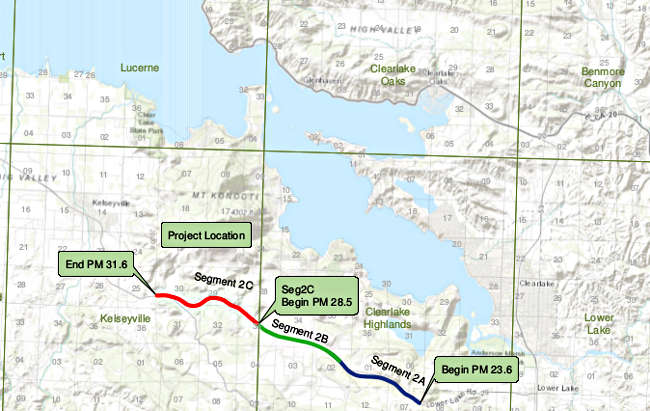
On the drawing board since the late 1980s, Caltrans staff said the overall Lake 29 Expressway project covers about 8 miles.
This first segment, called “2C,” is about 3 miles long. It will extend from Diener Drive near Lower Lake to just north of Highway 175/Cobb, about half a mile west of Red Hills Road near Kelseyville.
The other two portions, segment “2A” and “2B,” each less than 3 miles long, are to the east of 2C and are now being designed. Caltrans staff said there isn’t yet funding for those future project sections, although they’ve cleared the environmental requirements and have the funds for design work.
The 2C stretch of the project was determined to be a priority as it will meet the traffic flow needs in the areas of the county that are growing the fastest, Caltrans staff said.
That area also has been identified as having a high number of fatal collisions, which Caltrans said justified such a large project.
One of the project benefits will be greater sight distance, said Seyoum.
Other benefits, Matteoli said, will include bigger highway shoulders, two lanes in each direction with plenty of width for passing, curves that are up to current highway standards, three or four acceleration and deceleration lanes, a smoother and easier drive and a full-width median. It also will create opportunities for vehicles to more safely pass.
As such, Matteoli said collisions – particularly head-ons – should be reduced.
During construction, Seyoum said one of the more challenging aspects will be excavation.
There will be sandblasting and removal of a large amount of rock. About 800,000 cubic yards of material will be excavated with about 350,000 cubic yards of material – not all of it rock – to be removed as part of the work, Seyoum said.
One of the project’s main proponents for 30 years was Phil Dow of the Lake Area Planning Council, who retired in 2018.
“We wouldn’t be where we are today without Phil’s help,” said Matteoli.
Matteoli added that the project also likely wouldn’t have been possible without the help of the Lake Area Planning Council, which has been very engaged, persistent and patient through the years.
A lengthy project history
In a 2017 interview about the Lake 29 Expressway project, Dow – a longtime traffic planner and engineer – told Lake County News, “I was there in 1989 when the Area Planning Council made it a priority.”
He said of the lengthy time frame, “This is the way that large transportation projects go,” noting that sometimes it takes 10 years to do a very small one.
In the years since, the Lake Area Planning Council dedicated millions of dollars – the bulk of its regional share of State Transportation Improvement Program funding – to working with Caltrans on specific project components – environmental studies, design, right-of-way and construction, Dow said.
When the Lake Area Planning Council Board made this particular project a priority for state highway projects in Lake County, the No. 1 reason was safety, with Dow pointing to a high number of traffic fatalities.
Another reason for the project was the future capacity for the highway system, with Dow noting that stretch of highway’s heavy use by commuters between Clearlake and Lakeport, as well as recreational traffic and some trucks.
Officials also have wanted to reroute more traffic from Highway 20 to Highway 29, including trucks, because of constraints to Highway 20’s traffic flow. “It wasn’t feasible to widen Highway 20 to accommodate the future highway growth,” he said.
That made Highway 29 the important alternative, even though it creates a further travel distance, as that highway can be widened and offer more passing opportunities with four lanes. Dow said, ultimately, the larger expressway project will feed into the existing 7.5 miles of freeway near Lakeport.
Dow said that once the first segment is under construction, it should make it easier to get the funding for the rest of the work.
He also noted that there have been times over the last several years when there wasn’t any funding available for such projects, and that changing that was a political effort that involved the Legislature, regional agencies, cities and counties.

Long-term vision yields project
Davey-Bates said the Lake 29 Expressway is Lake County’s largest highway project in the last 50 years.
While Caltrans is the lead agency on the expressway, Davey-Bates explained that the Lake Area Planning Council is the regional transportation planning agency in Lake County that administers funding from the state and federal government for these types of projects.
“It’s been quite the uphill battle,” Davey-Bates of getting the expressway project to this point.
However, once the final dollars were in place and environmental and design work were underway, the challenges started to wind down. Then, she said, there was a waiting period.
“We’re so excited that we’re finally to that point because it has been such a long time coming,” she said. Referring to the decades since the project was first initiated, she said, “That’s why they call us long term planners.”
Highway 29 is a principal arterial corridor, and the project will improve both the safety and the highway’s operations by encouraging traffic, especially truck traffic, to go around Highway 53 and down around south of the lake, where more growth is expected, she said.
Davey-Bates said that eventually, as part of the overall planning, there are plans for more traffic calming measures on the Northshore to make it more pedestrian and bike-friendly and to encourage safety.
Earlier this year, a Highway 20 corridor planning study was completed, with the Area Planning Council approving it at its May meeting. Davey-Bates said the planning document looks at improvements to the corridor for bike and pedestrian transit improvements.
She said the two projects – the expressway and improvements on Highway 20 – will work in tandem to improve the flow of traffic through the Southshore and improve the Northshore.
The Area Planning Council has, to date, contributed $15,441,000 of its State Transportation Improvement Program funding to the expressway project, she said. Millions more have come from other sources, like the State Highway Operation and Protection Program, or SHOPP.
Davey-Bates said a lot of safety money has gone into the project because it has had such a high rate of injury and fatality crashes. “That’s not a normal situation.”
Caltrans has not historically allocated SHOPP funding on capacity-increasing projects, but this time they stepped up to the plate, Davey-Bates said.
While Lake County is small it has a lot of miles of roads, and Davey-Bates said Caltrans has worked hard to keep the state highways that pass through the county in good condition.
On this project, Davey-Bates said Caltrans will do its best to minimize the delays for motorists.
She said she hopes people will be patient and realize that, “in the end, we’ll be saving lives and improving the facility and it will be worth the wait.”
Davey-Bates said the goal now is to get funding for the last two sections of the project through grants and a federal bill.
They’re through the design process and just need construction funding, Davey-Bates added.
“We’re so close,” she said.
Email Elizabeth Larson at
LAKE COUNTY, Calif. – Public Health Officer Dr. Gary Pace gave the Lakeport City Council an update on Tuesday night on the effort to track and control the spread of COVID-19 in Lake County.
Pace said he wanted to talk about keeping cases low in an effort to stay off of the state’s monitoring list, which nearly 40 counties – including all of the counties that ring Lake – are on.
He said he thinks it’s a false dichotomy to choose between public health and a healthy economy.
Pace noted that California’s cases appear to have hit a peak and started to come down. He said new rules implemented by Gov. Gavin Newsom about a month ago may be contributing to the drop in cases following a surge attributed to Memorial Day and July 4.
While the rise in case numbers has backed off, Pace said deaths are rising and he pointed to a lag time between overall case and death numbers.
In discussing the connection between infection and economic impacts, Pace said he can’t sort out which impacts are due to closures and which are due to the virus coming on. “They’re very intertwined.”
Pace said the economy will do better if the virus can be kept under control.
He showed a graph that illustrated the continued high case numbers in the United States compared to the situation in the European Union, where cases comparatively are far lower. He said the difference has been explained by experts who have pointed to the ability in Europe to stick with preventive measures.
Pace said a key issue is how to navigate having more social and economic activity while not overwhelming the health care system and getting high preventable mortality.
“This is probably with us for an extended period going forward,” he said of the virus.
Pace promoted an approach that encourages interventions like masking, addressing sectors connected to increased spread and continued public health intervention.
He said a superspreader event site hasn’t been seen in Lake County, although some local cases have been tracked back to bars. A large amount of spread has been seen in large social gatherings.
“The schools are a very big deal that we’re struggling with right now,” he said, explaining that four districts are going to go with distance learning and two – Lucerne and Upper Lake – plan to do some on-site learning.
He said the data is very unclear on how contagious children are. However, with Lake County not being on the watch list, Pace said it can go forward with reopening schools.
Turning to masks, which he has required in his public health order, Pace explained, “The evidence is getting clearer and clearer that if people wear masks the transmission is less.”
He also emphasized the importance of social distancing and said there is no compliance mechanism related to health orders in Lake County.
City Manager Kevin Ingram told the council later in the meeting that the city does have compliance power through issuing administrative citations thanks to an order issued in March by newly retired City Manager Margaret Silveira.
“That’s not our first go-to,” said Ingram, noting that the city prefers to use education first.
Councilwoman Stacey Mattina asked Pace how close Lake County is to being on the watch list.
“We are kind of staying below the threshold,” he said, but added that with a few bad turns, “it could quickly change.”
Councilman Tim Barnes raised issues with the different rules for places like movie theaters compared to efforts to open up schools.
Pace acknowledged, “This all doesn’t fit together very well.”
He said he deals with such inconsistencies all day long, and it had been incredibly confusing, with a lot of mixed messages. “I really understand the frustration.”
Pace was concerned about a “generational loss” for the children who are now out of school, questioning how many may go back if, in two years, we’re still dealing with COVID-19.
He said we’re entering into a phase of how to get creative and think about what school will now look like, such as less in-person time and more time outdoors.
He suggested COVID-19 needs to be expected to go on for a year or more.
Council approves safety assessment placard ordinance, utility delinquency list, site improvement contract
In other business on Tuesday, Ingram presented to the council a safety assessment placard ordinance, which he said is recommended by the California Office of Emergency Services and the Federal Emergency Management Agency.
He said the simple, three-tiered system uses colored placards after disasters to indicate the structural conditions of buildings. Green indicates no apparent problems, yellow is for restricted use and red indicates unsafe structures with serious damage.
Ingram said it was one of the last things Tom Carlton wanted to put in place before he retired as the city’s building inspector in June.
The council approved the ordinance 4-0. Councilwoman Mireya Turner was absent from the meeting.
Councilmembers also approved the utility billing delinquency list and directed staff to submit the list to the County Auditor-Controller’s Office for inclusion on the property tax roll.
Lakeport Police Lt. Dale Stoebe presented the police department’s after action report on its July 4 fireworks operations.
There were far fewer people in Lakeport for July 4 this year due to COVID-19 and the cancellation of the city’s fireworks display. Still, Stoebe said there were large groups of safe and sane fireworks uses in the city and an uptick in illegal firework use.
Also on Tuesday, Ingram asked for and received authorization from the council to enter into a construction contract with Pacific West Builders in the amount of $650,000 for the completion of the Martin Street Apartments Off-site Improvement Project.
He said the developer is completing phase two of the project, with off-site improvements including, curb, sidewalk and gutter and road improvements a requirement of the $4.5 million grant that funded the apartments. Any costs over and above the $650,000 will be covered by the developer.
Ingram said the city is very thankful to Pacific West Builders, which also built the Bella Vista Senior Apartments on Martin Street, because their work has helped the city achieve its goals and the requirements of its housing element.
He said the projects, which have been complicated, are serving very low and low-income residents – those who make 80 percent of the median income and below.
Phase one of the project originally had been slated to be a 32-unit senior apartment complex. However, it was during the 2017 floods – which displaced many low-income families – that the city realized there was a higher need for multifamily housing.
As a result, the city was able to switch its grant funding to instead cover a 24-unit multifamily housing development, which includes two- and three-bedroom units, which Ingram said are hard to find.
Mayor George Spurr asked if more senior housing projects are still planned.
Ingram said yes, that Pacific West Builders is looking at a number of different sites, with the developer and city officials set to have a preapplication meeting on a site where such a senior housing project is being considered.
The council approved the contract 4-0.
Email Elizabeth Larson atThis email address is being protected from spambots. You need JavaScript enabled to view it. . Follow her on Twitter, @ERLarson, or Lake County News, @LakeCoNews.
Pace said he wanted to talk about keeping cases low in an effort to stay off of the state’s monitoring list, which nearly 40 counties – including all of the counties that ring Lake – are on.
He said he thinks it’s a false dichotomy to choose between public health and a healthy economy.
Pace noted that California’s cases appear to have hit a peak and started to come down. He said new rules implemented by Gov. Gavin Newsom about a month ago may be contributing to the drop in cases following a surge attributed to Memorial Day and July 4.
While the rise in case numbers has backed off, Pace said deaths are rising and he pointed to a lag time between overall case and death numbers.
In discussing the connection between infection and economic impacts, Pace said he can’t sort out which impacts are due to closures and which are due to the virus coming on. “They’re very intertwined.”
Pace said the economy will do better if the virus can be kept under control.
He showed a graph that illustrated the continued high case numbers in the United States compared to the situation in the European Union, where cases comparatively are far lower. He said the difference has been explained by experts who have pointed to the ability in Europe to stick with preventive measures.
Pace said a key issue is how to navigate having more social and economic activity while not overwhelming the health care system and getting high preventable mortality.
“This is probably with us for an extended period going forward,” he said of the virus.
Pace promoted an approach that encourages interventions like masking, addressing sectors connected to increased spread and continued public health intervention.
He said a superspreader event site hasn’t been seen in Lake County, although some local cases have been tracked back to bars. A large amount of spread has been seen in large social gatherings.
“The schools are a very big deal that we’re struggling with right now,” he said, explaining that four districts are going to go with distance learning and two – Lucerne and Upper Lake – plan to do some on-site learning.
He said the data is very unclear on how contagious children are. However, with Lake County not being on the watch list, Pace said it can go forward with reopening schools.
Turning to masks, which he has required in his public health order, Pace explained, “The evidence is getting clearer and clearer that if people wear masks the transmission is less.”
He also emphasized the importance of social distancing and said there is no compliance mechanism related to health orders in Lake County.
City Manager Kevin Ingram told the council later in the meeting that the city does have compliance power through issuing administrative citations thanks to an order issued in March by newly retired City Manager Margaret Silveira.
“That’s not our first go-to,” said Ingram, noting that the city prefers to use education first.
Councilwoman Stacey Mattina asked Pace how close Lake County is to being on the watch list.
“We are kind of staying below the threshold,” he said, but added that with a few bad turns, “it could quickly change.”
Councilman Tim Barnes raised issues with the different rules for places like movie theaters compared to efforts to open up schools.
Pace acknowledged, “This all doesn’t fit together very well.”
He said he deals with such inconsistencies all day long, and it had been incredibly confusing, with a lot of mixed messages. “I really understand the frustration.”
Pace was concerned about a “generational loss” for the children who are now out of school, questioning how many may go back if, in two years, we’re still dealing with COVID-19.
He said we’re entering into a phase of how to get creative and think about what school will now look like, such as less in-person time and more time outdoors.
He suggested COVID-19 needs to be expected to go on for a year or more.
Council approves safety assessment placard ordinance, utility delinquency list, site improvement contract
In other business on Tuesday, Ingram presented to the council a safety assessment placard ordinance, which he said is recommended by the California Office of Emergency Services and the Federal Emergency Management Agency.
He said the simple, three-tiered system uses colored placards after disasters to indicate the structural conditions of buildings. Green indicates no apparent problems, yellow is for restricted use and red indicates unsafe structures with serious damage.
Ingram said it was one of the last things Tom Carlton wanted to put in place before he retired as the city’s building inspector in June.
The council approved the ordinance 4-0. Councilwoman Mireya Turner was absent from the meeting.
Councilmembers also approved the utility billing delinquency list and directed staff to submit the list to the County Auditor-Controller’s Office for inclusion on the property tax roll.
Lakeport Police Lt. Dale Stoebe presented the police department’s after action report on its July 4 fireworks operations.
There were far fewer people in Lakeport for July 4 this year due to COVID-19 and the cancellation of the city’s fireworks display. Still, Stoebe said there were large groups of safe and sane fireworks uses in the city and an uptick in illegal firework use.
Also on Tuesday, Ingram asked for and received authorization from the council to enter into a construction contract with Pacific West Builders in the amount of $650,000 for the completion of the Martin Street Apartments Off-site Improvement Project.
He said the developer is completing phase two of the project, with off-site improvements including, curb, sidewalk and gutter and road improvements a requirement of the $4.5 million grant that funded the apartments. Any costs over and above the $650,000 will be covered by the developer.
Ingram said the city is very thankful to Pacific West Builders, which also built the Bella Vista Senior Apartments on Martin Street, because their work has helped the city achieve its goals and the requirements of its housing element.
He said the projects, which have been complicated, are serving very low and low-income residents – those who make 80 percent of the median income and below.
Phase one of the project originally had been slated to be a 32-unit senior apartment complex. However, it was during the 2017 floods – which displaced many low-income families – that the city realized there was a higher need for multifamily housing.
As a result, the city was able to switch its grant funding to instead cover a 24-unit multifamily housing development, which includes two- and three-bedroom units, which Ingram said are hard to find.
Mayor George Spurr asked if more senior housing projects are still planned.
Ingram said yes, that Pacific West Builders is looking at a number of different sites, with the developer and city officials set to have a preapplication meeting on a site where such a senior housing project is being considered.
The council approved the contract 4-0.
Email Elizabeth Larson at
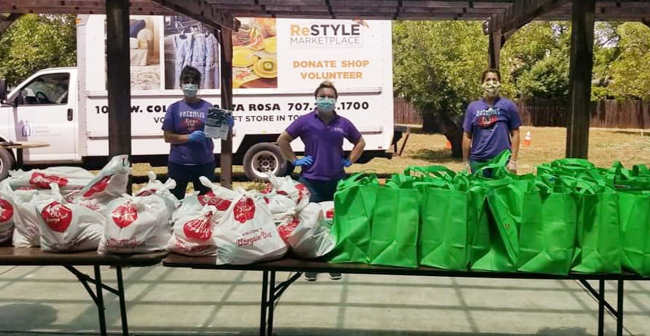
LAKE COUNTY, Calif. – A project to put food on the tables of community members who need assistance is restarting operations in response to the pandemic’s continuing impacts.
The Community Food Drive Project is a collaboration between several different organizations that are devoted to supporting Lake County throughout the COVID-19 pandemic.
With the current surge in local COVID-19 cases, the Community Food Drive Project, or CFDP, is resuming operations.
Applications are being accepted at 707-993-4644, with the first delivery slated for mid-August.
The CFDP aims to deliver food directly to the homes of Lake County residents impacted by COVID-19, focusing on those who do not have transportation, are medically vulnerable, symptomatic and/or COVID-19-positive.
The goal of the project is to fill a gap, serving those who are not currently accessing other community food resources.
Food is delivered directly to people’s homes by vehicles provided by the Lake Transit Authority.
Any community member in need of food is encouraged to call 707-993-4644 or email
Earlier this summer, the CFDP was delivering groceries to about 60 households each week. Grocery bags include items such as fresh produce, fresh meat, eggs, cheese and several non-perishable items like peanut butter, oatmeal, pasta, and more. Items vary weekly depending on availability.
The CFDP depends on community donations. Donations can be made by mail to North Coast Opportunities: Community Food Drive Project, 413 N. State St., Ukiah CA 95482 or online at www.bit.ly/2XSCHOi .
Agency partners in this collaboration include Catholic Charities of the Diocese of Santa Rosa, Hope Crisis Response Network, Hope Rising Lake County, Lake County Department of Social Services, Lake County Office of Education, Lake County Tribal Health, Lake Transit Authority, North Coast Opportunities and Partnership Health Plan.
Volunteers wanting to get involved and support this project should register at www.volunteernco.org or call 707-263-4688, Extension 421, for more information.
Residents who need groceries are encouraged to call 707-993-4644 or email
Agencies, individuals or community groups wishing to support this effort should contact Robyn Bera at
NCO is the Community Action Agency that serves Lake and Mendocino counties, as well as parts of Humboldt, Sonoma, Del Norte and Solano counties. NCO reacts and adjusts to community needs, including disaster response and recovery. For more information visit www.ncoinc.org or call 707-467-3200.
The California Department of Fish and Wildlife has confirmed outbreaks of adenovirus hemorrhagic disease in deer in several northern California counties, and is asking California residents to help curb the spread by not feeding wild animals, and reporting potential cases to the department.
“Providing attractants for deer – food, salt licks or even water – is against the law for good reason,” said Dr. Brandon Munk, senior wildlife veterinarian with CDFW’s Wildlife Investigations Laboratory. “Because these artificial attractants can congregate animals and promote the spread of disease, it’s particularly imperative to leave wildlife alone during an outbreak. There is no cure or vaccine for this disease, so our best management strategies right now are to track it carefully, and to take preventative measures to limit the spread.”
Beginning in May, CDFW began receiving increased reports of mortality in deer, both free-ranging and at fawn rehabilitation facilities.
With the assistance of wildlife rehabilitation facilities and the California Animal Health and Food Safety Laboratory, CDFW confirmed cervid adenovirus 1 (CdAdV-1) as the cause of hemorrhagic disease outbreaks in Napa, Santa Clara, Sonoma, Tehama and Yolo counties.
The disease is typically fatal to deer and can be spread by animals in close contact with each other.
The virus is not known to affect people, pets or domestic livestock.
CdAdV-1 was the cause of a 1993-1994 outbreak of hemorrhagic disease in black-tailed deer and mule deer that spanned at least 18 California counties.
Since then, CdAdV-1 has been identified as the cause of sporadic, often widespread, outbreaks of hemorrhagic disease in California and other western states.
Deer fawns are at greatest risk, with high rates of mortality following infection. Yearlings and adult deer are more resistant but mortalities in these age groups occur as well. Outbreaks can be widespread and have significant impact on affected deer populations.
Affected deer are often found dead without any obvious symptoms. They may be found near water. Sick animals may have excessive salivation (drooling or foaming at the mouth), diarrhea, regurgitation or seizures.
In addition to removing food and other attractants, Californians can help wildlife veterinarians track and study the disease by reporting sightings of sick or dead deer.
Anyone who observes a deer exhibiting symptoms, or encountering a deer that has died from unknown causes, can submit the information to CDFW through the department’s online mortality reporting system.
“Providing attractants for deer – food, salt licks or even water – is against the law for good reason,” said Dr. Brandon Munk, senior wildlife veterinarian with CDFW’s Wildlife Investigations Laboratory. “Because these artificial attractants can congregate animals and promote the spread of disease, it’s particularly imperative to leave wildlife alone during an outbreak. There is no cure or vaccine for this disease, so our best management strategies right now are to track it carefully, and to take preventative measures to limit the spread.”
Beginning in May, CDFW began receiving increased reports of mortality in deer, both free-ranging and at fawn rehabilitation facilities.
With the assistance of wildlife rehabilitation facilities and the California Animal Health and Food Safety Laboratory, CDFW confirmed cervid adenovirus 1 (CdAdV-1) as the cause of hemorrhagic disease outbreaks in Napa, Santa Clara, Sonoma, Tehama and Yolo counties.
The disease is typically fatal to deer and can be spread by animals in close contact with each other.
The virus is not known to affect people, pets or domestic livestock.
CdAdV-1 was the cause of a 1993-1994 outbreak of hemorrhagic disease in black-tailed deer and mule deer that spanned at least 18 California counties.
Since then, CdAdV-1 has been identified as the cause of sporadic, often widespread, outbreaks of hemorrhagic disease in California and other western states.
Deer fawns are at greatest risk, with high rates of mortality following infection. Yearlings and adult deer are more resistant but mortalities in these age groups occur as well. Outbreaks can be widespread and have significant impact on affected deer populations.
Affected deer are often found dead without any obvious symptoms. They may be found near water. Sick animals may have excessive salivation (drooling or foaming at the mouth), diarrhea, regurgitation or seizures.
In addition to removing food and other attractants, Californians can help wildlife veterinarians track and study the disease by reporting sightings of sick or dead deer.
Anyone who observes a deer exhibiting symptoms, or encountering a deer that has died from unknown causes, can submit the information to CDFW through the department’s online mortality reporting system.
LAKE COUNTY, Calif. – Public Health Officer Dr. Gary Pace on Wednesday reported Lake County’s second death related to COVID-19.
In a brief statement, Pace said the patient “died with a COVID-19-related illness.”
He said the individual was over age 60, had underlying medical conditions and was sick for a few weeks prior to dying.
“To protect the privacy of this person and their family, we will not be giving out any further information at this time,” Pace said.
Pace did, however, offer an explanation at Lake County News’ request about how the cause of death is determined.
“I can say that generally, a person is not identified as having COVID without them having a positive test. An attending doctor will determine presumed cause of death, not public health. Cause of death is usually decided based on a combination of determinations, including factoring in their underlying conditions, progression of the symptoms, and recent test results (like COVID results),” he said in an email.
He said decisions about autopsy are “generally made by the medical examiner if there is a pressing question about the progression not following an expected course given these factors.”
Pace added, “Usually, if the course of the illness leading to death follows a trajectory consistent with the presumed cause of death, no autopsy is needed.”
The county’s first COVID-19-related death was reported at the start of July.
On Wednesday, Public Health reported that Lake County’s COVID-19 caseload was up to 212. Of those, 22 are active, 189 are recovered and one patient is hospitalized.
Statewide, county Public Health departments are reporting close to 530,000 cases and more than 9,800 deaths.
Regarding this second death in Lake County attributed to the coronavirus, Pace said, “This is a tragic reminder that all Lake County residents must take precautions that can slow the spread of this virus.”
Email Elizabeth Larson atThis email address is being protected from spambots. You need JavaScript enabled to view it. . Follow her on Twitter, @ERLarson, or Lake County News, @LakeCoNews.
In a brief statement, Pace said the patient “died with a COVID-19-related illness.”
He said the individual was over age 60, had underlying medical conditions and was sick for a few weeks prior to dying.
“To protect the privacy of this person and their family, we will not be giving out any further information at this time,” Pace said.
Pace did, however, offer an explanation at Lake County News’ request about how the cause of death is determined.
“I can say that generally, a person is not identified as having COVID without them having a positive test. An attending doctor will determine presumed cause of death, not public health. Cause of death is usually decided based on a combination of determinations, including factoring in their underlying conditions, progression of the symptoms, and recent test results (like COVID results),” he said in an email.
He said decisions about autopsy are “generally made by the medical examiner if there is a pressing question about the progression not following an expected course given these factors.”
Pace added, “Usually, if the course of the illness leading to death follows a trajectory consistent with the presumed cause of death, no autopsy is needed.”
The county’s first COVID-19-related death was reported at the start of July.
On Wednesday, Public Health reported that Lake County’s COVID-19 caseload was up to 212. Of those, 22 are active, 189 are recovered and one patient is hospitalized.
Statewide, county Public Health departments are reporting close to 530,000 cases and more than 9,800 deaths.
Regarding this second death in Lake County attributed to the coronavirus, Pace said, “This is a tragic reminder that all Lake County residents must take precautions that can slow the spread of this virus.”
Email Elizabeth Larson at