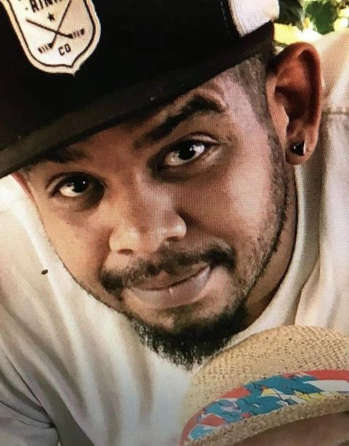
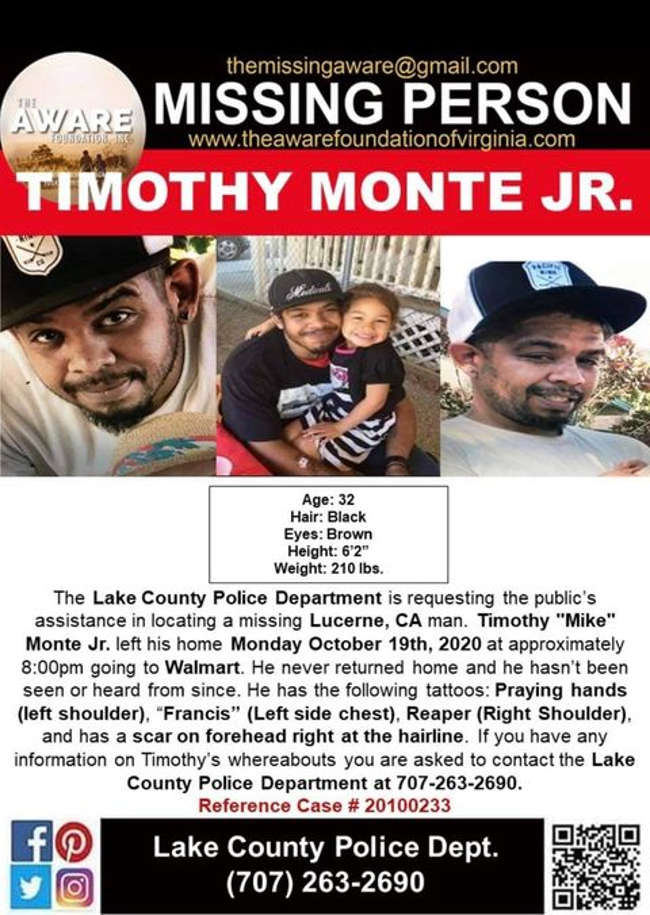
Timothy Michael Monte Jr., 32, of Lucerne, California, was last seen by family members on Monday, October 19, 2020. His family is now offering a reward for information that leads to his whereabouts. Courtesy photo. LUCERNE, Calif. – The Lake County Sheriff’s Office and the family of a missing Lucerne man are asking for the community’s help in locating him.
Timothy “Mike” Michael Monte Jr., 32, was last seen by family members at the Lucerne home he shared with his grandmother, girlfriend and children on Monday, Oct. 19.
His family said Monte, a local DJ, left Lucerne to travel to the Clearlake Walmart at around 8 p.m. that day. He did not return.
Monte was reported to be driving a gray Lexus that belongs to his girlfriend.
That vehicle showed up at his grandmother’s home two days after he was last seen – on Wednesday, Oct. 21. His family said the key was broken off in the ignition.
Lt. Corey Paulich of the Lake County Sheriff’s Office said Monte was reported missing to the agency this week, on Monday, a week after he was last seen.
Family members said they will be in Lake County on Friday to post fliers in an effort to locate him.
His family also is offering a $1,000 reward for information that leads to locating Monte.
Monte’s family described him as being Black and Mexican, 6 feet 2 inches tall and 210 pounds, with brown eyes and black hair.
He has several tattoos, including praying hands on his left shoulder, the name “Francis” on the left side of his chest and a grim reaper on his right shoulder. Family members said he also has a scar on his forehead hairline.
Anyone with information about Monte is asked to contact the Lake County Sheriff’s Office at 707-263-2690.
Email Elizabeth Larson at This email address is being protected from spambots. You need JavaScript enabled to view it.. Follow her on Twitter, @ERLarson, or Lake County News, @LakeCoNews.
LAKEPORT, Calif. – The Lake County Sheriff’s Office said that a dozen additional inmates at the Lake County Jail have tested positive for COVID-19.
Lt. Corey Paulich said a number of inmates at the Lake County Jail who are all housed in a single unit have been undergoing an isolation period after they were exposed to an inmate who tested positive for the COVID-19 virus on Oct. 12.
On Oct. 22, the sheriff’s office learned that a second inmate in that same housing unit also tested positive, Paulich said.
Then, on Thursday, Paulich said the sheriff’s office learned that 12 additional inmates from that same housing unit have tested positive for the coronavirus.
Including these 12 current cases, there have been 19 total cases of COVID-19 at the Lake County Jail, Paulich said.
Paulich said medical staff will be closely monitoring the isolated inmates and conducting the testing protocols recommended by Public Health. This includes the testing of staff and inmates as they work to contain the virus.
He said the sheriff's office continues to provide masks to inmates, employ comprehensive regular cleaning and to disinfect common areas in an effort to prevent the spread of COVID-19 in the jail.
CLEARLAKE, Calif. – Clearlake Animal Control has six dogs ready and waiting for adoption this week.
The following dogs are ready for adoption or foster.
“Banjo.” Photo courtesy of Clearlake Animal Control. ‘Banjo’
“Banjo” is a male American Staffordshire Terrier mix with a short tan and white coat.
He is dog No. 4267.
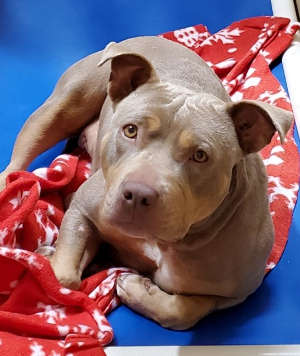
“Bella.” Photo courtesy of Clearlake Animal Control. ‘Bella’
“Bella” is a female American Bully mix.
She has a short beige and tan coat.
She is dog No. 3537.
“Charlie.” Photo courtesy of Clearlake Animal Control. ‘Charlie’
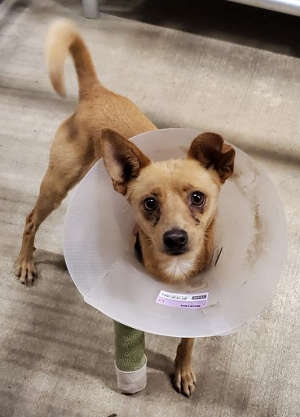
“Charlie” is a male adult Chihuahua with a short tan coat.
He has been neutered.
Charlie is recovering from surgery to fix a broken leg.
He is dog No. 4277.
“Chuckie.” Photo courtesy of Clearlake Animal Control. ‘Chuckie’
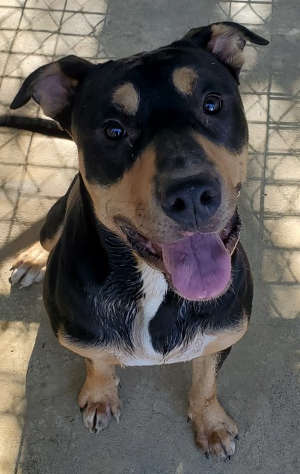
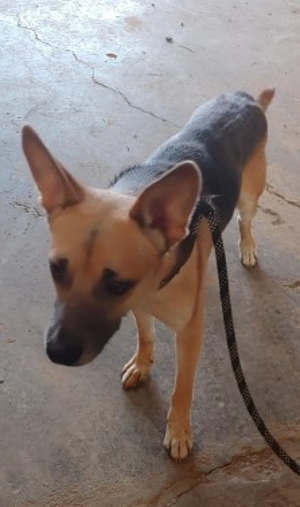
“Chuckie’ is a small male adult German Shepherd mix.
He has a short tan and black coat.
He is dog No. 4297.
“Jack.” Photo courtesy of Clearlake Animal Control. ‘Jack’
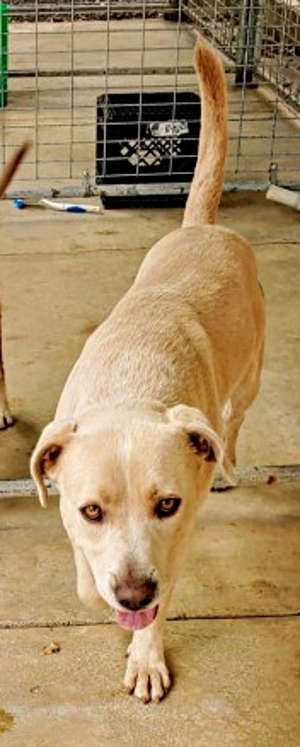
“Jack” is a male Labrador Retriever mix with a short yellow coat.
He is dog No. 4155.
“Lady.” Photo courtesy of Clearlake Animal Control. ‘Lady’
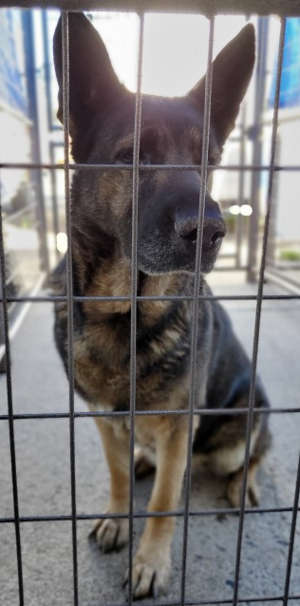
“Lady” is a female German Shepherd mix.
She has been spayed.
She is dog No. 3683.
The shelter is open by appointment only due to COVID-19.
Call the Clearlake Animal Control shelter at 707-273-9440, or email This email address is being protected from spambots. You need JavaScript enabled to view it. to inquire about adoptions and schedule a visit to the shelter.
Visit Clearlake Animal Control on Facebook or on the city’s website.
Email Elizabeth Larson at This email address is being protected from spambots. You need JavaScript enabled to view it.. Follow her on Twitter, @ERLarson, or Lake County News, @LakeCoNews.
BERKELEY, Calif. – Since the discovery that people infected with COVID-19 often shed the virus in their feces, scientists around the world have scrambled to spot signs of the virus in the stuff that we flush.
However, detecting tiny virus particles amid the wastewater that flows through our sewage pipes — which includes not only toilet water, but sink water, shower water and everything else that goes down a drain — is no easy feat.
A team of scientists at the University of California, Berkeley, has spent months refining and optimizing a rapid and low-cost new technique to test wastewater for SARS-CoV-2, the virus that causes COVID-19.
This month, the team has launched a new high-throughput pop-up lab — a temporary 1200-square-foot lab, rapidly set up in an empty research space in Hildebrand Hall — that, in conjunction with UC Berkeley and wastewater utilities and public health agencies from throughout the Bay Area, will monitor the region’s wastewater for the virus.
“From the very beginning of the pandemic, it was clear that there were major limitations to the ability to test every individual in a population frequently enough to find out whether they were infected or not,” said Kara Nelson, professor of civil and environmental engineering at UC Berkeley, who leads the team. “Wastewater naturally pools the waste from hundreds to even millions of people in a single sample, so if you can collect a representative sample of wastewater and analyze it, you can gain a tremendous amount of information that you likely couldn’t gain through testing people individually.”
Monitoring wastewater from a city, neighborhood or building is an efficient way to keep track of whether COVID-19 is spreading there. It also has the potential to provide an early warning for a potential outbreak, as evidence suggests that the virus can start to shed in an infected individual’s feces even before the person starts to experience symptoms.
Working with municipalities around the Bay Area, the team has identified sewersheds to monitor, each an area of land where all the sewers flow to a single pipe or station where samples can be collected. The sewersheds they are currently monitoring represent the waste of a few thousand to several hundred thousand people, Nelson said.
Through its COVID wastewater epidemiology for the Bay Area, or COVID-WEB project, the lab can currently process approximately 30 samples a week for 11 agencies, and the team plans to scale up to as many as 200 samples a week by the end of the year to meet the growing demand from regional public health agencies.
“One of the huge bottlenecks in wastewater testing has just been testing capacity,” Nelson said. “This pop-up lab is the first high-throughput lab in the Bay Area that has the capacity to bring in a large number of samples and provide results quickly to public health officials.”
Like finding a virus in a haystack
In theory, the SARS-CoV-2 virus can be spotted in wastewater using the same types of PCR-based assays that doctors currently use to diagnose COVID-19 in humans.
These tests work by first transcribing viral RNA into DNA and then using the polymerase chain reaction, or PCR, technique to make billions of copies of the viral DNA so that they can be quantified using fluorescent molecular markers.
However, detecting the virus in wastewater samples is decidedly more troublesome than finding in it a nasal swab, Nelson points out.
For one, wastewater contains chemicals, such as bleach, that can break down the SARS-CoV-2 virus as it travels through the sewer system. Wastewater also contains a plethora of other viruses that each have their own RNA molecules, making it harder to isolate the SARS-CoV-2 RNA in a sample.
Finally, each individual infected person can excrete different amounts of SARS-CoV-2 virus particles in their feces, and the wastewater itself is also variable in composition.
Luckily, Nelson and her team have ample experience analyzing and understanding the contents of wastewater.
Before the COVID-19 pandemic, the team was primarily concerned with detecting and removing pathogens from water sources, including wastewater, in order to make it safe to drink.
Many of the techniques and processes that the group uses in that work also apply to COVID-19 wastewater testing.
“Nelson’s lab is the primary research group on campus that studies treatment processes for pathogens in wastewater and drinking water, and so we already had a lot of preexisting relationships with the wastewater utilities,” said Rose Kantor, a postdoctoral scholar in Nelson’s lab and a member of the COVID-WEB team. “So, when the pandemic hit, we were able to pretty quickly start getting samples from them and testing out different methods for detecting SARS-CoV-2.”
Most methods start by concentrating the particles of the virus, then extracting the RNA for detection.
Working with Oscar Whitney, a graduate student in Robert Tjian’s lab in UC Berkeley’s Department of Molecular and Cell Biology, the team created a new technique that takes the opposite approach: Their technique first uses table salt to lyse, or slice open, the outer envelope of the virus, causing it to spill all of its RNA into the sample. The salt stabilizes the RNA, which is then concentrated in the lab.
By taking this approach, the technique is also able to catch bits of RNA from virus particles that may have already partially disintegrated in the wastewater, making it more sensitive to detecting the original number of virus particles that entered the sewer system.
It also uses very simple materials, like table salt and ethanol, which helps keep the costs low and helps bypass the supply chain issues that plagued many labs during the first few months of the pandemic.
“Back in early May, when people were just starting to explore wastewater surveillance, some of the materials were hard to obtain,” said Adrian Hinkle, a graduate student in Nelson’s lab and a member of the COVID-WEB team. “So, we tried to develop a method that required as few materials as possible and was fast, because we wanted to get the results as fast as possible, to inform public health authorities.”
The technique has an exceptionally high sensitivity, compared to other techniques that have been developed. Hinkle estimates that it is sensitive enough to detect the virus from just a handful of infected individuals in wastewater produced by a few thousand people.
It is also fast. Hinkle says the whole testing technique now takes about eight hours to complete, and the pop-up lab turns around the results for any given sample to public health officials within three days or less. They have taken extra steps to further streamline the process, like including salt in the sampling kits that they send to utilities, so that the lysis step can start before a wastewater sample even reaches the lab.
“Our technique has a high sensitivity, I think, in part, because of the salt lysis early on and because of the simplicity of the process and how we have fine-tuned the filtration and rinsing steps to maximize the percent recovery [of the virus],” Hinkle said.
‘A bit of a crapshoot’
On a smoky morning in early October, Tim Pine and Al Sanchez haul a large, grey, cylindrical plastic barrel out of a sewer hole located in UC Berkeley’s University Village.
The cylinder, which the researchers call an autosampler, had been hanging in the sewer hole for the past 24 hours. Several times an hour, a hose attached to the sampler draws up a small sample of wastewater from the sewer pipe below, depositing it into a two-liter bucket tucked safely inside the barrel.
Pine and Sanchez unhook the lid of the sampler and remove it, revealing the storage bucket and its contents. The wastewater inside looks like slightly dirty water — not quite the sludge you might imagine when you think of the word sewage.
“Every time we do this, it's a little bit of a crapshoot, pun intended,” Pine says, pointing at a piece of toilet paper, stuck on a ladder rail in the drain — a common hazard that could easily have plugged the sampling hose and ruined that day’s collection. “Today, it looks kind of clean. We don't usually see it this clean.”
Pine, an environmental protection specialist, and Sanchez, a senior hazardous materials technician, both work in UC Berkeley’s Office of Environment, Health and Safety. Pine has been collecting weekly samples of wastewater from University Village since mid-July and also samples from sewers that drain from UC Berkeley’s undergraduate dormitories and surrounding neighborhoods.
While Sanchez loads the day’s sample into a truck for transport back to the pop-up lab on campus, Pine describes the autosampler in more detail. Before COVID-19, he says, these devices were often used for environmental regulation. For instance, an autosampler, like this one, could be used to sample the water downstream of a factory suspected of illegally dumping pollutants into the sewer system. But the COVID-19 pandemic has given autosamplers a new use.
The COVID-WEB team has partnered with a number of Bay Area utilities, including the San Francisco Public Utilities Commission, or SFPUC, to form a regional working group that helps coordinate when, where and how to gather wastewater samples for COVID-19 testing.
“We have a great field monitoring team who usually sample wastewater to ensure permit compliance for industrial users, and they've pivoted quite deftly to using their equipment to pull composite samples from different locations in the city for COVID-19 surveillance,” said SFPUC General Manager Harlan L. Kelly Jr. “Depending on where they sample, they can get a comprehensive picture of the virus on a large scale, or we can use their skills to zoom in down to the building level.”
The regional working group also includes local public health agencies, which advise the team on how wastewater testing can best help the overall effort to slow the spread of COVID-19.
“One goal of this regional working group is to hear from public health officials how they think this wastewater data might help inform decision-making,” said Sasha Harris-Lovett, a postdoctoral fellow at the Berkeley Water Center and a member of the COVID-WEB team. “What are the gaps that this data could fill, and how could the data allow them to make more informed decisions?”
Harris-Lovett has learned that many in public health are interested in using wastewater testing to keep tabs on the SARS-CoV-2 virus in residential facilities and other dense living arrangements, where a few cases could quickly escalate to a major outbreak. This includes not just dorms and student apartments like University Village, but also places like nursing homes or prisons.
“Public health officials have also told us is that there are some neighborhoods that haven’t registered very many cases, not necessarily because people aren't sick, but because people aren't getting tested,” Harris-Lovett said. “So, there is an interest in using wastewater monitoring to keep track of trends in neighborhoods where perhaps people aren't able to access health care.”
Guy Nicolette, executive director and assistant vice chancellor of UC Berkeley’s University Health Services, said the wastewater testing being done near campus and at University Village will augment the school’s COVID-19 testing strategy.
“While we need to understand more, wastewater testing has great potential to be an early warning system, especially for sites where people aren't being tested frequently, for whatever the reason,” Nicolette said. “I can also imagine that when we see significantly reduced general transmission, (wastewater testing) could serve as large pooled testing for populations, so we can direct testing capacity to highest exposure risks and be even more adaptive and responsive, rather than try to directly test every single person.”
With COVID-19 case counts in California finally reaching a plateau, wastewater testing in the Bay Area could now play a role in helping public health officials keep an eye out for a possible resurgence of the virus, said Maya Petersen, chair of the Division of Biostatistics at UC Berkeley’s School of Public Health.
“I think there's really exciting potential for wastewater testing for the purpose of maintaining surveillance activity in a very efficient way that allows us to keep an eye on the bigger picture, and where an early surge might be happening, while at the same time really focusing our resources on persons and communities that are still bearing the brunt of the epidemic,” Petersen said.
A model for other wastewater surveillance projects
The potential of wastewater testing for COVID-19 goes beyond early detection and pooled surveillance of COVID-19. Working with Alexander Crits-Christoph, a graduate student in professor Jill Banfield’s lab in UC Berkeley’s Innovative Genomics Institute, the team has also developed a way to sequence the RNA of the individual strains of the SARS-CoV-2 virus.
Sequencing the RNA of SARS-CoV-2 helps scientists and epidemiologists monitor the virus as it changes over time and helps them track the different strains of the virus as they travel around the world. For example, by studying the genomes of SARS-CoV-2 virus samples collected on nasal swabs, epidemiologists have been able to deduce that the virus was brought to California via multiple introduction events.
“It’s harder to sequence viral genomes in wastewater because, with a nasal swab from a patient, you expect them to just have one strain of the virus. But in wastewater, a lot of different infected people are excreting virus into that single sample,” Kantor said. “To be able to look at the individual single nucleotide variants that are present in wastewater, you need to use more sophisticated bioinformatics tools that have been developed in Jill Banfield’s lab.”
In a preprint recently posted to MedRxiv, the team compares the strains of the virus found in the Bay Area’s wastewater with those found through nasal swabs of patients. In the wastewater, they found the same strains that had been identified through nasal testing, but also found additional strains that had not yet been observed in California.
Regularly sequencing the virus is also important, Kantor pointed out, because the virus is always mutating, but COVID-19 tests only work when they are programmed to detect the correct RNA sequences in the virus.
The researchers stressed that the rapid success of the new project has hinged on the close collaboration among the team members, both those from Berkeley and those who have joined the regional wastewater monitoring group. The team also shares information, via a massive Slack channel, with hundreds of researchers around the world who are also developing wastewater testing techniques, and such efficiency helps everyone progress faster.
Now that the high throughput pop-up lab is up and running, Nelson says that she and the team are eager to keep learning and sharing how to make this tool as useful as possible, by working collaboratively with their regional partners to put it into practice.
“One of our project goals is to help other regions replicate what we're doing,” Nelson said. “We want to share information as soon as we possibly can, so that we can speed up the process for other regions that are trying to create something similar.”
The COVID-WEB project is supported by UC Berkeley’s Innovative Genomics Institute, UC’s CITRIS and the Banatao Institute and a private foundation.
LAKE COUNTY, Calif. – A multi-vehicle wreck near Lower Lake on Thursday evening has resulted in one fatality and led to a temporary closure of Highway 29.
The crash occurred just before 5:30 p.m. Thursday on Highway 29 at C Street near Twin Lakes in the Lower Lake area, according to the California Highway Patrol.
Firefighters and law enforcement officers arriving at the scene reported finding four vehicles involved with the roadway completely blocked, according to radio reports.
A short time later, they confirmed over the radio that there was one fatality, along with four other individuals who had minor injuries and were able to get out of the vehicles on their own.
The CHP also separately confirmed that the crash had led to a fatality.
Caltrans was asked to respond to the scene and detour traffic around the crash site onto Spruce Grove Road North and Spruce Grove Road South as Highway 29 is expected to be closed for an extended period of time Thursday night.
Caltrans is reporting that the road is expected to open before 12 am. Friday.
Additional information will be published as it becomes available.
Email Elizabeth Larson at This email address is being protected from spambots. You need JavaScript enabled to view it.. Follow her on Twitter, @ERLarson, or Lake County News, @LakeCoNews.
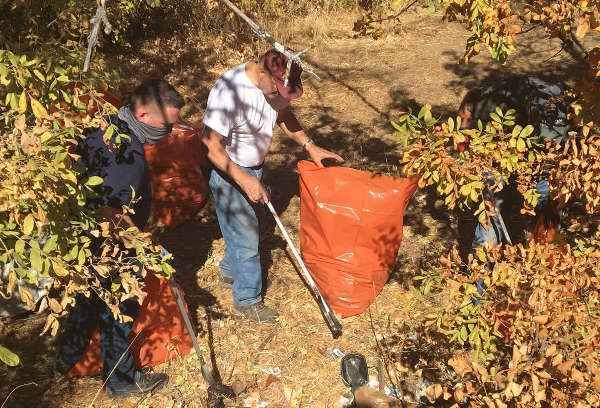
Members of the Kiwanis Club of Lakeport clean up the Forbes Creek watershed in Lakeport, California, on Saturday, October 24, 2020. Photo courtesy of the Kiwanis Club of Lakeport. LAKEPORT, Calif. – A community service organization this week got busy cleaning up one of the Lakeport area’s watersheds.
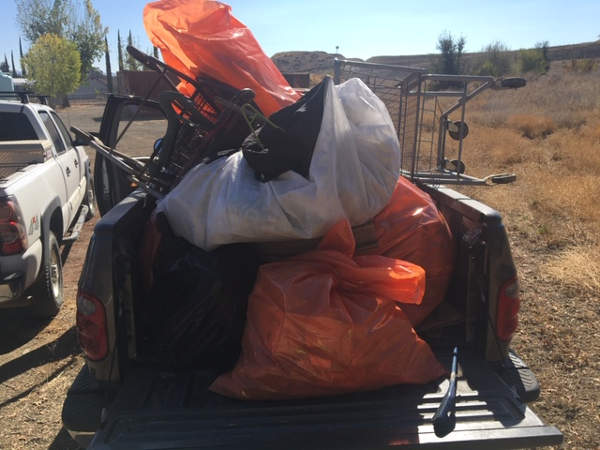
For their Kiwanis One Day project for 2020 on Saturday, members of the Kiwanis Club of Lakeport – assisted by personnel from the Lakeport Police Department and the city of Lakeport – recovered and properly disposed of four truckloads of trash from the Forbes Creek watershed.
Hundreds of pounds of garbage consisting of metal parts, tires, carpets, shopping carts, mattresses and blankets, food containers, tarpaulins, wood debris with nails and screws, chairs and other decaying materials were removed and transported.
This trash is harmful to wildlife, people, the environment and the water.
The cleanup operations ran the length of the watershed and surrounding land between Bevins Street and Martin Street, with the majority of the trash retrieved from city-owned property.
The Forbes Creek watershed drains to Clear Lake and includes property owned by the city of Lakeport, the fairgrounds, the fire department, Lake County Tribal Health and a private landowner.
Some of the trash the Kiwanis Club of Lakeport removed from the Forbes Creek watershed in Lakeport, California, on Saturday, October 24, 2020. Photo courtesy of Brad Rasmussen.
 How to resolve AdBlock issue?