How to resolve AdBlock issue?
News

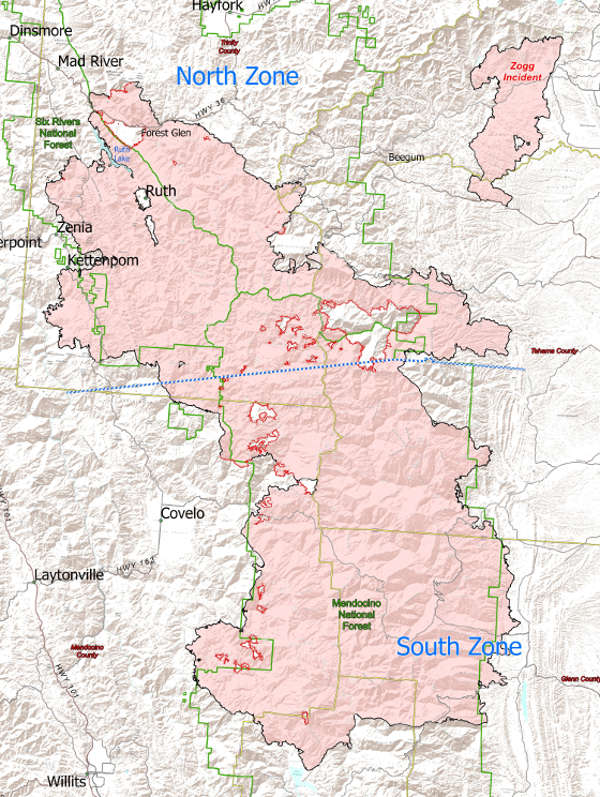
NORTHERN CALIFORNIA – Crews are making good progress on fire suppression repair across all areas of the South Zone of the August Complex.
The US Forest Service said the hard work of fire personnel is paying off keeping the South Zone at 499,826 acres and increasing containment to 97 percent. The South Zone includes the Mendocino National Forest in northern Lake County.
In addition to the Mendocino National Forest, the complex is burning in the Six Rivers and Shasta Trinity National Forests.
The entire August Complex, started by lightning on Aug. 16 and 17, is estimated at 1,032,649 acres and 93 percent containment.
As the August Complex nears full containment, incident management personnel are beginning to plan for a smooth transfer of responsibility back to local forest leadership, officials said.
There are 273 personnel working on the South Zone and 687 personnel on the entire incident, the Forest Service said.
The Forest Service said crews are continuing to focus on fire suppression repair in priority areas around the Sanhedrin Wilderness, in wild and scenic river corridors in the Mill Creek area, and in locations that are prone to landslides along key forest travel routes such as the M1 and M6 roads.
Additionally, officials said progress is being made on opening roadways and removing hazard trees to allow for further suppression repair activity throughout the forest.
In the interest of the safety of firefighters and visitors to the national forests in the Pacific Southwest Region, fire restrictions were extended to Nov. 6 to prevent further fires from being started and overtaxing the resources of those fighting existing wildfires.
The Forest Service estimates the complex will be fully contained on Dec. 15, at which point it will have burned for four months.

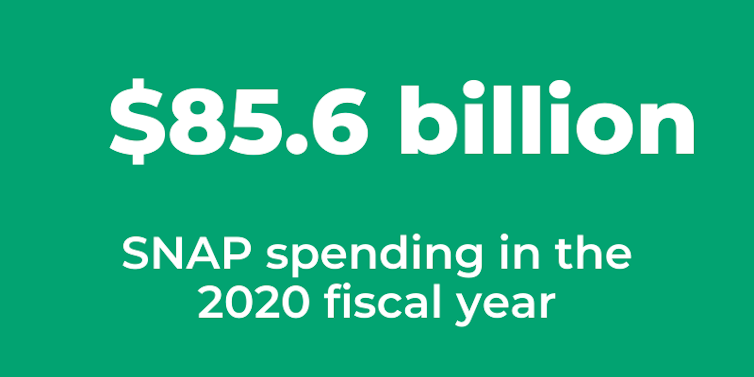
The government spent a record US$85.6 billion on the Supplemental Nutrition Assistance Program in the fiscal year ending in September. This sum, included in an October Treasury Department report, was about 35% higher than the $63.5 billion the federal government spent in 2019.
Spending on this state-administered program, which helps struggling families put food on the table, typically rises and falls in tandem with unemployment and poverty. Along with unemployment insurance, SNAP is one of the most responsive programs in a recession. The most vulnerable families can get benefits within seven days of applying.
Before the coronavirus pandemic, SNAP spending had been steadily declining since a 2013 peak of nearly $80 billion following the Great Recession. But as the COVID-19-triggered economic crisis hit, monthly spending more than doubled, from $4.9 billion in February to $10.6 billion in June, according to Treasury Department data.
The jump came from two factors. First, more people are getting benefits. Second, roughly 60% of the families who get them are eligible for more support than before.
Specifically, after the Families First Coronavirus Response Act relief package Congress passed in March 2020, the government temporarily offered the maximum benefit, typically given only to those with no income, to all families on SNAP. Following a 5.3% increase announced Oct. 1 in response to rising food costs, that maximum level stands at $680 a month for a family of four.
Despite this SNAP spending boost, lines at food banks have grown much longer during the pandemic.
To help both overwhelmed food banks and struggling farmers, the U.S. Department of Agriculture launched the Farmers to Families Food Box Program. The government had sent by mid-October 110 million boxes of fresh fruit, vegetables, dairy products and meat to food banks and other organizations assisting people facing economic hardship.
The USDA is spending about $4 billion to purchase the food. But the program has been criticized by lawmakers and anti-hunger groups as inefficient and poorly managed. Although food banks have appreciated the help, even people who run food banks see SNAP as the best way to help the hungry.
In fact, in researching the history of SNAP for an upcoming book, I found that the program long known as food stamps slowly replaced another program distributing surplus food to the needy in the 1960s. Government researchers found that giving families stamps to exchange for food in grocery stores was more efficient and effective.
In 2019, 92% of SNAP spending went directly to benefits. The program boosts the economy, leading to more consumer spending and jobs. SNAP also provides nine meals for every one meal supplied by Feeding America, the largest network of food banks.
[Deep knowledge, daily. Sign up for The Conversation’s newsletter.]
Almost 2,500 organizations serving the poor are calling for increasing maximum SNAP benefits by 15%. This would help all families on SNAP – including the 40% with the lowest incomes who have not gotten additional help so far during the pandemic. The House passed relief legislation in May and October that called for this 15% increase. As of late October, the Senate had not taken this step even though food insecurity has grown substantially.
Tracy Roof, Associate Professor of Political Science, University of Richmond
This article is republished from The Conversation under a Creative Commons license. Read the original article.

LAKE COUNTY, Calif. – While thousands of ballots remain to be counted, initial reports from Lake County election officials overnight gave early indications of the winners in key races on the general election ballot.
The Registrar of Voter’s Office issued several initial ballot count reports from Tuesday night into early Wednesday, with the last issued at 1:40 a.m.
Based on those preliminary reports, Jessica Pyska of Cobb is leading the race for District 5 supervisor with 944 votes, or 69.21 percent of the vote, while Bill Kearney of Kelseyville has 420 votes, or 30.79 percent.
For the District 4 State Assembly race, incumbent Cecelia Aguiar-Curry appears to have won reelection.
The Secretary of State’s Office reported that, with 100 percent of 522 precincts partially reporting, Aguiar-Curry, a Democrat, leads with 95,635 votes or 70.4 percent, while Republican challenger Matthew Nelson trails with 40,223 votes or 29.6 percent.
In the contested Lakeport City Council race, preliminary results show incumbent Kenny Parlet tied with Michael Green, at 579 votes each, followed by Nathan Maxman with 366 votes and Michael Froio with 355 votes.
In the Clearlake City Council race, with three seats available and two qualified candidates, incumbent Joyce Overton has 1,063 votes, followed by David Claffey, with 1,009 votes.
Three local school board races are on the ballot this year.
The Kelseyville Unified School District Board has three seats. Gilbert Rangel has the most votes in the preliminary count, 750, followed by Natalie Higley, 661; Mary Beth Mosko, 480; and incumbent, Beniakem D. Cromwell, 421.
In the Konocti Unified School District, with two seats up for election, incumbents Mary Silva, with 1,382 votes, and Susan Burton, with 1,348 votes, lead the field based on the count so far, followed by challengers Zabdy Neria, 1,171 votes, and Michael “Mac” McMurtrey, with 1,074 votes.
For the Upper Lake Unified School Board, with two seats up for election, incumbent Claudine Pedroncelli leads the field with 786 ballots, followed by Franklin Gudmundson, 606 votes, and Don Meri, 444 votes.
In the Callayomi County Water District, two board seats are being selected in the election. The initial vote count has incumbent Rosemary Córdova in the lead with 54 votes, followed by Sandra Harris, 47 votes, and Roger Rosenthal, 28 votes.
Email Elizabeth Larson at
LAKE COUNTY, Calif. – In Lake County or any other community across the country, the 2020 presidential election is unlike any other – whether it’s for voters or the people who are working to run the election process.
Thanks to COVID-19, this year saw a host of changes to casting ballots, with a shift toward voting by mail. For in-person voting, there were new safety protocols – including requirements to wear masks and social distance – while poll workers found themselves also having to regularly sanitize surfaces for the protection of voters.
Lake County News this year participated in the Lake County Registrar of Voters Office’s Election Observer Panel, which included seven community members who visited the 22 polling places in Lake County to watch how the process went on Election Day.
During the afternoon and early evening, a visit to five precincts – from Lucerne to Lakeport – revealed consistent trends, from large numbers of provisional ballots and same-day voter registrations being submitted to a steady stream of voters throughout the day.
Poll workers reported that the new protocols in place for this year’s election caused some frustration for voters – whether it was having to wait in lines or their desire to turn in their ballots in order to vote in person.
In one case, a man was reported to have thrown a pen at a poll worker at the Mormon church in Lakeport. A few frustrated voters were reported to have called the Secretary of State’s Office to complain about the process; the poll staffers said the individuals who made the complaints had been confrontational and confused.
Wanting to vote in person
This year, in response to the COVID-19 pandemic, California’s county election offices issued 22,389,846 vote by mail – or absentee – ballots to the state’s registered voters. By Monday, the Secretary of State’s Office said 11,807,069 had been returned, with 98.83 percent of those ballots accepted.
In Lake County, 37,717 vote by mail ballots were issued, and by Monday 16,823 ballots had been returned, with 98.64 percent accepted, the Secretary of State’s Office reported.
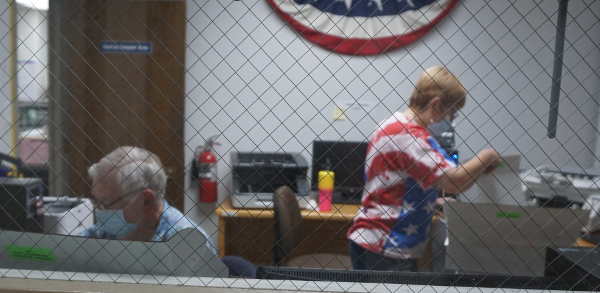
At the Community Baptist Church in Nice, polling staffers had one room set aside for people to come in and drop off their ballots, with another room organized with six voting booths for people to actually cast their ballots.
Poll workers, sitting behind plexiglass barries, handed out pens – which voters got to keep – and ballots, explained the process for voting either on paper or with voting machines (which reportedly got more use than in past years), then helped them put the ballots in the appropriate boxes and gave out “I Voted” stickers.
Many vote by mail ballots were surrendered so people could vote in person.
But, in many cases, people came to the polls without having registered to vote or without their issued ballots, according to polling staffers.
In the case of the former, they were allowed for the first time to do “same day” – or conditional – registration and cast their vote.
In the latter, pink provisional ballots were given to voters who hadn’t received ballots, had them and didn’t bring them to the polls or had lost them.
During visits to the polling precincts on Tuesday afternoon, this reporter watched as numerous provisional ballots were handed out to residents who lined up to vote.
Marilyn Pivniska, the precinct inspector for Lucerne, said she’s never seen so many provisional ballots. She said people were upset with having to vote provisionally and that they didn’t understand that they could have avoided provisional voting if they had brought their vote by mail ballots to the polls.
Steady streams of visitors
At North Shore Christian Fellowship on Main Street in Upper Lake, there was a steady stream of voters throughout Election Day, with about a dozen people lined up inside the church during the afternoon.
“It’s been a very busy day,” said Melinda Wright, working as a greeter at the polls.
The greeter is a new position assigned to help control the flow of voters moving through the polls in accordance with social distancing guidelines.
Wright also reported that people were confused about the need to bring their ballots to the polls either to drop them off or surrender them to avoid provisional voting.
Wright said some people were “grumbly” but not confrontational. One man, in frustration, was swearing at the new process for casting ballots.
“Some people can roll with it,” she said. “Others, not so much.”
Turning in vote by mail ballots
At the Mormon Church in Lakeport, Phyllis Navarro, the precinct inspector, and her crew were welcoming many voters who wanted to turn in their ballots, which were stored in a bulging vote by mail ballot bag.
But like the other polls, they reported many people coming in and having to vote provisionally because of not bringing their vote by mail ballots.
It was there that a frustrated man threw a pen at a poll worker, left, came back to show them he had a ballot and then sat in the lobby, where he tried to talk to other voters and ask if they had their ballots. The greeter told him to stop.
The Lakeport poll workers said that the social aspect of voting has been important to people – going to their precinct and seeing their friends and neighbors. That tradition has been disrupted this year.
Local authorities had been vigilant in case of election-related problems. However, Lakeport Police Chief Brad Rasmussen said his agency received no reports of issues on Tuesday.
A long day and night at the courthouse
At the Lake County Courthouse in downtown Lakeport, the polling area that could normally be found in the hallway outside the Registrar of Voters Office on the second floor was moved downstairs to the Board of Supervisors chambers on Tuesday.
The chambers, which in pre-COVID times had a maximum occupancy of 144 people, now is limited to 24 people. It has been cleared of its seats and on Tuesday seven voting booths for filling out paper ballots and one for the electronic voting machine were stationed around the room.
Shortly before 5 p.m., the staff there was preparing for a final evening rush of voters getting off of work.
Upstairs, scanning of vote by mail ballots that had been returned early was underway. Overseeing the work was Diane Fridley, the county’s retired registrar, and mentor and predecessor to current Registrar Maria Valadez.
In previous years, the work of counting ballots hasn’t always been completed on Election Night. That’s the expectation again this year due to the many additional checks and balances, and the challenges that will come with having to process thousands of provisional ballots as well as conditional ballots.
The polls close
Back at the Lucerne polling place, located at First Lutheran Church, after the polls closed staff started breaking down equipment, running reports for the voting machine and doing the necessary paper reports for stacks of pink provisional ballots.
Pivniska and fellow precinct inspector Bruce Maxwell then needed to transport some of the equipment and cases of ballots to the Registrar of Voters Office, where the first absentee ballot count report was issued before 9 p.m. and the last for the night came out at 1:40 a.m.
Email Elizabeth Larson at
Congressman John Garamendi, a Democrat representing the Third Congressional District, and Mike Thompson, a Democrat representing the Fifth Congressional District, won new two-year terms in the general election.
The California Secretary of State’s Office reported that, with 563 precincts partially reporting as of 2 a.m. Wednesday, Garamendi was leading Republican challenger Tamika Hamilton with 123,527 ballots to 89,220 ballots, or 58.1 to 41.9 percent.
Thompson led his Republican challenger, Scott Giblin, 193,191 to 52,493 votes, or 78.6 percent to 21.4 percent, with 821 precincts partially reporting.
Garamendi thanked voters for their support. “This victory gives us an opportunity to continue the critically important work that’s before us,” he said in a Tuesday night statement.
“The national election has exposed the reality of a deeply divided nation in remarkably stark terms. This is not new to America. Our history is filled with periods of conflict, but America always moves toward a ‘More Perfect Union.’ President Lincoln Charged Americans to ‘bind up the Nation’s wounds’ in his second inaugural address. After years of division, we must heal similar wounds today,” Garamendi said.
“The pain our nation has endured from the COVID-19 pandemic has reached new heights in recent weeks as cases and deaths are both on the rise. The American people deserve a new round of stimulus checks, our hospitals require additional PPE and supplies, and our schools need resources to safely welcome back their students. Senate GOP leadership has blocked several Democratic bills to address these issues, but I have newfound hope and optimism that tonight’s strong show of support for Democrats throughout the country will provide the votes that are needed to pass these bills and provide relief for the American people,” he continued.
Garamendi said policies must be enacted to address the climate crisis and create millions of good-paying middle-class manufacturing jobs in the clean energy sector.
He also emphasized the need to rebuild the nation’s crumbling infrastructure using American materials and workers, pledged to continue to advance his “Make it in America” and “Buy American” agendas to achieve this goal, promised to ensure that the nation’s policies promote the production of safe, affordable food for the district and communities around the world, and said he also will fight to ensure the region's water is protected and that there are investments in new storage infrastructure like the off-stream Sites Reservoir Project.
Thompson said he is “humbled and honored” to have earned the trust of the district to represent the community in Congress.
“Serving the place where I was born, grew up and raised my family is the greatest honor of my life. Know that I will work tirelessly in the upcoming Congress to ensure our district is the best place in the nation to raise a family, start a business and retire with dignity,” he said in a Tuesday night statement.
“Our district is facing many challenges, between the pandemic that has changed the way we live our lives and a devastating fire season that has destroyed so many homes and businesses. I know we can rise to meet this tough time. I will continue working to pass another Coronavirus relief package so we can support our local working families and small businesses that have been hit hard by the pandemic and need help. I’ll also continue working to bring back every Federal dollar and resource to help our district recover from the LNU Lightning Complex and Glass fires. I know we can get through this by working together,” he said.
“This was the most important election of my lifetime, one that will have consequences for decades to come. I am awed at the way that people in our district and across our nation turned out to vote and worked to help their friends and neighbors get out to vote. This spirit of civic service is one that we must all work to bring to our daily lives,” he said.
Thompson added, “As the results continue to come in, I encourage you to remain patient, to listen to the election officials who finalize these races, and to always check the source of information on which you rely. Whatever the results bring, know that I will continue fighting hard for our district and accomplishing the things that will move us forward.”
Email Elizabeth Larson at
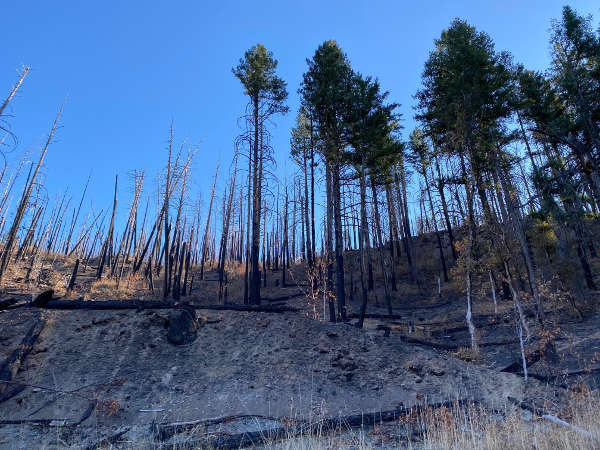
NORTHERN CALIFORNIA – Crews are working against time and unseasonable conditions to complete fire suppression repair across the South Zone of the August Complex before winter weather sets in.
The South Zone continues to hold at 499,826 acres and 90 percent containment. The entire August Complex is estimated at 1,032,649 acres and 93 percent containment, the US Forest Service said.
It began on Aug. 16 and 17 due to lightning. It is the largest fire in California’s history.
The Forest Service said the August Complex is approximately 70 miles long by 45 miles wide, covering an area larger than the entire state of Rhode Island. That includes portions of seven counties across six different fire weather forecasting zones.
There are 264 personnel working on the South Zone. Crews are focusing on fire suppression repair in priority areas such as dozer lines around wilderness, in wild and scenic river corridors and locations that are prone to landslides, the Forest Service reported.
Officials said repair is nearly complete in the Gloyd Slide area where there was risk of severe erosion and possible collapse of a segment of the M6 Road and repair is complete in the Sanhedrin Wilderness.