LAKE COUNTY, Calif. – Lake County’s move earlier this month out of the most restrictive tier on the state’s COVID-19 Blueprint for a Safer Economy has allowed for more local schools to open up for on-campus instruction.
Since the start of the school year, only two local districts – Upper Lake Unified and Lucerne Elementary – started all grades in the “hybrid” model that allowed for in-person instruction as well as distance learning, as Lake County News has reported.
The Lake County Office of Education reported that its schools also have been open since August for in-person classes, as has the Lake County International Charter School.
The rest of the districts at that point were in the distance learning model, and had been planning to reopen in the winter but had to remain in distance learning due to the county going into the purple, or most restrictive, tier on the blueprint at the end of November.
Even before the tier adjustment, elementary schools were able to open under the governor’s State Safe Schools for All plan, which focused on bringing the younger grades back first and phasing in other grade levels through the spring. The plan’s phased-in approach was based on the understanding that younger children are at a lower risk of contracting and transmitting COVID-19.
Konocti Unified School District opened to in-person hybrid instruction for kindergarten through sixth grades on Feb. 22, with grades seventh through 12th returning to campus on March 22.
Kelseyville Unified School District’s kindergarten through fifth graders returned to school on March 8, and sixth through 12th on March 23.
Lakeport Unified School District reopened on March 8 for in-person classes for K-6 and on March 22 for seventh through 12th grades.
In the Middletown Unified School District, Minnie Cannon and Cobb Elementary School opened to in-person instruction on half-days on March 1, the same date that Coyote Valley opened to in-person hybrid instruction.
Middletown Middle School is open to in-person instruction – no hybrid – and students returned to campus on March 22. All other grade levels at Middletown unified are in the in-person hybrid mode.
All schools are still offering distance only learning to those families that choose it, said Jill Ruzicka of the Lake County Office of Education.
Kelseyville Unified Superintendent Dave McQueen said the district was able to reopen transitional kindergarten through fifth grades while still in the purple tier.
Once Lake County went into the red tier, the district reopened Mountain Vista Middle School and the high school for hybrid instruction, McQueen explained.
“All the sites are open,” he said.
He said half of the district’s students are back on campus and half remain on distance learning because they wanted to stay home.
In the Lakeport Unified School District, Superintendent Jill Falconer said the principals of the middle and high schools, which opened for in-person learning last Monday, “report that things are going well and that students are very happy to be back on campus.”
She added, “Students have been respectful of the new rules and guidelines. We are overall very pleased to have had a smooth transition to Hybrid and it is just awesome to have some of our students back on campus.”
In related news, federal officials reported $28.3 million in assistance from the American Rescue Plan is allocated to help Lake County’s schools.
The breakdown is as follows:
– Kelseyville Unified, $5,054,000; – Konocti Unified School District, $13,835,000; – Lakeport Unified School District, $3,239,000; – Lucerne Elementary School District, $944,000; – Middletown Unified School District, $2,454,000; and – Upper Lake Unified School District, $2,848,000.
“We don't have any idea when we will actually see the money,” Falconer said.
She said the district is using its current budget/Local Control and Accountability Plan advisory committee to help gather input from stakeholders and determine the best use of the money.
Special thanks to Jill Ruzicka of the Lake County Office of Education for assistance in confirming the dates of in-person instruction reopening of the county’s school districts.
Email Elizabeth Larson at This email address is being protected from spambots. You need JavaScript enabled to view it.. Follow her on Twitter, @ERLarson, or Lake County News, @LakeCoNews.
A new U.S. Geological Survey study highlights the importance of homeowners testing their well water to ensure it is safe for consumption, particularly in drought-prone areas.
The first-of-its-kind national-scale study of private well water, conducted in collaboration with the Centers for Disease Control and Prevention, showed that drought may lead to elevated levels of naturally occurring arsenic and that the longer a drought lasts, the higher the probability of arsenic concentrations exceeding U.S. Environmental Protection Agency’s standard for drinking water.
Researchers estimate that during drought conditions, 4.1 million people in the lower 48 states who use private domestic wells are potentially exposed to unsafe levels of arsenic. This is an increase of 54% from the estimated 2.7 million people exposed to unhealthy arsenic levels in private wells during normal, non-drought conditions.
Arsenic is a metal that can occur naturally in bedrock and sediments around the world and is commonly reported in drinking-water supply wells.
However, chronic exposure to arsenic from drinking water is associated with an increased risk of several types of cancers, including bladder, lung, prostate and skin cancers. Other adverse effects include developmental impairments, cardiovascular disease, adverse birth outcomes and impacts on the immune and endocrine systems.
The study’s findings can help public health officials and emergency managers notify well owners in areas potentially affected and further refine their strategies for addressing the issue.
The EPA regulates public water supplies, but maintenance, testing and treatment of private water supplies are the responsibility of the homeowner.
Private well owners can work with their local and state officials to determine the best way to test and, if necessary, treat their water supply.
“The population potentially exposed to arsenic levels exceeding the EPA standard during simulated drought conditions amounts to roughly one-tenth of the estimated 37.2 to 43.2 million people in the conterminous U.S. who use domestic wells for household water supply,” said Melissa Lombard, a USGS hydrologist and lead author of this study.
This is the first national-scale study to assess the potential impact of drought on arsenic levels in private domestic wells. It is also the first to estimate the population of private well users who are potentially exposed during droughts to arsenic levels above EPA’s limits, which are intended to protect human health.
The study also estimated that 2.7 million people are exposed to elevated arsenic levels above EPA standards under normal conditions. This is an increase from a 2017 study by the USGS and CDC that estimated 2.1 million people were exposed to elevated arsenic levels. The increase reflects new estimates of well locations and the population reliant on private wells.
The new study, which did not examine private domestic wells in Alaska or Hawaii, includes maps showing where simulated drought conditions are likely to increase the probability of high arsenic levels and the number of people potentially exposed.
The states with the largest populations facing elevated arsenic levels in private domestic well water during the simulated drought conditions are Ohio (approximately 374,000 people), Michigan (320,000 people), Indiana (267,000 people), Texas (200,000 people) and California (196,000 people).
Even without drought conditions, relatively large numbers of people are estimated to be exposed to elevated arsenic levels in private domestic well water. Under normal conditions, the largest populations potentially exposed to high levels of arsenic are in Ohio (approximately 241,000 people), Michigan (226,000 people), Indiana (162,000 people), California (157,000 people) and Maine (121,000 people).
This study is the first to explore the potential large-scale impact of drought on naturally occurring arsenic in private drinking water wells,” said Lombard. “While the results suggest that drought will have a negative impact, the study cannot predict what might happen at an individual well, further highlighting the importance of testing.”
The occurrence of arsenic in groundwater is due to a variety of complex interactions, added Lombard. The reasons for the increase in arsenic during drought and as drought persists could vary depending on changes to groundwater flow, alterations in water chemistry and other factors.
Further exacerbating these challenges, climate models predict increasing temperatures and decreasing precipitation in portions of North America during the 21st century. USGS findings suggest that as the duration of drought increases, the probability of arsenic concentrations greater than EPA’s drinking water standard will also increase.
This study used an existing USGS statistical model that predicts the probability for elevated arsenic concentrations in domestic well water. In the new research, scientists used the model to simulate drought conditions by changing precipitation and groundwater levels. The researchers also used data from the drought of 2012, one of the worst on record in the U.S., to investigate how drought duration can impact arsenic levels.
Read the study “Assessing the Impact of Drought on Arsenic Exposure from Private Domestic Wells in the Conterminous United States” published in Environmental Science and Technology at https://pubs.acs.org/doi/full/10.1021/acs.est.9b05835.
LAKE COUNTY, Calif. – The governor has announced the distribution of $50 million in Community Power Resiliency grants through the California Governor’s Office of Emergency Services, or Cal OES, funds meant to protect local communities and vulnerable Californians from the impacts of utility-initiated power shutoffs.
“Even amidst a global pandemic, we continue to prepare our state for the natural and man-made disasters that may lie ahead,” said Gov. Newson. “These grants are part of our continued commitment to make sure that no Californian is left behind when disasters strike.”
This is the second round of public safety power shutoff resiliency grants from successive budget cycles proposed by the governor and supported by the Legislature.
In FY19-20, the Legislature approved the governor’s proposal to allocate $75 million in resiliency grants to counties, cities, tribes and state agencies.
Over these two budget cycles, counties have received $39 million, cities have received $23 million, tribes have received $4 million, state agencies have received $37.5 million and special districts have received $20 million.
This latest round of funds, allocated through the 2020-21 state budget, are designed to maintain the continuity of critical services that can be impacted by power outages, including schools, county election offices, food storage reserves and COVID-19 testing sites.
The funds are being distributed to 225 recipients, including all 58 counties, 51 incorporated cities, 20 federally recognized tribes and 96 special districts.
The state said the allocations include $13 million to counties, with allocations based on population and the counties required to use at least 50 percent of their award to support public safety power shutoff resiliency for one or more of the following priority areas – schools, elections offices, food storage reserves and/or COVID-19 testing sites.
Lake County will receive $183,393.
Cities also will receive $13 million, which the state allowing cities to apply for up to $300,000 on a competitive basis. Cities are encouraged to allocate funds to one or more of the following priority areas: schools, election offices, food storage reserves and/or COVID-19 testing sites. Neither of Lake County’s two cities are on the recipient’s list.
The state said $2.5 million has been allocated to California federally recognized tribes, with tribes allowed to apply for up to $150,000 on a competitive basis.
The Robinson Rancheria Citizens Business Council received $150,000.
Another $20 million will go to special districts that have an identified critical facility or facilities, or provide critical infrastructure, pursuant to the de-energization guidelines adopted by the California Public Utilities Commission. Funds also were awarded on a competitive basis to special districts, which were allowed to apply for up to $300,000.
Middletown Unified School District was the only special district in Lake County to receive grant funds. It was allocated $300,000.
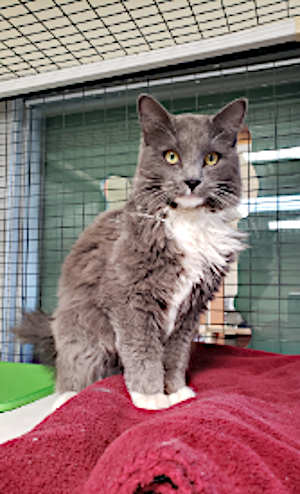
This young male domestic longhair cat is in cat room kennel No. 135, ID No. 14436. Photo courtesy of Lake County Animal Care and Control. Male domestic longhair
This young male domestic longhair cat has a gray and white coat and gold eyes.
He is in cat room kennel No. 135, ID No. 14436.
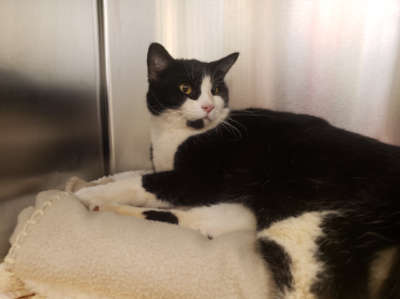
This male domestic short hair cat is in cat room kennel No. 142, ID No. 14386. Photo courtesy of Lake County Animal Care and Control. Male domestic short hair cat
This male domestic short hair cat has a black and white coat and green eyes.
He has been neutered.
He’s in cat room kennel No. 142, ID No. 14386.
Email Elizabeth Larson at This email address is being protected from spambots. You need JavaScript enabled to view it.. Follow her on Twitter, @ERLarson, or Lake County News, @LakeCoNews.
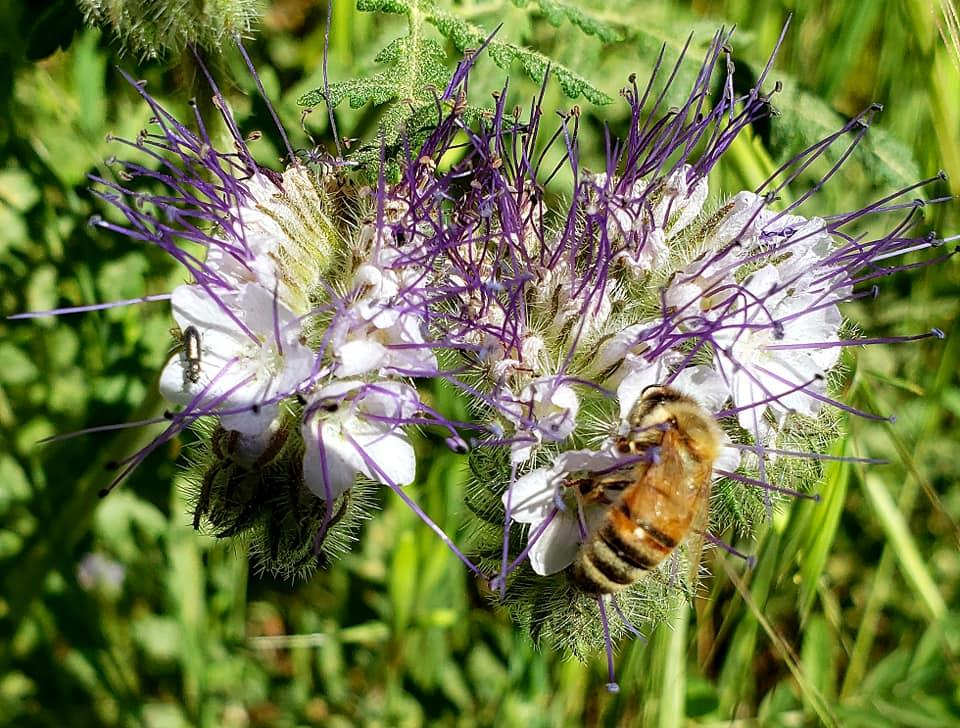
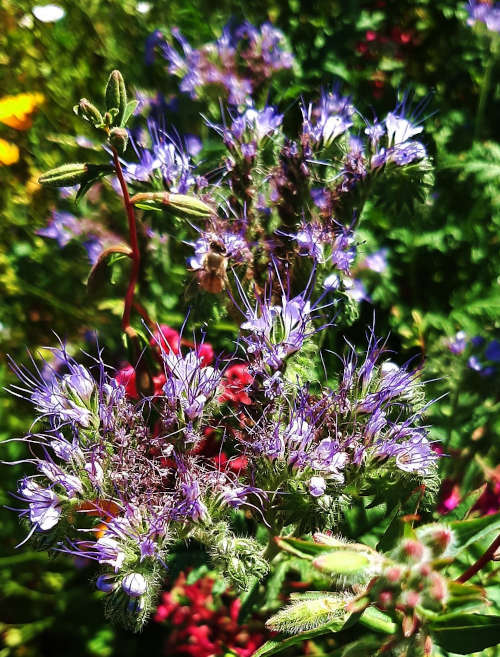
Photo Credit: Kim Riley. Name: Lacy Phacelia (Phacelia tanacetifolia) Family: Boraginaceae (Borage) Common Names: Friend-Of-The-Bees, bee feast, blue tansy, scorpionweed
LAKE COUNTY, Calif. – Early springtime, windows down, what is that tantalizing scent along the Lake County section of State Highway 20 from Glenhaven to Lucerne?
Most likely, it is Lacy Phacelia (Phacelia tanacetifolia), which is found blooming along the Northshore in profusion typically beginning in early March through April.
Phacelia tanacetifolia is an attention-grabber not only for your eyes and nose, this wildflower native to Lake County and the southwestern United States and northern Mexico, is used in many places as a hedgerow on farms, as it attracts bees and other beneficial insects.
Planted in vineyards and alongside row crops with irrigation, it will continue to grow and flower into the summer months and is highly prized for its long, coiling flower clusters of nectar-rich flowers which open in sequence, giving a long flowering period that attracts not only native and European honey bees, it is also attracts to hoverflies (family Syrphidae), which are useful as biological pest control agents because they eat aphids and other pests.
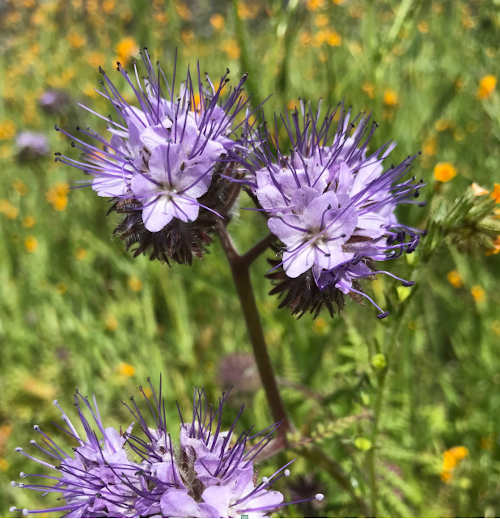
Photo Credit: Terre Logsdon. They also entertain the eyes of those driving along Highway 20 on the Northshore, interspersed with California poppies – the state flower.
This annual wildflower grows two to four feet tall, both in full sun or part shade, with fragrant flowers ranging from white to lavender to blue.
According to Judith Larner Lowry in her book, “Gardening with a Wild Heart,” “researchers in integrated pest management interplanted tansy-leaf phacelia with sugar beets. They found that sugar beet yields were significantly higher in plots grown with phacelia, possibly because adult syrphid flies, which feed on the floral nectar and pollen of phacelia,were significantly abundant. These syrphid flies were credited with reducing the aphids on the nearby sugar beets. Hoverflies as far as 200 meters from the planted phacelia were found with the characteristic blue, star-shaped phacelia pollen in their guts.”
Adding beneficial Lake County native wildflowers to your garden, vineyard, or orchard like Phacelia tanacetifolia is not only good for your crops – it is great for the native wildlife!
Terre Logsdon is an environmentalist, composter, and advocate for agroecology solutions to farming. An avid fan and protector of California wildflowers, plants, natural resources, and the environment, she seeks collaborative solutions to mitigate the effects of climate change. Kim Riley is retired, an avid hiker at Highland Springs, and has lived in Lake County since 1985. After 15 years of trail recovery and maintenance on the Highland Springs trails, she is now focused on native plants, including a native plant and pollinator garden on her property as well as promoting and preserving the beauty of the Highland Springs Recreation Area. Karen Sullivan has operated two nurseries to propagate and cultivate native plants and wildflowers, has lived in Kelseyville for the past 30 years, rides horses far and wide to see as many flowers as possible, and offers native plants and wildflowers for sale to the public. They are collaborating on a book, Highland Springs Recreation Area: A Field Guide, which will be published in the future. In the meanwhile, please visit https://www.facebook.com/HighlandSpringsNaturalists and https://www.facebook.com/HighlandSpringsRecreationArea.
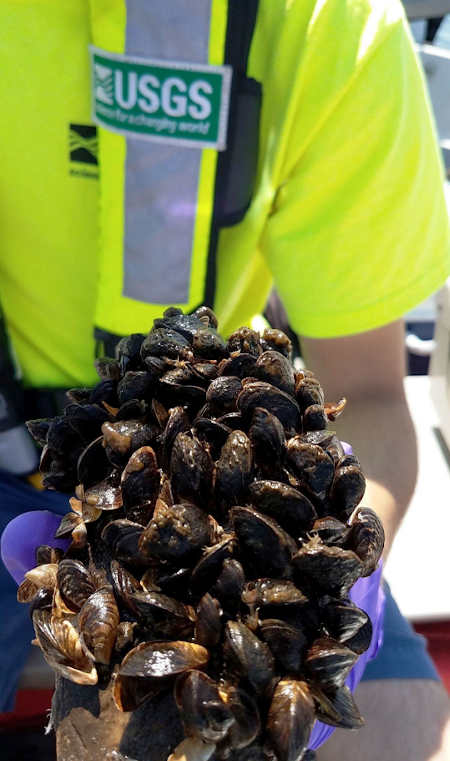
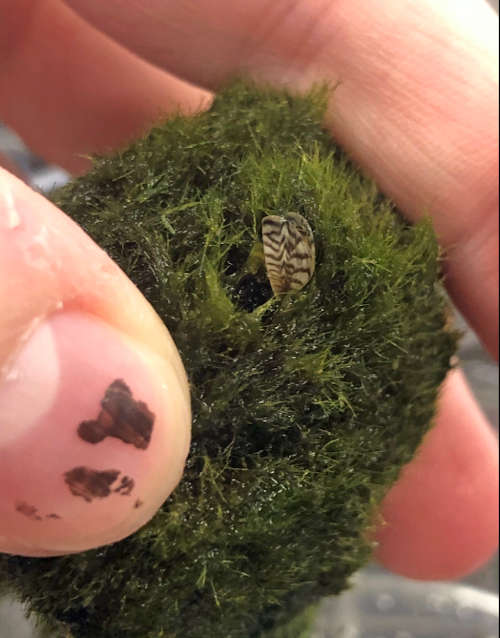
In May of 2018, USGS Hydrologic Technician Dave Knauer found a batch of zebra mussels attached to the boat anchor in the St. Lawrence River in New York. Credit: John Byrnes, USGS. Public domain. A citizen’s report of an invasive zebra mussel found in an aquarium moss package found in a pet store prompted a U.S. Geological Survey expert on invasive aquatic species to trigger nationwide alerts that have led to the discovery of the destructive shellfish in pet stores in at least 21 states from Alaska to Florida.
Amid concerns that the ornamental aquarium moss balls containing zebra mussels may have accidentally spread the pest to areas where it has not been seen before, federal agencies, states, and the pet store industry are working together to remove the moss balls from pet store shelves nationwide.
They have also drawn up instructions for people who bought the moss balls or have them in aquariums to carefully decontaminate them, destroying any zebra mussels and larvae they contain using one of these methods: freezing them for at least 24 hours, placing them in boiling water for at least one minute, placing them in diluted chlorine bleach, or submerging them in undiluted white vinegar for at least 20 minutes.
The decontamination instructions were developed by the U.S. Fish and Wildlife Service, the USGS and representatives of the pet industry.
Zebra mussels are an invasive, fingernail-sized mollusk native to freshwaters in Eurasia. They clog water intakes for power and water plants, block water control structures, and damage fishing and boating equipment, at great cost. The federal government, state agencies, fishing and boating groups and others have worked extensively to control their spread.
In 1990, in response to the first wave of zebra mussel invasions, the USGS set up its Nonindigenous Aquatic Species Database, which tracks sightings of about 1,270 non-native aquatic plants and animals nationwide, including zebra mussels. State and local wildlife managers use the database to find and eliminate or control potentially harmful species.
The coordinator of the Nonindigenous Aquatic Species Database, USGS fisheries biologist Wesley Daniel, learned about the presence of zebra mussels in moss balls on March 2 and alerted others nationwide about the issue. Moss balls are ornamental plants imported from Ukraine that are often added to aquariums.
“The issue is that somebody who purchased the moss ball and then disposed of them could end up introducing zebra mussels into an environment where they weren’t present before,” Daniel said. “We’ve been working with many agencies on boat inspections and gear inspections, but this was not a pathway we’d been aware of until now.”
On Feb. 25, an employee of a pet store in Seattle, Washington, filed a report to the database that the employee had recently recognized a zebra mussel in a moss ball. Daniel requested confirming information and a photograph and received it a few days later.
Daniel immediately notified the aquatic invasive species coordinator for Washington State and contacted invasive species managers at the USGS and USFWS. He visited a pet store in Gainesville, Florida, and found a zebra mussel in a moss ball there. At that point federal non-indigenous species experts realized the issue was extensive.
The USFWS is coordinating the response along with the USGS. The U.S. Department of Agriculture, several state wildlife agencies and an industry group, the Pet Industry Joint Advisory Council, are also taking steps to mitigate the problem. National alerts have gone out from the USFWS, the federal Aquatic Nuisance Task and regional aquatic invasive species management groups. Reports of zebra mussels in moss balls have come from Alaska, California, Colorado, Florida, Georgia, Iowa, Massachusetts, Michigan, Montana, Nebraska, Nevada, New Mexico, North Dakota, Oklahoma, Oregon, Tennessee, Vermont, Virginia, Wisconsin, Washington and Wyoming.
“I think this was a great test of the rapid-response network that we have been building,” Daniel said. “In two days, we had a coordinated state, federal and industry response.”
The USGS is also studying potential methods to help control zebra mussels that are already established in the environment, such as low-dose copper applications, carbon dioxide and microparticle delivery of toxicants.
 How to resolve AdBlock issue?