 How to resolve AdBlock issue?
News
LAKE COUNTY – Last week Lake County Sheriff's Office (LCSO) deputies and members of a recently formed task force conducted an operation to make sure convicted sex offenders are following registration requirements.
A report from LCSO Det. Mike Curran of the said that on July 23 and July 24, a sex registrant compliance and enforcement sweep was conducted by the Region II Sexual Assault Felony Enforcement (SAFE) Task Force in the City of Clearlake and south Lake County.
The Region II SAFE Task Force is funded through a grant from the Governor’s Office of Emergency Services and covers 12 counties along the North Coast from Monterey County to Del Norte County.
Approximately 130 registrants were contacted to ensure that they are in compliance with their sex registrant requirements, in particular that the registrants are residing at the address given during registration, Curran reported.
Registrants with parole and/or probation search terms were also subject to search conducted at the time of contact. Several arrests were made and additional investigations were initiated as a result of alleged registration violations.
Staffing shortages at the sheriff’s office have created a real challenge for the patrol and investigations divisions to perform brief quarterly compliance checks, reported Curran, as well as initiating investigations on registrants known to be out of compliance with their sex registration responsibilities. Periodic compliance/enforcement operations such as the one just completed will take place on both ends of Lake County.
Agents assigned to the task force coordinate with agencies within their respective counties for operations such as the one just completed in Lake County, and also assist agents within the region with operations in their own respective county, according to Curran's report.
SAFE Task Force Agents from Santa Clara County, Humboldt County, Del Norte County and Napa County participated in the operation, Curran reported.
Additional agencies involved in the operation were the Lake County Sheriff’s Department, Clearlake Police Department, Lake County Probation Department, Lake County District Attorney’s Office, Lakeport Police Department and State Parole. Curran, a Lake County SAFE Task Force agent, coordinated the operation.
Santa Clara County Sheriff Laurie Smith submitted the grant for the task force, which was approved and funded by the Governor’s Office of Emergency Service, Curran reported.
Smith’s desire to pursue a regional task force has added a seriously needed tool for law enforcement not only for her county, but for every county, especially the smaller ones covered within the grant boundaries that allows funding and staffing for sex registrant compliance/enforcement operations, according to Curran's report.
Thanks to Smith's innovative efforts, LCSO – which might otherwise not have been able to carry out such an operation due to a lack of available funding – is able to participate in this most-needed aspect of protecting the public, Curran reported.
Sheriff Rod Mitchell expressed his gratitude to Smith for including Lake County in the grant funding, and said he applauded her for her initiative and innovation.
{mos_sb_discuss:2}
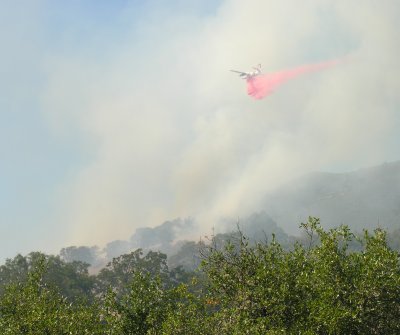
NICE – Northshore firefighters took on their largest wildland fire of the season so far, battling a Saturday afternoon blaze that burned 128 acres near Robinson Rancheria.
Suzie Blankenship, a Cal Fire fire prevention specialist, said the fire was reported at 3:45 p.m. It broke out in steep, rugged terrain behind the rancheria's playground, which is located behind the main area of the rancheria.
Witnesses at the scene said the fire then burned up into the hills toward Nice.
Northshore Fire Protection District, Cal Fire and Lakeport Fire Protection District responded to the scene, said Northshore Chief Jim Robbins. The Lake County Sheriff's Office also was at the scene to control traffic.
Blankenship said Cal Fire sent seven engines, four dozers, three fire handcrews, one air attack, five air tankers and three helicopters, along with two officers on the ground helping an incident commander organize the effort.
Another five engines from Northshore Fire responded, said Robbins, along with two four-wheel drive attack units, he and a battalion chief. Lakeport Fire also sent an engine.
Blankenship said firefighters had difficulty fighting the fire because of high-tension power lines in the area, which limited the use of air crews.
The fire was contained at 7:15 p.m., said Blankenship.
However, the fire was far from out at that point, said Robbins.
“There's still a lot of hot spots,” he said from the scene.
Because of the need to monitor the area, Robbins said crews were being ordered in overnight.
No single family dwellings were threatened, said Robbins, although a few small sheds that were buried in the remote area's brush were destroyed.
There were no injuries to area residents or firefighters, said Robbins.
Robbins said it was the biggest blaze that Northshore Fire has had to fight so far this season.
The wind helped the fire spread rapidly, said Robbins.
“We went from 20 acres to about 60, 70 acres in less than 20 minutes, it had such a good westerly wind on it,” he said.
The cause of the fire is under investigation, said Robbins. A Cal Fire official was at the fire scene Saturday evening in an effort to determine the source.
E-mail Elizabeth Larson at
{mos_sb_discuss:2}
The US Fish and Wildlife Service announced July 20 that it will reconsider eight decisions involving endangered species that were overseen by former Assistant Secretary of Fish, Wildlife and Parks Julie MacDonald.
MacDonald was a Bush appointee who joined the Department of the Interior in July 2002. She resigned April 30 following an investigation by the Department of Interior’s Inspector General that found she had used her position to violate the Endangered Species Act, rewrote scientific reports, browbeat agency scientists and colluded with industry lawyers to generate lawsuits against the Fish and Wildlife Service.
During a July 2 Congressional hearing in Vallejo, MacDonald's role in influencing environmental decisions in the Bay-Delta came to light in testimony given by Steve Thompson, manager of the U.S. Fish & Wildlife's California/Nevada Operations Office, as Lake County News previously reported.
Congressman Mike Thompson questioned Steve Thompson about if the agency had been under political pressure to change science used for decisions in the Bay-Delta, similar to how Vice President Dick Cheney used political influence in a decision last year that resulted in the death sof 70,000 salmon in the Klamath River.
Steve Thompson said MacDonald had shown interest in the agency's work on delta smelt, a seriously threatened fish that calls the Bay-Delta home.
But he said he couldn't discuss the issue further, as another Inspector General's investigation is under way into the matter.
Growing concern over the role MacDonald might have played in compromising science in the name of politics has resulted in calls for Fish and Wildlife to reconsider decisions that may have been tainted by her influence, as well as Congressional hearings on the matter.
Red-legged frog decision slated for reconsideration
The final critical habitat designation for the California red-legged frog is one of the endangered species decisions that will be re-examined because the decision was potentially tainted by MacDonald, according to the Center for Biological Diversity, one of the groups that helped bring MacDonald's actions to light.
The red-legged frog was made famous in Mark Twain's 1865 short story, “The Celebrated Jumping Frog of Calaveras County.”
The frog once ranged across most of California, according to a Fish and Wildlife report. In the late 1800s and early 1900s it was harvested excessively for food, and today only occurs in about 10 percent of its historic locations.
The frog is found in 238 streams and drainages in 23 counties statewide, including Lake County. Project documents from the county's proposed Middle Creek Ecosystem Restoration Project state that the red-legged frog is among several “special-status wildlife species” that the plan could help by creating additional wetland, riparian habitat and open space. Other county planning documents reveal that major projects must ensure that they don't impact the frogs.
In 2006 the Fish and Wildlife Service slashed the critical habitat protection for the red-legged frog by 90 percent, which the center called “a giveaway to the development industry” and which conservation groups called “a recipe for extinction of the frog.”
The service cited a biased and controversial economic analysis as justification for cutting the original designation from 4.1 million acres to 450,288 acres of critical habitat, according to the center. The final critical habitat designation excluded much of the areas the service had previously determined are necessary for the long-term survival and recovery of the frog.
The other species which will get another look from Fish and Wildlife include:
White-tailed prairie dog;
Preble’s meadow jumping mouse;
12 species of Hawaiian picture-wing flies;
Arroyo toad;
Southwestern willow flycatcher;
Canada lynx.
The Center for Biological Diversity issued a statement in which it said that, while it's glad these species will receive consideration for additional protection, but that the effort falls short of what's needed to address MacDonald's damage to endangered species protections. The center added that it appears to be more a token effort to deflect criticism.
“Fish and Wildlife’s reconsideration of eight decisions tainted by former assistant secretary Julie MacDonald is a day late and a dollar short,” said Noah Greenwald, conservation biologist with the Center for Biological Diversity. “Despite no scientific training, MacDonald interfered in dozens of scientific decisions concerning endangered species--only a full and transparent accounting of all the decisions tainted by MacDonald’s malignant influence can undue the damage she has done.”
The center said the list fails to include decisions to not list the Mexican garter snake, to potentially delist the marbled murrelet, and to sharply reduce critical habitat for the bull trout, even though regional directors of the Fish and Wildlife Service specifically requested that these decisions be reconsidered because of MacDonald’s influence.
The list also fails to include reconsideration of critical habitat for the Sacramento splittail, even though a story by the Contra Costa Times revealed that MacDonald may have illegally limited designation of habitat to avoid an 80-acre farm she owns in Dixon.
The center reported that MacDonald is known to have been involved in reversing numerous other decisions by agency scientists to protect species, including decisions over Gunnison sage grouse, Montana fluvial arctic grayling, Mexican garter snake, Southwestern bald eagle and many others. These decisions should also be reconsidered.
E-mail Elizabeth Larson at
{mos_sb_discuss:2}
LAKE COUNTY – The California Highway Patrol (CHP) is advising California residents to be aware of people soliciting donations on behalf of the department’s members.
Officer Josh Dye of the Clear Lake CHP office said he was recently notified that a local woman had received a call from someone claiming to be a CHP officer from the local office who was seeking donations for a charity.
Dye reported that the woman later received a letter that looked official and had instructions for where to send her donation.
“The CHP does not seek out donations in this manner,” Dye said in an e-mail message.
Dye said that the local CHP office has participated in the local “Tip A Cop” fundraiser, as well as activities for Special Olympics, but, he added, “We will never call seeking funds.”
CHP headquarters in Sacramento also reported that many people around the state in recent weeks have reported receiving letters and phone calls requesting the donations to the “American Association of State Troopers” that support their CHP members.
The CHP warns that these letters and calls are not from representatives of the California Highway Patrol or its retirees.
“The CHP, its officers, its unions, our Widows and Orphans Fund, and The 11-99 Foundation never solicit funds from the general public by phone, mail, Internet or in person,” stated CHP Commissioner Mike Brown. “If anyone contacts you claiming they represent CHP officers or their families and seek contributions, tell them no.”
The 11-99 Foundation is a nonprofit organization of individuals who contribute to CHP employees and their families in time of need. 11-99 is the CHP radio code for officer requiring help in an emergency. Information about the CHP’s 11-99 Foundation is available by visiting www.chp11-99.org .
As per the CHP’s written request in November 2006, the American Association of State Troopers agreed to discontinue using the department’s name in soliciting donations. However, it appears letters and phone calls are again surfacing. Anyone with questions or concerns please contact your local CHP office.
“We appreciate the public’s desire to help our families in their time of need, but I want to emphasize that we are not and have not been soliciting funds,” said Commissioner Brown.
{mos_sb_discuss:2}
NICE – Firefighters are battling a fire that has reached 50 acres in size close to Robinson Rancheria.
Suzie Blankenship, a Cal Fire fire prevention specialist, said the fire was reported at 3:45 p.m. It broke out in steep, rugged terrain behind the playground, which is located behind the main area of the rancheria.
Northshore Fire Protection District, Cal Fire and the Lake County Sheriff's Office were among the agencies at the scene. Blankenship said seven engines, four dozers, three fire handcrews, one air attack, five air tankers and three helicopters were on scene, along with two officers on the ground helping an incident commander organize the effort.
Blankenship said firefighters were having difficulty fighting the fire because of high-tension power lines in the area.
“They have to work around those,” she said.
The power lines were limiting the use of air crews, Blankenship added.
No structures currently are threatened, said Blankenship.
The cause of the fire, said Blankenship, is under investigation.
E-mail Elizabeth Larson at
{mos_sb_discuss:2}
LUCERNE – An early morning house fire in Lucerne on Friday revealed a marijuana cultivation operation that officials are now investigating.
Sheriff Rod Mitchell said Friday that fire officials and sheriff's deputies responding to the fire, located in a home along Foothill Drive, discovered a large number of marijuana plants.
Mitchell said the Lake County Narcotics Task Force also responded to the scene, where they seized approximately 70 marijuana plants.
An undisclosed number of plants were left behind as a certain number of those plants were deemed by the agents to growing in accordance with the provisions of Proposition 215, California's medical marijuana law, said Mitchell.
An investigation into the cultivation of the seized marijuana is under way, Mitchell added.
Mitchell deferred questions about the cause and origin of the fire to Northshore Fire Protection District. However, a call to Northshore Fire Chief Jim Robbins for more information about the fire was not returned.
E-mail Elizabeth Larson at
{mos_sb_discuss:2}