 How to resolve AdBlock issue?
News
Emergency crews fighting fires in the Yolla Bolly-Middle Eel Wilderness have set up an incident base camp at the Paskenta Community Park where the Nome Cult gathering was previously scheduled to be held. The Nome Cult gathering has been moved to the nearby Elkins Elementary School, 2960 Elkins Road, in Paskenta. All times and activities remain the same as previously announced.
Next week, on Saturday afternoon, Sept. 15, the Round Valley Indian Tribes will sponsor a gathering at the Round Valley Reservation in Covelo to mark the completion of the 12th annual retracing of the original 100-mile trek.
Descendants of Native Americans who took part in the original relocation and other supporters will walk all the way from Chico to Covelo starting Sunday, Sept. 9, descending down into Round Valley on Sept. 15.
The theme for the walk and gatherings is "Honor Their Memory … A Path Not Forgotten." All events are free and are open to the public.
The Paskenta gathering will begin at 10 a.m. Saturday, Sept. 8, at the Paskenta Community Park with a program of historical presentations, followed by musical performances and a lunch. During the afternoon there will be performances by Native American dancers and singers, cultural demonstrations, and information on Passport in Time (PIT) excavations at sites on the Mendocino National Forest. Native American arts and crafts vendors will participate. Throughout the day there will be horseshoe and softball tournaments.
At the Covelo event, there will be presentations by the walkers and a meal, starting at about 3 p.m. Saturday, Sept. 15, at the Tribal Building, 77826 Covelo Road. From Sept. 9 through 15 the walkers will retrace the original trail, camping out each night along the way. The tribes welcome the public to join them for all or any part of the walk and for the gathering in Covelo on Saturday afternoon.
The National Forest requests that people traveling the forest roads along the trail route be careful of the walkers to ensure their safety.
The removal of Indians from Chico to the Nome Cult Reservation in 1863 is one of the many forced relocations following the establishment of reservations in Northern California in the 1850s. Several different tribes were moved to the Nome Cult Reservation after it was established in Round Valley in 1856.
In September 1863, 461 Indians were marched under guard from Chico to the Nome Cult Reservation, nearly 100 miles across the Sacramento Valley and rugged North Coast Ranges. Only 277 Indians completed the journey. Some were killed, a few escaped, and others were left behind, too sick to go on.
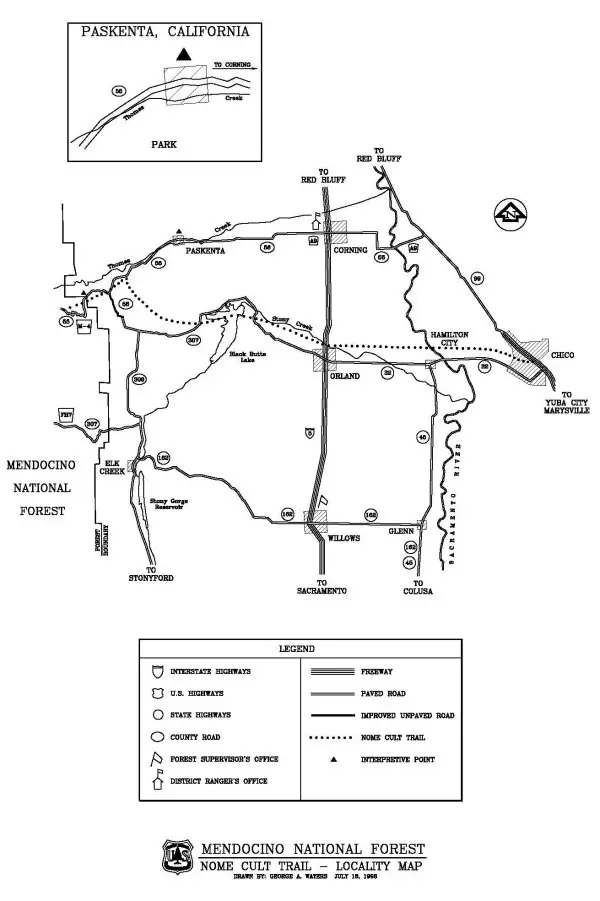
Although the path itself has disappeared, this route is now called the Nome Cult Trail. The most grueling part of the trail passed through what is now the Mendocino National Forest. The Forest Service has marked places where the Indians and their military escorts camped by placing interpretive signs along the route. The Forest Service has also prepared a free brochure and trail map which is available from Mendocino National Forest offices for persons who may want to travel the route.
This year the walkers, many of whom are descendants of those who made the trek in 1863, will begin west of Chico at at the Irvine Finch Park at River Road and State Highway 32 at 6 a.m. on Sunday, Sept. 9. They will walk west on State Highway 32 and camp at the Buckhorn Campground at Black Butte Lake the first night. For the remainder of the week they will walk across the Mendocino National Forest, following the Nome Cult Trail.
Their planned schedule is:
Monday, Sept. 10, camp at Paskenta (evening gathering at Grindstone Rancheria).
Tuesday, Sept. 11, camp at Black Bear Campground.
Wednesday, Sept. 12, camp at Log Springs.
Thursday, Sept. 13, camp at Wells Cabin Campground.
Friday, Sept. 14, camp at Eel River Campground.
Saturday, Sept. 15, walk into Round Valley.
The Round Valley Tribes will welcome the walkers with a gathering and potluck dinner at the Tribal Administration Building in Covelo on Saturday afternoon, Sept. 15.
For further information on the September 8 Paskenta event, please contact Kim Freeman, Paskenta Band of Nomlaki Indians at (530) 680-3842; or Phebe Brown at the Mendocino National Forest, (530) 934-3316, TTY (530) 934-7724. For further information on the Covelo event and the re-enactment walk, please contact Alberta Azbill at (707) 983-6126, Rema Lincoln at (707) 983-6188, EXT 30, at Round Valley Tribes; or Arlene Ward, Chico Mechoopda Tribe, at (530) 899-8922.
{mos_sb_discuss:2}

On Friday afternoon, Gov. Arnold Schwarzenegger signed into law a bill to help the state battle the light brown apple moth.
The bill, SB 556, the Light Brown Apple Moth Act of 2007, was authored by Sen. Patricia Wiggins.
When the light brown apple moth was discovered in the Bay area in late February 2007, it became the newest pest to make its way into the state.
Wiggins represents two counties – Napa and Solano – where the presence of the light brown apple moth has been confirmed, according to a statement from her office.
The light brown apple moth has not been found in Lake County, state and local officials report.
A second light brown apple moth discovery was made in Napa late in August, according to California Department of Food and Agriculture officials. The first moth was found in May in a residential area; Napa County agriculture officials said this second moth was found in a winegrape producing area.
In recent months agriculture officials have been working on eradicating the moth in Napa and Contra Costa counties by using pheromone treatments.
The US Department of Agriculture in August dedicated $15 million to aid California's eradication effort.
Originally from Australia, the moth has spread quickly across California, resulting in a multi-county quarantine by Food and Agriculture. The moth is considered a threat to 250 host species of native and ornamental plants, fruits, and vegetables.
Wiggins' bill would create the Light Brown Apple Moth Program in the CDFA, along with an LBAM account, from which the department may allocate funds to local agencies for activities to eradicate the moth, her office reported.
“LBAM destroys, stunts or deforms young seedlings, spoils the appearance of ornamental plants, and injures deciduous fruit tree crops, citrus, and grapes,” Wiggins said in a statement. “This pest poses a very serious threat to California agriculture, nurseries and related industries, and my bill will help ensure that our state and local agencies have he tools and resources they need to eradicate the LBAM before it can do any more damage.”
SBl 556, according to Wiggins' office, is patterned after the state’s Pierce's Disease/Glassy Winged Sharpshooter program, which was enacted several years ago in response to the pest's introduction and threat to the state's wine grape and table grape industry.
Exotic pests and diseases create environmental and financial havoc, not only to California's agricultural industry, but to the environment, as well. Due to increased global travel, relaxed federal inspections at ports of entry, and lack of funding for agricultural inspection stations, California has battled exotic pests and diseases with an increasing frequency, Wiggins' office reported.
The CDFA, in collaboration with county agricultural commissioners, inspects products and shipments entering the state, but due to the increasing volume and limited financial resources, not all products and shipments can be inspected, Wiggins reported.
State quarantine programs are coordinated with the U.S. Department of Agriculture, which Wiggins' office said recently acted to restrict the interstate movement of nursery stock, cut flowers and greenery from affected California counties and the State of Hawaii.
Due to this discovery and quarantine, both Canada and Mexico have prohibited certain shipments of flowers, fruits and other products within the quarantine zones and require inspections and phytosanitary certifications to accompany a variety of products from non-quarantine areas within California, according to Food and Agriculture.
The light brown apple moth already has caused significant economic harm to agricultural producers within the quarantine areas, as well as added costs and new regulatory pressures to all California producers who grow potential the moth's host commodities, Wiggins' office reported.
E-mail Elizabeth Larson at
{mos_sb_discuss:2}
On Sept. 7, Victor Junior Lovato, 32, was sentenced to six years in state prison for failing to register as a sex offender, according to a report from the District Attorney's Office.
Lovato has been required to register pursuant to Penal Code section 290 since he was convicted of four counts of felony child molestation in 1994, when he was sentenced to twelve years in prison.
Failing to register as a sex offender carries a maximum prison sentence of three years; however, Lovato also admitted to having been convicted of a prior felony strike offense, which served to double his prison commitment to a maximum of six years, the District Attorney's Office reported. Lovato will not be eligible for parole until he completes 80 percent of his prison sentence.
Detectives Martin Snyder and Richard Towle of the Clearlake Police Department investigated the case, which was prosecuted by Deputy District Attorney John R. DeChaine.
Lovato had last registered on Nov. 14, 2005, but failed to update his registration in November 2006, prompting the investigation.
Lovato has been in custody on this charge with bail set in the amount of $60,000.00 since July 23.
The Honorable Judge Steven Hedstrom presided over the taking of the guilty plea as well as the Sept. 7 sentencing hearing.
Lovato's picture and description are available on the Megan's Law Web site, www.meganslaw.ca.gov.
{mos_sb_discuss:2}
CHP Officer Adam Garcia said CHP dispatch received a call about 8:30 a.m. from some boaters who said they saw a motorcycle down an embankment just off Highway 20, west of Bruner Drive in the Kono Tayee area.
Garcia said the CHP's preliminary investigation indicates that the motorcyclist was riding at a high rate of speed heading westbound on Highway 20 and failed to negotiate a curve in the road.
The rider and motorcycle flew over the road edge and landed in a rocky area of Clear Lake's shoreline, said Garcia.
Garcia said it appeared that the rider – whose name has not been released pending family notification – died on impact, but the final determination will be made by a coroner's report.
The investigation, Garcia reported, is continuing, led by CHP Officer Brian Engle.
E-mail Elizabeth Larson at
{mos_sb_discuss:2}
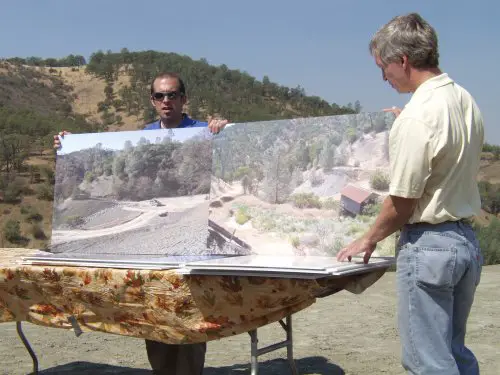
ABBOTT MINE – A massive mine cleanup project of two south county mercury mines begun last fall officially wrapped on Thursday.
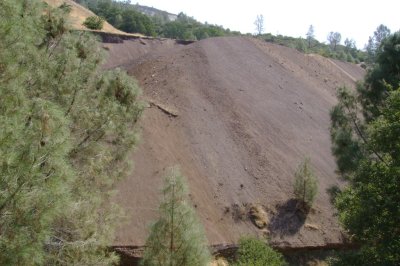
The Abbott and Turkey Run mines, minus the mountains of mine tailings and buildings that once marked the site along Highway 20 near Walker Ridge Road, were shown off Thursday by officials from El Paso Corp. of Colorado Springs, Colo., and the US Environmental Protection Agency.
The cleanup project began Oct. 10, 2006, said Clay Bowers, project manager for Camp, Dresser and McKee (CDM), the Cambridge, Mass.-based contractor that El Paso hired to complete the cleanup job.
Daniel Schnee, senior legal counsel for El Paso, said EPA's Region Nine Office, based in San Francisco, contacted El Paso in June 2006 to inquire if the company had ever conducted mining operations at the two mines.
El Paso's business is centered mostly in the southwest, where spokesman Richard Wheatley said they have some 43,000 miles of natural gas pipeline. That puts their current operations nowhere near Lake County.
However, Schnee said El Paso conducted an internal review and found that one of the subsidiaries it had purchased over the years, COG Minerals Corp., had, indeed, been responsible for mining operations at the site.
This wasn't the first mine cleanup El Paso has undertaken. Wheatley said the company also has been involved with cleanup of the famous Comstock Mine, which produced Nevada's silver Comstock Lode.
Schnee said the Abbott Mine claim was filed in 1866. There is some uncertainty about the Turkey Run's history, he added, although the company believes that the Turkey Run claim was filed in 1893. The two mines consolidated operations in 1900.
The mines were highly productive, yielding between 50,000 and 60,000 flasks of mercury during operation, which ceased in 1961, said Schnee. A flask is the size of a three-liter soda bottle and weighs 76 pounds.
The project gets started
Marc Ferries, El Paso's environmental remediation director, said the company was, at first, admittedly reluctant to spend the $5 million needed to carry out the cleanup.
However, he said El Paso's leadership decided it needed to be proactive and clean up the site, which also was in keeping with its corporate vision of being "the neighbor to have."
Schnee added that it came down to trust. "We are very conscious of the public's view of our company and our reputation means a lot to us."
By taking the lead on the project, El Paso also made a smart business decision financially.
EPA was poised to move forward with the cleanup, even if El Paso wasn't, said Schnee. Had the company chosen to contest its liability, Schnee said it would have resulted in an estimated cleanup cost three times the amount the company paid to do the work on its own.
So El Paso moved forward quickly, hiring CDM to lead the cleanup, said Schnee. El Paso Remediation Manager Bart Wilking; Janet Yocum, EPA's onsite coordinator; and Dale Evans of CDM, an expert in mine remediation, designed the project.
Schnee said work began only four months after EPA's initial contact with El Paso.
A unique factor to the cleanup is that El Paso, although held as a responsible party through its subsidiary holdings, doesn't actually own the property, said Schnee. There are now between four and six private owners who own the land through old mine patents passed down to them. Lake County News could not reach them for comment for this story.
El Paso had other challenges, said Evans, including unbelievably steep terrain, with grades as high as 52 degrees in some places.
And besides the mine they had to clean up 23 abandoned vehicles and tons of illegally dumped garbage, company officials reported.
There also was the matter of a squatter who had lived on the land for eight years and created a compound of sorts that included old trailers. Schnee said eventually the company reached a settlement with the man, who left.
Landscape a challenge
Pointing across the landscape, Evans said, "The terrain was obviously a challenge."
In some cases, it was a study in geometry, he said.
Much credit was given to CDM's heavy equipment operators, whose virtuoso skills on bulldozers helped carry out the work. Evans joked that the men were "part mountain goat"; so skilled were the operators that they were able to take the dozers down the incredibly steep slopes safely.
On the topic of safety, El Paso representatives on Thursday were very proud of the absence of any safety concerns or accidents as the project – which required 20,000 man hours – took place.
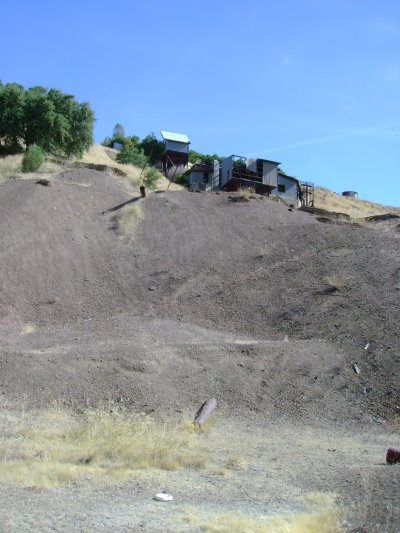
Evans explained that they removed tons of mine tailings – the waste left over after the mercury is extracted from the rock – from the hillsides and roads, including one mountain of tailings that had formed out from the natural hillside.
Bob Cornez, CDM's lead site construction supervisor, said they looked at the materials and judged whether they were leachable or nonleachable. If they were likely to leach mercury into the soil, those materials were removed completely, he said.
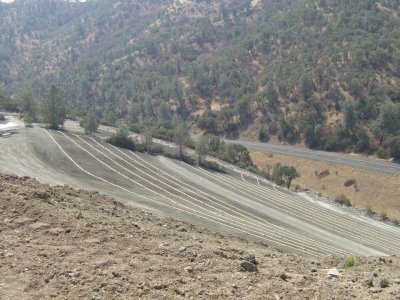
Mine tailings not considered a worry for leaching were capped with a 2-foot-thick layer of clean soil taken from nearby, Wilking said.
Materials considered to be hazardous were loaded, covered and trucked to a hazardous waste site in Nevada, said Wilking.
Cornez estimated that 50 truckloads of the hazardous materials were transported to Nevada.
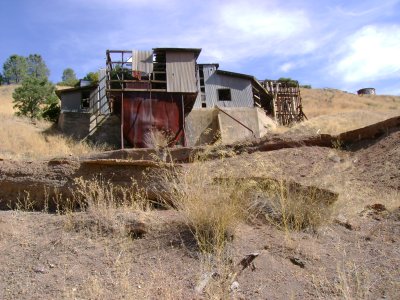
The mine's buildings, 30-ton furnace and ore bins – the latter considered major contributors to the site's mercury contamination – were completely removed, said Cornez.
Evans said the wooden structures had soaked up mercury and were contaminated.
However, 10 pieces of metal mining equipment that could be decontaminated were saved, said Cornez.
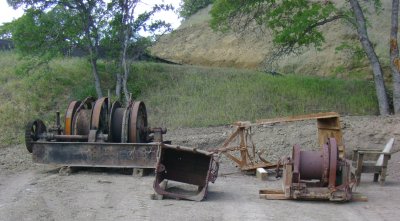
The Lake County Historical Society received several pieces of equipment, according to Greg Dills, who chairs the Historical Society's committee on the Ely Stage Stop Museum, where the equipment eventually will be displayed.
Included was a large winch for raising and lowering people into the mine shafts, a smaller winch, a drag line and a cage used for the ore cars, said Dills. “It's some nice old historic equipment of Lake County's mining.”
Confronting water quality issues
One of the most important aspects of the project was to stop mercury escaping from the site and going into Harley Gulch, at the base of the hillside where the mine was located.
An estimated 10.2 kilograms of mercury in the form of sediment was eroding from the site each year into Harley Gulch, said Wilking. Evans added that Harley drains into Cache Creek about eight miles from the mines.
"We've isolated all that mine waste," said Wilking, with the goal that no more mercury will leach into Harley Gulch or Cache Creek.
That's an important goal; a 2002 report on the Cache Creek Watershed noted that Cache Creek was a major source of mercury to the Bay-Delta, which it drains into.
Wilking said the excavation went down as far as the gulch's flow line; today the gulch is thoroughly riprapped with rock brought from local quarries.
The project was intended to withstand a 100-year flood event, but Evans surmised it could survive much more – possibly a 500-year or 1,000-year event, due in part to the size of the riprap used to secure the site's drainages and creeks.
Evans said they tried to spare as much vegetation and as many trees as possible during the cleanup.
The four to five mine entries, leading to shafts that in some areas led as far as 500 feet into the mountainside, are all now filled and capped, Evans added.
Regulator, company worked well together
El Paso officials cited a great working relationship with EPA, a situation that isn't common between companies and regulators.
"I could not have imagined how good the final project was going to look," said Yocum, who added that the project will greatly benefit the environment.
On behalf of EPA, Yocum thanked El Paso for taking the lead and jumping ahead of EPA's processes. "At every level it's been a great team to work with."
A question company officials couldn't answer is how the site will be monitored going forward. That, said Schnee, has yet to be determined, and could involve not just El Paso but state and federal officials.
Abandoned mines are no small problem for Lake County. Ferries reported that there were 14 mercury mines in the county's Sulphur Bank district.
David Lawler, coordinator of the Bureau of Land Management's (BLM) Abandoned Mine Lands Program in the California state office, said BLM was currently assessing cleanups of about 10 mines in the county. Lawler estimated that there are 100 mercury mines around Lake County.
The reason, said Lawler, is California's rich mineral deposits. "California has world-class mercury deposits," he said, adding that the state is home to the five largest mercury mines in North America.
Supervisor Ed Robey, one of several visitors to the mine site Thursday, thanked El Paso officials for completing the project. In comparison, he said there has been an ongoing battle over the cleanup of the Sulphur Bank mine.
That mine, which is owned by Bradley Mining, is an EPA Superfund site. Last year EPA completed the first phase of its cleanup of the site, which took place at the Elem Colony.
E-mail Elizabeth Larson at
{mos_sb_discuss:2}
A report from the Clearlake Police Department said officers arrested 49-year-old Robert Stuart Enos on Sept. 5 for kidnapping, false imprisonment, terrorist threats and assault with a deadly weapon.
The arrests, the department reported, resulted from an ongoing police investigation.
Enos allegedly kidnapped a 45-year-old woman on the evening of Sept. 1.
He is alleged to have taken the woman to his Clearlake residence, where he held her against her will, threatened and assaulted her with a deadly weapon. Police did not specify what weapon was used.
Clearlake Police reported Enos eventually released the woman, who had no physical injuries.
The woman contacted police, who began an investigation which included serving a search warrant on Enos' home. During the search police found evidence related to the alleged crime.
Enos was arrested and transported to the Lake County Jail, according to the report. He remains in jail on $60,000 bail.
Anyone with information on the case is asked to contact Sgt. Crandall at 994-8251.
{mos_sb_discuss:2}