 How to resolve AdBlock issue?
News
Justin Scott Vibbert, 28, of Nice was killed when his motorcycle went off Highway 20 and landed in some rocks down an embankment near Kono Tayee, according to California Highway Patrol Officer Adam Garcia.
CHP received a call reporting the crash at about 8:30 a.m., Garcia reported.
As Lake County News previously reported, CHP's investigation has so far shown that Vibbert, who was riding at a high rate of speed westbound along Highway 20, lost control while going through a curve.
Vibbert, a glass artist originally from the Midwest, had contact with the CHP over the July 4 weekend. Sheriff's logs show that he had been arrested on two felony drug possession charges and was booked into the Lake County Jail on July 5.
Garcia said the collision investigation, led by CHP Officer Brian Engle, is continuing.
E-mail Elizabeth Larson at
{mos_sb_discuss:2}
The Department of Labor filed the lawsuit in November 2004 against Local 38 of the United Association of Plumbers, Pipefitters and Journeymen, whose Convalescent Trust Fund, Lakeside Haven, has owned Konocti Harbor since 1959.
Labor Secretary Elaine Chao alleged that Local 38 had used pension funds “imprudently” by investing millions in the operation of Konocti Harbor.
James P. Baker of the San Francisco-based Jones Day law firm was the lead attorney for Local 38 in the suit.
“Everybody is happy to have this dispute resolved and it was resolved amicably,” said Baker.
He added, “My clients didn't admit they did anything wrong and I don't think they did anything wrong.”
Baker said the underlying lawsuit was specifically related to whether or not the union should have invested in Konocti Harbor.
“That's going to prove out to be a pretty good deal,” said Baker.
As part of the settlement, Local 38 agreed to appoint WhiteStar Advisors LLC as an independent fiduciary to oversee the resort's sale, said Baker.
WhiteStar, he said, “had been working for us for over two years by the time of the settlement” on the resort sale. “We were already doing the right thing.”
Baker said Local 38 decided to sell the resort in the last few years.
“The thrill was gone from being in lawsuits with the Department of Labor,” which Baker said have been ongoing since 1979.
Baker said the Department of Labor has investigated Local 38 five times about the same question – whether or not Konocti Harbor was a good investment for the pension funds.
It was in everyone's best interest to settle the case, said Baker, adding that the union felt it had a number of good defenses.
Baker joined Local 38 not long before this current lawsuit was filed, he said.
Lawrence Mazzola Sr., son of labor leader Joe Mazzola, remains the union's business manager, but will resign as a pension fund trustee by year's end as a condition of the settlement, as will most of the other trustees, said Baker.
Lawrence Mazzola Jr. and another trustee are the only two being allowed to stay on as trustees, which was “one of the big bones of contention,” said Baker. The two men must undergo fiduciary training in order to continue in their trustee capacity, according to the settlement terms.
If and when Konocti Harbor sells, Baker said Local 38 will still have a presence in the county. “They're going to keep about 10 acres on the lake for a kids camp and recreation area,” he said.
Labor Department describes its role
Wayne Berry, one of the Department of Labor attorneys on the case, said he and colleagues Peter Doland and Megan Guenther took over for a retiring attorney who had originally been assigned the lawsuit.
Berry said the Department of Labor had sued Joe Mazzola and many of the other pension fund trustees in the early 1970s not long after the Employee Retirement Income Security Act (ERISA) was established. That law is meant to oversee how retirement plans are managed.
That original lawsuit, said Berry, was for loan-type transactions, and was not directly related to Konocti Harbor.
In that case, he said, Local 38 hired a doctor to do a feasibility study for a spa at Konocti Harbor. The union borrowed against the resort to get a loan to pay for the study.
It came out at trial that the doctor had no ability to do a feasibility study of how worthwhile it would be to add a spa to the resort, said Berry.
The 2004 lawsuit settled recently didn't involve loans but undocumented, unsecured transfers of cash from Local 38's pension fund to its Lakeside Haven Convalescent Trust Fund, which owns Konocti Harbor.
Berry said there have only been the two lawsuits between the Department of Labor and Local 38 relating to pension plans, although the government has investigated the union on other occasions.
The 1970s lawsuit went on for some time, said Berry. “After we won at trial they appealed at the Ninth Circuit.”
The case eventually went to the Supreme Court, where Local 38 lost the case, Berry said.
Fund was suffering annual losses
Berry said Local 38 needed to show that its investment in Konocti Harbor followed ERISA's rules for prudent use of pension plan money.
The Convalescent Trust Fund's operations, including Konocti Harbor, usually lost about half a million dollars a year, said Berry. Department of Labor spokesperson Gloria Della added that the Convalescent Trust Fund itself was not an ERISA fund.
The lawsuit alleged Local 38 had transferred $36 million from the pension funds to the Convalescent Fund for Konocti Harbor's operations and improvement.
Guenther said the Department of Labor's investigation found that between 1994 and 2004 the union had transferred a total of $54 million to the Convalescent Trust Fund.
“One of the big problems in this case is it's so hard to track that stuff down because there were no records,” Berry said.
While Local 38 has hired WhiteStar to sell the property, Berry pointed out, “The consent order itself does not have any language that says the resort must be sold.”
The Department of Labor doesn't have the power to make that demand, he said.
However, he added, “Part of the recovery that the ERISA plan is going to get is the proceeds of the sale,” which is the only asset the union has to make up the money.
Local 38 also will be reimbursed for a $4 million loan it made to the Convalescent Trust Fund in 2000, when the Convalescent Trust Fund was hit with a foreclosure action on a loan for which Konocti Harbor was the security, Berry explained.
Berry said numerous appraisals of the resort were completed for the lawsuit, with the main one used for the trial in the $11 million to $13 million range.
Court documents show that Page Mill Properties of Palo Alto is a possible buyer for the property. The possible purchase price, the documents report, is $25 million.
Berry said he felt the case moved through the courts in a normal, even quick manner. The more than $500,000 Local 38 was required to pay the government was a civil penalty established by statute, he said.
Della said that, as a general rule, the Department of Labor doesn't point to any one source for the basis of an investigation like this one. Rather, she said, cases are derived from a variety of sources, including informal and random looks at ERISA funds and concerns from people who administer the plans.
However, in the Local 38 suit, the case was referred to the Department of Labor by the Internal Revenue Service. Court documents Della referenced show that the IRS began an audit of Local 38's pension plan in November 1999, when it referred the plan for investigation of possible fiduciary breaches.
E-mail Elizabeth Larson at
{mos_sb_discuss:2}

NICE – Riders brought out their bikes for a good cause on Saturday, as Lake County Special Olympics hosted the fourth annual Scorchin' Torch Poker Run to benefit its spirited young athletes.
Event coordinator Kristina Navarro reported that 126 riders participated in the 83-mile, five-stop course around the lake, which began in the morning at Robinson Rancheria Resort and Casino.
Also on scene were California Highway Patrol Officer Adam Garcia and CHP Commander Lt. Dane Hayward. Hayward was a civilian for the event and a participant in the ride.
Cash prizes and gift certificates were donated by more than two dozen Lake County businesses, Navarro reported.
As a result of the excellent turnout more than $4,500 was raised to help 120 Lake County Special Olympics athletes, according to Navarro.
E-mail Harold La Bonte at
{mos_sb_discuss:2}


The US Geological Survey reported that the quake occurred at 5:19 a.m. at a depth of 1.6 miles four miles northwest of The Geysers and eight miles west of Cobb.
The US Geological Survey received reports from residents who felt the quake from Santa Rosa and Cloverdale to Lakeport, and even as far away as Vacaville.
A 2.9-magnitude quake had occurred Saturday at 11:29 p.m. at a depth of less than a mile two miles west of Anderson Springs and five miles east southeast of The Geysers.
The last quake measuring in magnitude of 3.0 or above occurred Aug. 19 near Anderson Springs, according to the US Geological Survey.
A 4.4-magnitude earthquake hit the North Coast Saturday at 1:16 a.m., the US Geological Survey reported. That quake's center was in the ocean, 20 miles west of Petrolia in Humboldt County. Residents in faraway San Francisco even reported feeling that quake.
E-mail Elizabeth Larson at
{mos_sb_discuss:2}
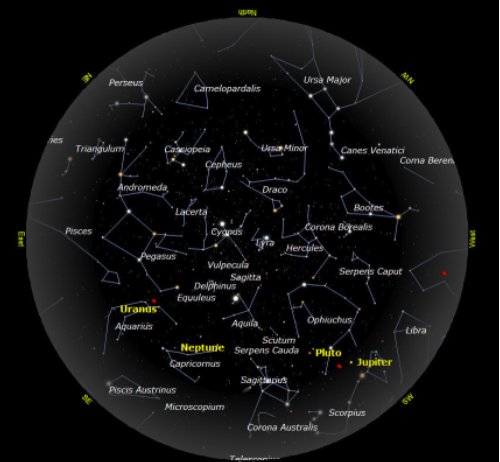
Lake County has some of the clearest, darkest skies in the country – perfect for stargazing! In this monthly column, we’ll talk about some of the things you can see during September nights.
Let’s start by looking at a star chart for September. The chart above is what the night sky will look like around Sept. 15 at around 9 p.m.
If you recall from last month, we mentioned the “Summer Triangle” made up of the bright stars Vega (in the constellation Lyra), Deneb (in the constellation Cygnus) and Altair (in the constellation Altair). This month, this trio of luminaries has moved directly overhead – you can see them in the star chart.
There are also four planets visible this month. Jupiter, the largest of the planets, is setting in the western sky – it’s the brightest object in that direction.
Next to Jupiter is Pluto, the “un-planet.” Up until the fall of 2006, Pluto was considered to be a planet. But this changed when the definition of the term “planet” changed, and Pluto was relegated to “dwarf planet” status. In spite of this change, we still affectionately refer to Pluto as a planet. As for viewing Pluto, you need a very large, powerful telescope, and even then, it will only appear as a faint point of light.

The other two visible planets are Neptune and Uranus. Both need a telescope to see. Neptune is bluish in color, and Uranus is greenish. Both appear very small through a telescope. Jupiter, Neptune and Uranus are what we term “gas giants.” They are huge balls of gas – they aren’t solid like our earth.

Uranus has a ring system similar to Saturn’s. Neptune has a beautiful blue tinted atmosphere. That beautiful color isn’t from water – it’s from methane gas, the kind of stuff cows produce (and no, there are no cattle ranches on Neptune!).

As for Pluto, even our most powerful telescopes take pictures that reveal very little detail, as shown in the photo at the left. Pluto is just too small and too far away to reveal very much.
To learn more about Lake County Skies in September, and to observe these objects through a telescope, visit Taylor Observatory (www.taylorobservatory.org) on Saturday, Sept. 15, from 8 to 11 p.m. This month’s observatory theme is “Global Warming – is Man destined to end up like the dinosaur?” After a presentation about global warming, there will be a planetarium show, followed by telescope viewing.
John Zimmerman has been an amateur astronomer for 50 years. He is a member of the Taylor Observatory staff, where, among his many duties, he helps create planetarium shows.
{mos_sb_discuss:2}
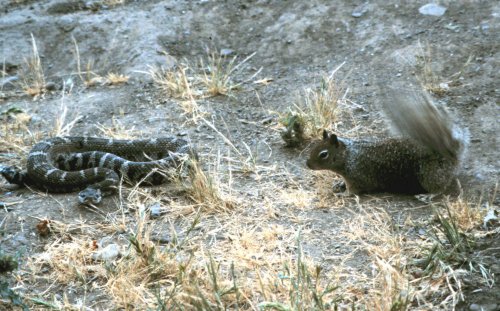
Rattlesnakes do not have it easy. Although they have evolved a characteristic ‘rattling’ warning system to advertise their dangerous venomous bites, these snakes are so feared and hated by humans they are often killed on sight. And, if their situation could not get any worse, Northern Pacific rattlesnakes also have to contend with their favorite prey item – California ground squirrels.
Rattlesnakes and ground squirrels co-occurred millions of years ago, leading to an ancient and intimate predator-prey relationship. Currently, there are about 30 species of ground squirrels in the western US and, for those in rattlesnake habitat, evolving methods to evade these rattlesnake predators was a strong source of natural selection.
In particular, California ground squirrels have evolved an amazing array of anti-rattlesnake behavior and physiology. Back in the 1940s naturalists noted some strange behavior in California ground squirrels – they would go straight up to rattlesnakes, waving their tails and kicking up dust. These naturalists knew that ground squirrels made up almost seventy percent of the northern pacific rattlesnake diet, so why would these prey animals put themselves into harm’s way?
Professor Donald H. Owings at UC Davis and his colleagues managed to explain this puzzling behavior and found that California ground squirrels are actually resistant to rattlesnake venom. Thus the danger of succumbing to a rattlesnake bite does not exist; at least for adult ground squirrels.
Juvenile ground squirrels were shown not to have enough of the venom resistance protein needed to survive a snake bite. This created a unique predator-prey relationship: rattlesnakes could kill and eat young ground squirrels but not the adults.
However, adult female ground squirrels are very protective of their pups and have evolved a sophisticated alarm call system to warn other squirrels of impending danger: a high pitched whistle to warn of aerial predators and a chattering call for terrestrial predators. But these alarm calls might also communicate to predators that they have been spotted and their ambush tactics will fail.
The calls do not, however, work against rattlesnakes. Rattlesnakes have amazing visual and chemosensory systems and can even perceive temperature changes – but they cannot hear. Thus ground squirrel adults attempting to protect their young by calling at a snake will not be heard. So, instead of an audible warning, ground squirrels have apparently keyed in on the rattlesnake’s most sensitive sensory organs – visual, infrared, and olfactory.
When a rattlesnake is discovered, ground squirrels will approach cautiously, bobbing their heads up and down to size up the snake and waving their long tails back and forth – termed ‘tail-flagging’ – the visual equivalent of an alarm call. Snakes seeing this motion are being told they have been spotted. In addition, recent studies by our research group have demonstrated that ground squirrels can actually heat up their tails during rattlesnake encounters, creating an infrared beacon to further get their message across.
Once the ground squirrel has moved closer, they begin ‘substrate throwing,’ flinging dirt and causing the snake to rattle. This behavior by the squirrel is not just to antagonize the snake, it turns out that the squirrel can determine how big and how warm the rattlesnake is by the frequency of its rattle. A large, warm snake is more dangerous than a small, cold one since warm rattlesnakes move faster and larger snakes have a stronger strike.
These harassment tactics are also thought to drive the snake out of the area and away from the younger and more vulnerable squirrels.
Ground squirrels cannot always be on the alert, however, especially at night when they are asleep in their burrows and when rattlesnakes seem to prefer to hunt. Nevertheless, there is some recent evidence that they have evolved yet another unique defense mechanism.
When California ground squirrels, particularly adult females and juveniles, come across a rattlesnake skin or a patch of grass where a rattlesnake has been resting, they chew on the snake-scented substance and apply it to their fur by licking their bodies. Why would they do this? Finding the answer to this question became the focus of my PhD research.
We had three hypotheses. First, the squirrel may fool predators sniffing around a burrow by smelling like a rattlesnake instead of a squirrel. Second, the predator scent may cause other ground squirrels to leave the area and not compete for food. Finally, applying scent to their bodies might repel the ground squirrels major parasite – fleas.
In a series of experiments, we found that ground squirrel scent mixed with rattlesnake scent reduced rattlesnake foraging behavior but had no effect on ground squirrels or fleas. Therefore, a sleeping adult female ground squirrel and her young might prevent a hungry rattlesnake from entering their burrow at night by applying snake scent to their bodies.
Even with all their defenses, rattlesnakes still get their fill of ground squirrel juveniles and, over millions of years, have not become endangered by these anti-snake tactics. Many rattlesnake species across the country are, however, threatened by humans.
As urban development and agriculture move into rattlesnake habitat, there is an increase in human encounters with rattlesnakes. Due to the fear and hatred felt for these snake species, humans often reflexively kill “rattlers,” including at organized events, or ‘rattlesnake roundups’ at which snakes are killed by starvation, crushing, skinning or other cruel and often horrifying ways in a public setting.
Though caution is appropriate when in an area where rattlesnakes can be found, rattlesnakes are not aggressive and will normally prefer to stay out of sight, and even rattle to warn about their presence. In fact, medical research shows that most rattlesnake bites are caused when a human picked up or provoked a rattlesnake.
If you encounter a rattlesnake in the field, respect its space, and if you find one in your yard think twice before killing it and instead about how you could change your behavior so you and the rattlesnake can safely coexist.
Barbara Clucas is a PhD student in the Animal Behavior Graduate Group at UC Davis and has been studying rattlesnakes and ground squirrels for 5 years. Tuleyome Tales is brought to you by: Tuleyome, a local non-profit working to protect both our wild heritage and our agricultural heritage for future generations. Past Tuleyome Tales articles are available in the library section of their website. www.tuleyome.org.
{mos_sb_discuss:2}