 How to resolve AdBlock issue?
News
The study, published in JAMA Pediatrics, is the first scientific inquiry into whether infants are at increased risk of neurodevelopmental impairments as a result of maternal vaccination.
The landmark study of more than 2,200 infants from across the country found that in utero exposure to the vaccine caused no abnormal delays when the infants were tested at 12 months and again at 18 months.
“This is a very reassuring finding — pregnant women have been facing unanswered questions around COVID vaccinations for several years,” said first author Eleni Jaswa, MD, MSc, a reproductive endocrinologist and fertility specialist at UCSF Health, noting the investigation started in April 2020. She is also an assistant professor in the UCSF Department of Obstetrics, Gynecology & Reproductive Sciences.
First meaningful evidence of maternal vaccination safety during pregnancy
Although pregnant women are considered at increased risk of severe illness with COVID-19, some chose not to get the COVID vaccine due to safety concerns around potential risks to their unborn children.
Some 34% of the participants in the study were vaccinated in the first trimester, about 45% in the second trimester, and nearly 21% in the third trimester. They were asked to complete a 30-item questionnaire assessing whether their infants performed expected milestones.
After adjusting for such factors as maternal age, race, ethnicity, education, income and maternal depression, the researchers found no difference in the risk of infant neurodevelopment at either 12 months or 18 months. They noted an increased risk of delay among male infants at 12 months but the difference was not observed at 18 months.
The study is ongoing.
“Understandably, there’s been concern about the potential impact of maternal vaccination on offspring,” said senior author Heather Huddleston, MD, a UCSF Health reproductive endocrinologist and director of the UCSF Polycystic Ovary Syndrome Clinic, or PCOS.
“Despite early safety data as well as recommendations from physicians and health organizations, vaccine hesitancy is still preventing universal use,” she said. “To this day, misinformation continues to abound. People are concerned about such issues as brain development and conditions like autism in children. This is the first meaningful evidence into the safety of vaccination from the standpoint of early offspring neurodevelopment.”
Co-authors: All from UCSF, the paper’s co-authors are Marcelle Cedars, MD; Karla Lindquist, PhD; Somer Bishop, PhD; Young-Shin Kim, MD, MPH, PhD; Amy Kaing, MD; Mary Prahl, MD; Stephanie Gaw, MD, PhD; Jamie Corley, BS; Elena Hoskin, MS; Yoon Jae Cho, MD; and Elizabeth Rogers, MD.
Elizabeth Fernandez writes for the University of California, San Francisco.
In a unanimous vote, the supervisors approved creating the “Big Valley Advisory Council,” which is scheduled to hold its first meeting on April 17. The supervisors are expected to come back in two weeks to approve applicants, who are urged to submit their applications by March 27.
There will be five regular members and one alternate, serving two-year staggered terms.
Applications can be found here.
Due to being created by the Board of Supervisors, the new council will be required to operate in accordance with the Brown Act. It is scheduled to meet at the Kelseyville Event Center, also known as the senior center, which the county of Lake is in the process of buying, a plan Supervisor Jessica Pyska promoted.
The council will not represent the entire Kelseyville area, but will cover the Kelsyville planning area, which also includes a portion of Lakeport.
It will not include the Kelseyville Rivieras, as Sabrina Andrus, a business owner and part of the steering committee for the creating the council, said the Rivieras already have representation through their homeowners associations. Pyska said she is encouraging the Riveras to form their own municipal advisory council.
While the board originally was to consider naming the new organization the Kelseyville Advisory Council, at the suggestion of the Citizens for Healing — the group that applied in the fall to the U.S. Board of Geographic Names to rename Kelseyville to “Konocti” — the supervisors chose to name it the Big Valley Advisory Council.
Supervisor Michael Green, whose district the council will partly cover, brought the suggestion forward to the board.
Lucerne resident Alan Fletcher, a Citizens for Healing member, thanked the board for accepting his suggestion to name the council “Big Valley” rather than “Kelseyville, a move which he said is more inclusive.
However, while board members like Moke Simon said he considered the name more inclusive and open, it’s also likely to be more confusing, considering that, based on the Kelseyville planning area map, Big Valley only covers about a quarter of the larger Kelseyville planning area that the council is supposed to represent. It runs from Merritt Road in the south to the lakeshore in the north.
Fletcher’s suggestion appeared to have been submitted on Monday night to the board through its ecomment section on the county website.
“I endorse the formation of a MAC, to remove the discussion of area matters from the members-only Kelseyville Business Association (KBA ) and a private Facebook page. As a participant in citizensforhealing.org, we noted the lack of a MAC in our proposal to ‘Rename Kelseyville to Konocti,’ wrote Fletcher.
“The proposer is surely aware by now that the name of ‘Kelseyville’ is being reviewed by the U.S. Board on Geographic Names, and has just been referred to the California Advisory Committee on Geographic Names,” Fletcher wrote. “I therefore believe that it should have a less specific, and potentially less provocative name.”
In an earlier version of the comment, Fletcher wrote, “Save the Name of Kelseyville (SNK) and the Kelseyville Business Association (KBA ) seem to be determined to stamp the offensive name on everything (a new sign, and fund-raising for an arch) … and will then quote the expense of changing them.”
Fletcher also asked the board to consider changing the area plan’s name to Big Valley instead of Kelseyville.
He was accompanied to the meeting by fellow Citizens for Healing group members Verge Belanger, an Upper Lake resident, and Lorna Sue Sides, who manages the Kelseyville Event Center. Belanger and Sides also spoke in favor of that council’s name change and conflated that action with the overall proposal to change the name of Kelseyville.
Group works to establish council
“The community has decided that it is time to establish a municipal advisory council in the Kelseyville area,” said Pyska.
Andrus and Brian Hanson are part of a group that got the effort off the ground.
“The hope for the group from the get-go was to provide an additional space for Kelseyville residents to come together, talk about issues that impact the community,” said Andrus, adding that the catalyst was the timing with the general plan and Kelseyville area plan, which needs to be updated.
In response to questions from Lake County News, Andrus said the effort started Jan. 12 when she sent out an email to a group of Kelseyville residents to discuss forming the council. The group that actually drafted the bylaws included Sabrina Andrus, her sister Caitlin Andrus, Brian Hanson, Greg Panella, Joy Merrilees, Megan Lankford, Rick White, Weston Seifert and Angel Acosta.
Hanson said they reviewed the bylaws of the six other municipal advisory councils in the county.
Those include the Middletown Area Town Hall, the first to be established in December 2006, as well as the Cobb Municipal Advisory Council, Scotts Valley Advisory Council, Western Region Town Hall, East Region Town Hall and the Central Region Town Hall, formerly known as the Lucerne Area Town Hall, which Supervisor EJ Crandell disbanded and reformed after community pushback over a homeless shelter plan for the historic Lucerne Hotel proposed by the Scotts Valley Pomo that came to light in December 2022.
Board Chair Bruno Sabatier said he found it “awkward” that the majority of the area is in District 4 but is titled as an advisory council to District 5. He also urged them to add a seat specifically for the Big Valley Rancheria.
“Because of the thousands of emails that we have received with what’s going on in Kelseyville, and I’ll leave it at that, this also covers the Big Valley area, the sovereign nation of Big Valley, and I would say, offer a seat, because everything that happens in that area has impact to our neighboring communities,” he said.
Pyska suggested working with Green to collaborate with the group. “I always believe that these municipal advisory councils come organically up from the community and I would like to respect that this is what they want to do and I feel like the two supervisors could join together and work collaboratively. We could both support the meeting. We could both be there to report out on what’s going on,” she said.
Rick White, one of the drafters of the bylaws, told the board he supported the Big Valley name for the group and said they have a lot of young people who want to be involved.
Sides thanked Pyska for putting forward the council plan and Green for bringing up its name change, adding she wanted to push out the western border to include more of the Big Valley Rancheria.
The Scotts Valley Pomo also asked for a seat, with tribal leader Gabriel Ray saying they own property and have tribal members who live in the area.
“We’re working on the name change,” he said, referring to the larger Kelseyville name issue, and said he was concerned the group’s formation was a backdoor way of getting around the name change.
Jeanine Pfeiffer, another member of Citizens for Healing, complained about not knowing about the advisory council proposal until that same day and that more public outreach was needed.
Ron Montez Sr., a Big Valley elder and historic preservation officer, also supported naming the council for Big Valley. He said inclusivity is something they have been seeking for years and that it’s been a stumbling block in the Kelseyville community and around the lake.
Sarah Ryan, environmental director for Big Valley Pomo, wanted them to waive the residency requirement because it would limit who the Big Valley tribal leadership could select to represent them on the council. Ryan also said the map seemed “arbitrary,” with multiple tribal-owned parcels not on it.
“We have to start somewhere and so this is the starting point,” Pyska said.
“Or the starting point that is proposed,” Sabatier said.
Andrus said the Kelseyville name change has not been a part of the conversation for the group that put together the council’s bylaws. Rather, she said their goal has been to draft a resolution, create bylaws and get them to this point.
Sabatier said they will be looking at diversity and inclusion in selecting council members.
Simon warned the group that the Brown Act “is a pain in the butt” to deal with. “It complicates things as much as it helps things out with these advisory committees.”
Pyska offered the resolution, with the name amended. The board approved it 5-0.
Email Elizabeth Larson at
The board will meet on Thursday, March 14, at the Lake County Campus of Woodland Community College, 15880 Dam Rd Extension, Rooms 209 to 211.
A closed session will be held beginning at 3 p.m., with the regular board meeting at 5 p.m.
Members of the public may opt to attend this meeting virtually. The Zoom link is https://yccd-edu.zoom.us/j/85289077257; the meeting ID is 852 8907 7257. The call-in number is +1 669 900 6833.
To access the YCCD Governing Board meeting agendas, please visit
https://go.boarddocs.com/ca/yccd/board.nsf/public#.
On Thursday, the board will consider extending the employment of the interim director of the Health and Medical Career Program and nursing, and as well as the extension and conversion of the employment of the college’s acting director of institutional effectiveness.
They also will discuss nonresident tuition, the STEM building modernization, easement dedications, the elimination of three full-time equivalent college police officer positions, the 2022-23 Audit Response Plan and a number of reports.
Email Elizabeth Larson at
The commission will meet at 5:30 p.m. Wednesday, March 13, in the council chambers at Lakeport City Hall, 225 Park St.
The council chambers will be open to the public for the meeting. Masks are highly encouraged where 6-foot distancing cannot be maintained.
The agenda is available here.
To speak on an agenda item, access the meeting remotely here; the meeting ID is 814 1135 4347, pass code is 847985.
To join by phone, dial 1-669-444-9171; for one tap mobile, 16694449171,,81411354347#,,,,*847985#.
Comments can be submitted by email to
On the agenda is the annual progress report for the housing element.
Commissioners also will discuss the planning department and commission goals for this year.
Email Elizabeth Larson at
Climate change matters to more and more people – and could be a deciding factor in the 2024 election
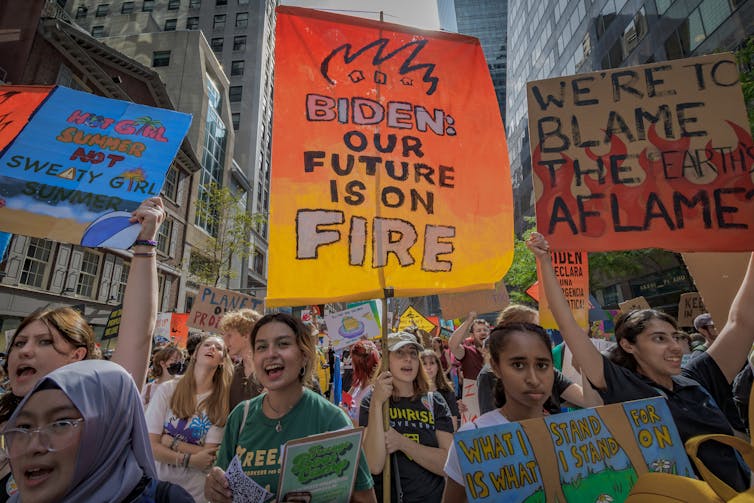
If you ask American voters what their top issues are, most will point to kitchen-table issues like the economy, inflation, crime, health care or education.
Fewer than 5% of respondents in 2023 and 2024 Gallup surveys said that climate change was the most important problem facing the country.
Despite this, research that I conducted with my colleages suggests that concern about climate change has had a significant effect on voters’ choices in the past two presidential elections. Climate change opinions may even have had a large enough effect to change the 2020 election outcome in President Joe Biden’s favor. This was the conclusion of an analysis of polling data that we published on Jan. 17, 2024, through the University of Colorado’s Center for Social and Environmental Futures.
What explains these results, and what effect might climate change have on the 2024 election?

Measuring climate change’s effect on elections
We used 2016 and 2020 survey data from the nonpartisan organization Voter Study Group to analyze the relationships between thousands of voters’ presidential picks in the past two elections with their demographics and their opinions on 22 different issues, including climate change.
The survey asked voters to rate climate change’s importance with four options: “unimportant,” “not very important,” “somewhat important” or “very important.”
In 2020, 67% of voters rated climate change as “somewhat important” or “very important,” up from 62% in 2016. Of these voters rating climate change as important, 77% supported Biden in 2020, up from 69% who supported Hillary Clinton in 2016. This suggests that climate change opinion has been providing the Democrats with a growing electoral advantage.
Using two different statistical models, we estimated that climate change opinion could have shifted the 2020 national popular vote margin (Democratic vote share minus Republican vote share) by 3% or more toward Biden. Using an Electoral College model, we estimated that a 3% shift would have been large enough to change the election outcome in his favor.
These patterns echo the results of a November 2023 poll. This poll found that more voters trust the Democrats’ approach to climate change, compared to Republicans’ approach to the issue.
What might explain the effect of climate change on voting
So, if most voters – even Democrats – do not rank climate change as their top issue, how could climate change opinion have tipped the 2020 presidential election?
Our analysis could not answer this question directly, but here are three educated guesses:
First, recent presidential elections have been extremely close. This means that climate change opinion would not need to have a very large effect on voting to change election outcomes. In 2020, Biden won Georgia by about 10,000 votes – 0.2% of the votes cast – and he won Wisconsin by about 20,000 votes, 0.6% of votes cast.
Second, candidates who deny that climate change is real or a problem might turn off some moderate swing voters, even if climate change was not those voters’ top issue. The scientific evidence for climate change being real is so strong that if a candidate were to deny the basic science of climate change, some moderate voters might wonder whether to trust that candidate in general.
Third, some voters may be starting to see the connections between climate change and the kitchen-table issues that they consider to be higher priorities than climate change. For example, there is strong evidence that climate change affects health, national security, the economy and immigration patterns in the U.S. and around the world.
Where the candidates stand
Biden and former President Donald Trump have very different records on climate change and approaches to the environment.
Trump has previously called climate change a “hoax.”
In 2017, Trump withdrew the U.S. from the Paris Agreement, an international treaty that legally commits countries to reduce their greenhouse gas emissions.
Biden reversed that decision in 2021.
While in office, Trump rolled back 125 environmental rules and policies aimed at protecting the country’s air, water, land and wildlife, arguing that these regulations hurt businesses.
Biden has restored many of these regulations. He has also added several new rules and regulations, including a requirement for businesses to publicly disclose their greenhouse gas emissions.
Biden has also signed three major laws that each provides tens of billions in annual spending to address climate change. Two of those laws were bipartisan.
On the other hand, the U.S. has also become the world’s largest producer of oil and gas, and the largest exporter of natural gas, during Biden’s term.
In the current campaign, Trump has promised to eliminate subsidies for renewable energy and electric vehicles, to increase domestic fossil fuel production and to roll back environmental regulations. In practice, some of these efforts could face opposition from congressional Republicans, in addition to Democrats.
Public opinion varies on particular climate policies that Biden has enacted.
Nonetheless, doing something about climate change remains much more popular than doing nothing. For example, a November 2023 Yale survey found 57% of voters would prefer a candidate who supports action on global warming over a candidate who opposes action.
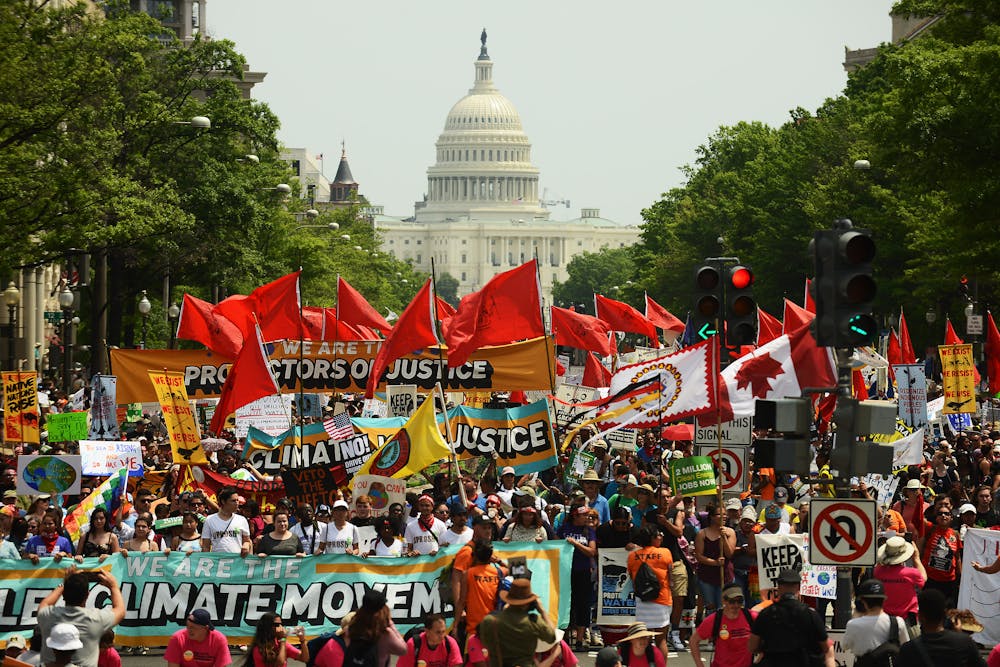
What this means for 2024
Our study found that between the 2016 and the 2020 presidential elections, climate change became increasingly important to voters, and the importance voters assign to climate change became increasingly predictive of voting for the Democrats. If these trends continue, then climate change could provide the Democrats with an even larger electoral advantage in 2024.
Of course, this does not necessarily mean that the Democrats will win the 2024 election. For example, our study estimated that climate change gave the Democrats an advantage in 2016, and yet Trump still won that election because of other issues. Immigration is currently the top issue for a plurality of voters, and recent national polls suggest that Trump currently leads the 2024 presidential race over Biden.
Although a majority of voters currently prefer the Democrats’ climate stances, this need not always be true. For example, Democrats risk losing voters when their policies impose economic costs, or when they are framed as anti-capitalist, racial, or overly pessimistic. Some Republican-backed climate policies, like trying to speed up renewable energy projects, are popular.
Nonetheless, if the election were held today, the totality of evidence suggests that most voters would prefer a climate-conscious candidate, and that most climate-conscious voters currently prefer a Democrat.
Matt Burgess, Assistant Professor of Environmental Studies, University of Colorado Boulder
This article is republished from The Conversation under a Creative Commons license. Read the original article.
The crash occurred shortly after 10 p.m. Sunday on Butte Street in Nice, according to a report from the California Highway Patrol’s Clear Lake Area office.
The names of the two men who died — the 39-year-old driver from Nice and the 34-year-old passenger from Upper Lake — were not immediately released pending the notification of next of kin.
The CHP said that at 10:18 p.m. Sunday CHP Officer Officer Zachary Cornell was dispatched to a solo vehicle traffic crash involving a red 2021 Subaru WRX that hit a fence and landed in a swimming pool at a residence on Tehama Street.
Radio reports indicated that the vehicle landed upside down in about six feet of water, with the individual who called the CHP indicating that they couldn’t get those inside of the vehicle out of it.
Shortly after the crash, the Northshore Dive Team was requested to respond to the team to assist with the rescue, according to radio reports.
The CHP said that its investigation so far has found that the Subaru was traveling on Butte Street when it went over the embankment.
Neither the driver nor the passenger, who was found in the rear seat, were wearing seat belts, at the time of the crash, the CHP said.
The cause of the collision is still under investigation, however, the CHP said in its preliminary statement on the crash that alcohol use is suspected to be a factor.
Along with the CHP and Northshore Fire Protection District, the Lake County Sheriff’s Office and All in One Towing responded to the scene to assist with the crash recovery.
Email Elizabeth Larson at