 How to resolve AdBlock issue?
News
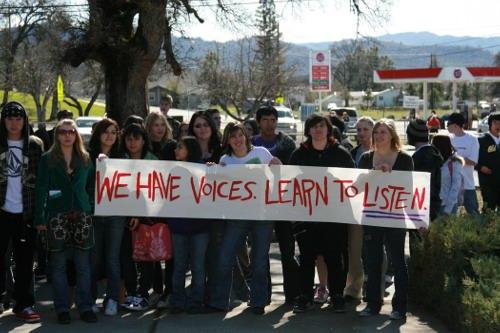
KELSEYVILLE – Following a district school board meeting earlier this week to accept an interim budget, a group of Kelseyville High students held a march to their district office to share their own concerns about what the future holds for education.
It was at about 1:15 p.m. on Friday that the group of well over 100 students – carrying a banner that said, “We have voices. Learn to listen” – marched down the hill from Kelseyville High and approached the Kelseyville Unified School District Office.
The sentiment among the participating students was that they wanted to protect their education. One female student urged her peers to show respect to administrators and teachers, and they could expect respect in return.
District Superintendent Boyce McClain, who has headed the district for nine and a half years, was there to welcome the students and speak with them.
Before the students appeared, McClain told Lake County News that his office had been notified that a group of about a dozen students might appear, so he appeared surprised when it was dozens more.
It quickly became evident that they couldn't all fit in the district's board room, so together students and administrators walked back up to the high school, and were joined along the way by more students, so that the group was approaching about 200 people.
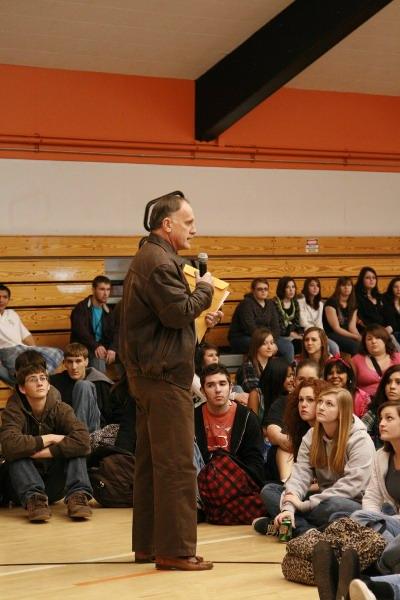
McClain and high school Principal Matt Cockerton decided to have the group move to the gym, where they could use the sound system. There, they were joined by still more students and about a dozen teachers.
Administrators assured students that they were aware of their concerns. McClain told students he would hold an assembly to discuss the budget issues on Tuesday.
In an interview with Lake County News after the demonstration, McClain said he had received letters from students who were concerned about losing sports and educational programs, and increasing class sizes, among other things.
“These are great kids,” said McClain. “They want to be able to be heard and I just deeply respect that.”
He added that he wants the students to know that he hears their concerns.
The Tuesday assembly, McClain said, will give him a chance to explain the situation to students fully, and give them accurate information. “I just want to show them that we'll be fine.”
“I think it's great that they're involved and concerned about what's happening in the education system,” school board member Gary Olson said of the students.
Olson said education is struggling statewide.
It's true for districts across the rest of the county as well. This week, the Konocti Unified School District held more community meetings to take input on several options to save that district money in the face of deep cuts, with proposals including closing some middle schools. Konocti Unified's board is set to meet March 4 to look at the issue further.
Elsewhere, districts are looking at cutting programs and possibly more teaching positions.
Lake County Superintendent of Schools Dave Geck said the situation countywide is looking tough.
“Across the county, all districts are looking at where they can effect cost savings as far away from classrooms as possible,” he said.
Based on an initial analysis, Geck said the county's schools are looking at $5.7 million in cuts from now through the 2009-10 budget year, for a 16.6 percent reduction.
He estimated all of the schools will have to lay off personnel. When 85 percent of education budgets are personnel, and cuts are estimated at 20 percent, “There's no way to avoid people's lives getting impacted,” Geck said.
Last year was the first time in Geck's 10 years at the Lake County Office of Education that they had layoffs. Looking toward the year ahead, he said, “I don't look forward to having to do that.”
An ongoing dialogue
Concerns for students and staff alike had arisen earlier in the week, when the Kelseyville Unified board convened for a special Monday meeting to discuss the budget situation.
In the wake of the state budget's passage, McClain said district administration put a budget presentation together in about four hours on Monday for the district board to consider. He called it “a very quick look” at the coming year's budget.
At that meeting, the Konocti Unified Teachers Association expressed their concern about the potential budget, said union President Rico Abordo, an English teacher at Kelseyville High.
Abordo said the union made clear its ideas about where it would like to see the district's money spent, urging against the district keeping an a fiscal reserve of more than 5 percent.
Anything over that amount should be spent on students and employees, Abordo said. “We're an educational institution, not a savings institution.”
Abordo said the union and the district are taking part in an ongoing conversation, and he said those initial concerns the union discussed Monday already have been addressed. He said he feels there has been a healthy dialogue between the board of trustees and the bargaining unit.
Olson said trustees needed to approve an interim budget by March 15 as required by the state. “Nothing of what we approved is set in stone. It's based on what we think might happen. It's sort of a worst case scenario.”
In normal years, the interim budget has never been met with much attention, said Olson. “We're not in normal times at all.”
Abordo said the district has been run extremely well over the years, and credited McClain for his work to keep Kelseyville Unified fiscally solvent, and for dealing effectively with controversial issues, such as the changing of Kelseyville High's mascot from an Indian to a knight.
“We're probably in better position than most other districts,” Abordo said of the fiscal situation.
Olson also credits McClain for keeping a good relationship going between the union and the district.
“We've worked real hard to pay the teachers as much as we can afford to,” he said, adding that the district offers its teachers the best benefits package of any group of teachers in the county.
Morale in the district was the highest it's been in a long time until the economic crunch started, said Olson.
Kelseyville Unified's situation looks better than some
McClain said the school district's budget actually is looking a lot healthier than they initially expected. They're not facing a big midyear cut, and have implemented a spending freeze.
Olson said last year the district lost close to 40 classified employees, many of them part-time, and 13 teachers. He attributed much of the district's budget situation to “the elephant in the room” – declining enrollment.
He said he understands personally what teachers are going through – his wife is a teacher at Riviera Elementary, and she went from a full-time to a half-time position last year.
Looking ahead, district officials had expected as much as a $1.4 million cut to their $15 million annual budget for the 2009-10 fiscal year, but McClain said he's since penciled it out and that amount comes in under $1 million.
McClain, who said the district has a $1 million a month payroll, has four teachers retiring, and that may mean that the district can shift assignments and not have to lay off any teachers this year.
Abordo said that layoff notices are due on March 13.
He said that on Friday the high school librarian retired and that means the junior high school librarian will have to do double duty over the rest of the year. As a result, the high school library will be closed two and a half days a week.
Over the next two weeks, as districts finalize their budgets, Geck said he expects tough decisions to be made.
Local districts and government agencies also are meeting to look at ways they can make joint purchases, share resources and be more cost-effective in their operations.
“The piece that's really a wild card that's still being defined is the flexibility that district will have inside of their categorical programs,” said Geck, explaining that the flexibility came out of the state's budget compromise.
Categorical funding is that which comes from state and federal governments and is targeted for specific programs and purposes, according to the Education Data Partnership. The use of funds usually is restricted.
“The devil is definitely in the details,” said Geck.
Harold LaBonte contributed to this report.
E-mail Elizabeth Larson at
{mos_sb_discuss:2}
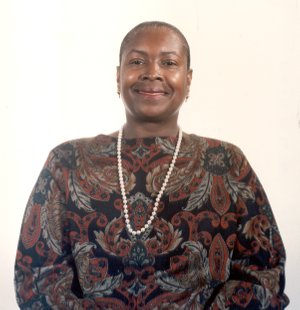
LAKE COUNTY – The National Association for the Advancement of Colored People (NAACP) just celebrated its 100th year on Lincoln’s birthday.
Aqeela El-Amin Bakheit, president of the Lake and Mendocino County chapters, would like to see more people involved with the organization. Presently there are between 70 and 80 members.
“I first became a member of the branch because I had a problem that I needed help with and they helped me,” Bakheit said.
She was paying it forward when she became a member. She promised herself that if the NAACP helped her, she would help the branch and that’s what she’s been doing since.
Bakheit said that sometimes people call needing help, want her to stop on a dime and want help yesterday, or don’t fully understand the need to speak with people on all sides of a matter.
There are a number of steps that must be taken to help people and a specific process to follow, she explained.
According to the NAACP Web site, “The mission of the National Association for the Advancement of Colored People is to ensure the political, educational, social, and economic equality of rights of all persons and to eliminate racial hatred and racial discrimination.”
The cost of membership is $30 for adults and $15 for youth annually. It includes a year subscription to the NAACP magazine, “The Crisis.”
The primary goals for youth in the NAACP include, honing leadership qualities, political action, social activism and education.
Bakheit’s primary focus is to improve education. She raised six children and obtained her undergraduate degrees in liberal studies and human development from California State University, Hayward, in her mid-40s.
She thinks that youth have a real disadvantage without education. Bakheit would like to see children inspired about education beginning in kindergarten.
“I would like to see more youth going to college after high school,” she said. “It’s challenging as an adult, with adult responsibilities. I was constantly juggling – family, job and school.”
Her family pulled together as a team. The older children would help with laundry and chores, as well as helping to care for the younger children.
She remembers the skills she learned vividly and says that her education helps her on a daily basis, extending far beyond the doors of a classroom.
Housing is also at the forefront of her primary issues.
“With the current economic crisis, and foreclosures, we are working on the challenges facing us involving housing,” she said.
Bakheit takes an easy-going, peaceful approach, seeking a meeting of the minds.
“My grandmother Elizabeth had a hand in raising me,” she said. She put a lot of goodness in me.”
Though Bakheit is a compelling force, she humbly compliments everyone but herself.
“We have a very good executive board. I’m very proud of the people who work with me,” she said.
The Lake/Mendocino County branch of the NAACP will host its annual Black History Program on Saturday, Feb. 28, from 1 p.m. to 4 p.m. at Praises of Zion Baptist Church, 3890 Emile St. in Clearlake. The keynote speaker will be Rick Mayo, founder and first vice president.
E-mail Mandy Feder at
{mos_sb_discuss:2}
The U.S. unemployment rate also increased in January to 7.6 percent.
In December, the state’s unemployment rate was a revised 8.7 percent, and in January 2008, the unemployment rate was 6.1 percent. The unemployment rate is derived from a federal survey of 5,500 California households.
“The number of Californians without jobs and a means to provide for their families is a sobering reminder that there is nothing more important than getting California’s economy back on track,” Gov. Arnold Schwarzenegger said on Friday.
He added that the road to full economic recovery will not be short, but the economic stimulus measures in the state budget – combined with the federal economic recovery agenda – will help California create jobs while laying a strong foundation for better economic times ahead.
The number of nonfarm jobs in California decreased by 79,300 over the month, for a total of 14,648,100, according to the survey of 42,000 California businesses which measures jobs in the economy. This survey is larger and less variable statistically than the household survey. The year-over-year (January 2008 to January 2009) change shows a decrease of 494,000 jobs (down 3.3 percent).
EDD will release the January unemployment figures for counties next week.
Lake County's unemployment rate in December was 13.1 percent, as Lake County News has reported.
The federal survey of households shows a decrease in the number of employed people. It estimates the number of Californians holding jobs in January was 16,668,000, a decrease of 283,000 from December, and down 437,000 from the employment total in January of last year.
The number of people unemployed in California was 1,863,000 – up by 257,000 over the month, and up by 754,000 compared with January of last year.
Of the unemployed, 990,600 were laid off, 126,700 left their jobs voluntarily, and the remaining were either new entrants or reentrants into the labor market, or persons who completed temporary jobs, according to the federal household survey.
EDD’s report on payroll employment (wage and salary jobs) in the nonfarm industries of California totaled 14,648,100 in January, a net loss of 79,300 jobs since the January survey. This followed a loss of 84,400 jobs (as revised) in December.
Four categories (natural resources and mining; educational and health services; leisure and hospitality; and government) added jobs over the month, gaining 7,400 jobs. Educational and health services posted the largest gain over the month, up by 3,900 jobs. Seven categories (construction; manufacturing; trade, transportation and utilities; information; financial activities; professional and business services; and other services) reported job declines this month, down 86,700 jobs. Information
posted the largest decline over the month, down by 27,700 jobs.
In a year-over-year comparison (January 2008 to January 2009), nonfarm payroll employment in California decreased by 494,000 jobs (down 3.3 percent).
Three industry divisions (natural resources and mining; educational and health services; and government) posted job gains over the year, adding 43,000 jobs.
Educational and health services showed the strongest gain on both a numerical and percentage basis, adding 39,600 jobs (a 2.3 percent increase).
Eight categories (construction; manufacturing; trade, transportation and utilities; information; financial activities; professional and business services; leisure and hospitality; and other services) posted job declines over the year, down 537,000 jobs.
Trade, transportation and utilities employment showed the largest decline on a numerical basis, down by 145,000 jobs (a decline of 5.0 percent). Construction posted the largest decline on a percentage basis, down by 15.5 percent (a decrease of 130,800 jobs).
In related data, the EDD reported that there were 717,525 people receiving regular unemployment insurance benefits during the January survey week. This compares with 655,445 last month and 480,858 last year. At the same time, new claims for unemployment insurance were 75,514 in January 2009, compared with 87,979 in December and 57,364 in January of last year.
{mos_sb_discuss:2}
Capt. James Bauman of the Lake County Sheriff's Office reported that on Feb. 19 the Sonoma County Sheriff’s Office released a safety alert for motorists traveling the areas of Calistoga Road and Porter Creek Road at night. The alert relates to a series of suspicious events occurring over the past two months in that area.
Sonoma County received two separate reports of a male subject following female motorists along the rural route, tailgating the women and flashing his lights at them in an apparent attempt to get them to pull off the road, said Bauman.
In one of the reports, the female driver did pull over and after the man told her to call 911 to report a motorcycle accident, he tried to open her door and she fled the area. Bauman said the suspect vehicle in that incident was described only as a black SUV.
A third incident was reported to Sonoma County authorities in which a man jumped out from a hillside along the route and laid down next to the roadway as the female driver passed. Bauman said the woman did not stop and there was a suspicious vehicle, possibly a blue sedan with a spoiler, parked along the road in the area.
He said the incidents reportedly all occurred between the hours of 6:30 p.m. and 2 a.m. The suspect is described only as possibly being a white male with his face partially concealed with either a bandana or turtle-neck pulled up about his face.
Bauman said residents commuting in and out of the Lake County are reminded to avoid stopping for anyone on rural routes unless the circumstances clearly demonstrate a need for immediate assistance, such as an obvious traffic collision.
Motorists encountering a pedestrian on rural routes are otherwise advised to continue to a well-lit, preferably populated, area before stopping to call and report suspicious circumstances, Bauman added.
{mos_sb_discuss:2}
The California Indian Museum and Cultural Center's Tillie Hardwick Lecture Series will present “The Origins of Tribal Disenrollment” from 1:30 p.m. to 3:30 p.m. this Saturday, Feb. 28. The museum is located at 5250 Aero Drive, Santa Rosa.
Dozens of members of the Robinson Rancheria Band of Pomo were disenrolled last December, as Lake County News has reported. The Elem Colony also has disenrolled members.
Thousands of Indians across California and many more across the nation have been subject to the growing practice, according to the American Indian Rights and Resources Organization and the American Indian Movement.
For those who have ever wondered about the nature of tribal disenrollment issues, the Saturday lecture may answer a host of questions.
What is the origin of tribal disenrollment ? Are there jurisdictional parameters? Why is it a growing issue for tribes throughout California and the nation? What are the options for individuals who are disenrolled? Do tribal governments have an obligation to provide civil rights protections and due process to persons undergoing disenrollment? These and other important issues will be probed in
this lecture.
The event should be enlightening for Indian and non-Indians alike.
Admission to the public is free.
For more information call the California Indian Museum and Cultural Center, 579-3004.
{mos_sb_discuss:2}
Lori Anne Bond-Keech, 48, of Lucerne was fatally injured in the crash, which occurred at 5:34 p.m. Monday on Highway 20 west of Gladys Street in Glenhaven, according to CHP Officer Adam Garcia.
Garcia said that minutes before the collision numerous other drivers had called to report Bond-Keech's silver Volkswagen Beetle swerving into the oncoming lane of traffic.
Bond-Keech, who was driving westbound on Highway 20, reportedly turned left across double-yellow lines in front of an eastbound Freightliner tractor trailer driven by 50-year-old Leo Steinle of Magalia, Garcia said.
Garcia said the two vehicles collided head-on, with Bond-Keech sustaining fatal injuries. Steinle was unharmed.
The collision closed the roadway in both directions from just after 5:30 p.m. until shortly before 9 p.m., said Garcia. Caltrans, Northshore Fire Protection District personnel and tow companies responded to the scene to remove the badly damaged Volkswagen and tractor trailer, and clear the roadway of debris.
During the road closure Caltrans activated the electronic message signs at Highway 20 and Highway 29, and at Highway 20 and Highway 53 to advise motorists of the road closure, Garcia said.
Caltrans turned cars around at Paradise Cove and Glenhaven during the closure while CHP investigated the traffic collision and Lake County Sheriff's Office personnel performed coroner functions, he added.
Garcia said CHP Officer Randy Forslund is conducting the collision investigation.
{mos_sb_discuss:2}