 How to resolve AdBlock issue?
News
After three hours and 15 minutes of discussion, which included going through a list of contingency items and making choices to reach an additional $1.9 million in savings, the board voted unanimously to accept the proposed budget.
For board members and district administrators, the challenges were many – chiefly, that funds for education are dwindling.
The district's 2009-10 budget is $27.2 million, down 3.4 percent from the $28.1 million budgeted for the previous budget year.
But they were also tasked with accepting the district's budget when the state budget – on which so much depends for local school districts – isn't itself in a final form, and doesn't appear to be nearing finality for some time.
Although the state Legislature is due to present a budget document Tuesday, Schwarzenegger was adamant that any budget that didn't have the state living within its means would die on his desk.
“We do not have time for any more floor drills or partial solutions,” he said in a Monday statement. “It's time for the legislature to send me a budget that solves our entire deficit without raising taxes.”
But districts must have their budgets done in time for the beginning of the new fiscal year, which arrives this Wednesday, July 1.
“We need to adopt a budget tonight even though we don't have very good role models at the state,” said Laurie Altic, Konocti Unified's business manager.
The half-inch-thick budget document that Altic presented to the district board was the results of months of work and weeks of fine tuning, with new information coming in daily – even hourly, she said.
What board members had before them Monday represented the information they had as of Saturday night, when Altic finished recalculations based on a packet of information from the state that was delivered last Thursday.
“It has been the most difficult budget year that I've ever faced,” she said.
Altic said she kept the district's goals – established at Jan. 24 workshop – on the wall in her office as she crafted the document. Those goals include intervention, safety, class size reduction and classroom personnel.
Board members emphasized Monday that they wanted to keep cuts as far away from classrooms as possible.
The budget they accepted is based on the governor's May revise. Board Clerk Anita Gordon asked if that was the worst case scenario.
“Absolutely,” replied Superintendent Dr. Bill MacDougall.
Under the governor's May revise, the district is looking at a 65-percent reduction – or $568,000 – in home to school transportation funds. If the Legislature's current proposal were to survive the threatened veto, close to $300,000 would be added back to those funds, Altic said.
Legislative proposals for schools also include a five-day reduction to the school year and suspending the California High School Exit Exam, which students must pass before graduating.
.
The district's projected deficit spending in the 2009-10 fiscal year “is the most pronounced suffered by the district,” with expenditures and transfers exceeding income by $1.4 million, Altic wrote in the introduction to the budget.
Konocti Unified is getting some help from Stabilization and and Special Education funding supplied through the federal stimulus, Altic explained.
Those funds are included in the $2.9 million positive ending balance for 2008-09, which will be carried forward to balance the coming year's budget, projected to have an ending balance of $1.5 million – most of which will be stimulus money, according to Altic's budget analysis.
Altic said the state also requires the district to keep a 3-percent “reserve for economic uncertainty” – which in this case totals approximately $832,495.
Under the Legislature's proposed budget, school districts would be able to operate with only a 1-percent reserve for the 2009-10 and 2010-11 budget years.
However, Altic emphasized to the board that once that money is spent, it's gone, and the state will require them to provide a strategy for recovering that 3-percent reserve. If no new revenues are coming into the district, Altic said it would require further cuts ahead to rebuild the fund.
That money, she added, also serves as an important cushion for the district.
The silver lining for the district is that they've been able to hire back all but two of the 53 teachers who received layoff notices in March, said MacDougall. They also have given notices of release to eight administrators, and hired back seven.
In addition, MacDougall said they realized a savings of $522,000 with the closure of Oak Hill Middle School, approved by the board in March.
On Monday at 4 p.m., the portable buildings that housed Highlands High School at the district offices left to be transported to the district's elementary schools, where MacDougall said they'll be used to work with children with greater educational needs.
Meantime, Highlands High School will be moved to Oak Hill, where a number of other alternative education and social programs will be housed, MacDougall said.
Board members requested that MacDougall place a discussion on an upcoming meeting agenda to look at consolidation. Trustees Gordon, Hank Montgomery and Carolynn Jarrett all said that they've been talking about service consolidations for a long time, and the time has come to do something.
Jarrett also questioned why consolidation didn't play a bigger part in the budget itself.
They're planning to have a discussion and direct MacDougall to bring back recommendations at a later date.
E-mail Elizabeth Larson at
The fire was reported at about 2 p.m. near a Bureau of Land Management campground along the highway, said Cal Fire spokesman Kevin Colburn.
The clouds of smoke rising from the fire could be seen from around the south county.
By 7:30 p.m., the blaze had grown to 350 acres in very steep, rugged terrain, with the fire burning through grass, brush, oak and some pine, Colburn said.
At that time Colburn said the blaze was 40-percent contained, with between 250 and 350 firefighters on scene trying to bring it under control.
Two outbuildings and a residence were destroyed, said Colburn, and one firefighter suffered a heat-related injury.
Colburn, who is a part of the team that's still investigating the case, said the fire was caused by a vehicle, but he didn't reveal specifically how the fire started.
Among the personnel on scene were Cal Fire firefighters and equipment from stations in Lake County, said Colburn.
The Rumsey Rancheria Fire Department also sent firefighters and equipment to assist, he said.
“Crews are going to be out all night working on getting the other 60 percent contained,” said Colburn.
The California Highway Patrol reported that Highway 16 at Highway 20 will be closed until sometime on Tuesday because of the fire.
John Jensen contributed to this report.
E-mail Elizabeth Larson at
LAKE COUNTY – Health officials are reporting that they've confirmed the first case of the H1N1 influenza – known more commonly as swine flu – in Lake County.
Lake County Health Officer Dr. Karen Tait reported Monday that the case involved a 39-year-old woman who developed symptoms on June 20.
The woman, whose identity and area of residence in the county were not released, is recovering and did not require hospitalization, said Tait.
Tait said the woman's symptoms included fever, a cough and vomiting. The diagnosis was confirmed through a test Lake County Public Health helped facilitate at the Sonoma County Public Health Laboratory.
About a week before her symptoms appeared, the woman had visited family in another county, said Tait.
“It's kind of widespread in California right now, so it's not too surprising,” Tait said.
The H1N1 virus began to raise concerns earlier this spring when hundreds of cases were reported in Mexico, eventually spreading to the United States.
As of Monday, the Centers for Disease Control reported that 70 countries are reporting human cases of the virus.
On June 11, the World Health Organization raised its worldwide pandemic alert to Phase 6, indicating that a global pandemic is under way.
California had 1,519 cases of confirmed and probable H1N1 influenza as of June 25, with 142 requiring hospitalization and 17 resulting in death, Tait reported.
Nationwide, 27,717 cases and 127 deaths have been reported, according to the Centers for Disease Control.
Tait said health care providers were expecting the H1N1 virus to calm down over the summer months, much like the seasonal flu.
“But then surveillance around the state showed it starting to pick up in the last three weeks,” she said, noting that Sonoma County has recently reported several confirmed cases.
That H1N1 has a propensity for spreading in the summer is proving to be one of the virus' unpredictable aspects, said Tait, which arises largely because the virus is very new.
With a new virus, Tait said, people can be easily infected once exposed because they don't have antibodies from similar flu infections to protect them. When the immune system encounters the virus for the first time, it has to develop a reaction from scratch, rather than waking up old antibodies that have experience with it.
The severity of the illness, she noted, resembles the ordinary seasonal flu, and has so far been mild enough that people can be treated at home.
However, it also can be severe – just like seasonal influenza – and there are occasional deaths as a result.
Tait said she believes there probably have been other H1N1 cases in Lake County, but the identification process involves specialized laboratory testing done only on a limited basis to help officials track the virus' outbreak.
Because of that limited testing, Tait said statistics underestimate the actual number of cases.
When Public Health gets a call from a medical provider about a suspect case, the agency facilitates getting a testing sample to a laboratory, as in the case of the local flu sufferer, said Tait.
“I was eager to do some testing because I felt that we probably did have cases out there that we hadn't yet confirmed,” she said. “We thought it was there, now we know that it's here.”
Once H1N1 is found in a community, Tait said cases will be diagnosed based on symptoms, not lab testing. Lab testing currently is being done on hospitalized patients, which Tait said emphasizes the number of more severely ill patients.
Tait said Lake County Public Health is working with health providers and others to monitor local influenza activity, which has not so far shown the increases observed in nearby counties, which she suggested may be because of Lake County's relatively sparse population and outdoor lifestyle.
An H1N1 influenza A vaccine currently is under development. Tait said it likely will be available this fall.
In the mean time, health officials urge people to take basic precautions this summer and into the regular health season in order to stay healthy – including regular hand washing, covering coughs and sneezes, and staying home when ill.
E-mail Elizabeth Larson at

This is the first of a two-part article on a new geothermal drilling project at The Geysers.
THE GEYSERS – In the coming months, a two-year project to test the viability of a developing geothermal technology will begin in The Geysers.
But while the technology is heralded by some in the geothermal industry as a promising new clean energy source, it's also known to cause sizable earthquakes at some of its test sites around the world.
That's raising concerns for the earthquake-prone Geysers area's residents, who already contend with small earthquakes on an almost daily basis.
AltaRock Energy, based in Sausalito and Seattle, is a venture capital company with $36 million in private investment and government funding which plans to try out its engineered geothermal system (EGS) at The Geysers.
The company will drill down thousands of feet and create fractures in bedrock, and then will inject water into those fractures in an effort to harness the heat deep in the earth to create steam for geothermal energy production.
Jeff Gospe, an Anderson Springs property owner and president of the Anderson Springs Community Alliance, has closely monitored seismic issues in the area over the years.
He said the community isn't against geothermal, but they feel AltaRock's project was rushed through a less-than-transparent process, that the company wasn't upfront about the problems inherent in EGS technology and that they ignored critical seismic data in their environmental assessment.
“It doesn't feel like a real honest process,” he said, adding that he wished there had been more study of the project.
Gospe said the geothermal industry is glossing over the fact that earthquake numbers near The Geysers are growing. There have been 360 earthquakes in the area this year alone, averaging about one a day that can be felt by residents. In addition, the numbers of earthquakes measuring 4.0 and above also are on the rise.
AltaRock Chief Executive Officer Don O'Shei and Senior Vice President Jim Turner said they wanted to work in The Geysers because it's the largest geothermal operation in the United States today, and has had a history of geothermal production going back to 1921.
Turner said The Geysers is operating at only half capacity, with some areas of its steamfield already depleted. It's also one of the best studied areas in the US, which helps their work since they'll know where the existing faults are located.
Murray Grande, geothermal facilities manager for the Northern California Power Agency (NCPA) – which owns and operates two geothermal power plants and a steamfield at The Geysers – said AltaRock has a two-year agreement with NCPA to conduct a demonstration project on its EGS technology.
NCPA's members include 15 municipalities and utilities around California, including Ukiah, Healdsburg and the Alameda Municipal Power. Lake County currently is not a member, although officials have mentioned joining the group, which benefits from local facilities.
AltaRock approached NCPA, said Grande, which agreed to let them use an unproductive well first drilled 20 years ago which since has been used for water injection. That well is located on property that NCPA leases from the Bureau of Land Management. The steam would be run to NCPA's power plant in order to generate electricity, Grande said.
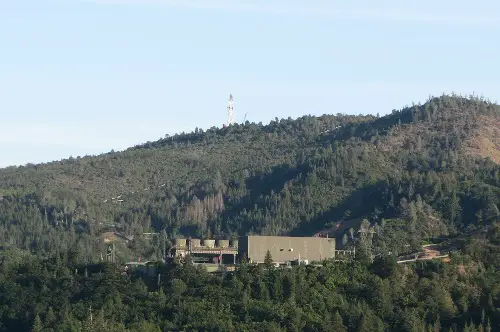
The infrastructure is in place for work to begin immediately, said Turner. Using a drill rig that sits at an elevation of 3,150 feet and is visible on a hill above Middletown, AltaRock has begun drilling down 3,200 feet through the well's casing. O'Shei said drilling has taken place in the area in the past with no incident.
The EGS technology has raised concerns because of a 2006 incident in Basel, Switzerland, where it triggered a 3.4-magnitude earthquake and another 3,500 quakes over the following year, with millions of dollars in insurance claims paid out in Switzerland, France and Germany. AltaRock wasn't involved in that project, Turner and O'Shei emphasized.
They explained that Basel – which suffered severe damage in a 14th century earthquake – has a large fault running underneath it. The Basel project – which located the drill in the middle of the medieval town – drilled down directly into the existing fault and injected water into it. There were no fatalities or injuries, but the populace was badly shaken up by the incident.
Faults build up stress and then release, said O'Shei. Injecting water into the fault at Basel lubricated the fault and caused a slippage which, he noted, likely would have happened at some point anyway.
The Basel project made a number of mistakes that “we're not looking to repeat,” said O'Shei.
Another EGS project is taking place in Soultz-sous-Forêts, France, where large amounts of water are being injected into fractures five kilometers deep, according to the Geophysical Journal International.
The project – which isn't AltaRock's – involves three wells. Between 2000 and 2005, 700 seismic events of magnitude 1.0 to 2.9, the journal reported. One of the wells had a greater seismic response due to being closer to large faults.
The journal noted, “The future EGS programme will have to drill wells in zones free of large faults to avoid poor hydraulic performance and inconvenience to the population.”
AltaRock's environmental assessment notes that EGS sites in Australia and the United Kingdom also experienced earthquakes of 3.7 and 3.1, respectively.
Because NCPA is a public agency, the project went through a California Environmental Quality Review, said Grande.
Grande said a seismologist will be on site 24 hours a day, seven days a week, to monitor seismicity.
Mark Dellinger, administrator for Lake County Special Districts, is one of the county's most knowledgeable officials when it comes to geothermal, having worked for years on The Geysers pipeline.
He said AltaRock submitted permits that went through the Community Development Department for seismic monitoring. Because the project is located on a federal lease, Dellinger said he's not sure those county permits technically were needed.
“I think there needs to be mitigations, and I think there are adequate mitigations for this project,” said Dellinger.
He added, “Nobody knows what's going to happen,” but he thinks monitoring is going to help. “That's a very important thing.”
The benefits to NCPA are twofold, said Grande. First, if it works, they'll have access to a new heat source. Second, they could then purchase the steam from AltaRock, which will allow NCPA to generate more renewable geothermal energy.
Grande said EGS technology has the potential to expand geothermal productive to areas across the western United States that haven't been traditional geothermal production areas.
“There's a a huge potential to create many many megawatts of energy that would otherwise not be available,” he said.
Calpine, which is reportedly looking at expanding its Geysers operations, said it won't use the EGS technology.
“They're not planning any of these new techniques,” said company spokesman Jason Barnett.
However, Dennis Gilles, Calpine's senior vice president of renewables growth, explained that the corporation is doing “enhanced geothermal system” work – also known as “EGS.”
Enhanced geothermal involves going into an existing geothermal reservoir, like The Geysers, and injecting water into the existing cracks in the in the bedrock, which heats the water to steam and facilitates geothermal production.
Calpine has received Department of Energy grants for its geothermal projects in the past, Gilles said.
The public process is faulted, say neighbors
Turner said AltaRock officials began attending community meetings in Anderson Springs last October, which they plan to continue doing. They're also attending twice-yearly seismic monitoring council meetings. He said the company wants to be active in the community and responsive to its concerns.
Rich Eastabrook, a petroleum engineer with the Ukiah BLM office, said the lease for the land where AltaRock's project will take place has been in effect since the 1970s.
He said an environmental assessment process took place, in partnership with NCPA, which was the lead agency under CEQA.
AltaRock solicited geophysicists to complete the 218-page project review, available on its Web site (http://altarockenergy.com/media.html), about the possible impacts. That document used as a source data from the environmental impact report completed on The Geysers pipeline, Grande said.
“It was pretty well concluded that, yes, there are going to be some microearthquakes that are generated by this project, but the impact of those are going to be fairly insignificant compared to what already occurs at The Geysers,” Grande said. They're also confident they won't additionally impact the neighboring Anderson Springs community.
The assessment said the largest earthquake that's been attributed to EGS is 4.6 in magnitude, with quakes measuring less than 3 in magnitude expected to result from AltaRock's project.
But Gospe and fellow Anderson Springs residents believe the project's environmental assessment document has problems. They said it relies on outdated information and omits or ignores a lot of readily available seismic data provided by the US Geological Service and even the community itself at its Web site, www.andersonsprings.org .
Meriel Medrano, who said AltaRock's drill rig is located up the hill about a mile and a half from her home, called the environmental assessment “absolutely ridiculous.” It didn't include any of the 12 years of information collected by the county's seismic monitoring committee – which has been meeting since 1997, said Gospe – but instead used outdated materials.
Getting information about the project out to the public in the first place drew criticism from residents.
BLM put a small public hearing notice in the legals section of the local newspaper on March 25, said Medrano. That notice announced a public meeting on the evening of April 9 at the Calpine Visitor Center in Middletown, which the night of the meeting was moved to a nearby church.
The public comment period on the project lasted from March 19 through April 17, said Medrano.
She said “very few” local residents attended, estimating at most there were 10 of them there.
Anderson Springs resident Joan Clay said the community meeting was the first time the community really had heard about the project. She said no notices were mailed to the community. Gospe said the only notice they saw was mailed to the Anderson Springs Community Services District.
Eastabrook said copies of the draft environmental assessment were sent to residents in the impacted areas, but he added, “We kind of dropped the ball a little bit there.”
“They dropped it but good,” said Medrano.
He said BLM relied on a mailing list provided by a project consultant and NCPA. “It turns out the mailing list was not as inclusive as it should have been,” with some residents in the target area of Anderson Springs and Cobb not getting the information that they should have gotten.
“We take full responsibility for that,” he said.
Although the noticing technically met the legal requirements, Eastabrook said BLM wants to go beyond that. So when they found out some residents hadn't received the documents, they had the assessments shipped out immediately.
At the hour-and-a-half-long April 9 meeting, Gospe presented updated seismic information along with the community's concerns, and AltaRock made some responses. He said the company never disputed his facts, instead claiming that they had no bearing on the project.
A permit already has been issued to deepen the existing geothermal well where AltaRock plans to drill, said Eastabrook. BLM also will issue a federal “sundry” notice.
Said Medrano, “It was a fast shuffle. It really was. It was very unfair to the community.”
Eastabrook said the project will have “fairly strict” monitoring requirements. There will be seismic trigger points; if those are reached, the drilling would have to be curtailed or suspended.
Just what the trigger points are hasn't been stated specifically in terms of magnitude. However, it has been described in terms of the Modified Mercalli Intensity Scale.
Quakes at a level IV – which awaken people at night, are felt indoors by man during the day and have a sensation like a heavy truck striking a building would result in modifications, according to project documents. A level V – felt by nearly everyone, breaking some dishes and windows, and awaking most people at night – could shut the project down.
“Our role is going to be one of monitoring, inspection and enforcement,” said Eastabrook.
He explained that BLM is supposed to get daily reports on the drilling. If anything goes wrong, he said, “We will not hesitate to take appropriate enforcement action.”
AltaRock was straightforward in sharing seismic data with BLM, said Eastabrook.
However, “They never told us that the Basel project had been shut down because of the seismicity,” Eastabrook said.
In fact, a word search for “Basel” in the environmental assessment document finds only two passing references to Basel, with no discussion of that project's impacts.
As well, Gospe accused AltaRock of a coverup because, at the April 9 meeting, he said they sold it as a demonstration project that they had done before. The big quake and the thousands of smaller quakes in Basel were omitted, he said.
“I don't think that's a deal killer,” Eastabrook said of Basel, adding, “I would have liked to have known that.”
But O'Shei said Basel is well known in the geothermal industry, and they didn't hide that fact. “There's nothing secret about what happened in Basel.”
An updated version of AltaRock's report does incorporate information provided by Gospe and Anderson Springs community members.
In the next installment, a seismologist describes the layout and operations of the Geysers steamfields, AltaRock gets involved in the community and company officials describe interest in renewable energy.
E-mail Elizabeth Larson at
Read the second part of this report here:
Company says proposed geothermal project holds promise for renewables

The annual vintage Volkwagen car show, held at Library Park, is sponsored by the Silver Circle Chapter of the Vintage Volkswagen Club of America .
About 50 cars participated in this year's show, with everything from sporty Karmann Ghias to Beetles to VW vans on display along Park Street.
Car owners and visitors alike grabbed whatever shade they could in between looking at the vehicles.
Another show and shine event is scheduled in Clearlake's Austin Park in August.
Harold LaBonte contributed to this report.




Cal Fire Captain George Gonzalez reported Sunday that the vegetation fire, located at Lake Berryessa's south end, was reported Saturday at 11:17 p.m.
Gonzalez said the fire was inaccessible by roads and firefighters had to be ferried across the lake by the Napa County Sheriffs Department Boat.
Cal Fire, Napa County Fire, California Department of Corrections and the Napa County Sheriff's Office joined forces to fight the blaze, which firefighters contained the fire at 7:41 a.m. Sunday, Gonzalez reported.
He said a total of 125 firefighters helped battle the 20-acre fire.
No injuries were reported and the cause of the fire is under investigation, Gonzalez said.