 How to resolve AdBlock issue?
News
Kim Louise Lemoine, 36, who passed counterfeit state government checks totaling $308,000, was sentenced on Wednesday to five years in prison on charges of identity theft, forgery and grand theft, according to a report from state Attorney General Edmund G. Brown Jr.'s office.
Two of Lemoine's associates are in custody; two remain at large.
"This band of counterfeiters fabricated 235 state government checks that looked and felt like the real thing," Brown said. "They were able to pass these forgeries and amass more than $300,000."
On March 11, 2009, Brown filed 63 criminal charges of grand theft, possession of counterfeit card making equipment, identity theft, forgery of a California driver's license, forgery of a check and forgery of the California state seal against:
Kim Louise Lemoine, 36, arrested on March 13, pled guilty in Sonoma County Superior Court on April 28 and was sentenced today to five years in prison;
Hiedi Lynn Roth, 36, arrested on April 22, and is expected to be sentenced to 8 years in prison on July 21;
Daria Inessa Sidorkina, 23, who is being held in Solano County jail on unrelated charges;
Laura Renee Harkey, 29, who remains at large; and
Mary Nicole Holstein, 35, who remains at large.
The defendants cashed 235 counterfeit checks at Bank of America branches located in 20 California counties from October 2007 until September 2008. The counterfeit checks ranged from $777 to $3,000.
Attorney General's Office spokesman Evan Westrup told Lake County News Wednesday that it doesn't appear, from a review of the case, that any of the counterfeit checks were passed in Lake County.
The counterfeit checks looked similar to state-issued checks and included the state seal, bank routing information, and the state Controller's signature. The driver's licenses that the defendants used to verify their identifications also appeared valid. In reality, both the checks and driver's licenses were forgeries, created at Lemoine's home in Sonoma County.
On July 28, 2008, a bank teller in Sebastopol refused to cash one of the checks. After being informed that the check would not be honored, the suspect grew angry and demanded the items back. The bank employee refused, and the bank's staff then contacted the California State Controller's Office.
The Controller's Office launched an investigation in conjunction with Brown's office. Last September, agents discovered counterfeiting equipment capable of producing fraudulent checks and driver's licenses, including laminating machines, printers, check paper and blank driver's license cards at Lemoine's home in Sonoma County.
The agents also discovered personal information for more than 50 individuals and businesses in a duffel bag. The information included credit reports, driver's license numbers, social security numbers, and dates of birth.
The U.S. Environmental Protection Agency (EPA) and the U.S. Department of Health and Human Service’s Indian Health Service (IHS) on Wednesday announced $90 million nationwide in “shovel ready” infrastructure projects designed to better protect human and environmental health in Indian Country.
“On tribal lands, 10 percent of homes lack access to safe drinking water compared to less than one percent of non-native homes. Together with the Indian Health Service, EPA is using Recovery Act funds to provide much-needed support for water and wastewater systems in Indian Country,” said Laura Yoshii, acting regional administrator for the U.S. EPA in the Pacific Southwest.
Yoshii said the funding creates jobs for tribal members, addresses critical infrastructure needs and will increase access to drinking water and basic sanitation services.
“By 2010, over 4,400 tribal homes in the Pacific Southwest are expected to receive piped drinking water or basic sanitation services for the first time,” she said.
The tribes receiving funds include the following:
Tule River Indian Reservation will receive $6,371,470 to upgrade its wastewater treatment plant serving 268 homes;
Round Valley Indian Tribes will receive $474,380 to expand its wastewater treatment facility serving 132 homes;
Redwood Valley Rancheria of Pomo Indians will receive $316,770 for improvements to its wastewater treatment plant serving 32 homes;
Grindstone Indian Rancheria of Wintun-Wailaki Indians of California will receive $205,310 to upgrade sewer connections serving 10 homes;
Redding Rancheria will receive $180,070 to expand sewer connections serving 13 homes;
Quechan Tribe will receive $340,630 to upgrade sewer lines serving 15 homes;
Campo Band of Kumeyaay Indians will receive $753,100 for drinking water treatment serving 29 homes.
Continuing a tradition spanning 20 years, EPA and IHS’s combined effort to improve water services in Indian Country contributed to their identification of 95 wastewater and 64 drinking water priority projects to be completed by IHS’s Sanitation Facilities Construction Program through EPA Recovery Act funds.
The projects exceed the Recovery Act requirement that 20 percent of the funds be used for green infrastructure, water and energy efficiency improvements and other environmentally innovative projects.
President Barack Obama signed the American Recovery and Reinvestment Act of 2009 on Feb. 17 and has directed that the recovery act be implemented with unprecedented transparency and accountability. To see how every dollar is being invested, visit www.recovery.gov .

THIS STORY HAS BEEN UPDATED WITH ADDITIONAL INFORMATION AND PICTURES.
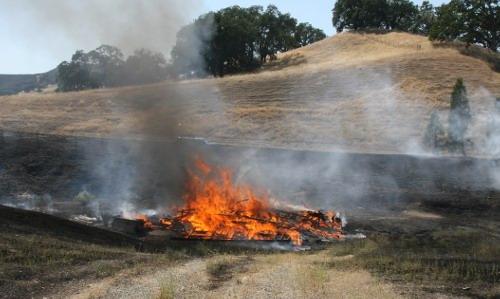
LAKEPORT – About eight acres burned Wednesday afternoon as the result of what appears to be two separate fires that may have merged in the north Lakeport area.
The fires burned near Highway 29 in an area near a housing development not far from Sutter Lakeside Hospital, as Lake County News reported earlier this afternoon. Mop up work continued through the afternoon and early evening in the area.
One outbuilding was destroyed, and firefighters on scene estimated about eight acres were charred.
Nearby, homeowners wetted down their homes as gusts of wind carried the flames close to the houses, according to Lake County News correspondent Harold LaBonte, who was at the scene.
A helicopter made about six water drops on the outbuilding that burned, which appeared to be a major fire hot spot, as other aircraft flew over the scene.
No injuries were reported, and officials at the scene did not identify an ignition source for the fire.
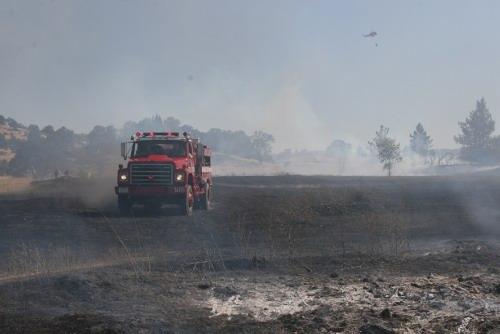
Lakeport, Northshore and Kelseyville Fire Districts were on scene, along with Cal Fire, US Forest Service and Konocti Conservation Camp, according to Northshore Fire Chief Jim Robbins.
Robbins estimated a total of 40 firefighters from the various agencies were involved in fighting the fire.
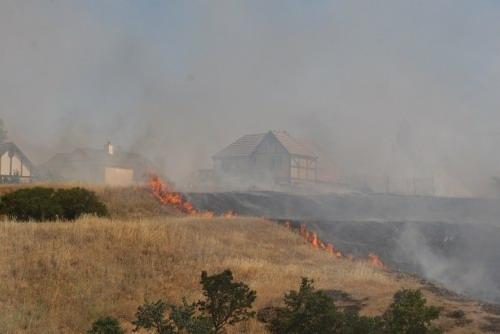
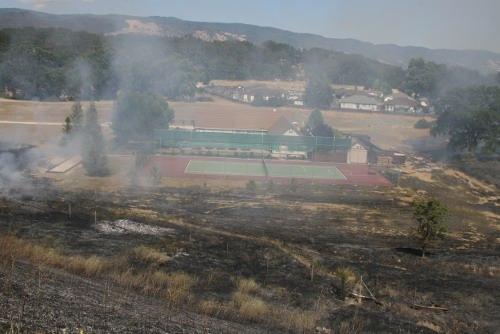

The fire appears to have started at Highway 29 and is being fanned by gusting winds, according to Lake County News correspondent Harold LaBonte, reporting from the scene.
So far the fire has burned several acres and is threatening homes on Lancaster, across from Sutter Lakeside Hospital, according to LaBonte.
People are trying to secure their homes, and in some cases working alongside firefighters to keep homes safe. LaBonte estimated the flames in one area came within 50 feet of the homes.
Lakeport and Northshore Fire Protection Districts, Cal Fire and the US Forest Service are among the agencies on the scene.
The fire is being fought both from the ground and the air, with aircraft dropping water on hot spots in the area, including a burned outbuilding that had large amounts of construction material inside.
Some of the plywood appeared to be exploding, and loud popping noises and black smoke were coming from an area where a transformer may have been located.
Lake County News will post more updates as more information becomes available.
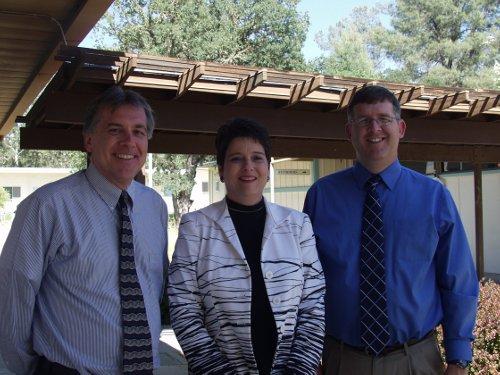
CLEARLAKE – Yuba College's new president paid a visit to the Clear Lake campus for a reception on Tuesday.
Dr. Patricia “Kay” Adkins spent her first day on the job Monday in the college's Marysville headquarters, and was in Clearlake Tuesday to visit the campus, its staff and administrators.
Adkins succeeded President Paul Mendoza, who retired. She was selected after a nationwide search that began in January, led by the Association of Community College Trustees, in collaboration with the Yuba College Community District Governing Board and chancellor.
The process included public forums to gather input on constructing a presidential profile, acceptance of applications through April and then, in mid-May, public forums in Marysville and Clearlake where finalists spoke to the community, according to a college statement.
“The excellent work of the search committee should be commended,” said Yuba College Community District Board Chair Alan Flory in a statement. “They orchestrated an elaborate five-month process and chose four exceptionally well-qualified finalists, of which Dr. Adkins was the best fit for our district. We are excited to have Dr. Adkins on board and look forward to her leadership in stewarding Yuba College into the future.”
In her new job Adkins will oversee 120 faculty and an estimated 10,000 students – 6,000 of them full-time – across eight counties and nearly 4,200 square miles of rural Northern California, from Marysville and Woodland to Clearlake, according to college officials.
She arrives in California with husband, Barry Gowin – a retired educator – from Ohio, where she was provost of Columbus State Community College.
Adkins herself is a community college graduate. She earned an associate of science degree from Shawnee Community College in Illinois before going on to receive both her bachelor's degree in elementary education and master's degree in education from Southern Illinois University.
At Illinois State University she earned her doctorate in higher education administration.
During her career she's held various leadership positions in community colleges in Illinois, where she worked for 14 years, as well as eight years in Florida's community colleges.
Working in both rural and urban settings, Adkins has experience working with business and industry, plus a strong background in strategic planning and regional accreditation processes.
Adkins said she was attracted to Yuba College because of the school's quality, reputation and student-centered philosophy. She also was “extremely impressed” with the college's history of community involvement.
California's budget crisis means colleges all over California don't yet know what budget they'll have in the coming fiscal year. There are a lot of agencies in the same boat, said Adkins.
But Adkins is pragmatic about the fact that she's arriving at a time when California is having so many financial struggles.
“Every state's budget is imploding now for education,” she explained.
When the going gets tough, it's time for administrators like Adkins to look at core programs and services and make sure they're responding to the needs of their particular communities.
“The community college has two missions,” said Adkins.
The first is helping young people get their transfer units to go on to universities or four-year colleges. Adkins said the second mission focuses on offering occupational, vocational and credential programs for adults.
“We've always served both,” Adkins said of the college's missions. “There's not one that's more important than the other.”
Right now, Adkins is busy getting to know her faculty, staff and students as a prelude to assessing where the college needs to go next.
Adkins plans to take a collaborative approach in working with the community college system's chancellor, her faculty and the school's strategic plan to build on Yuba College's goals and existing programs.
She also will have the opportunity to oversee the district's building and facilities improvements which are funded through its $190 million Measure J bond, approved by voters in November of 2006.
“It's coming at a very good time,” said Adkins.
The Clear Lake campus has 11 full-time faculty and about 700 full-time students, said campus Dean Bryon Bell.
Bell estimated that the campus has around 11 acres. Measure J includes $9 million to build the campus a new 30,000-square-foot multi-use building that will include a student center, science lab and culinary space, in addition to other facilities.
At one point the college was looking at possibly moving its campus to another location, said Bell.
However, now college officials are in discussions with the Konocti Unified School District to explore the possibility of purchasing three acres of the Oak Hill Middle School campus next door, Bell said. Konocti Unified closed that school earlier this year but has moved some alternative programs there.
“We're just looking at our options right now,” said Adkins.
Classes start for the fall semester at the Clear Lake campus on Aug. 17, Bell said.
E-mail Elizabeth Larson at
Gerald Stanley, 64, made his appearance in Butte County Superior Court on Monday via teleconference from San Quentin State Prison, where he is on death row.
Appearing with his public defender, Chico attorney Dennis Hoptowit, Stanley asked to have Judge Steven J. Howell disqualified from the case.
In a June 4 letter to the Butte County Superior Court, Stanley said he wanted Howell removed for bias.
Howell, who was assigned to preside, in turn appointed Judge Gerald Hermanson to take the case, according to Lake County District Attorney Jon Hopkins, who was in Butte County for the hearing.
Stanley was convicted of the August 1980 murder of his wife, Cynthia Rogers, at her father's resort in Nice. He was sentenced to death and sent to death row in February 1984.
The former hunting guide also had done prison time for murdering his first wife, Kathleen Rhiley, in 1975. His wife, Diana Lynn Ramel, went missing on Feb. 14, 1980, but he has maintained his innocence in her death. Then, before Cynthia Rogers was shot, a 19-year-old Redding woman, Sheryl Ranee Wright, went missing, and Stanley was being investigated for her murder at one point as well.
His murder conviction has been the subject of numerous appeals and legal proceedings over the years.
However, it took a new turn in March of 2008 when federal court Judge Frank C. Damrell ruled that a new hearing was needed to determine whether or not Stanley had been mentally competent during his trial's death penalty phase.
Damrell's finding was based on a female juror who had been a domestic violence victim but hadn't disclosed it in court. Stanley told Lake County News in a phone interview earlier this year that he and his attorneys had been aware of the woman's experience but had wanted to keep her on the jury anyway.
Nevertheless, that kicked off a new series of legal proceedings in Butte County, where the trial – which took place during the latter half of 1983 and into early 1984 – was moved from Lake County due to pre-trial publicity.
Hopkins has said previously that, despite the length of time that has passed, a retroactive competency hearing could be held, and he plans to argue that Stanley was sane at the time of trial.
Stanley, in a June 29 phone interview with Lake County News, had worried that the Monday hearing might not take place because he said San Quentin officials were considering postponing it due to his health.
“I'm ready, I want to do this. It's important,” he said.
Stanley, who has heart problems, said he began a hunger strike after he claimed he was assaulted by prison guards – who also allegedly took photos from his cell – on June 25.
Hopkins said Stanley had written the court threatening not to show up at the hearing because of the issues.
A prison spokesman couldn't be reached for comment before the end of the day Monday to address the allegations.
Stanley has alleged similar abuse issues before, and in a June 1 letter to the court accused San Quentin officials of interfering with his legal mail and calls, while he said guards were making him wait “in stand up cages for hours.”
He said they're trying to force him to provide the location of Ramel's body, which he has stated is to be found buried in a creek bed in Manton, in northern Tehama County.
Earlier this year Stanley gave Tehama County officials information about where he and a friend buried Ramel, who he said overdosed. He's offered the information over the years in exchange for an execution date.
At a Sept. 15 hearing, which Hopkins said was set Monday, Stanley is expected to argue for representing himself in court and is expected once again to seek to have Hoptowit removed. He told Lake County News on June 29 that he wanted Hoptowit off the case.
That issue was supposed to be discussed at the Monday hearing, but Hopkins said Hoptowit requested more time.
Stanley also has once again indicated that he wants Hayward attorney Jack Leavitt to represent him in court. He had wanted to bring Leavitt on previously, but was turned down by Howell last September.
In March of 2008, Stanley had a chance to ask for Leavitt, but instead requested Mark Olive, a Florida attorney who specializes in death row cases and has worked on Stanley's case in the past. Hoptowit was appointed at that time by Judge Sandra McLean.
Last month Stanley wrote to the court once again saying he wanted Leavitt on the case, and accusing Hoptowit and the federal defenders working his case of continuing “to deceive me and the courts.” He said he wants to represent himself with Leavitt's help.
Hoptowit could not be reached for comment on Monday.
Explaining his plans, Stanley said, “We're going to agree with Jon Hopkins that I was competent in 1983 and that I'm competent now.”
Hopkins said that he hopes on Sept. 15 to be able to set a date for a hearing on the feasibility of a retroactive competency hearing.
He admitted that, with the delays in the case, it's entirely possible that hearing won't happen this year.
“We just need to get going here,” he said.
E-mail Elizabeth Larson at