 How to resolve AdBlock issue?
News
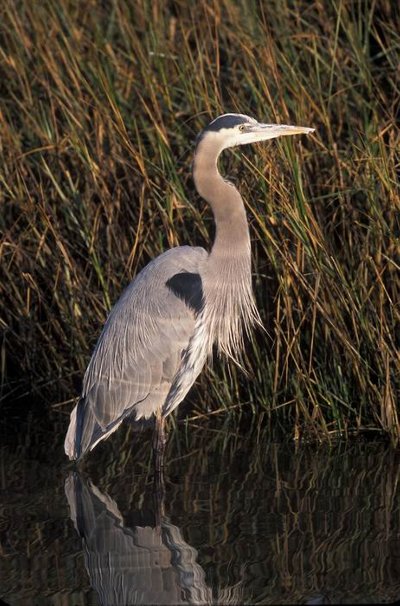
A very special caller has been helping us out on the farm of late. The visits are usually in the early morning hours just before dawn and again at dusk. We see him most often at the little fish pond in the front yard, standing motionless and alone. Wary and alert, he waits for prey to come within range of his long sharp beak.
Standing about 4 feet tall, long-legged with dusky light feathers floating above the thicker gray-blue feathers of his back and neck, he will begin a slow, measured gait away from the pond. Moving at a snail's pace towards the nearest gopher hole he suddenly strikes with a speed so great you can barely see his head move forward, and then he is back in position again with a vole or gopher proudly displayed in his beak. Then whoosh down the gullet it goes. Ahhh, breakfast!
Sometimes called Big Cranky, Long John, or Poor Joe, and often called the blue crane (although related, herons are in a different taxonomic family than are cranes), the great blue heron is the most common and largest of North American herons and one of the most widely distributed, breeding from southeastern Alaska to Nova Scotia and southward across the continent to Mexico and the West Indies.
Standing some 3 to 4½ feet tall and sporting a wingspan of nearly 6½ feet, great blues are a great joy to see in flight, often cruising at a speed of 20 to 30 miles an hour. As nature would never be without irony this beautiful bird, majestic in flight and displaying movements on the ground measured with the precision of a Swiss watchmaker, has a flight call that can only be described as a cranky honk, and when startled it produces a low pitched croak sounding much like grandpa waking from a deep sleep.
Great blues prefer to nest in colonies in very tall trees but will also nest by themselves in low shrubs. Typically their nests are flimsy, flat platforms of sticks about 18 inches across, but well-used older nests can be very bulky and measure 3 to 4 feet across. These older nests are generally repaired and used year after year, and may be lined with twigs, mosses, pine needles, reeds, and marsh grasses.
Generally, nesting occurs between March and May. The birds will lay three to seven eggs that are a pale blue-green to olive in color.
Both parents will take turns incubating the eggs and feeding the nestlings; when newly hatched, the nestlings are fed by the parents regurgitating food into the mouths of the chicks (usually fish) and then later onto the nest floor.
The young will start taking sustained flights around the nesting grounds 60 days after hatching and will abandon the nest between 65 and 91 days after hatching.
Great blues typically live between 10 and 21 years.

The great blue heron is protected by law and may not be kept in captivity without a permit. Adult great blues have few natural enemies. They are occasionally preyed upon or attacked by hawks or owls, but predation is not a limiting factor on their populations. The eggs and young can be heavily preyed upon in the nest by crows, ravens, hawks, owls, gulls and raccoons.
Historically populations of great blue herons were adversely affected by shooting and collecting of their plumage for fashion (for plumed women’s hats) and egg collecting, as well as by the extensive loss of wetland habitats in the U.S. within the last century.
Changing attitudes and the regulation of wetland losses in recent years have allowed great blue heron populations to recover and stabilize throughout much of the species’ range, though the potential for human-caused declines still exists.
As urban sprawl claims more of our beautiful landscape year after year, you can bet that wherever the interests of humans and wildlife collide the great blue heron is a good indicator of the environmental health of its region.
As one of many top-level predators, great blue herons cut a high profile within an ecosystem. These birds require wetland areas that are relatively disturbance-free for nesting, while feeding in both aquatic and terrestrial habitats throughout the year.
Environmental landscapes that support great blue herons clearly have many elements required to support a variety of other wildlife species.
Because they are waders and expert fishers the great blue heron is typically seen along coastlines, in marshes, or near the shores of ponds or streams. Their diet consists primarily of fish, but they also eat amphibians, reptiles, insects, crustaceans, and sometimes small mammals and birds.
They are often seen around rice fields, in open pastures (especially when wet), along creeks and in protected wetlands, or in my front yard eating the voles and gophers.
Debra Chase is the Executive Director of Tuleyome. She and her husband Dave reside on their farm in Colusa County. Tuleyome is a local nonprofit working to protect both our wild heritage and our agricultural heritage for future generations. Past Tuleyome Tales articles are available in the library section of their Web site, www.tuleyome.org .

LAKE COUNTY – The U.S. Coast Guard Auxiliary, Flotilla 88 of Lake County has been honored for excellence in its efforts to serve the community.
The group recently won “Flotilla of the Year” for 2009.
At the Dec. 13 Division 08-08 meeting at the Benbow Inn in Garberville, with four flotillas represented, Lake County's Flotilla won the honor of being selected as Flotilla of the Year based on total number of volunteer hours.
Flotilla 88 Commander Harry De Lope said the flotilla received the award because its 49 members devoted a total of 4,876 hours to Coast Guard administrative and missions supports in 2009.
Those volunteer hours covered 146 safety patrols, 25 regatta patrols, 18 marine safety patrols, 164 Coast Guard support hours, 20 boaters assists and $37,000 property saved, and 180 vessel inspections, De Lope said. The group also published 35 public affairs articles.
The prestigious award will be displayed at the Lake County Courthouse in the flotilla's showcase adjacent to the elevators on the first floor, according to flotilla officials.
Follow Lake County News on Twitter at http://twitter.com/LakeCoNews and on Facebook at http://www.facebook.com/pages/Lake-County-News/143156775604?ref=mf .

Whether you’ve made your new year’s resolutions already or if you haven’t, I want you to think about adding one more thing to your list for the new year. I do it every year myself: Try some new foods.
You could call it your culinary “bucket list” or just a simple “There, I tried it, now leave me alone” list. Personally I try to experience as many different types of foods and flavors as I can. This is not only to be able to say that I’ve tried it but I’m looking to possibly add it to my own kitchen. After all, you are going to be eating for the rest of your life, why should you stick with the same old thing over and over again? Why not expand your culinary horizons to something that may change your way of cooking forever?
I cooked a pig’s head recently just to say I’ve done it. Unfortunately for a culinary adventurer like myself, at this point in my life there are very few things that I haven’t at least tried so things keep getting more and more exotic. This year my list of new things to try will include things like lamb’s eyeballs, canned gooseneck barnacles and Bhut Jolokia chilis.
I don’t expect everyone to be as adventurous as that. I don’t even expect my own family to try all those things (although here’s hoping they will!).
Here’s my list of things you might not have tried before but should in 2010.
Asian fish sauce
Buy a bottle, but make it a small bottle. It doesn’t spoil even at room temperature, so you will most likely own it for the rest of your life (unless you are like me and develop a taste for it and try to put it in everything).
Ignore the people who say it tastes like anchovies and armpits – although they are correct – still, ignore them and try it. It’s used as liquid salt in many Asian cuisines. It adds salt and a distinctive anchovy-like flavor to many dishes. It is the parent sauce of Worcestershire sauce.
Puy (aka green) lentils
Available at local health food stores, green lentils don’t dissolve into a paste when cooked like other lentils do. Sometimes called “caviar lentils” since they mildly resemble caviar. They take about 20 minutes to cook, and take about 10 minutes longer if you cook them in an acidic liquid. They have a firm texture and are almost impossible to overcook.
Use them as a side dish, as an addition to soups, salads, even bread. They can even be spouted. They have a fantastic unique flavor, and are high in protein.
Sake
Every time I buy sake someone asks what it tastes like and I tell them, “Wine tastes like grapes intensified a thousand times, and sake tastes like rice intensified a thousand times.” Good quality sake should be drunk cold. The practice of drinking sake warm was to hide the fact that after the war American GIs were being served cheap sake and heating it hid its bad qualities.
The thing that most people don’t know is that it is impossible to get a hangover from good quality sake. Try adding a couple of tablespoons of sake to the water in which you cook your rice.
Capers
Capers are the pickled unopened flower buds from a Mediterranean shrub. They are salty and sour, with floral overtones.
Popular in sauces like puttanesca, they add a brightness to even the heaviest sauce, especially tartar sauce. Mayonnaise, lemon juice, chopped dill pickles, and chopped capers is my favorite accompaniment for French fries.
A rarer find are caper berries, the pollinated flower “seed”; they are similar in taste but look like an olive with a stem attached and less delicate of a flavor. These are popular as a cocktail garnish. If you are really curious about them let me know – I’ve got a huge jar of them in the fridge.
Israeli couscous
Different from regular couscous in that it is larger and toasted. It is sometimes called “pearled couscous.” This is one item that my family enjoys too.
Boil in water or stock, drain, then serve with butter. You could change things up by draining the couscous and then tossing in a handful of grated cheddar while still hot and stir to combine.
If you don’t want to try Israeli couscous, orzo (in the pasta section of your grocery store) also is a great thing to play with. It’s rice-shaped pasta that's a great change from rice with dinner.
Look for Israeli couscous in the Kosher area of your grocery store. I always have this in my kitchen.
Italian-style Giardiniera
A traditional pickled Italian vegetable mix. My father-in-law used to make it at home and so my wife says the smell of Giardiniera is “the smell of summer.” It's carrots, cauliflower, celery, cucumbers, pearl onions, red bell peppers, and pepperoncini in a salty/sour brine.
Chicago has a Giardiniera sandwich spread that is nothing like the Italian-style Giardiniera (Why does Chicago have Giardiniera that isn’t Giardiniera and a pizza that isn’t a pizza, and what’s up with those hot dogs? Chicago is a culinary dichotomy).
Giardiniera is a great snack food, especially if served cold during the summer. I snack on it year-round. I always have a jar in my fridge and one or two more in my pantry.
Kava tea
Kava Kava is derived from the root of the pepper tree and contains a narcotic that is very popular with men in Micronesia where it grows. The Kava Kava drink that is popular in New Zealand tastes like muddy water and gives your mind a foggy narcotic veil for a couple minutes (I had it once while on vacation).
The Kava tea (available at many local health food and grocery stores) is much better tasting and puts a much milder narcotic veil like effect. I drink it after a stressful day just before bedtime. CAUTION: It WILL show up on a drug test, so drink it appropriately. In New Zealand, men who abuse Kava Kava develop impotence.
Palm hearts
Eaten fresh in the American South and Caribbean where they grow, Southerners call it “Cajun cabbage,” which is confusing since it is nothing like cabbage.
Commonly found in jars and cans in the canned vegetables aisle, it has a taste and texture like nothing you have ever experienced before. It looks like shiny, bulky, white sticks of chalk. I like to chop some coarsely and throw it on salads to bring to potluck dinners. It’s fun to watch the looks on people’s faces when they see them and can't quite figure out what they are.
Very mild flavored, palm hearts are a fascinating ingredient to use and even just snack on plain. My first experience with palm hearts was in the Cayman Islands and are a part of one of my greatest and fondest memories.
If you can’t see yourself eating even one of these ingredients, go ahead and make your own list. Try a new vegetable, a new fruit, a new sauce, a new deli meat, a new cheese, a new liqueur, a new flavor of ice cream, a new spice … you’re getting the idea. Just open yourself to something you have never experienced before.
I’d love to hear your comments about the new things you’ve tried and what you thought about them.
Have fun with new ingredients, and Happy New Year!
Ross A. Christensen is an award-winning gardener and gourmet cook. He is the author of "Sushi A to Z, The Ultimate Guide" and is currently working on a new book. He has been a public speaker for many years and enjoys being involved in the community. Follow him on Twitter, http://twitter.com/Foodiefreak .

LAKE COUNTY – A good way to start the new year is with gratitude, especially for the beauty and natural wonders of Lake County.
Local readers are generous with contributions and pictures, and to start the new year off we've compiled a group of pictured submitted by readers over the past month.
Photos always are welcome; e-mail them to
Follow Lake County News on Twitter at http://twitter.com/LakeCoNews and on Facebook at http://www.facebook.com/pages/Lake-County-News/143156775604?ref=mf .



Lake County Mediacom system manager Shawn Swatosh said this week that the changes are designed to open up more channels for high-definition in the more expensive packages such as Family Cable, which carries 70 channels. He said two new HD channels were added Monday, for a total of 40.
Subscribers have been notified of the new channel lineup by mail.
Basic subscribers will lose Fit TV on Channel 21 to Shop NBC and ABC Family on 16 to the TBN religion channel. The QVC shopping channel on 18 will move to channel 14 and be replaced by the Home Shopping Network. KOVR, the CBS affiliate in Sacramento, will move from 14 to 13, previously a blank channel which once was a guide listing programs.
Swatosh said the changes are partly motivated by economics. “Fit TV kept raising their rates.” The shopping channels cost the cable provider nothing.
An Associated Press story published Tuesday in the Sacramento Bee said the entire “free TV” industry is in flux, with networks and local stations demanding higher fees from the cable systems for the right to broadcast their stations. They also face increased competition as cable channels proliferate. Some viewers turn to watching favorite shows on their computers at convenient times.
Rupert Murdoch, whose News Corp. owns Fox, reportedly told a shareholder meeting this fall that Fox "can no longer be supported solely by advertising revenues."
Swatosh said that as of Tuesday afternoon he had heard of no cancellations because of the new channel changes. He said there were several cancellations when the guide channel was eliminated.
Mediacom's franchise agreements with Lake County and with the city of Lakeport now are statewide franchises while the city of Clearlake has a franchise running until 2013. The statewide franchises were instituted in 2007 by the California legislature and require that the franchise holder pay 5 percent of its annual gross to the state, with the state expected to pass part of that back to cities and counties.
Jeff Rein, who oversees the franchise in the county's administration office, said he hasn't yet heard from the state about what amount the county can expect; the last annual check from Mediacom was for $280,000 in January, 2008.
E-mail Sophie Annan Jensen at
When used at all, a will contract often is between persons contemplating marriage (e.g., regarding premarital property agreements); married persons (e.g., in order to protect children from prior relationships); persons involved in dissolving their marriage (e.g., as part of a settlement agreement); or between someone who is receiving personal services and the care giver involved (e.g., involving compensation for a personal services contract).
An example would an agreement between husband and wife that the surviving spouse shall leave everything equally between the deceased spouse’s children (50 percent) and the surviving spouse’s own children (50 percent). Another example is an agreement by someone receiving personal care at home (say cleaning and companionship services) to leave a significant gift to the caregiver.
Will contracts are valid under California law; they are governed by the law of contracts, not the law of wills. Therefore, to be enforceable the contracting parties must have mental capacity to contract and voluntarily give their consent (i.e., without coercion); have a lawful objective (i.e., not an agreement to do something that is unlawful or contrary to public policy – such as to require that a beneficiary marry inside of a certain religious faith in order to inherit). In addition, the contract must be supported by consideration; that is, each party must get something.
Presuming a valid contract, its terms and provisions can ideally be established by a written contract signed by the parties; otherwise, without such an independent writing, by means of a will that either contains the material provisions of the contract or an express reference to the contract, with the terms of the contract proved by external evidence.
Failing that, when necessary to prevent an injustice, clear and convincing evidence of an agreement or a promise that is enforceable in equity (i.e., fair play and justice require enforcement) is also allowed.
Will contracts, not surprisingly, are very difficult and expensive to draft. They involve describing the property interests subject to the contract, defining the rights of the parties to use or dispose of the properties (and any income), providing remedies to any breach of contract, and providing flexibility to respond to unanticipated future circumstances.
Often such planning results in lawsuits, such as over whether the surviving party may consume or gift away the property received from the deceased party to the detriment of the deceased party’s intended purpose.
Also, controversy may result over tracing the proceeds from the sale of certain property that was part of the contract. Thus, while lawful, will contracts are undesirable and should be avoided. Fortunately, much better alternatives such as trusts or reciprocals wills exist. These alternatives are controlled by the law of trusts and wills.
That is, instead of using a will contract, the parties could use a trust and become co-trustees. The trust could either start out as irrevocable or become irrevocable on the death of the first party to die.
Alternatively, the parties could execute reciprocal wills – with identical dispositions at each death – and establish a testamentary trust at the death of the first party to die.
Drafting these types of documents is less expensive and the results are more predictable, due to the controlling statutory and case law being better defined. Thus, litigation is less likely, a definite plus.
Dennis A. Fordham, attorney (LL.M. tax studies), is a State Bar Certified Specialist in Estate Planning, Probate and Trust Law. His office is at 55 1st St., Lakeport, California. Dennis can be reached by e-mail at
Follow Lake County News on Twitter at http://twitter.com/LakeCoNews and on Facebook at http://www.facebook.com/pages/Lake-County-News/143156775604?ref=mf .
Education
Health
Business
Obituaries
Veterans
Recreation
Religion
Arts & Life
Government & Politics