 How to resolve AdBlock issue?
News
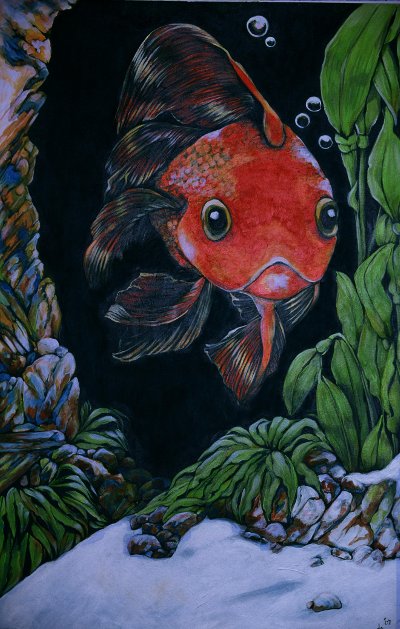
LAKEPORT – “There are some dreams forgotten and some dreams remembered, but then there are those special dreams that inspire!”
That's the opening line from “The Ancient One: Once Undiscovered is NOW Discovered,” the latest children's book from local author Diane Arruda.
Arruda has taken her dream to the next step with the release of “The Ancient One,” the second book in her “The Dream River Adventure Series.”
Dreams are the focus of the series, which will consist of a total of five books. The story is meant to appeal to people of all ages but is placed in the genre of children’s books.
Arruda, a mother of four grown children and a grandmother of five, plans to have the whole series written by the end of April. But her inspiring dream has been floating in her mind for a few decades, and has been part of a journey, she said.
“The stories have manifested through a fantastic dream I had when I was 9 years old,” she said. “It was a dream about a beautiful, sparkling river located in a lush colorful forest. Small, beautiful but very unusual water creatures lived in it. I met others just like the first water angel and together they showed me new places and new things to do in the river.”
She added, “It was magical.”
Her dreams also were influenced by a childhood reading experience, when she read a children's book from the 1800s that featured “water babies,” magical children that lived underwater.
Her books feature “water angels,” which represent love, joy, adventure and understanding.
Arruda's dream river was finally put into words five and a half years ago when her childhood dream suddenly returned to her one day.
“I saw, quite vividly in my mind’s eye, the image of a water angel swimming among cattails. It was a beautiful sight. It was an incredible experience and it signaled to me that it was time to change my energy and finally write the story,” said Arruda.
She had recently suffered the loss of her career and it took months for her to recover. But now she believes that losing her job was a turning point in her life, and that her true purpose in life now is to write and paint what she imagines.
The main character of the stories is Golden Fish, who correlates to Arruda herself. Readers were first introduced to Golden Fish in Arruda’s first published book, “The Undiscovered River: Golden Fish and a True Dream,” that was published early last year, several months before the August release of the second book.
Arruda couldn’t control her urges to paint her story, and she started painting just as soon as she started writing. Being a professional artist and having a degree in art history greatly contributed to her ability to visually depict her magical dream river, she said.
Her acrylic paintings are very vivid and bright, just as she described her dream. Her desire to use her own illustrations for her writing made it difficult to get her books published, though. However, she would not trust the imagery to any other artist because she feels she is the only one who can truly depict it.
“I was the happiest I had been in a very long time,” Arruda said of writing the series. “The stories and the artwork started a new chain of life events that began to give me a clearer picture of the person I was becoming on the inside versus the one I was slowly leaving behind on the outside.”
The adventure begins when Golden Fish truly believes in a dream she had of a beautiful, undiscovered river. She lives in The Great Pool, which Arruda said represents the way the world thinks and acts in the present time.
Because she truly desires to learn more about life beyond the Great Pool, Golden Fish is given an invitation to journey through a secret passageway into the Undiscovered River. This event in the story has major significance to Arruda’s life.
“It represents the beginning of my own determined desire to reeducate myself by reading who, what, when, where and the why of past and current thinkers in psychic growth and understanding,” she said. “This personal education became my passageway to the new way of looking at things.”
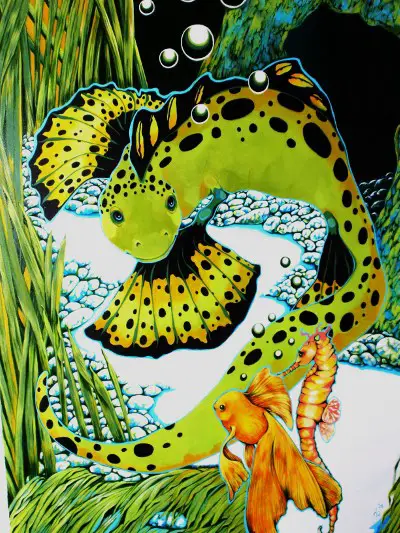
Golden Fish encounters many of the same feelings and similar experiences as Arruda has had in her own life, such as having a desire to know more and taking action to educate oneself.
“Growing up, getting married, divorced, educated and leading careers are experiences that are a part of that time,” she said. “I can now take my life’s journey through Golden Fish and her dream river adventures where happiness and fulfillment are the very important words.”
Golden Fish decides to leave the Great Pool and discover the world beyond, never to return again.
“The Undiscovered River,” the first book, leads Golden Fish to realize that there are five Living Codes once she makes it out of the Great Pool. Her discovery stems from a meeting with the Magnificent Whirlpool, who is the source of all that lives in the Undiscovered River and beyond.
After Golden Fish tells her friend about the second true dream, she discovers the First Living Code. Her friend helped her by telling her that the code is that “all living things are connected and share the power of source. Arruda describes “source” as energy.
“The Ancient One,” the second book, is based on Golden Fish’s journey to discover the Second Living Code.
Many overarching ideas can be interpreted religiously, but Arruda did not intentionally reflect any organized religious sensitivities.
“The stories reflect a personal desire to go beyond the accepted ways of thinking about one’s life and personal expectations and take a deeper look at the world around them,” she said.
The first two books can be purchased locally at Wild About Books, Watershed Books and Catfish Books, or online at Amazon.com for $12.95 each. They are each 50 pages in length including the beautiful artwork.
The third book, “Dream Keepers” will be available by the end of January this year. Because it is longer than the first two, it will be sold for $13.95.
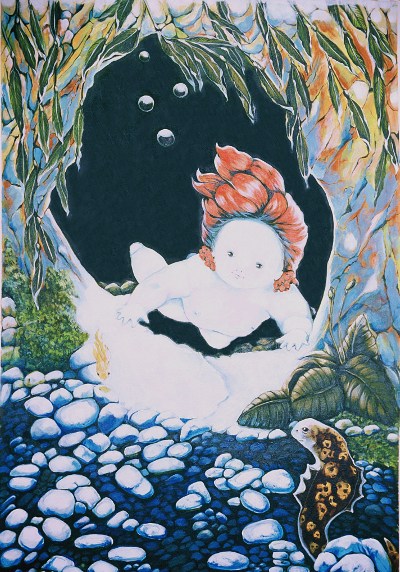
“Dream Keepers,” is a turning point in Golden Fish’s journey. She must return to the Great Pool to find the Third Living Code. The last two books in the series will be about discovering the fourth and fifth living codes.
The search for the codes is a search for many of life’s basic questions like: “Why am I here?” Where should I be now, at this time in my life?” and “Who am I?”
“I've got a lot of work to do,” said Arruda.
But, she added, “It's the most fun I've ever had.”
Visit Arruda’s Web site, www.goldenfishbooks.com , and the publisher, Eloquent Books’ Web site, www.eloquentbooks.com/TheUndiscoveredRiver.html , for more information about The Dream River Adventure Series.
E-mail Tera deVroede at

The 6.5-magnitude quake occurred at 4:27 p.m., according to the US Geological Survey.
The quake's epicenter was 27 miles west of Ferndale and 33 miles west southwest of Eureka, the US Geological Survey reported. Its depth was recorded at 13.5 miles in the ocean floor.
Fifteen smaller earthquakes followed, eight of which were larger than 3.0 in magnitude, according to US Geological Survey records. They included a 4.5-magnitude earthquake with the same epicenter as the 6.5-magnitude quake.
Caltrans reported late Saturday evening that its crews has responded quickly to inspect roads and bridges in the area after the quake occurred.
Based on an initial assessment, the agency concluded that the highways “performed well” and will remain open. Inspections will continue in the coming days, Caltrans reported.
The US Geological Survey was continuing to receive shake reports from around the region late into the night. Shortly before 2 a.m. Sunday they had received 7,725 responses in 508 zip codes from people who felt the earthquake.
Responses came as far away as Salem, Ore. – nearly 500 miles from the quake – as well as Reno, Nev., and south another 500 miles to Hilmar.
Residents in Lake County – specifically the Nice and Clearlake areas – also reported feeling the quake.
The Associated Press reported that some injuries resulted in Humboldt County, where there were widespread power outages, and damage to utilities and buildings.
E-mail Elizabeth Larson at

Saving the planet should start in the kitchen. After all, that is where we consume most of it. Water, wildlife, vegetation, chemicals, packaging of all sorts – all of them pass through your kitchen before they pass through other parts of our homes.
I follow many different practices and I’ve been doing them now for so long that I don’t even realize I’m doing them most of the time. Hopefully, in this new year you will start new habits to lessen your footprint and readers will add their own tips after reading this.
I want to lessen my impact on the planet but I want to be smart about it. I think about the amount of fuel that is used to ship foods, the amount of energy that is used in processing them and the amount of water that is used in all of it. I can’t help but think that we don’t have droughts from lack of water but from overuse of it.
Save water
I keep a half gallon water bottle next to my kitchen sink and when I need some hot water instead of letting the water gradually get warm while running wastefully down the sink I catch it in the bottle and use the tepid water to water my plants, add to my aquarium, put in my water filter, or even to cook with.
You may be amazed at how many gallons you waste if you actually start saving them. I estimate that I save about 1,000 gallons a year by doing this.
If you think about it, if we didn’t use so much water every day then there would be that much more in the lakes and water table.
Bring your own bags to the store
The canvas bags that you can reuse at the grocery stores I like but make me shake my head sometimes.
If you go to a major grocery chain you can purchase theirs for typically two or three dollars with their name and logo on it. Wait a minute! You want me to pay you $3 to advertise YOUR company? My local grocery store (Nylander's) carries generic canvas bags for only 99 cents. I’ve saved a couple bucks and am not someone else’s billboard.
I’ve purchased 10 of these bags and have two free from swag of the Lake County Wine Auction supplied by Kelseyville Lumber; between all of them they hold enough for even my largest grocery run.
The major grocery stores will give you a discount on your grocery bill – typically three to five cents per canvas bag – but be sure to remind them and tell them how many bags you have provided so they can apply the discount. There aren’t a lot of people using canvas bags yet so reminding the cashier will help assure you receive your discount.
One of my favorite moments was when the cashier finished ringing up by groceries and then looked back and said with a frustrated look “Oh, and you have bags,” as if I was paying with pennies. Not only do I save the grocery store bags from the dump but with their rebate the bags have paid for themselves since I’ve bought them.
Use natural cleaners
I clean my cutting board first by scraping it with a board scraper (I bought mine at the Kitchen Gallery). Then I squeeze the juice of half a lemon on the board and sprinkle with a tablespoon or two of kosher salt (kosher salt has no use in my kitchen except to clean my cutting board).
I then use the spent half a the lemon as a scrubber and mix the lemon juice and salt (which is now a natural hydrochloric acid that will kill anything) scrubbing the entire board clean. When I have cleaned the board enough I rinse it under running water and set it aside to dry. You now have an eco-friendly, yet sanitized, cutting board.
Cover your pots when bringing them to a boil
A watched pot never boils but a covered pot boils in no time. The heat you are creating in a pot escapes into the air but if the pot is covered the heat is trapped, reflects back and helps the heat in the pot increase substantially so the pot boils faster wasting less energy whether you are heating with gas or electricity.
In my kitchen I may start boiling a pot of water, not see a lid nearby and just cover the pot with another (larger) pot. It’s that simple.
Also boil with less water
When you need water to boil pasta try to use less water since the more water there is, the more gas or electricity you will need to bring that water to a boil.
When I am done with the boiling water I take it directly outside and pour it over any weeds in my yard. I hate weeding so this works well for me because not only does the boiling water kill the weeds but it cooks them, making them palatable for the scavenger insects in my garden that then eat the dead cooked weeds almost overnight.
Cook from scratch
When you eat a packaged “just add water” or “just add ground beef” dinner, that food was harvested from all over the planet then shipped to a factory, processed and then, meanwhile, packaging is manufactured, printed, shipped, the product is put into the packages then they are shipped again to distributors that guess what? Ship them again!
When you eat prepared meals you are promoting a massive wheel of processing, waste and, did I mention … shipping? I can only imagine the amount of gasoline that is used to get your box-o-dinner to your house.
When you make your food from scratch you not only save the planet but your money. I look at a can of sloppy Joe mix, a box of San Francisco treat, or macaroni and cheese and think, “I can make that better and cheaper myself.”
I tried making my own mayonnaise for a while but it was too much work so I buy it now. Even I have my limits for saving the planet and money.
I also like cooking from scratch because I need a smaller garbage can. Since I don’t have as much packaging to throw out I can order a smaller trash container from my garbage company and pay less for my garbage service. Save money and landfill space, cook from scratch.
You’ve watched Rachel Ray’s 30 Minute Meals (I don’t like to admit it either but come on!) so you have to admit, it doesn’t take long to make a dinner from scratch.
Process as much as you can yourself
I only purchase whole chickens or, more commonly, capons at the grocery store. There are many reasons.
First of all, why should I pay someone to dismember them when I can do it and save the money? Look at the price per pound for boneless chicken breasts to the price of a whole chicken per pound.
Secondly, I get more for my money. Not only do I get the chicken meat, I get a skeleton to make into soup but also the giblets to make all sorts of things.
I mentally pull my hair out when I see people on food stamps buying tons of food that, with just a little bit of work, they could get a lot cheaper. I just want to scream, “You could get so much more for less!”
Lastly, I enjoy doing it, since all of my wife’s cats stand around my feet meowing their heads off waiting for me to throw a scrap at them while I trip over them (sarcasm alarm sounding).
I also purchase “primals” whenever I can. These are large cuts of meat that I can cut myself into individual steaks or roasts. Buying a primal can cost over $100 but after you’ve cut them into your individual servings the price is drastically less expensive than what you would pay at the grocery store.
Literally, you can save hundreds of dollars working with primals. Recently I purchased a whole pork shoulder, cooked it, and made half a dozen dinners with it – pulled pork sandwiches, enchiladas, cassoulet, soup, curry. I was able to make a lot of dinners with the one piece of meat.
Eat sustainable food and more vegetables
Americans have become obsessed with meat. We eat far more of it than our bodies actually need. The meat with your dinner should be about the size of a deck of playing cards yet we regularly eat much larger amounts.
Raising these animals requires massive amounts of food, water, medicine, land and labor, all of which themselves require massive amounts of money, fuel and other resources to produce. It can take up to 12 pounds of feed to make one pound of animal.
Some are more efficient, like tilapia, which takes barely over a pound of feed to make a pound of meat, rabbits need three pounds of food to make one pound of meat, etc. The fact is that you are growing feed for something else that you could have grown for humans and negated the “middle meat.”
Bring your cart back to the grocery store
It’s what, 60 feet to return the grocery cart back the building from your vehicle? If you bring the cart back to the building then the grocery store doesn’t have to pay someone to stop their job inside the building to go retrieve them. This little step saves the grocery store money which then can be passed on to you.
If you think about it, every step you make for yourself saves someone else from doing it, which can save you money and the world resources.
Farmers markets/seasonal local foods
Now in the middle of winter it’s hard to promote farmers market that won’t be available until spring, but if you buy foods that are seasonal you save the planet also.
After all, it you buy a cucumber in the middle of winter it probably came from Chile, where a lion's share of our out-of-season winter produce comes from.
How much fuel does it take to ship a cucumber from Chile to us? If you eat fruits and vegetables that are in season for California you are more environmentally sane but have more of a connection to your food.
These are just some of the things that you can start to do to reduce your drain on the planet.
Anyone else have steps that they follow that can help?
Ross A. Christensen is an award-winning gardener and gourmet cook. He is the author of "Sushi A to Z, The Ultimate Guide" and is currently working on a new book. He has been a public speaker for many years and enjoys being involved in the community. Follow him on Twitter, http://twitter.com/Foodiefreak .
Follow Lake County News on Twitter at http://twitter.com/LakeCoNews and on Facebook at http://www.facebook.com/pages/Lake-County-News/143156775604?ref=mf .
The workshop will be held on Saturday, Jan. 23, from 9:30 a.m. to 1 p.m. at the Lower Lake Historic Schoolhouse Museum, located at 16435 Morgan Valley Road in Lower Lake.
Presented by the county of Lake, the National Park Service (Rivers, Trails, and Conservation Assistance Program), and Alta Planning, this community workshop will provide an opportunity to learn about the county’s efforts to plan for and develop a network of trails and community pathway connections on and around Clear Lake.
The workshop, which is a follow up to a workshop held in September, will feature a presentation on the county’s trails planning efforts, the results of the recently conducted trails community survey, breakout sessions to gather feedback about proposed trail concepts and ideas for potential connections, a trails open house, and an opportunity for “trail talk” with trail vendors and experts.
Information tables will feature sample trail plans and documents. Volunteer opportunities for trails development also will be discussed.
Light lunch will be provided. After the workshop, attendees can choose to participate in an optional one-hour guided hike through Anderson Marsh State Historic Park (weather permitting).
Be a part of this workshop and help shape a trails system that will meet community needs and encourage tourism by making Lake County a world-class trails destination.
For information on the county’s trails development efforts, go online to www.konoctitrails.com or contact the Lake County Public Services Department at 707-262-1618.
Follow Lake County News on Twitter at http://twitter.com/LakeCoNews and on Facebook at http://www.facebook.com/pages/Lake-County-News/143156775604?ref=mf .
Javier Agustin Ramirez Orozco, 22, was arrested for robbery at around 8 a.m. Friday, according to a report from Capt. Rich Williams of the Yolo County Sheriff's Office.
Williams said that the victim, a 64-year-old female Vacaville resident, was walking near the casino entrance at around 7:30 a.m. and passed by a handicap parking space, where Orozco allegedly got out of a vehicle and grabbed her purse.
During the struggle for the purse, the victim was dragged on the ground towards the suspect’s vehicle, Williams said.
Orozco eventually gained control of the purse and then drove away on Highway 16, William said.
Shortly before 8 a.m. a Yolo County Sheriff’s deputy located Orozco's vehicle on Highway 16 near County Road 93, according to the report.
Williams said the deputy stopped Orozco and arrested him.
Orozco was booked at Yolo County's Monroe Detention Center.
Follow Lake County News on Twitter at http://twitter.com/LakeCoNews and on Facebook at http://www.facebook.com/pages/Lake-County-News/143156775604?ref=mf .
More precisely put, the estate tax died, only to be resurrected come Jan. 1, 2011, if not sooner, when it returns with a vengeance, under the 2001 enacted federal law.
What does this mean for you?
Since 2002, the estate tax has provided a tremendous income tax benefit for many heirs of middle class persons whose estates never paid any estate tax.
Last year, as a general rule, only decedents with net worths over $3.5 million paid estate tax. So long as the estate tax was in effect, however, inheriting property at death was often advantageous as it usually meant a so-called “step-up” in basis.
That is, until now, inherited property has received a basis equal to the appraised death value – basis is what determines whether any capital gains is owed on the property at sale.
A stepped-up basis wipes out any appreciation in value that occurred between the date of the deceased owner’s purchase and the date of the purchaser’s death.
For example, if someone purchased their home in 1975 for $100,000 and died in 2009 when the property had appreciated and was appraised at $450,000, then the inheriting beneficiaries/heirs would receive a “stepped-up” basis of $450,000 (not $100,000).
Accordingly, the heirs could later sell that property for a price at or below $450,000 without triggering any capital gains (income) tax.
The step up in basis is a gift of the estate tax which allows persons inheriting property of a decedent to receive a “date of death” basis regardless of whether that deceased person’s estate paid any estate tax or not.
Usually, when the property has been held a long time, the date of death basis exceeds the original purchase price. Now, with no estate tax, there is no legal authority for the date of death basis adjustment.
Remarkably, after nine years of impending uncertainty over the slated 2010 repeal, Congress was unable to agree on what to do with the estate tax, even just for 2010.
This has defied all expectations in the legal community, which expected a last-minute enactment to freeze the estate tax in its present state, at least for 2010.
It is not impossible, however, that belated legislation could be enacted in 2010 on a retroactive basis to Jan. 1. While controversial, retroactive taxation is not without precedent.
Otherwise, come Jan. 1, 2011, the estate tax will be resurrected with the old 2001 threshold, of $1,000,000, i.e., estates with net worths greater than $1,000,000 will be taxed on the excess at close to 50-percent rates.
Once again, many upper middle class families may need to be concerned about estate taxation planning.
Dennis A. Fordham, attorney (LL.M. tax studies), is a State Bar Certified Specialist in Estate Planning, Probate and Trust Law. His office is at 55 1st St., Lakeport, California. Dennis can be reached by e-mail at
Follow Lake County News on Twitter at http://twitter.com/LakeCoNews and on Facebook at http://www.facebook.com/pages/Lake-County-News/143156775604?ref=mf .
Education
Health
Business
Obituaries
Veterans
Recreation
Religion
Arts & Life
Government & Politics