 How to resolve AdBlock issue?
News
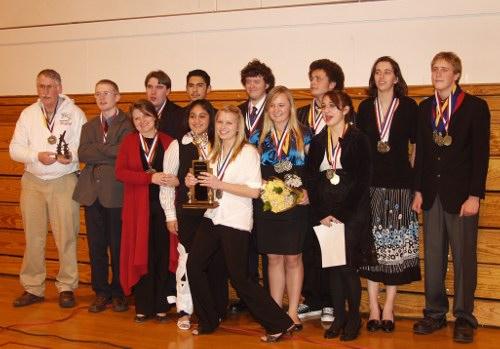
UPPER LAKE – Before a packed audience Saturday night in the Upper Lake High School gym, the school's Academic Decathlon team added another countywide title and numerous individual medals to its cache of accomplishments.
The 30th annual Lake County Academic Decathlon was held at Upper Lake High on Saturday. Testing began at 8:30 a.m., with community members invited to attend the competition's finale, the Super Quiz, which began at 4 p.m.
Three schools took part this year: Upper Lake, Lower Lake – which had enough students that it created two teams – and Middletown.
Parents and community members crowded into Upper Lake's gym for the event, which had as its theme this year the French Revolution.
In honor of that theme, veteran Lower Lake coach Nancy Harby donned a black beret. Some of her students wore versions of the red Phrygian – or liberty – cap, a conical hat first worn in ancient times that symbolized freedom and which was adopted by the sans culottes, who were volunteers in the French revolutionary army.
During the Super Quiz, teams worked their way through 45 questions about that turbulent and bloody period of French history, answering questions about the Thermidorian Constitution, the Old Regime, Girondins and Jacobins, and the downfall of King Louis XVI.
The Super Quiz involved students from the three categories of competition – Varsity (grade point averages of 2.99 and below), Scholastic (GPAs of 3.0 to 3.74) and Honors (GPAs of 3.75 to 4.0) – answering questions in nine rounds. Each was given 10 seconds to give an answer.
At the end of the Varsity round, Lower Lake Team I and Upper Lake were tied with seven points each, followed by Middletown with five points and Lower Lake Team II with two points.
The three Scholastic rounds of questions followed. Lower Lake Team I led with 14, Upper Lake had 11, Middletown had nine points and Lower Lake Team 2 had six points.
Then came the Honors round. By the end of the 45 questions, Lower Lake Team I had extended its lead, coming out on top with 19 points, followed closely by Upper Lake with 17, Middletown with 13 points and Lower Lake Team II with 10 points.
With the Super Quiz completed, it was up to the judges to tally up the day's competition and announce the winner.
While the calculations took place, Upper Lake High's band played several musical selections from the revolutionary period, the best known among them being “La Marseillaise,” written by Claude-Joseph Rouget de Lisle in 1792, and later becoming France's national anthem.
Then Lake County Superintendent of Schools Superintendent Dave Geck, who was the master of ceremonies for the evening, announced the winners. Lower Lake High Principal Jeff Dixon, Upper Lake High Principal and Superintendent Patrick Iaccino and Middletown High coach Ryan Callen handing out the awards.
The following is the list of award winners at Saturday's competition.
Written essay
Bronze: Spence Hadden, Varsity, Lower Lake
Silver: Ben Mullin, Varsity, Upper Lake
Gold: Laura Wold, Honors, Upper Lake
Speech, impromptu
Bronze: Courtney Havrilla, Honors, Upper Lake
Silver: Devin Hoyt, Scholastic, Upper Lake
Gold: Ben Mullin, Varsity, Upper Lake
Interview
Bronze (tie): Teodora Toshich, Honors, Lower Lake Team II; Alyssa McCosker, Honors, Lower Lake Team I
Silver: Ben Mullin, Varsity, Upper Lake
Gold: Justin Harrison, Honors, Lower Lake Team I
Language and literature
Bronze: Tiffany Criss, Varsity, Upper Lake
Silver: Elizabeth Perkins, Honors, Lower Lake Team I
Gold: Ben Mullin, Varsity, Upper Lake
Art
Bronze: Ben Mullin, Varsity, Upper Lake
Silver: Joe Riggs, Scholastic, Lower Lake
Gold: Tiffany Criss, Varsity, Upper Lake
Science
Bronze (three-way tie): Sean Grant, Scholastic, Lower Lake Team II; Tiffany Criss, Varsity, Upper Lake; Ian Weber, Scholastic, Upper Lake
Silver: Roy Hankins, Scholastic, Upper Lake
Gold: Ben Mullin, Varsity, Upper Lake
Mathematics
Bronze: Ian Weber, Scholastic, Upper Lake
Silver: Ben Mullin, Varsity, Upper Lake
Gold (tie): Roy Hankins, Scholastic, Upper Lake; Joe Riggs, Scholastic, Lower Lake
Music
Bronze (tie): Courtney Havilla, Honors, Upper Lake; Tiffany Criss, Varsity, Upper Lake
Silver: Corey Cherrington, Scholastic, Lower Lake Team I
Gold: Ben Mullin, Varsity, Upper Lake
Economics
Bronze: Spence Hadden, Varsity, Lower Lake Team I
Silver: Joe Riggs, Scholastic, Lower Lake Team I
Gold: Ben Mullin, Varsity, Upper Lake
Varsity top scorers
Bronze: Spence Hadden, Lower Lake
Silver: Tiffany Criss, Upper Lake
Gold: Ben Mullin, Upper Lake
Scholastic top scorers
Bronze: Devin Hoyt, Upper Lake
Silver: Roy Hankins, Upper Lake
Gold: Joe Riggs, Lower Lake
Honors top scorers
Bronze: Courtney Havrilla, Upper Lake
Silver: Alyssa McCosker, Lower Lake
Gold: Laura Wold, Upper Lake
Top scorers on each team
Upper Lake High School: Ben Mullin, Varsity
Middletown High School: Nick Speridon III, Honors
Lower Lake High School Team 2 (tie): Teodora Toshich, Honors; Bianey Madrigal, Honors
Lower Lake High School Team 1: Joe Riggs, Scholastic
Super Quiz
Silver: Lower Lake Team I
Gold: Upper Lake
Winning teams
Silver: Lower Lake Team I
Gold: Upper Lake
At the competition's end, Geck told the audience that keeping the Academic Decathlon and performing arts programs intact “really depends on us as a community.”
He added, “It will take all of us to keep these kinds of program going.”
With the competition over for another year, the student decathletes congratulated each other and offered high fives to teammates and their opponents from other schools.
Upper Lake was led this year by Anna Sabalone, a former student decathlete now in her second year of coaching, and Steve Harness.
Sabalone called the experience “purely and simply overwhelming.”
This year proved more challenging than last year because Sabalone had “a fully new crop of kids.”
She started the new year with only two experienced decathletes – Ben Mullin and Courtney Havrilla. On top of that, she lost half of her Academic Decathlon class before the year had even started, and she didn't know if she would have enough students to fill the team.
She worked to convince students to stay with it long enough to “get the bug.”
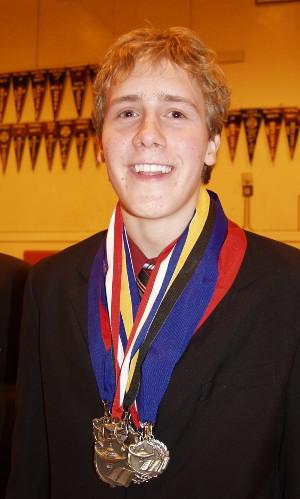
Those getting the bug included the statuesque Tiffany Criss, wearing a broad smile and plenty of medals around her neck after the competition.
A senior, Criss credited her friend, Ben Mullin for talking her into joining the Academic Decathlon team this year.
Mullin last year was the high point winner, and he kept his title in grand style this year, ending the evening with 13 medals around his neck.
However, even with those awards, Mullin hadn't accomplished everything he'd set out to do.
He had a bet with two of his friends that if he didn't beat them in the mathematics competition he would dye his hair pink and paint his fingernails.
Teammate Roy Hankins topped him in that category, so Mullin admitted he had to honor the bet.
Sabalone said she'll give her students a few days off, which will include a victory movie day on Tuesday.
Then it's back to work to prepare for the state Academic Decathlon, which will be held in Sacramento March 12 through 15.
Asked if he has anything riding on how he competes at the state meet, Mullin said, “I would not accept any more bets.”
E-mail Elizabeth Larson at

People who follow me on Twitter or friend me on Facebook will already know about this, but to tell everyone: I have recently been diagnosed with type 2 diabetes.
What no one but those really close to me knows is that my daughter and I are big fans of the TV series “Futurama,” a sci-fi cartoon set in the year 3001. Our daily conversations are dotted with quotes from the program, and (because she chooses not to watch the show) my wife has no clue what we are talking about. “A wondrous thing happened why not?” How can she not understand that?
I mention this because I am once again growing sunroots in my garden. Years ago when I had a bigger garden I had a huge patch of them growing there. I really like them.
Sunroots are a potato-like tuber that grows underground and looks like really fat ginger. They are a great food for diabetics because sunroots store their starch in the form of inulin (a polysaccharide) and not carbohydrates. Diabetics can eat sunroots all day long without having blood sugar problems.
You might not be familiar with this vegetable because they’ve gone through a little identity crisis. For a long time sunroots went by the name “Jerusalem Artichokes” but the title just confused people since they aren’t from Jerusalem and they aren’t anything like an artichoke. They’re actually a variety of sunflower.
I personally don’t care for the new name, since to me it sounds like it was created by a marketing team of third graders. I prefer the name “sunchoke,” although I realize it doesn’t sound very appetizing. It does however remind me of the Futurama joke when they were talking about using a “smell-o-scope” to explore space …
Fry: "Hey, as long as you don't make me smell Uranus." (he laughs)
Leela: "I don't get it."
Professor: "I'm sorry, Fry, but astronomers renamed Uranus in 2620 to end that stupid joke once and for all."
Fry: "Oh. What's it called now?"
Professor: "Urectum. Here, let me locate it for you."
How can my wife not love humor like that?
The new marketing name aside, sunroots are going to be showing up more and more in America’s food baskets because not only are they good for diabetics – and we seem to be homogenizing into a nation of them (I guess I should start saying “us”) – but because they are a vegetable native to North America and grow like weeds.
Since they are native they don’t need much for special attention and are super productive which makes them cash cows for farmers. Imagine if you will, preparing a planting bed, planting the tubers and then ignoring them for months then harvesting buckets full of produce.
Sunroots are so prolific that if you want to grow them in your garden you should plant them in an out-of-the-way section in which you don’t have any intention of doing anything else, because they will reseed themselves if even the smallest of tubers is left behind. Because they are so prolific, some people consider the sunroot to be a noxious weed.
Sunroot tubers found in the grocery store will grow if planted, but many more interesting varieties are available online.
In the spring find an out-of-the-way area in your garden, work into the soil some steer manure, compost and your favorite fertilizer. Plant the tubers 3 or 4 inches deep and at least a foot apart. Mulch the area with straw, water occasionally, and watch as numerous stalks grow from each tuber.
In the fall frost will kill the tops and you can harvest the tubers as needed, leaving the extras in the ground for storage. It helps to leave at least part of the dead stalks on the plant so you can find the remaining tubers when you want them.
I’ve never tried it, but it is said that the leaves can be made into a tea that relieves the pain of Rheumatoid arthritis.
When I had my last sunroot patch I harvested so many sunroots that my family got sick of them, so I gave them to the local shelter, coworkers, even people walking down my street. The nice thing is that if you don’t want to harvest the roots you can just leave them in the ground until you want them.
I don’t have a lot of room in my garden but I’ve ordered a rare heirloom variety of sunroots to plant in my yard and hopefully I can keep it happy yet also keep it in check. The plants are huge and dense. They make a perfect wind break. They grow to be 8 to 10 feet tall and the stalks grow so thick that an you might as well consider a patch of sunroots as a fence.
They are a great organic farmer’s friend. Birds love them because the flowers contain tiny seeds and the plants provide great cover.
Sunroots were “discovered” in a tribal garden in Cape Cod by Samuel de Champlain (in 1605 ACE) who sent them to his homeland, France. He called them “Canadian Artichokes” since he thought they tasted like artichoke hearts.
A Swedish Naturalist then renamed them “Topinambour” after a cannibalistic tribe from Brazil (that’s a long, dull story) and they are still called that in France today.
They became mildly popular and traveled around Europe and eventually made their way to Italy. Since sunroots are a member of the sunflower family and produce an abundance of yellow flowers that turn to follow the sun throughout the day, the Italians called them “Girasole” meaning “turning to the sun.”
The name “Jerusalem Artichoke” is actually a mispronunciation of Girasole Articocco. Europe really embraced the sunroot as an animal feed; pigs love them.
Finally in 1620 The English Oxford dictionary makes mention of “The Artichokes of Jerusalem.”
So if the sunroot is so wonderful and easy to grow why isn’t it more popular today? People throughout history have looked at food and associated its appearance with what it can do.
For example, many foods that resemble genitals are thought of as aphrodisiacs. Sunroots are knobby and misshaped and resemble a leper’s hand, so it came to be thought that sunroots caused leprosy. There’s nothing like the threat of a disfiguring disease to whet the appetite! So sunroots were dropped off the menu like the population during the plague.
Good news, everyone! Sunroots are returning to popularity, and it’s a good thing too. They’re high in free glutamines, amino acids, iron (almost 20 percent RDA), potassium and low in calories.
Scrub them with a vegetable brush and use them raw in salads or cooked in almost anything. Boil them and toss them with butter and chives. Always try to eat them with the peel on since most of the nutrition is there.
What do they taste like? Raw, their texture is like water chestnuts or like jicama, but they’re sweeter. Cooked, they can best be described as a cross between potatoes and artichoke hearts. They are popular in France cooked as a fritter, but then they are also pickled, put in soups and salads, fried, and they have even been roasted and used as a coffee substitute. You get the idea.
The sugar (fructose) produced in one acre of sunroots could produce twice the amount of alcohol of corn or sugar beets, and in Germany they produce a spirit made from sunroots called Rossler. Some people have predicted that they could be used to produce the automobile fuel of the future.
Since I try not to keep any secrets, I’ll tell you the last thing you should know, and it’s not very flattering for the sunroot. Some people may not digest the inulin in sunroots well and this will translate into flatulence and sometimes stomach cramps. In the 18th century they were called “the windy root” and some children like to call it “fartichoke.” This doesn’t happen to everyone, but now at least you are forewarned.
A new season of “Futurama” will be starting in a few months, unless Fathers Against Rude Television stops it. How can you not love that humor?
Ross A. Christensen is an award-winning gardener and gourmet cook. He is the author of "Sushi A to Z, The Ultimate Guide" and is currently working on a new book. He has been a public speaker for many years and enjoys being involved in the community. Follow him on Twitter, http://twitter.com/Foodiefreak .
Follow Lake County News on Twitter at http://twitter.com/LakeCoNews and on Facebook at http://www.facebook.com/pages/Lake-County-News/143156775604?ref=mf .
KELSEYVILLE – A Kelseyville family is mourning the loss of a son, killed this week in Pakistan.
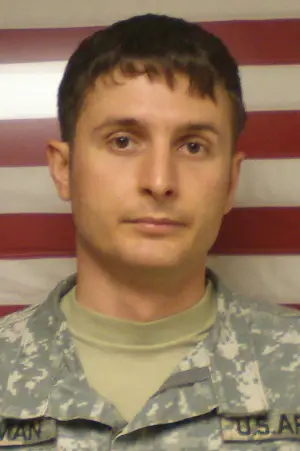
Sgt. 1st Class David J. Hartman, 27, was killed on Wednesday by a terrorist bomb while in Pakistan in support of Operation Enduring Freedom, the Department of Defense reported Friday.
Hartman's father, Greg Hartman, and stepmother, Kate, live in the Clear Lake Riviera, while his mother, Mikail Bacon, lives in Pardeeville, Wisc.
The family couldn't be reached for comment on Friday.
However, late Friday their pastor, Victor Rogers, who leads the North Shore Christian Fellowship in Upper Lake, said he just returned from picking the Hartmans up from the Sacramento airport.
He said they had just returned from Delaware, where David Hartman's body had arrived from Pakistan. The young man's body is due to return to California next week, but funeral arrangements are currently undecided.
Hartman and wife, Cherise, have a young son, Michael, and were expecting their second child together.
Officials said Hartman died along with Sgt. 1st Class Matthew S. Sluss-Tiller, 35, of Callettsburg, Ky. – who, like Hartman, was part of the 96th Civil Affairs Battalion (Airborne), 95th Civil Affairs Brigade (Airborne), out of Fort Bragg, N.C. – and Staff Sgt. Mark A. Stets, 39, of El Cajon, assigned to the 8th Psychological Operations Battalion (Airborne), 4th Psychological Operations Group (Airborne), out of Fort Bragg, N.C.
The men were killed in Timagura, Pakistan – located in the Lower Dir District of Pakistan’s North West Frontier Province – when their unit was hit by an improvised explosive device planted by insurgents, the Department of Defense reported.
The United Kingdom's Telegraph newspaper reported that the three deaths were believed to be the first US military deaths to occur in Pakistan.
The US Embassy in Islamabad reported that in addition to the deaths of Hartman, Sluss-Tiller and Stets, two other soldiers were injured in the bomb blast, which occurred at around 11:20 a.m. Wednesday.
Rear Adm. Hal Pittman, director of Communication at U.S. Central Command, said the three men and their fellow members of the military were in Pakistan at the request of that country's government.
The US military had been invited by the Pakistan Frontier Corps to conduct training in Lower Dir, according to the US Embassy. They were attending the opening of a new girls' school that had been renovated through US humanitarian assistance when the bomb went off.
Such schools have become a particular target for insurgents, according to recent press reports.
Pittman said the attack demonstrated “the terrorists' lack of respect for life and their willingness to use violence against women and children for advancing their malign vision.”
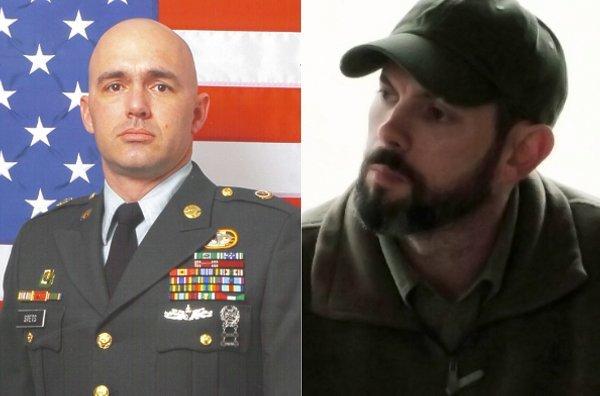
Along with the military casualties, the US Embassy reported that several Pakistani citizens – among them children – were killed and injured in the blast.
The US Embassy condemned the bombing. “The carnage at the school in Lower Dir clearly shows the terrorists' vision. The United States and Pakistan are partners in fighting terrorism – and our people are working together to build schools,” according to an agency statement.
Both Hartman and Stuss-Tiller were civil affairs senior noncommissioned officers and had previously deployed to Iraq and Afghanistan in support of the war on terror, according to a statement from the US Army Special Operations Command.
Hartman was assigned to Team 622 in Company B, 96th Civil Affairs Battalion (Airborne), 95th Civil Affairs Brigade (Abn.), Fort Bragg, N.C.
In November 2002 Hartman deployed to Afghanistan in support of Operation Enduring Freedom and in 2004 he supported Operation Iraqi Freedom, according to a Special Forces biography.
"Both Matthew and David are heroes in my mind – they volunteered to come to Army Special Operations and the 95th Civil Affairs Bde. (Airborne), they both believed in what they were doing, and they were committed to helping people in a place where violence against innocent populations was too often commonplace," said Col. Michael J. Warmack, commander, 95th Civil Affairs Bde. "In the pursuit of what they believed, they made the ultimate sacrifice.”
Col. Warmack said the work the men were doing “is terribly important and goes to the heart of strengthening the population’s ability to live free from the stranglehold of extremism.”
Stets, a senior psychological operations sergeant, was on his second deployment in support of Operation Enduring Freedom, and also had served in Operation Iraqi Freedom, officials reported.
The bombing is still under investigation, US Army Special Operations Command reported.
David Hartman was born in Merced in 1982. In 2000 he graduated from Kadena High School on Kadena Air Force Base in Okinawa, Japan, and immediately enlisted into the US Army, according to a Special Forces biography.
While in the Army he had completed a number of courses and served previous assignments including holding the position of platoon sergeant with Company C, Special Troops Battalion, 3rd Battalion, 1st Infantry Division, officials reported.
His biography said that he also served in multiple positions with the 50th Signal Battalion, XVIII Airborne Corps, including as an electronic maintenance shop foreman, forced entry switch section team chief and sergeant, senior electronic maintenance technician and senior switch technician.
Officials reported that Hartman's awards included the Joint Service Commendation Medal, Army Commendation Medal, Army Achievement Medal, Good Conduct Medal, National Defense Service Medal, Iraq Campaign Medal, Global War on Terror Expeditionary and Service medals, NCO Professional Development Ribbon and Overseas Service Medal.
As of Friday, the Department of Defense reported that 969 members of the military have died in support of Operation Enduring Freedom, with 894 of those deaths occurring in and around Afghanistan. Total deaths for Operation Iraqi Freedom stood at 4,378 on Friday.
E-mail Elizabeth Larson at
The Lucerne increases proposed are 54.9 percent for 2011, 7 percent for 2012 and 6.6 percent for 2013, a three-year total of 68.5 percent.
CWS rates manager Darin Duncan, in the company's San Jose headquarters, explained that rates vary widely throughout the company's districts in California. For instance, the 2012 proposal for the Coast Springs portion of the Redwood Valley District (which includes Lucerne) is 154.8 percent.
Duncan said the proposals reflect various district needs, including infrastructure work needed and sometimes the size of the district.
The proposal for Antelope Valley is 73 percent, among the highest, and for Palos Verdes is 6.3 percent.
The total three-year increase request for all districts is 26.5 percent.
The details are contained in the Company's full 44-page application, available online at http://docs.cpuc.ca.gov/efile/A/103362.pdf .
In the last regularly scheduled rate hearings for Lucerne, the company originally proposed a 246 percent increase, which was reduced by about half during the CPUC hearings.
Follow Lake County News on Twitter at http://twitter.com/LakeCoNews and on Facebook at http://www.facebook.com/pages/Lake-County-News/143156775604?ref=mf .
The reason is that California statutory law provides absolute protection against creditor claims to so-called “private retirement plans.” The same cannot be said of IRAs.
Now let’s examine “private retirement plans.”
A “private retirement plan” is a plan “designed and used” primarily for retirement purposes to benefit the retiree and his family.
It is established by the participant’s employer and must operate in accordance with its primary purpose of providing retirement benefits upon reaching retirement age. Thus, it cannot be accessed by the participant prior to retirement to make withdrawals, as if it were a bank account, nor can it be used to borrow money.
There are, however, limited exceptions such as illness, disability or financial hardship, which may justify an early distribution; but, the determination of such justification must be made by someone other than the plan participant.
The private retirement plan must hold assets that are suitable for retirement purposes. Thus, one cannot transfer one’s home and rental properties into a retirement plan in order to shield these assets from one’s creditors. Moreover, the accumulation of retirement funds inside of the retirement plan must be gradual and not spontaneous, aside from a rollover (discussed below).
Private retirement plans do not need to qualify under the federal ERISA standards for so-called “qualified retirement plans”, although many do qualify. ERISA qualified plans are doubly protected because ERISA provides near absolute federal law protection against creditor claims.
IRAs, by contrast, have only limited creditor protection. They are protected only insofar as necessary to meet the IRA participant’s basic retirement needs. What is necessary is determined after taking into consideration the participant’s other available resources and current and future earnings power. The foregoing itself involves a “debtor’s examination” by the creditors.
Fortunately, assets transferred from an IRA into a private retirement plan are fully protected as a “private retirement plan.”
The transfer will not be treated as a reversible fraudulent conveyance if properly done. Nor do private retirement plan assets transferred into an IRA from a private retirement plan lose their exempt status, provided that the existing assets can be traced back to the source private retirement plan. Thus, if one transfers one’s private retirement plan into an IRA consisting exclusively of funds received from such plan, then the IRA is protected like it were a retirement plan.
Lastly, upon reaching retirement age, any funds received by the private retirement plan participant are exempt. That is, any use by the retiree of plan distributions counts as a retirement use. This is true even if the retiree is still working while withdrawing funds.
Patience is definitely a virtue when it comes to realizing the benefits of private retirement plans.
Dennis A. Fordham, attorney (LL.M. tax studies), is a State Bar Certified Specialist in Estate Planning, Probate and Trust Law. His office is at 55 1st St., Lakeport, California. Dennis can be reached by e-mail at
Follow Lake County News on Twitter at http://twitter.com/LakeCoNews and on Facebook at http://www.facebook.com/pages/Lake-County-News/143156775604?ref=mf .
Education
Health
Business
Obituaries
Veterans
Recreation
Religion
Arts & Life
Government & Politics