How to resolve AdBlock issue?
Refresh this page
How to resolve AdBlock issue?
Refresh this page
Lake County News,California
  • Home
    • Registration Form
  • News
    • Education
    • Veterans
    • Community
      • Obituaries
      • Letters
      • Commentary
    • Police Logs
    • Business
    • Recreation
    • Health
    • Religion
    • Legals
    • Arts & Life
    • Regional
  • Calendar
  • Contact us
    • FAQs
    • Phones, E-Mail
    • Subscribe
  • Advertise Here
  • Login

News

McGuire to host May 8 fire preparedness town hall

LAKE COUNTY, Calif. — Ahead of the summer fire season, state Sen. Mike McGuire is planning to hold a town hall on wildfire preparedness and prevention.

The online event will take place beginning at 6:30 p.m. Wednesday, May 8.

RSVP and submit questions for the town hall here.

It can be watched live here.

“The state has invested mightily over the past several years making the Golden State more fire safe,” McGuire said. “We've significantly beefed up firefighting resources in every corner of the state, hiring thousands of additional Cal Fire firefighters and we've advanced record funding for vegetation management, dead and dying tree removal and creating new fire breaks around communities. That said, we know there's much more work to do.”

McGuire will be joined by Cal Fire Chief Joe Tyler to share the latest updates and take questions.

New decision approves prescribed fire plan for Mendocino National Forest

Mendocino National Forest Supervisor Wade McMaster signs the decision notice on Mendocino Prescribed Fire and Fuels Management Strategy in front of community members at FireScape Mendocino’s 10th Anniversary Celebration on Thursday, April 25, 2024, in Williams, California. Photo courtesy of the Mendocino National Forest.

MENDOCINO NATIONAL FOREST, Calif. — The increasing frequency and extent of high-intensity wildfires pose a significant threat to California’s ecosystems.

To address the current wildfire crisis and restore forest health, Mendocino National Forest Supervisor Wade McMaster has signed a decision on the Mendocino Prescribed Fire and Fuels Management Strategy.

McMaster signed the document in front of a diverse group of local partners, tribal representatives and community members at a FireScape Mendocino workshop and 10th anniversary celebration, held in Williams on Thursday, April 25.

“The Mendocino Prescribed Fire and Fuels Management Strategy is incredibly important to me and my team, especially after we’ve had several catastrophic, dynamic fire seasons and other challenges with insect infestation, drought and back-to-back winters with severe storms,” said McMaster. “This forest-wide and multi-phased approach will allow us to more quickly adapt to changing conditions, reduce impacts from future fire and improve forest resilience and health.”

With this decision, forest managers can use prescribed fire with manual and mechanical treatments to reduce the build-up of hazardous fuels such as grasses, brush, small-diameter trees, downed trees and woody debris.

Treatments will be phased over time, targeting overly dense forest underbrush and small trees before and after wildfires.

Prescribed fires will be applied at varying intensities, sizes, frequencies, seasons and places, and manual and mechanical fuels-reduction tools will be utilized up to 20,000 acres per year to achieve and maintain desired vegetative conditions.

Treatments will vary across the landscape and will depend on several factors, including terrain, fire severity, desired conditions and ecology. Several constraints are in place to protect key Resources.

The strategy excludes treatment within Wilderness Areas and within 100-acre nest groves for the endangered northern spotted owl.

Also, treatments like thinning to reduce fuels are limited to small trees, up to 12 inches in diameter. No new roads or landings will be constructed under the strategy.

Projects under the strategy will have to meet site-specific conditions. Before the forest can implement in the field, projects will be vetted by an interdisciplinary team in a screening process.

Local tribes, partners and collaborative groups like FireScape Mendocino will also play an important role in monitoring and helping identify potential areas for treatment.

“As we look to return fire to the landscape, our relationships are going to be key. I am excited to work alongside our tribal partners to incorporate cultural burning and healing as we move forward,” McMaster said.

The Mendocino Prescribed Fire and Fuels Management Strategy is consistent with the post-fire  restoration framework and conforms to several elements of the 2023 Wildfire Crisis Strategy, which calls for a new paradigm to step up the pace and scale of the fuels and forest health Treatments.

More information about the Mendocino Prescribed Fire and Fuels Management Strategy, including the decision notice and environmental assessment are available on the project website.

Census Bureau reports on largest year-to-year increase in over 20 years for public school spending per pupil

Nationally, public school spending per student rose 8.9% from $14,358 in FY 2021 to $15,633 in FY 2022, according to new data from the 2022 Annual Survey of School System Finances released by the U.S. Census Bureau.

This represents the largest percentage increase in public school spending per pupil in the 50 states and the District of Columbia in over 20 years. Statistics are not adjusted for inflation or cost-of-living differences between geographic areas.

The states spending the most per pupil were New York ($29,873), the District of Columbia ($27,425), New Jersey ($25,099), Vermont ($24,608) and Connecticut ($24,453).

The states spending the least per pupil were Utah ($9,552), Idaho ($9,670), Arizona ($10,315), Oklahoma ($10,890) and Mississippi ($10,984).

California came up in the middle, with $17,049 spent per pupil.

Among the 100 largest school systems (by enrollment), New York City School District in New York ($35,914) spent the most per pupil in FY 2022, followed by Washington Schools in the District of Columbia ($27,425), San Francisco Unified in California ($23,654), Atlanta School District in Georgia ($22,882), Los Angeles Unified in California ($21,940) and Detroit School District in Michigan ($21,771).

Public school systems in Mississippi (23.3%), South Dakota (21.7%), Montana (20.9%), Alaska (20.6%), and Arkansas (20.4%) had the highest percentage of revenue from federal sources compared to their total revenue in FY 2022, while those in New York (7.2%), New Jersey (7.4%), Connecticut (8.0%), New Hampshire (8.8%), and Massachusetts (9.4%) had the lowest.

Total school district debt increased by 2.1% from $532.5 billion in FY 2021 to $543.9 billion in FY 2022.

On the revenue side, elementary and secondary education revenue from all sources in FY 2022 amounted to $878.2 billion, up 8.4% from the prior year.

Revenue raised from local sources amounted to $375.2 billion (42.7%) of elementary-secondary funding, while the federal government contributed $119.1 billion (13.6%).

Of the $375.2 billion schools received from local sources, $326.2 billion was from taxes and parent government contributions while property taxes accounted for 65.4% of revenue from local sources.

State governments contributed the greatest share (43.7% or $383.9 billion) of all public school system funding.

Regarding expenditures, total expenditure by public elementary-secondary school systems totaled $857.3 billion in FY 2022, up 7.8% from the prior year.

Of the total expenditure for elementary and secondary education, current spending made up $746.9 billion (87.1%) and capital outlay made up $84.2 billion (9.8%).

The largest expenditure category was instructional salaries with public elementary and secondary school systems spending $266.4 billion for salaries in FY 2022, which was 31.1% of total expenditures.

Expenditure for instruction for all school systems amounted to $446.9 billion or 59.8% of total current spending, while expenditure for support services amounted to $264.6 billion (35.4%).

California’s students urged to apply for cash for college


With fewer high school students across the country filing for federal student aid so far this year, California is promoting a statewide campaign to mobilize local partners and engage high school seniors in completing the Free Application for Federal Student Aid, or FAFSA, or the California Dream Act Application, known also as CADAA.

From tuition to textbooks and other costs of attendance, financial aid is essential to making college more accessible and supporting student success.

In light of delays and issues impacting the federal rollout of the 2024-25 FAFSA, Gov. Gavin Newsom in March signed an urgency measure by Assemblymember Sabrina Cervantes (D-Riverside) to support students navigating the process by extending the application deadline for state financial aid programs from April 2 to May 2.

Students bound for four-year institutions should complete the FAFSA or CADAA by the May 2 priority deadline to be eligible for various state financial aid programs, including the Cal Grant and Middle Class Scholarship.

For community college students and foster youth, the deadline is Sept. 3, 2024.

To find out more or apply, click here.

The governor issued the following letter highlighting the state’s outreach efforts to ensure students don’t leave money on the table for college, including financial aid workshops scheduled across the state through May 2 for students, high school counselors and other partners.

A copy of the Governor’s letter can be found here and the text is below.

2024-25 Race to Submit: Cash for College

California is committed to helping students – our future leaders and innovators – pursue their college dreams and reach their full career potential. Financial aid helps hundreds of thousands of students in our state to achieve their higher education goals, and it’s critical that everyone who could benefit has the opportunity to enroll. The first step in accessing financial aid is timely submission of the Free Application for Federal Student Aid (FAFSA), which unlocks federal, state and institutional aid.

This year, California passed an urgency measure to extend the application deadline for state financial aid programs from April 2 to May 2, meaning students have an additional month to submit their FAFSA by the state’s priority deadline. This action was taken to help students who have been impacted by challenges in the federal rollout of changes to the FAFSA.

The California Department of Education and the California Student Aid Commission are teaming up with local partners throughout the state to offer financial aid workshops for students, counselors and others in the community, among other resources to support outreach and training.

We’ll keep working with partners throughout the state to get the word out and help students and their families unlock these crucial opportunities to get them on the path to college success.

Sincerely,

Governor Gavin Newsom

How bird flu virus fragments get into milk sold in stores, and what the spread of H5N1 in cows means for the dairy industry and milk drinkers

How bird flu virus fragments get into milk sold in stores, and what the spread of H5N1 in cows means for the dairy industry and milk drinkers

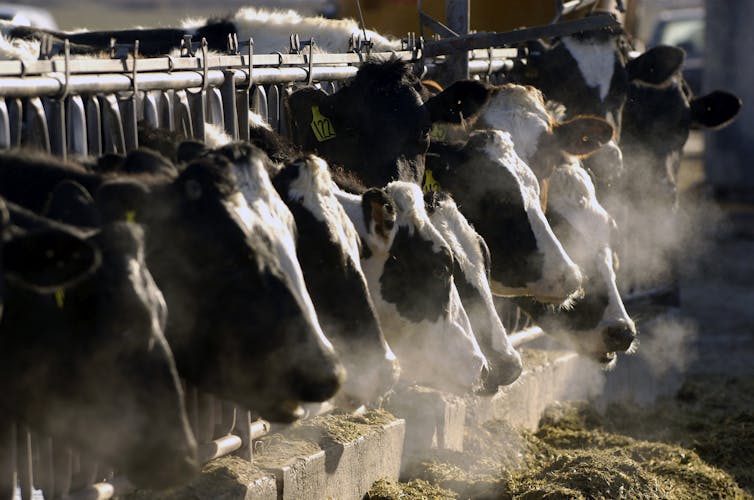
Cows typically get over avian flu in a couple of weeks, but it’s an economic blow for farms. AP Photo/Charlie Litchfield

The discovery of fragments of avian flu virus in milk sold in U.S. stores, including in about 20% of samples in initial testing across the country, suggests that the H5N1 virus may be more widespread in dairy cattle than previously realized.

The Food and Drug Administration, which announced the early results from its nationally representative sampling on April 25, 2024, was quick to stress that it believes the commercial milk supply is safe. The FDA said initial tests did not detect any live, infectious virus. However, highly pathogenic avian influenza virus can make cows sick, and the flu virus’s presence in herds in several states and new federal restrictions on the movement of dairy cows between states are putting economic pressure on farmers.

Five experts in infectious diseases in cattle from the University of California, Davis – Noelia Silva del Rio, Terry Lehenbauer, Richard Pereira, Robert Moeller and Todd Cornish – explain what the test results mean, how bird flu can spread to cattle and the impact on the industry.

What are viral fragments of avian flu, and can they pose risks to people?

It’s crucial to understand that the presence of viral fragments of H5N1 doesn’t indicate the presence of intact virus particles that could cause disease.

The commercial milk supply maintains safety through two critical measures:

  • First, milk sourced from sick animals is promptly diverted or disposed of, ensuring it does not enter the food chain.

  • Second, all milk at grocery stores is heat treated to reduce pathogen load to safe levels, mainly by pasteurization. Pasteurization has been shown to effectively inactivate H5N1 in eggs, and that process occurs at a lower temperature than is used for milk.

The viral fragments were detected using quantitative polymerase chain reaction testing, which is known for its exceptional sensitivity in detecting even trace amounts of viral genetic material. These fragments are only evidence that the virus was present in the milk. They aren’t evidence that the virus is biologically active.

To evaluate whether the presence of the viral fragments corresponds to a virus with the capacity to replicate and cause disease, a different testing approach is necessary. Tests such as embryonated egg viability studies allow scientists to assess the virus’s ability to replicate by injecting a sample into an embryonated chicken egg. That type of testing is underway.

On April 24, 2024, the FDA said it had found no reason to change its assessment that the U.S. milk supply is safe. The agency does strongly advise against consuming raw milk and products derived from it because of its inherent risks of contamination with harmful pathogens, including avian flu viruses.

How does an avian flu virus get into cow’s milk?

Currently, cows confirmed to have H5N1 have different symptoms than the typical flu-like symptoms observed in birds.

Abnormal milk and mastitis, an inflammatory response to infection, are common. While there is speculation that other bodily secretions, such as saliva, respiratory fluids, urine or feces, may also harbor the virus, that has yet to be confirmed.
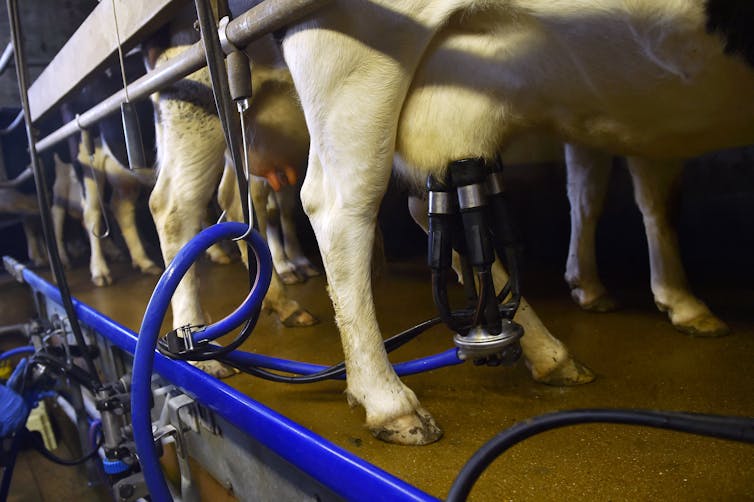
The legs of a cow showing a milking device attached to the udder and tubes for the milk to flow.
Milking equipment can help viruses spread. Loic Venance/AFP via Getty Images

How waterfowl or other birds transmitted H5N1 to cattle is still under investigation. In 2015, an outbreak of highly pathogenic avian influenza in commercial poultry farms reached its peak in April and May, the same time birds migrated north. Birds can shed the virus through their oral, nasal, urine and fecal secretions. So the virus could potentially be transmitted through direct contact, ingesting contaminated feed or water, or inhaling the virus.

Infected dairy cows can shed the virus in milk, and they likely can transmit it to other cows, but that still needs to be proven.

Contagious pathogens that cause mastitis can be transmitted through milking equipment or contaminated milker’s gloves. Ongoing research will help determine whether this is also a potential transmission route for H5N1, and if so, what makes the virus thrive on mammary tissue.

If H5N1 is found to be widespread in milk, what risks can that pose for the dairy industry?

For the dairy industry, infection of cattle with H5N1 avian influenza virus creates challenges at two levels.

The overriding concern is always for the safety and healthfulness of milk and dairy products.

Existing state and federal regulations and industry practices require sick cows or cows with abnormal milk to be segregated so that their milk does not enter the food supply. Proper pasteurization should kill the virus so that it cannot cause infection.

The American Association of Bovine Practitioners has also developed biosecurity guidelines for H5N1, focusing on key practices. These include minimizing wild birds’ contact with cattle and their environment, managing the movement of cattle between farms, isolating affected animals, avoiding feeding unpasteurized (raw) colostrum or milk to calves and other mammals, and ensuring the use of protective personal equipment for animal caretakers.

The other major concern is for the health of the dairy herd and the people who take care of the dairy cattle. A farm worker who handled dairy cows contracted H5N1 in Texas in March 2024, but such cases are rare.

No vaccines or specific therapies are available for avian influenza infections in dairy cattle. But following good sanitation and biosecurity practices for both people and cows will help to reduce risk of exposure and spread of the avian influenza virus among dairy cattle.

For cows that get the virus, providing supportive care, including fluids and fever reducers as needed, can help them get through the illness, which can also cause loss of appetite and affect their milk production.

Dairy farms facing an outbreak will have economic losses from caring for sick animals and the temporary reduction in milk sales. Approximately 5% to 20% of the animals in the affected herds have become ill, according to early estimates. Affected animals typically recover within 10 to 20 days.

At least 22 states have restricted importing dairy cattle to prevent the virus’s spread, and the federal government announced it will require that lactating dairy cattle be tested before they can be moved between states starting April 29, 2024. While the overall impact on U.S. milk production is projected to be minor on an annual basis, it could lead to short-lived supply disruptions.

How worried should people be about avian flu?

The federal government’s monitoring and food safety measures, along with pasteurization, provide important safeguards to protect the public from potential exposure to avian influenza virus through the food chain.

Drinking raw milk, however, does represent a risk for exposure to multiple diseases, including H5N1. This is why the FDA and Centers for Disease Control and Prevention strongly recommend drinking only pasteurized milk and dairy products.

This article, published April 25, 2024, has been updated with new FDA test results.The Conversation

Noelia Silva del Rio, Associate Specialist in Cooperative Extension, Production Medicine and Food Safety, University of California, Davis; Richard V. Pereira, Associate Professor of Veterinary Medicine and Associate Agronomist, University of California, Davis; Robert B. Moeller, Professor of Veterinary Medicine, University of California, Davis; Terry W. Lehenbauer, Professor of Veterinary Medicine, University of California, Davis, and Todd Cornish, Professor of Veterinary Medicine, University of California, Davis

This article is republished from The Conversation under a Creative Commons license. Read the original article.

Clearlake woman dies in Sunday night Highway 20 crash

LUCERNE, Calif. — A Clearlake woman died Sunday night after her vehicle went off Highway 20 and hit an embankment east of Lucerne.

The California Highway Patrol’s Clear Lake Area office did not release the name of the woman pending notification of her next of kin.

The CHP said the crash occurred at around 10 p.m. Sunday on Highway 20 east of Verna Way.

The crash was reported to CHP officers at 10:05 p.m. Sunday. When the officers arrived, the CHP said they found an overturned 2000 Honda Civic sedan blocking the westbound traffic lane.

The CHP’s initial investigation concluded that the driver was traveling eastbound on Highway 20 at an unknown speed when she crossed over the solid double yellow lines into the westbound traffic lane, and went off the roadway, where the Honda crashed into the dirt/rock embankment and overturned.

The wreck caused the driver, who was not wearing her seat belt, to be ejected from the vehicle, the CHP said.

The CHP said the driver died at the scene of her injuries.

Officer Cameron Ramsey is leading the investigation for the CHP.

Email Elizabeth Larson at This email address is being protected from spambots. You need JavaScript enabled to view it.. Follow her on Twitter, @ERLarson, or Lake County News, @LakeCoNews.
  • 463
  • 464
  • 465
  • 466
  • 467
  • 468
  • 469
  • 470
  • 471
  • 472

Community

  • Lake County Wine Alliance offers sponsor update; beneficiary applications open 

  • Mendocino National Forest announces seasonal hiring for upcoming field season

Public Safety

  • Lakeport Police logs: Thursday, Jan. 15

  • Lakeport Police logs: Wednesday, Jan. 14

Education

  • Woodland Community College receives maximum eight-year reaffirmation of accreditation from ACCJC

  • SNHU announces Fall 2025 President's List

Health

  • California ranks 24th in America’s Health Rankings Annual Report from United Health Foundation

  • Healthy blood donors especially vital during active flu season

Business

  • Two Lake County Mediacom employees earn company’s top service awards

  • Redwood Credit Union launches holiday gift and porch-to-pantry food drives

Obituaries

  • Rufino ‘Ray’ Pato

  • Patty Lee Smith

Opinion & Letters

  • The benefits of music for students

  • How to ease the burden of high electric bills

Veterans

  • CalVet and CSU Long Beach team up to improve data collection related to veteran suicides

  • A ‘Big Step Forward’ for Gulf War Veterans

Recreation

  • Wet weather trail closure in effect on Upper Lake Ranger District

  • Mendocino National Forest seeking public input on OHV grant applications

  • State Parks announces 2026 Anderson Marsh nature walk schedule 

  • BLM lifts seasonal fire restrictions in central California

Religion

  • Kelseyville Presbyterian to host Ash Wednesday service and Lenten dinner Feb. 18

  • Kelseyville Presbyterian Church to hold ‘Longest Night’ service Dec. 21

Arts & Life

  • Auditions announced for original musical ‘Even In Shadow’ set for March 21 and 28

  • ‘The Rip’ action heist; ‘Steal’ grounded in a crime thriller

Government & Politics

  • Lake County Democrats issue endorsements in local races for the June California Primary

  • County negotiates money-saving power purchase agreement

Legals

  • March 3 hearing on ordinance amending code for commercial cannabis uses

  • Feb. 12 public hearing on resolution to establish standards for agricultural roads

How to resolve AdBlock issue?
Refresh this page