 How to resolve AdBlock issue?
News
James Dyment, 55, of Hidden Valley Lake died at the scene of the crash, which the California Highway Patrol said occurred on Highway 29 north of Grange Road in the Hidden Valley Lake area at about 1:20 p.m.
A family traveling in the second car involved in the crash escaped with minor injuries, according to the CHP report.
Officer Dallas Richey reported that Dyment, who was driving an Acura Integra southbound on the highway, pulled his vehicle onto the right shoulder and began to make a U-turn in the path of a Toyota Camry driven by Michael Damiata, 40, of Lakeport.
Damiata, traveling southbound at 55 miles per hour, didn't have time to brake or take evasive action and the front of his vehicle hit the driver's side of Dyment's car, Richey reported.
Dyment was pronounced dead at the scene, Richey said.
Damiata and family members traveling with him – Rachelle Damiata, 40, and two boys, ages 11 and 9 – were transported to St. Helena Hospital Clearlake where Richey said they were treated for minor injuries, including abrasions.
Richey said neither of the drivers was suspected of driving under the influence, and everyone riding in the two cars were wearing their safety belts.
The south county area also saw another serious crash early Friday afternoon, according to Richey.
That second collision occurred on Highway 175 south of Middletown, where Richey said an elderly woman's vehicle hit a tree, causing the vehicle to flip over.
The woman was flown out to an area hospital, but Richey did not have further details immediately available about the incident or the woman's condition.
E-mail Elizabeth Larson at
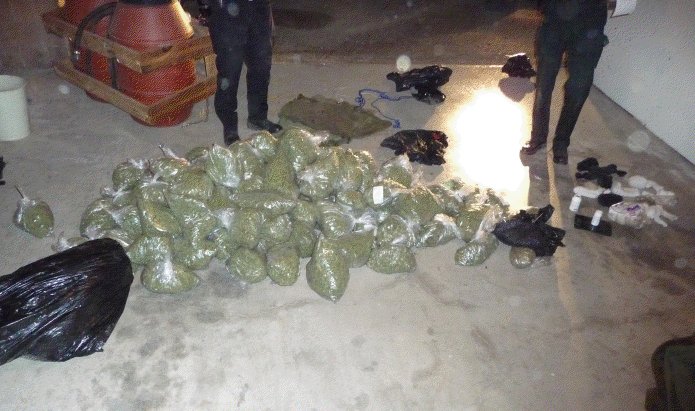
LAKEPORT – On Thursday a Santa Rosa man was convicted of numerous charges related to cultivation and sale of illicit marijuana.
A Lake County Jury in Lake County Superior Court Department 3 returned guilty verdicts against Franco Banales-Pacheco for cultivation of marijuana, possession of marijuana for purpose of sale and transportation of marijuana, according to the Lake County District Attorney's Office.
Banales-Pacheco was one of 11 individuals who were arrested in the Mendocino National Forest on Aug. 30, 2009, the district attorney's office reported.
United States Forest Service law enforcement officers, assisted by Lake County Sheriff’s Office personnel, seized approximately 91 pounds of processed marijuana “bud,” 11 pounds of unprocessed marijuana and more than 10 pounds of marijuana seeds from the 11 defendants who were occupying two SUVs driving out of the Snow Mountain Wilderness Area at approximately 3:30 a.m., the report explained.
Forest Service Officer Ben Hughes noted that at the time of the arrest various law enforcement agencies had seized approximately 198,629 marijuana plants within four miles of that location that same year.
Banales-Pacheco was the last remaining defendant to be adjudicated. Two individuals were dealt with in the juvenile system, and eight adults were convicted following guilty pleas, with sentences ranging from probation with county jail to two years in state prison, according to the district attorney's office.
The evidence at trial indicated that the responsible individuals were part of a professional drug trafficking organization utilizing public lands for large scale marijuana grows, the report noted.
Banales-Pacheco is scheduled to be sentenced on July 26.
Follow Lake County News on Twitter at http://twitter.com/LakeCoNews and on Facebook at http://www.facebook.com/pages/Lake-County-News/143156775604?ref=mf .
LAKEPORT – The city of Lakeport is hosting an invasive species boat inspection event on Saturday, July 3.
The event will take place from 8 a.m. to 2 p.m. at the Third Street boat ramp in Lakeport.
Hot dogs and sodas will be provided to the first 200 children – under 18 years of age – between 11 a.m. and 2 p.m.
Show your inspection receipt to a participating Main Street business and get a great discount on your next purchase. A list of participating businesses is available on the city’s Web site, www.cityoflakeport.com.
Inspections will be provided free of charge.
Stickers for boats that pass inspection will be available for $7.
A hot water, low pressure cleaning station will be available for boats and/or other watercraft that have been identified as suspect for infestation.
Join the movement to help keep invasive species out of Clear Lake – get your boat inspected July 3.
Visit www.cityoflakeport.com for more information.
Follow Lake County News on Twitter at http://twitter.com/LakeCoNews and on Facebook at http://www.facebook.com/pages/Lake-County-News/143156775604?ref=mf .
Structured settlements ensure that the beneficiary receives his or her payments gradually over their expected lifetime.
Often persons receiving the injury awards are already receiving needs-based government benefits, such as SSI and/or Medi-Cal.
In such cases, a special needs trust is usually established to receive all payments that would otherwise go directly to the beneficiary. The structured settlement and the special needs trust work together. Let us examine how this works.
A structured settlement turns a lump sum settlement award into a secure and steady stream of income for the disabled person’s lifetime.
Typically, some, or all of the settlement award is used to purchase an annuity contract that provides a steady stream of income.
When a special needs trust is in existence, the income payments are paid to the trustee of that trust and not to the beneficiary, so as to protect the needs-based government benefits.
The risk with investing the entire lump sum award into a structured settlement is the inflexibility of the structured settlement and the eroding effect that inflation has on fixed incomes.
If money is needed to make a large purchase or to pay for an emergency expense, the structured settlement is unavailable, except to the extent of the fixed payments – which may not be enough.
Also, the rising cost of living eats away at the purchasing value of the structured settlement’s fixed income payments.
Any modest index for inflation doesn’t usually keep pace with inflation, which often results in a declining standard of living for the beneficiary.
Accordingly, a proper balance must be struck between how much of the settlement award goes toward funding the structured settlement, and how much goes directly into the special needs trust.
Structured settlements are complex and often involve a life care planner, an independent financial planner, and a structured settlement broker, all working together.
Any remaining portion of the award that is not invested in the structured settlement is assigned to to the trustee of the special needs trust.
The purpose of the special needs trust is to preserve the needs-based government benefits that would otherwise be lost if the beneficiary received the money directly, instead of being received by the trustee.
The trustee of the special needs trust has absolute discretion over whether, how and when to use the trust’s funds to supplement the government benefits being received by the person with special needs. Otherwise, the trust funds would be considered available and countable resources for purposes of continued eligibility to receive, or to qualify for needs based government benefits.
Giving the trustee a portion of the lump sum settlement award up front –with the remainder placed into the structured settlement – allows the trustee more money on hand to meet the beneficiary’s immediate needs at the outset.
The trustee could then buy a home, purchase a van that is modified for persons with disabilities, and deal with emergency needs.
In addition, the trustee could invest some of that money into other investments that might partially offset the effects of inflation associated with fixed income payments.
In conclusion, careful consideration and planning for the immediate and future needs of the special needs beneficiary are necessary at the time before the personal injury award settlement is committed to a structured settlement.
Reaching the correct solution requires enlisting the assistance of professionals with whom the trial attorney that won the settlement award may or may not be used to dealing.
Engaging a special needs trust attorney is, therefore, advisable in order to bring in the necessary expertise.
Dennis A. Fordham, attorney (LL.M. tax studies), is a State Bar Certified Specialist in Estate Planning, Probate and Trust Law. His office is at 55 1st St., Lakeport, California. Dennis can be reached by e-mail at
Follow Lake County News on Twitter at http://twitter.com/LakeCoNews and on Facebook at http://www.facebook.com/pages/Lake-County-News/143156775604?ref=mf .
California Secretary of State Debra Bowen said Tuesday that the Local Taxpayer, Public Safety and Transportation Protection Act of 2010 has qualified for this November's ballot.
The measure is meant to prevent the state from taking, diverting or borrowing local government, transportation and public transit funds by closing loopholes in state laws, according to Californians to Protect Local Taxpayers and Vital Services, the coalition supporting the initiative.
Protected funds would include the Highway User Tax on gasoline, which funds transportation-related improvements and services for local governments; locally levied taxes, such as parcel, sales, utility user or transit occupancy taxes; Public Transportation Account revenues dedicated to public transit; and create constitutional protections to prevent the state from raiding redevelopment funds or shifting redevelopment funds to other state purposes, according to the coalition.
Chris McKenzie, executive director of the League of California Cities and co-chair of Californians to Protect Local Taxpayers and Vital Services, said they will now turn their attention to educating the voters to support this initiative to protect funding for the vital local services that they rely upon.
California voters have passed measures in previous elections to restrict state raids of local government funds, as well as to dedicate gasoline taxes to transportation and public transit improvements and services, proponents of the bill have pointed out.
However, state politicians have exploited loopholes in the law and used what opponents allege are “legally questionable tactics” to borrow and raid approximately $5 billion in local government, transit and redevelopment funds in the 2009-10 budget cycle and billions more in past years.
The measure is supported by a coalition of local government, transportation, business, public safety, taxpayer, labor and public transit leaders. Not listed among the endorsers are the county of Lake and the cities of Lakeport and Clearlake.
However, County Administrative Officer Kelly Cox told Lake County News this week that he supports any measures of this kind that protect local government revenues.
“It's unfortunate that it requires ballot initiatives like this to protect local revenues, but if that's what it takes, so be it,” he said.
This particular measure, he pointed out, was driven by cities more than counties.
“Our only concern is that the state will find new ways to shift costs to counties if this measure passes, but if it does pass I would hope that it sends a strong message to state officials to stop balancing the state budget on the backs of local government,” he said.
Cox said that, at this point, cities, counties, special districts and redevelopment agencies all need protection from state raids on their revenues, and the initiative would provide another layer of needed protection.
“What a sad commentary on the dysfunctional nature of our state government that these type of initiatives are necessary,” he said.
The raids on local funds – happening at the same time as the economic downturn – are contributing to deep cuts in local services, everything from police and fire to street repair, libraries and parks, according to groups who support the measure.
“Reduced revenues are putting a strain on front-line fire protection, emergency response and public safety services,” Sheldon Gilbert, fire chief of the Alameda County Fire Department and president of the California Fire Chiefs Association, said in a written statement on the measure. “We must pass this measure to prevent future state actions that erode local public safety funding.”
Ron Cottingham, president of the Peace Officers Research Association of California, said cities and counties throughout California have been forced to make “devastating cuts to law enforcement and other public safety services,” which he said have been due in part to state budgetary raids.
Jim Earp, executive director of the California Alliance for Jobs and co-chair of Californians to Protect Local Taxpayers and Vital Services, said the measure will “once and for all protect gas taxes from future raids and insure they are used to improve our roads, highways and transit systems – just like the voters intended.”
“Local transit agencies up and down the state are cutting routes for buses, shuttles and commuter trains as a direct result of continued state raids of local transit funds,” said Josh Shaw, executive director of the California Transit Association and co-chair of the coalition.
He said the cuts are creating “real hardships” for working families who have no other mode of transportation to and from work, school, health care appointments and other life responsibilities. “The decisions made in Sacramento are harming real people who rely on local services. Enough is enough. ”
McKenzie said his group is confident the voters will pass the measure in November.
Bowen's office reported that the measure needed 694,354 valid signatures – which is equal to 8 percent of the total votes cast for governor in the November 2006 general election. Supporters submitted more than 1.1 million signatures.
This was the fifth measure Bowen has certified for the November ballot, according to her office.
For more information visit www.savelocalservices.com.
E-mail Elizabeth Larson at
The call will be held from 7 p.m. to 8 p.m. Pacific Standard Time.
Thompson is inviting every resident of the 1st Congressional District to join him.
Participants can ask him questions about the issues that are important to them, and the Congressman will respond live for everyone to hear.
“Our country is facing many big challenges right now, from the tough economy to the spill in the Gulf,” said Congressman Thompson. “Please take this opportunity to call in and make your voice heard. I welcome any questions, comments and concerns you may have.”
To join the call, dial 877-229-8493 and enter the passcode 13293.
Follow Lake County News on Twitter at http://twitter.com/LakeCoNews and on Facebook at http://www.facebook.com/pages/Lake-County-News/143156775604?ref=mf .