How to resolve AdBlock issue?
News

Every hundred years or so, a solar storm comes along so potent it fills the skies of Earth with blood-red auroras, makes compass needles point in the wrong direction, and sends electric currents coursing through the planet's topsoil.
The most famous such storm, the Carrington Event of 1859, actually shocked telegraph operators and set some of their offices on fire.
A 2008 report by the National Academy of Sciences warns that if such a storm occurred today, we could experience widespread power blackouts with permanent damage to many key transformers.
What's a utility operator to do?
A new NASA project called "Solar Shield" could help keep the lights on.
“Solar Shield is a new and experimental forecasting system for the North American power grid,” said project leader Antti Pulkkinen, a Catholic University of America research associate working at NASA's Goddard Space Flight Center. “We believe we can zero in on specific transformers and predict which of them are going to be hit hardest by a space weather event.”
The troublemaker for power grids is the “GIC” – short for geomagnetically induced current.
When a coronal mass ejection (a billion-ton solar storm cloud) hits Earth's magnetic field, the impact causes the field to shake and quiver.
These magnetic vibrations induce currents almost everywhere, from Earth's upper atmosphere to the ground beneath our feet.
Powerful GICs can overload circuits, trip breakers, and in extreme cases melt the windings of heavy-duty transformers.
This actually happened in Quebec on March 13, 1989, when a geomagnetic storm much less severe than the Carrington Event knocked out power across the entire province for more than nine hours.
The storm damaged transformers in Quebec, New Jersey, and Great Britain, and caused more than 200 power anomalies across the USA from the eastern seaboard to the Pacific Northwest.
A similar series of “Halloween storms” in October 2003 triggered a regional blackout in southern Sweden and may have damaged transformers in South Africa.
While many utilities have taken steps to fortify their grids, the overall situation has only gotten worse.
A 2009 report by the North American Electric Reliability Corporation (NERC) and the US Department of Energy concluded that modern power systems have a “significantly enhance[d] vulnerability and exposure to effects of a severe geomagnetic storm.”
Since the beginning of the Space Age the total length of high-voltage power lines crisscrossing North America has increased nearly 10 fold. This has turned power grids into giant antennas for geomagnetically induced currents.
With demand for power growing even faster than the grids themselves, modern networks are sprawling, interconnected, and stressed to the limit – a recipe for trouble, according to the National Academy of Sciences: “The scale and speed of problems that could occur on [these modern grids] have the potential to impact the power system in ways not previously experienced.”
A large-scale blackout could last a long time, mainly due to transformer damage. As the National Academy report notes, “these multi-ton apparatus cannot be repaired in the field, and if damaged in this manner they need to be replaced with new units which have lead times of 12 months or more.”

That is why a node-by-node forecast of geomagnetic currents is potentially so valuable. During extreme storms, engineers could safeguard the most endangered transformers by disconnecting them from the grid. That itself could cause a blackout, but only temporarily. Transformers protected in this way would be available again for normal operations when the storm is over.
The innovation of Solar Shield is its ability to deliver transformer-level predictions. Pulkkinen explains how it works: “Solar Shield springs into action when we see a coronal mass ejection (CME) billowing away from the sun. Images from SOHO and NASA's twin STEREO spacecraft show us the cloud from as many as three points of view, allowing us to make a 3D model of the CME, and predict when it will arrive.”
While the CME is crossing the sun-Earth divide, a trip that typically takes 24 to 48 hours, the Solar Shield team prepares to calculate ground currents.
“We work at Goddard's Community Coordinated Modeling Center (CCMC),” said Pulkkinen.
The CCMC is a place where leading researchers from around the world have gathered their best physics-based computer programs for modeling space weather events.
The crucial moment comes about 30 minutes before impact when the cloud sweeps past ACE, a spacecraft stationed 1.5 million km upstream from Earth. Sensors onboard ACE make in situ measurements of the CME's speed, density, and magnetic field. These data are transmitted to Earth and the waiting Solar Shield team.
“We quickly feed the data into CCMC computers,” said Pulkkinen. “Our models predict fields and currents in Earth's upper atmosphere and propagate these currents down to the ground.”
With less than 30 minutes to go, Solar Shield can issue an alert to utilities with detailed information about GICs.
Pulkkinen stresses that Solar Shield is experimental and has never been field-tested during a severe geomagnetic storm. A small number of utility companies have installed current monitors at key locations in the power grid to help the team check their predictions.
So far, though, the sun has been mostly quiet with only a few relatively mild storms during the past year. The team needs more data.
“We'd like more power companies to join our research effort,” he added. “The more data we can collect from the field, the faster we can test and improve Solar Shield.”
Power companies work with the team through EPRI, the Electric Power Research Institute. Of course a few good storms would help test the system, too.
They're coming. The next solar maximum is expected around 2013, so it's only a matter of time.
Dr. Tony Phillips works for the National Aeronautics and Space Administration.
Follow Lake County News on Twitter at http://twitter.com/LakeCoNews , on Facebook at http://www.facebook.com/pages/Lake-County-News/143156775604?ref=mf and on YouTube at http://www.youtube.com/user/LakeCoNews .
The Tooth Travelers Mobile Dental Program, serving Central and Northern California, will be in Clearlake on Monday, Dec. 6, and Tuesday, Dec. 7.
They will provide free dental services to the residents of Clearlake Apartments, an affordable housing community located at 7145 Old Highway 53 No. 73 Clearlake, CA 95422, with sponsorship provided by Highland Property Development and Hearthstone Housing Foundation, a 501(c)3 nonprofit.
The mobile dental program includes a fully-equipped mobile unit with two dental operatories, providing a wide range of both preventive and restorative services.
They work in partnership with community health care providers, governmental organizations, private businesses and community service organizations to bring quality dental health care to where it’s most needed.
The nonprofit's partners include community health centers, affordable housing groups, state and county children's programs, homeless collaboratives, veteran's groups, skilled nursing facilities, and other community service agencies and organizations.
The Tooth Travelers Mobile Dental Program is staffed with California licensed dentists, registered dental assistants, dental assistants and support staff with more than 80 years of cumulative experience in oral health.
Oral health and hygiene education, including proper brushing and flossing techniques; preventive services: teeth cleaning, fluoride varnish applications, sealants; treatment includes dental examinations, x-rays, fillings, extractions and selective endodontic procedures.
For more information, visit http://toothtravelers.org/Tooth_Travelers/HOME.html .
Follow Lake County News on Twitter at http://twitter.com/LakeCoNews , on Facebook at http://www.facebook.com/pages/Lake-County-News/143156775604?ref=mf and on YouTube at http://www.youtube.com/user/LakeCoNews .
The Warm for the Winter program, led by Clearlake Vice Mayor Joyce Overton, is once again gathering warm clothes, food, blankets, tents and monetary donations.
Overton said that they will hand out the items at the Clearlake Rotary Christmas dinner at Burns Valley School on Saturday, Dec. 11.
She said that she is particularly looking for children's coats, as she has plenty for adults.
Overton said coats do not have to be new, but must be clean and in good shape.
She's also having a food drive, as food banks this year are short.
If someone cannot come to the giveaway, they can call Overton to arrange a dropoff.
For more information, call Overton at 707-350-2898.
Follow Lake County News on Twitter at http://twitter.com/LakeCoNews , on Facebook at http://www.facebook.com/pages/Lake-County-News/143156775604?ref=mf and on YouTube at http://www.youtube.com/user/LakeCoNews .
The general rate case decision will allow the corporation to raise rates in its 24 California districts. That will add $25.44 million to annual gross revenues beginning Jan. 1, 2011, and an additional $8 million in rate relief that may be obtained after completion of certain capital projects, according to a statement from Cal Water.
The document included a settlement between Cal Water and the CPUC's Division of Ratepayer Advocates that also allows Cal Water to file for smaller increases in the second and third years of the three-year rate case cycle, 2012 and 2013, respectively.
“We believe the decision is balanced and will help ensure that we have adequate resources to continue to provide a reliable supply of high-quality water while providing a reasonable return to stockholders for capital they invest in our water systems,” said Cal Water President and Chief Executive Officer Peter C. Nelson.
Cal Water owns the water system in the Northshore town of Lucerne, which is included in the company's Redwood Valley District. The company previously reported it has 1,279 customers in Lucerne.
The proposed decision stated that Cal Water requested a revenue requirement increase of $683,000 or 54.9 percent for 2011, $135,000 or 7.0 percent for 2012, and $135,000 or 6.6 percent for 2013, for the Redwood Valley District.
The authorized increase for the district will be $516,600 or 41.6 percent for 2011, $39,600 or 2.2 percent for 2012 and $39,200 or 2.2 percent for 2013.
Residential customers with an average annual usage of 15 cubic fee per month can expect their bills to increase by 41.6 percent in 2011, according to the document.
As part of the settlement, Cal Water is allowed to make water main replacements.
Redwood Valley District Manager Gay Guidotti said Thursday that Cal Water had asked for permission for three water main replacement projects in Lucerne, and was approved for two.
One of those – on First Avenue – was just completed, she said.
The second, which is supposed to take place next year, will be on Country Club Drive, between 13th and 17th avenues, she said.
Guidotti said the third project – which it was agreed would be put off for a few years – would tie in the other end of Country Club Drive, crossing the creek and tying into Foothill Drive. She said that is part of finishing off a water main section on First Avenue.
The CPUC's Rate Case Plan requires utilities like Cal Water to file for a general rate case every three years.
The company reported that its next general rate case is scheduled to be filed in July of 2012, with rates effective in January 2014.
Nelson said the company recognizes that some of it customers are struggling in the tough economy, so they provide a range of conservation programs and a low-income rate assistance program. He said the company continues to focus on operational efficiencies in an effort to minimize rate increases.
E-mail Elizabeth Larson at
The IRS identified 249,185 fraudulent tax returns and prevented the issuance of $1.48 billion in fraudulent refunds during the 2010 Filing Season, a 50-percent increase over the number of fraudulent tax returns identified during the 2009 Filing Season, the report found.
Yet the report also found that the returns of those most likely to commit fraud are seldom screened by the IRS.
TIGTA’s analysis found that the majority of tax returns the IRS identifies as being filed by prisoners are not being screened to assess their fraud potential.
The review found that 253,929 (88 percent) of the 287,918 returns filed by prisoners as of March 24, 2010, were not selected for screening. Of those, 48,887 who claimed refunds totaling more than $130 million had no wage information reported to the IRS by employers.
While some of the potential fraud may have been caught by other IRS programs, the report concluded that giving the IRS expanded and expedited access to wage and withholding information during the filing season would significantly increase the IRS’s ability to more efficiently and effectively verify wage and withholding information reported on a tax return at the time a tax return is processed.
“While the IRS is identifying larger numbers of fraudulent returns, improvements must be made to its screening processes to ensure that returns filed by prisoners get adequate scrutiny,” said J. Russell George, the Treasury Inspector General for Tax Administration.
“Unscrupulous individuals, including prisoners, continue to submit tax returns with false income documents to the IRS for the sole purpose of receiving a fraudulent refund,” he added. “Expanded and expedited access to wage and withholding information would significantly increase the IRS’s ability to verify information reported on a tax return when processed, and prevent fraud.”
The IRS uses data mining to identify potentially fraudulent tax returns using formulas based on specific characteristics of the tax return.
TIGTA assessed the IRS’s processes to identify potentially fraudulent tax returns for screening.
Existing law limits IRS access to wage information submitted by Federal agencies and State workforce agencies to the Department of Health and Human Services (HHS).
Only individuals claiming the Earned Income Tax Credit have their wage information submitted to the IRS. In addition, the IRS could benefit from expediting the use of wage and withholding information it receives from the Social Security Administration (SSA).
TIGTA made four recommendations to the IRS, including: seeking increased access to HHS data; verifying whether the 48,887 tax returns with tax refunds that were filed by prisoners with no reported wages were fraudulent; and identifying revisions that could be made to data mining criteria to better identify fraudulent tax returns filed by prisoners.
The IRS disagreed with the amount of potential savings from expanded and expedited access to SSA data and improving verification of prisoner tax returns.
TIGTA’s findings regarding prisoners are similar to its findings in a Sept. 28, 2005, audit, “The Internal Revenue Service Needs to Do More to Stop the Millions of Dollars in Fraudulent Refunds Paid to Prisoners.”
To view the report, including the scope, methodology, and full IRS response, go to: http://www.treas.gov/tigta/auditreports/2010reports/201040129fr.pdf .
Follow Lake County News on Twitter at http://twitter.com/LakeCoNews , on Facebook at http://www.facebook.com/pages/Lake-County-News/143156775604?ref=mf and on YouTube at http://www.youtube.com/user/LakeCoNews .
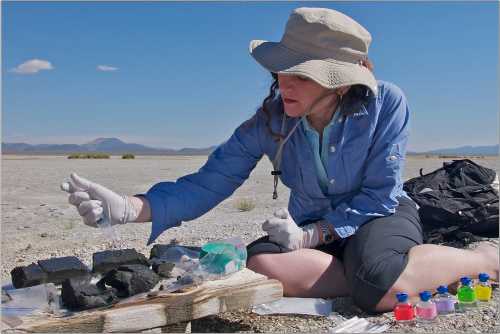
Researchers conducting tests in the harsh environment of Mono Lake in California have discovered the first known microorganism on Earth able to thrive and reproduce using the toxic chemical arsenic. The microorganism substitutes arsenic for phosphorus in its cell components.
“The definition of life has just expanded,” said Ed Weiler, NASA's associate administrator for the Science Mission Directorate at the agency's Headquarters in Washington. “As we pursue our efforts to seek signs of life in the solar system, we have to think more broadly, more diversely and consider life as we do not know it.”
This finding of an alternative biochemistry makeup will alter biology textbooks and expand the scope of the search for life beyond Earth, according to a NASA report. The research is published in this week's edition of Science Express.
Carbon, hydrogen, nitrogen, oxygen, phosphorus and sulfur are the six basic building blocks of all known forms of life on Earth.
Phosphorus is part of the chemical backbone of DNA and RNA, the structures that carry genetic instructions for life, and is considered an essential element for all living cells.
Phosphorus is a central component of the energy-carrying molecule in all cells (adenosine triphosphate) and also the phospholipids that form all cell membranes.
Arsenic, which is chemically similar to phosphorus, is poisonous for most life on Earth. Arsenic disrupts metabolic pathways because chemically it behaves similarly to phosphate.
“We know that some microbes can breathe arsenic, but what we've found is a microbe doing something new – building parts of itself out of arsenic,” said Felisa Wolfe-Simon, a NASA astrobiology research fellow in residence at the U.S. Geological Survey in Menlo Park, Calif., and the research team's lead scientist. “If something here on Earth can do something so unexpected, what else can life do that we haven't seen yet?”
The newly discovered microbe, strain GFAJ-1, is a member of a common group of bacteria, the Gammaproteobacteria.
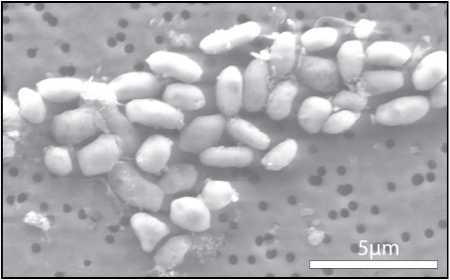
In the laboratory, the researchers successfully grew microbes from the lake on a diet that was very lean on phosphorus, but included generous helpings of arsenic.
When researchers removed the phosphorus and replaced it with arsenic the microbes continued to grow. Subsequent analyses indicated that the arsenic was being used to produce the building blocks of new GFAJ-1 cells.
The key issue the researchers investigated was when the microbe was grown on arsenic did the arsenic actually became incorporated into the organisms' vital biochemical machinery, such as DNA, proteins and the cell membranes. A variety of sophisticated laboratory techniques were used to determine where the arsenic was incorporated.
The team chose to explore Mono Lake because of its unusual chemistry, especially its high salinity, high alkalinity, and high levels of arsenic. This chemistry is in part a result of Mono Lake's isolation from its sources of fresh water for 50 years.
The results of this study will inform ongoing research in many areas, including the study of Earth's evolution, organic chemistry, biogeochemical cycles, disease mitigation and Earth system research. These findings also will open up new frontiers in microbiology and other areas of research.
“The idea of alternative biochemistries for life is common in science fiction,” said Carl Pilcher, director of the NASA Astrobiology Institute at the agency's Ames Research Center in Moffett Field, Calif. “Until now a life form using arsenic as a building block was only theoretical, but now we know such life exists in Mono Lake.”
The research team included scientists from the U.S. Geological Survey, Arizona State University in Tempe, Ariz., Lawrence Livermore National Laboratory in Livermore, Calif., Duquesne University in Pittsburgh and the Stanford Synchrotron Radiation Lightsource in Menlo Park.
NASA's Astrobiology Program in Washington contributed funding for the research through its Exobiology and Evolutionary Biology program and the NASA Astrobiology Institute. NASA's Astrobiology Program supports research into the origin, evolution, distribution and future of life on Earth.
Additional reports on the work can be found at http://astrobiology.nasa.gov .
Follow Lake County News on Twitter at http://twitter.com/LakeCoNews , on Facebook at http://www.facebook.com/pages/Lake-County-News/143156775604?ref=mf and on YouTube at http://www.youtube.com/user/LakeCoNews .