 How to resolve AdBlock issue?
News
“This landmark settlement mandates the replacement of outmoded wind turbines with newer models that are more efficient, generate more power and are less harmful to eagles, falcons and other birds,” Brown said.
The Altamont Pass Wind Resources Area in Alameda and Contra Costa counties is the site of the world's first wind turbines.
These units, constructed more than three decades ago, are now outdated, inefficient and deadly to thousands of birds each year, Brown's office said.
Tuesday's settlement is between environmental groups, the state, and NextEra Energy Resources, the largest turbine operator at the site.
Under the agreement, NextEra will upgrade all its older-model turbines. Scientific data shows that newer, larger turbines are more efficient and kill far fewer birds.
A 2004 study commissioned by the California Energy Commission found that the 5,400 older turbines operating at Altamont Pass killed an estimated 1,766 to 4,271 birds annually, including between 881 and 1330 raptors such as golden eagles – which are protected under federal law -- hawks, falcons and owls.
The bird fatalities at Altamont Pass – an important raptor breeding area that lies on a major migratory route – are greater than on any other wind farm in the country, the study showed.
In September 2005, Alameda County renewed permits for the turbines, but several Audubon Society chapters and Californians for Renewable Energy (CARE), a local environmental group, challenged the permits in a lawsuit under the California Environmental Quality Act (CEQA).
After a settlement failed to substantially reduce the large number of bird fatalities, Brown stepped in and brokered today's agreement.
Under the agreement, NextEra will replace some 2,400 turbines over the next four years and will shut down all its existing turbines no later than 2015.
The company also has agreed to erect the new turbines in environmentally friendly locations.
NextEra agreed to pay $2.5 million in mitigation fees, half to the state Energy Commission's Public Integrated Energy Research Program and half to East Bay Regional Park District and the Livermore Area Regional Park District for raptor habitat creation.
Follow Lake County News on Twitter at http://twitter.com/LakeCoNews , on Facebook at http://www.facebook.com/pages/Lake-County-News/143156775604?ref=mf and on YouTube at http://www.youtube.com/user/LakeCoNews .
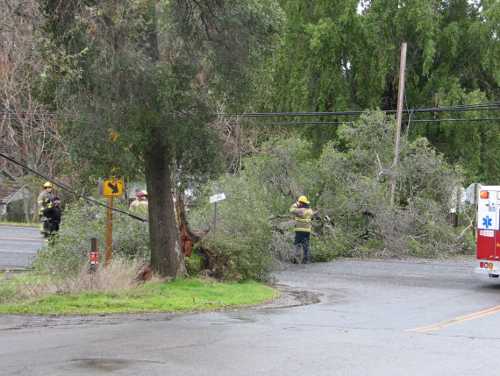
LAKE COUNTY, Calif. – The heavy rain that hit Lake County on Sunday led to some spots of minor flooding in Lakeport, a downed tree and utility lines in Nice and hazardous road conditions elsewhere.
Rain fell steadily around the county on Sunday afternoon after forecasters had warned area residents to be prepared for precipitation.
The forecast proved accurate, with the resulting rains making for tricky driving conditions. The California Highway Patrol reported that rocks and small boulders had been spotted along areas of Highway 175 near the Granite Construction quarry, on Bottle Rock Road not far from Highway 29 and on Highway 20.
Early in the afternoon a large oak tree fell on Highway 20 at Hudson, knocking utility lines into the roadway, the CHP reported.
The incident originally was reported as a traffic collision just after 1 p.m. but later blamed on the tree alone, according to reports from the scene.
The CHP created a detour off of Highway 20 and onto Manzanita in order to allow utility crews to work on the pole. Caltrans, Northshore Fire and the sheriff's office also responded to assist with controlling the scene.
A call to Pacific Gas & Electric about possible power outages and other impacts was not returned Sunday evening. Mediacom also was reported to be working on lines at the site.
The roadway was reopened at about 4:45 p.m., the CHP said.
The rain appeared to get heavier in the late afternoon, and at around 5 p.m. Sgt. Kevin Odom of the Lakeport Police Department said he noticed some minor areas of flooding in the city, especially at around N. Forbes and 10th streets.
“Heavy rain has obviously done something to overload the system,” he said.
After he drove through the area and saw the flooding, Odom notified the city's Public Works Department.
Public Works staff put up barricades around the flooded areas and were working late Sunday evening to try to find out what was going on and how to fix it, Odom said, noting the water appeared to be going toward the lakefront.
Lake County News had received reports of some businesses in the area being flooded, but Odom said he wasn't aware of actual flooded structures.
The National Weather Service said Sunday that a surface cold front was located coming through the county, with rain expected to continue through the night and early Monday.
E-mail Elizabeth Larson at
Bernard Rostker, former under secretary of defense for personnel and now a senior fellow at the RAND Corp., has a more optimistic perspective on how, over time, America cares for and compensates its wartime veterans.
For more than a year Rostker has been researching what will be a two-volume study on the treatment of veterans and their survivors, going back to before the Revolutionary War, with a special focus on wounded warrior care.
His original working premise, as he explained it in a phone interview, was that veterans’ care and benefits today reflect a deeper attachment to the force, the result of moving away from a military of conscripts, after the Vietnam War, to a more professional force comprised entirely of volunteers.
But as he completed volume one of his study, covering the Colonial era through World War II, Rostker said he found the working premise to be wrong. Much of what’s being done today for veterans of the all-volunteer force is “rediscovering” what’s been done before.
One glaring exception, he said, is the focus today on treating mental wounds of war, post-traumatic stress disorder. Resources aimed at the invisible wounds are unprecedented, reflecting more medical knowledge, the nature of current wars and an attitude shift, even since the Persian Gulf War.
“Today it’s remarkably different. Much more willing to deal with issues of stress than what came out of the Gulf War,” said Rostker.
In the late 1990s he was the defense secretary’s special assistant on Gulf War Illness.
Otherwise the infusion of money and staff for veterans’ care and benefits today fits an historical pattern, Rostker said, the nation’s deep appreciation for those who fight for country and suffer wounds or illness.
Other patterns emerge, Rostker said.
Government support tends to deepen with budget surpluses. Benefits tend to improve as veterans age, their ranks thin out, and enhancements become more affordable.
Wars bring change too. The Department of Veterans Affairs budget has more than doubled since U.S. troops invaded Afghanistan in October 2001 – from $51 billion then to $114 billion in the fiscal years that ended Sept. 30. VA spending is set to climb another 10 percent this year, to $125 billion.
Vet groups laud a 25 percent rise in VA spending since President Obama took office. Some contrast that largess to the Bush administration difficulty in June 2005 when it had to request $2 billion supplemental for VA to meet pressing health care obligations. Some veterans groups had called the original budget that year “tightfisted, miserly” and “woefully inadequate.”
Rostker avoids such comparisons. But his research might inform cost-conscious politicians about the perils of scrimping on veterans.
President Franklin Roosevelt made such a misstep, he said, while trying to pull the nation out of the Great Depression.
At his urging, Congress in 1933 passed the Economy Act, which cut deeply into veterans’ benefits. Roosevelt told the American Legion convention “the mere wearing of a uniform” in war should not entitle a veteran, and later his survivors, to a pension for disabilities incurred after he left service.
The backlash was strong enough that the following March, Congress had enough votes to override Roosevelt’s veto and it restored almost all of the benefits it had cut a year earlier.
The Continental Congress in 1776 first recognized responsibility for wounded veterans, voting to authorize half pay for life to anyone who lost a limb or their ability to earn a living due to the revolution. By 1805 Congress approved pay for disabilities developed years after a veteran left service.
Support for lifetime “half pay,” particularly for officers, drew criticism. Funds to pay it sometimes could not be found. Yet Congress extended the same pension rights to disabled veterans from the War of 1812 and other wars.
By 1818, with federal coffers flush with tariff money, the Department of War gave pensions to anyone who served in wartime, not just disabled.
Ten years later Congress settled complaints of Revolutionary War veterans by granting 850 surviving officers and soldiers full pay for life.
Rostker noted too that in 1833 Congress first approved “concurrent receipt” – payment of both an “invalid pension” and service pension. In 1836, Congress extended pension eligibility to widows and children of Revolutionary War veterans, adding enormously to the cost. The last spouse eligible for that Revolutionary War pension died in 1906, Rostker said.
The Civil War Pension Law of 1862 was viewed as the most generous any government had ever adopted, Rostker said, allowing disability payments for injuries or ailments incurred as a direct result of service. It even set up a medical screening system, though reliance on hometown doctors led to rampant fraud and soon a purging of the rolls, Rostker said.
Payments to surviving spouse and children could exceed what veterans got. The last Civil War pensioners lived well into the 20th Century, all the while drawing payments.
Our conversation provided just a glimpse of how America has cared for veterans long ago. The study will span newer, more controversial periods including Gen. Omar Bradley’s reform of the VA after World War II, Korea and Vietnam and Gulf War Syndrome.
Given the history, I asked, what might be ahead for the newest generation of war veterans. More effective help, Rostker suggested. The nation knows now that not all wounded have missing limbs or physical scars.
Through history, he said, “you see the generosity in many ways. You see it in the amount of money given, in the change of eligibility standards. And recently in the understanding of the mental aspects of conflict.”
To comment, send e-mail to
Follow Lake County News on Twitter at http://twitter.com/LakeCoNews , on Facebook at http://www.facebook.com/pages/Lake-County-News/143156775604?ref=mf and on YouTube at http://www.youtube.com/user/LakeCoNews .
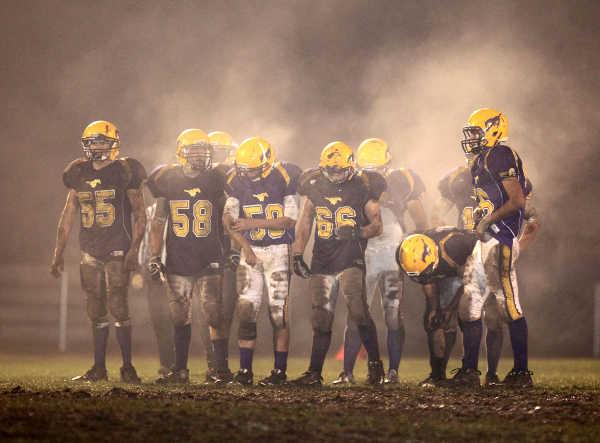
MIDDLETOWN, Calif. – It was trench football. It was hit-to-hit, yard-to-yard, down-to-down good old-fashioned mud bath football.
In short, it was the kind of game the Middletown Mustangs – with their stalwart defense and nose-to the-grindstone offense – excel at.
And excel they did, knocking out the Healdsburg Greyhounds – the North Coast Section (NCS) Division IV tournament’s No. 1 seed – 10-0 Friday night in Middletown before a large, raucous crowd.
“It was a battle,” Mustangs Head Coach Bill Foltmer said after the game. “Every yard, every run, every play was hard-fought yards. Both sides took a beating; it was a very physical football game.”
Sure, it was yet another Mustang shutout, and those statistics – five of their last six games have been shutouts, and eight of 13 games this season – are impressive by themselves, but this shutout was different.
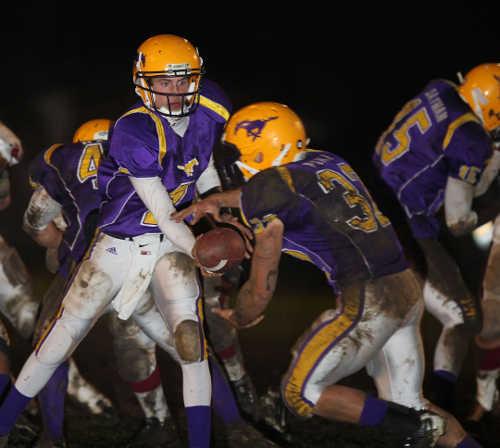
This was no cakewalk; this was a battle of wills. And that battle was lead by Middletown’s hard-hitting, aggressive running back and linebacker Jacob Davis.
“Jake Davis is amazing,” Healdsburg Head Coach Tom Kirkpatrick said about the Middletown senior. “There were plays that looked like we were going to have some room to run, and he would just fly into the ball – an outstanding player.”
The action started early, on the Mustangs’ opening possession.
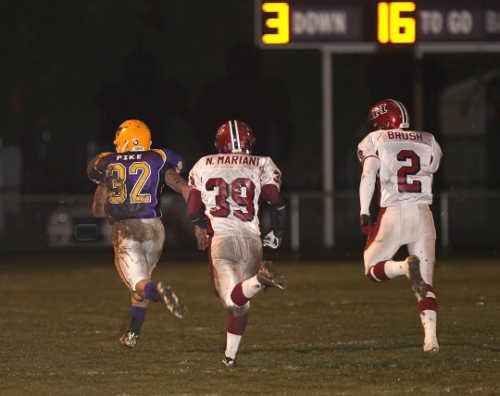
With Middletown trying to establish a running game and Healdsburg pushing back hard, David Pike caught a Kyle Brown screen pass on third and 16, broke a couple of tackles and streaked 79 yards downfield to score the game’s only touchdown.
Surefire kicker Danny Cardenas put the extra point through the uprights, the Mustangs took the lead 7-0, and the slog continued.
Healdsburg used most of the remaining first quarter to grind downfield, starting from their own 15 and needing two critical fourth-and-inches to make it down to Middletown’s 10-yard line, but on their second fourth-and-short and with their backs against the wall in the red zone, offensive lineman Luke Parker broke through the Healdsburg line and stopped the Greyhounds short.
“Our kids played hard tonight, and I’m so proud of them,” a jubilant Foltmer said after the game. “It was a great win against a great opponent.”
The game’s only other score came in the second quarter, when the Mustang’s needed 12 plays, a pass interference call and a horse-collar penalty before Cardenas kicked a 27-yard field goal to put Middletown ahead 10-0.
Of the Cardenas field goal, Foltmer said, “That was big, because now it’s a two-score game.”
Although the Greyhounds found some hard-earned forward progress in the second quarter, their attempts to even the score were twice thwarted by critical interceptions from cornerback Andres Fernandez, and the clock ran out with Healdsburg trailing 10-0.
“They did a good job of stopping us, and I thought we did a good job of stopping them,” Foltmer said about the game. “It was just a battle, you know?”
The second half was more of the same – a back-and-forth struggle in the trenches, fueled by the Middletown loud crowd, with both teams slogging downfield at times, only to see their efforts come up short.
Healdsburg’s fate was sealed with two and a half minutes left in the game, when Connor Chick intercepted a Max Opperman pass at Middletown’s 31-yard line, and the Mustangs ran out the clock to end the classic struggle.
“They played really hard, they played as hard as they could,” Kirkpatrick said about his Greyhounds, “and I told them, there was no problem with effort. This was not an effort game; this was an execution game.”
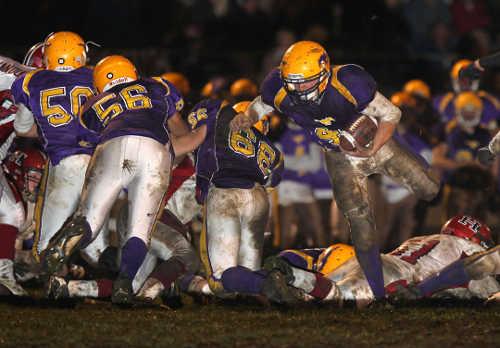
The Greyhounds successfully executed 12 out of 23 passes (with three interceptions) for 145 yards, while rushing 83 yards in 21 carries. The Mustangs logged 143 yards in the air on four of 10 passing, and 132 yards in 36 carries.
Having now secured a spot in the finals of the NCS tournament, Foltmer lamented, “People don’t understand: it’s not that easy to get there. My last time we were in the finals was 10 years ago.”
He added, “Normally, we tell the kids, ‘Hey, make the best of your year,’ and if it doesn’t work out this year for me, I’ve always got next year. But I’ve been telling this group that this might be my best shot at a section title with this group of kids.”
In a bit of irony, the Mustangs will end the season as they began it: by playing the Salesian Pride, who advanced to the NCS finals with a 76-28 trouncing of the Ferndale Wildcats Saturday in the tournament’s other semifinal game.
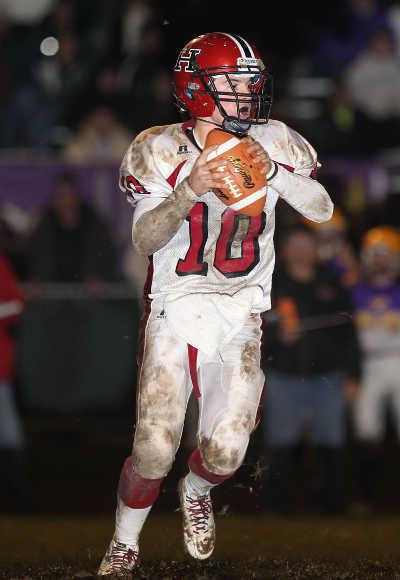
Middletown lost to Salesian 57-52 in that game – their season opener, and their only loss of the year – but powerhouse Jake Davis sat out the game with a broken jaw.
The Mustangs-Pride final will be held at Alhambra High School in Martinez on Saturday, Dec. 11, at 7 p.m.
“Yeah, we’ll go scout Salesian and Ferndale tomorrow,” Foltmer said Friday night about the other NCS semifinal game, “but we worked so hard this week, and with a big win like this, I just want to enjoy it.”
Healdsburg’s Kirkpatrick looked across the field to the Middletown side after the game and said with simple admiration, “That’s a great high school team right there.”
Follow Lake County News on Twitter at http://twitter.com/LakeCoNews , on Facebook at http://www.facebook.com/pages/Lake-County-News/143156775604?ref=mf and on YouTube at http://www.youtube.com/user/LakeCoNews .

The pageant, now in its 17th season, is festive Christmas entertainment, resplendent with madrigal singing, colorful period costumes and an original script that changes each year.
In addition, a medieval-style feast is served to the guests that function as members of the court of Greystone Castle (into which the Middletown Community United Methodist Church transforms for the yearly performances).
I enjoyed every aspect of the event nine years ago (as I have in the years since then), but the food especially piqued my interest.
Chicken flavored with cinnamon provided a savory entrée with a hint of sweetness. It was served on a round of flat bread that functioned as our dish, and eating it made our role as guests of Lord and Lady Greystone all the more plausible.
On Monday evening I was again a guest at the castle, this time for a dress rehearsal. The temporary trip back in time rekindled my interest in the cookery of that time, hence the subject of today’s column.

The National Weather Service in Sacramento issued a special weather statement warning of moisture that will “continue to stream across the region for the remainder of the weekend.”
A weak storm front brought in moisture Saturday night, the agency reported.
A stronger low pressure system from the Eastern Pacific is expected to travel through Northern California throughout the day and into the night Sunday, bringing wind, moderate to heavy rain, and snow above 5,000 feet, the National Weather Service said.
Forecasters predict a 60 percent chance of rain Sunday, which will decrease early in the week. Precipitation is expected to return on Wednesday and possibly later in the week.
E-mail Elizabeth Larson at
Education
Health
Business
Obituaries
Veterans
Recreation
Religion
Arts & Life
Government & Politics