 How to resolve AdBlock issue?
News

I hadn’t planned to write about carrots for today’s column, but awakening to snowy weather on New Year’s Day planted the seed in my mind.
Though carrots aren’t seasonally a winter veggie (their peak-of-season is midsummer to early fall), they’re used frequently this time of year in comforting cold-weather foods like soups and stews. In fact, it’s hard for me to think of winter cuisine without carrots coming to mind.
I came home the other evening and my mother (who’s now living with my family and me) had made a beautiful dish of carrots infused with honey and mint. The marriage of these flavors is reminiscent of North African or Indian cuisine, and the combination is so pleasant that it would be easy for me to eat a whole pot’s worth on my own!
I adapted my mother’s free-form version into a recipe, and the result is below. The thing that’s beautiful about such simple recipes is that they’re so easily adapted to your own style and taste. One can add a bit more or less honey or mint depending on taste, or use olive oil instead of butter. The herb can be switched up, as well, such as using basil or thyme instead of mint.
Perhaps more than any other vegetable, carrots may just as easily be used in sweet dishes as in savory ones. In addition to carrot cake (rivaling pumpkin pie as a favorite sweet veggie treat), they may be used in cookies, muffins, and scones.
Sweet carrot pudding is a dish that’s traditional in a variety of cultures around the world; however, an unsweetened version of the dish is used as a savory accompaniment to a main dish.
In Ireland, sweet carrot pudding has been served since at least the 18th century, and 1876 marks the first recorded use of it in the U.S.
The creamy, sweet Indian dessert is what comes to mind for me when the words “carrot pudding” are uttered. Depending on the recipe, the Indian version can include ingredients as exotic as pistachios and rosewater, or it can simply contain carrots, sugar, and rich milk flavored with a bit of cardamom.
In India the dish is called “gajar halwa,” and when made there, red carrots are used, which give the dish a deep color.
Surprisingly, carrots were not originally orange. Until the 17th century, carrots grown in Europe all had slender yellow or purple roots.
The carrot’s orange color came about through the efforts of breeders in the Netherlands during the Dutch struggle for independence from Spain, when orange represented Dutch patriotism.
Today’s carrots may be found in a veritable rainbow of varying shades of red, yellow, purple, white, and, of course, the more common orange. A rare variety of pink-red carrot is grown in Northern India.
Dual-colored carrots, such as those with purple exteriors and orange interiors, have been developed through the years. These types of carrots make a dramatic presentation at the table when cut to showcase both colors, especially when used raw in a salad.
Carrot roots come in plethora of shapes, from stubby and round to long and slender, some as long as 3 feet. Ultra tender baby carrots have become popular in recent years, but beware of packaged supermarket varieties, which are not actually immature carrots, but large carrots which have been cut and rounded.
Modern day carrots are descendents of a wild plant native to Afghanistan, and were first cultivated there in the 10th century, though it may be earlier. A variety of wild carrot that’s common to the U.S. is Queen Anne’s Lace, which can be found in meadows and along many a roadside.

Selected breeding over the centuries has reduced bitterness and minimized the woody core and given us today’s carrot, which has a higher sugar content than any vegetable, save beets. Despite this, paradoxically, the carrot is considered a good blood sugar regulator.
Carrots are related to celery, chervil, dill, fennel, parsley and parsnips, and like some of their relatives (such as dill and chervil), they were initially cultivated for their greens and seeds. Over time the roots became the more popularly eaten component of the plant.
Carrots are compatible with a large variety of seasonings and flavors. In addition to mint, dill, fennel, cinnamon, ginger, coriander, nutmeg, orange, tarragon, mustard, maple syrup, brown sugar and thyme are also great accompaniments for them.
When I prepare them as a side dish, I typically add a little orange juice or zest while they’re cooking and finish them by tossing with a sweet spice like coriander or nutmeg. Fresh dill with just a touch of lemon zest is another good combination for carrots.
I also love pairing them with honey and mustard. To do this, I roast the carrots in the oven with a bit of olive oil, salt and pepper until they’re tender, and then toss them in a glaze of honey and Dijon mustard in a pot on the stove top. It’s remarkable how such a simple process produces such a rich taste!
Carrots are one of the three components in mirepoix (pronounced meer PWAH), the French name for a combination of carrots, celery and onion which forms the flavor base for a wide range of dishes.
Traditionally, the ratio for ingredients is two parts onions to one part each celery and carrots, based on weight, not volume. These three ingredients are commonly referred to as aromatics.
Similar combinations are known as holy trinity in Creole cooking, refrogado in Portuguese cooking, soffritto in Italian and sofrito in Spanish. The combinations vary; for example, the Italian version may contain garlic, fennel and herbs, and is sautéed in olive oil, rather than butter as the French do.
The health benefits of carrots are legendary. Their vitamin A content is off the charts; in fact, they’re the richest vegetable source of pro-vitamin A carotenes.
Carrots' antioxidant compounds help protect against cardiovascular disease and cancer and also promote good vision, especially night vision.
I’ve always wondered how the vitamin A in carrots protects and improves our vision, and I found a great explanation at www.whfoods.org:
“Beta-carotene helps to protect vision, especially night vision. After beta-carotene is converted to vitamin A in the liver, it travels to the retina where it is transformed into rhodopsin, a purple pigment that is necessary for night-vision. Plus beta-carotene's powerful antioxidant actions help provide protection against macular degeneration and the development of senile cataracts, the leading cause of blindness in the elderly.”
If you juice raw veggies and fruits, you probably know that carrot juice is fantastic with a variety of other ingredients, including ginger, orange, beet and celery. Carrot juice’s pleasantly sweet taste makes it a good base for many fresh juice drinks, and with its wealth of nutrients, it’s a good choice.
Before I leave you with today’s recipe, I want to share two other reasons the snow made me think of carrots: first, they develop an intense sweetness if they’re left in the ground during a frost; and secondly, they’ve been used by many a snow artist as a snowman’s nose.
On this latter note, I’ve taken two photos of snowmen that appeared with carrot noses near my home on New Year’s Day.
Happy New Year!
Honey-mint carrots
6 to 8 small carrots (about a pound)
1 teaspoon kosher salt, plus more to taste
1 tablespoon finely chopped fresh mint
1 to 2 tablespoons unsalted butter
1 tablespoon honey
Wash and peel the carrots and cut them into thin rounds. (If carrots are fresh from the garden, scrubbing, rather than peeling, is fine.)
Place them in a pot with just enough cold water to cover them.
Bring them to a boil over medium-high heat, adding salt when water begins to boil.
When carrots are nearly tender, drain most of the water, leaving about a tablespoon in the pot. Return to stove over medium-low heat.
Add the butter and honey, and cook a few minutes until butter is absorbed, carrots are tender and honey begins to caramelize.
Remove from heat and add mint. Add salt to taste, if desired.
This makes about three or four servings.
Esther’s note: Mint and other large-leafed herbs may be chopped by layering leaves, rolling them up cigar style and cutting into thin slices. This is a time saver because it saves having to chop each leaf individually.
Esther Oertel, the “Veggie Girl,” is a culinary coach and educator and is passionate about local produce. Oertel teaches culinary classes at Chic Le Chef in Hidden Valley Lake, Calif., and The Kitchen Gallery in Lakeport, Calif., and gives private cooking lessons. She welcomes your questions and comments; e-mail her at
Follow Lake County News on Twitter at http://twitter.com/LakeCoNews , on Facebook at http://www.facebook.com/pages/Lake-County-News/143156775604?ref=mf and on YouTube at http://www.youtube.com/user/LakeCoNews .


“It's an incredible feeling to have another world right in the palm of your hand,” said Mike Zolensky, associate curator for Interplanetary Dust at the Johnson Space Center, and one of the three non-Japanese members of the science team. “We're seeing for the first time, up close, what an asteroid is actually made of!”
He has good reason to be excited. Asteroids formed at the dawn of our solar system, so studying these samples can teach us how it formed and evolved.
Hayabusa launched in 2003 and set out on a billion kilometer voyage to Itokawa, arriving a little over two years later.
This is only the second time an asteroid landing has been achieved. The only other time in history a spacecraft landed on an asteroid's surface was when NASA’s Near Earth Asteroid Rendezvous-Shoemaker spacecraft landed on asteroid Eros in February 2001.
In 2005, the Hayabusa spacecraft performed a spectacular feat – landed on the asteroid's surface. The hope was to capture samples from the alien world.
But there was a problem. The projectiles set to blast up dust from the surface failed to fire, leaving only the particles kicked up from landing for collection. Did any asteroid dust made it into the collection chamber?
Zolensky and other eager scientists, with eyes riveted skyward, watched the answer plunge back into Earth's atmosphere at 27,000 miles per hour on the night of June 13, 2010.
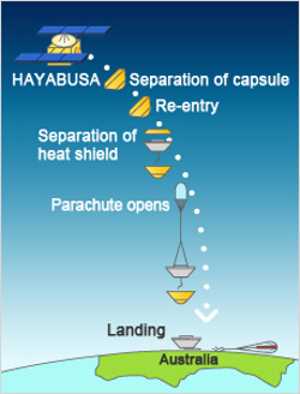
Hayabusa's main bus shattered over the Australian outback during reentry, and the intact sample return capsule drifted to Earth via parachute.
“We were mesmerized,” said Zolensky. “As we waited for it to land, no one even moved.”
But the waiting was only just beginning. Because attempting retrieval of the capsule in the dark was too dangerous, he spent a sleepless night before getting a closer look.
“I was one of the first people to board the helicopter that flew to the landing site the next morning,” Zolensky said. “And I was the first person to walk up to the capsule.”
He had to stop within 10 feet of it. More waiting.
“I watched the retrieval team recover it,” Zolensky said. “They wore face masks and gloves and blue padded suits. They had to disable the unexploded parachute release charges, and that was pretty nerve wracking. Then they picked up the capsule oh so carefully and placed it in a box.”
The precious cargo was flown via charter jet to Japan for analysis. Guess who was waiting for it when it arrived?
“I was ready to work,” said Zolensky, who along with fellow team member Scott Sandford of NASA Ames Research Center had traveled to Japan for the opening.
“The first results were disheartening. When we scanned the capsule with a modified CAT scan, there appeared to be nothing inside,” Zolensky said.
Next, Japanese members of the team painstakingly dismantled the capsule, piece by piece. “They had to use a micromanipulator to avoid contamination, and the process took months,” Zolensky explained.
More waiting.
“Once we got inside the capsule, we could see dust on the interior walls. I thought to myself, 'We've got asteroid dust here!' But there was still a possibility the contents could be contamination from launch or reentry and landing.”
The next step was to remove and analyze the particles – another agonizingly slow process and more waiting.
“The particles are each smaller than the diameter of a human hair,” Zolensky said. “We finally used a Teflon spatula to sweep out a large number of tiny particles.”
Though most of the particles are still in the capsule, the team has removed and analyzed 2000 of them with an electron microscope.
And?
“At least 1,500 of them are from the asteroid,” Zolensky said. “We're seeing pieces of another world. It looks like a very primitive type asteroid. We'll tell you more in March at the 2011 Lunar and Planetary Science Conference in Houston.”
This is only the third time ever that samples of a solid extraterrestrial body have been brought back to Earth.
The Apollo astronauts and Soviet Luna robots were first – they brought us samples of moondust. And NASA's Stardust spacecraft returned samples of comet Wild 2 in 2006.
“The Japanese people are thrilled, and so are we,” Zolensky said. “The emperor even requested a personal tour of the capsule. This is their Apollo mission. They're showing us all a new world.”
Dauna Coulter works for the National Aeronautics and Space Administration.
Follow Lake County News on Twitter at http://twitter.com/LakeCoNews , on Facebook at http://www.facebook.com/pages/Lake-County-News/143156775604?ref=mf and on YouTube at http://www.youtube.com/user/LakeCoNews .

Through a partnership with Yokayo Biofuels in Ukiah, residents can drop off used cooking oil free of charge at several locations around the county including Southlake Refuse and Recycling in Clearlake and Lake County Waste Solutions in Lakeport.
Drop off at Northshore Fire Protection District station in Lucerne will begin in late January.
Yokayo Biofuels is a production and distribution company based in Ukiah, the closest facility of its kind to Lake County.
Taking a waste product – used cooking oil – Yokayo Biofuels produces “biodiesel” – a fuel that can be used in any motor that operates on diesel for fuel.
Producing nearly 500,000 gallons of biodiesel a year, Yokayo distributes the biodiesel to fuel stations in Northern California.
Cooking oils and grease should not be poured down drains, including in your own home as it makes treating wastewater more difficult. Additionally, oils and grease build-up on the inside of pipes and is a major contributor to clogged sink drains, sewer lines, and septic systems, which may require costly repairs.
While cooking oil can be disposed of in the trash, it is a valuable commodity and can be recycled into fuel.
The United States Environmental Protection Agency Office of Solid Waste estimates that one to three billon gallons of waste oil are produced each year in the U.S. which could be processed into biodiesel.
In 2009, 545 million gallons of biodiesel was produced in the U.S., but only 6 percent of that total was from used cooking oils, according to an August 2010 article in BioCycle magazine. The majority of biodiesel, 77 percent, was produced using virgin oils such as canola, soybean, cottonseed, and palm.
Dropping-off used cooking oil is simple.
First, strain the oil to remove large food particles. Save used oil in a container that is free of contamination from other materials, particularly toxic or hazardous materials (such as a container that once held motor oil, chemicals, or detergents). Containers that once held food or vegetable oil are a good choice.
Oils that can be accepted include olive, soybean, canola, etc. – any vegetable cooking oil that is liquid at room temperature. Bacon grease cannot be accepted.
Oil can be dropped-off during operating hours at the facilities below free of charge. Please do not leave containers at a location when the site is closed. Northshore Fire Protection District will be accepting used vegetable oil in late January, but residents can now drop-off oil at Lake County Waste Solutions and South Lake Refuse & Recycling.
For more information on reducing, reusing, and recycling, please visit the Lake County Recycling Website at www.recycling.co.lake.ca.com, or call the Recycling Hotline at 263-1980. For more information about Yokayo Biofuels, visit www.ybiofuels.org .
No-charge cooking oil drop-off locations:
Lake County Waste Solutions
230 Soda Bay Rd., Lakeport
234-6400 or 1-888-718-4888
Monday to Saturday
7:30 a.m. - 4 p.m.
South Lake Refuse & Recycling
16015 Davis St., Clearlake
707-994-8614
Daily
7:30 a.m. - 3 p.m.
Northshore Fire Protection District station
6257 Seventh Ave, Lucerne
Monday - Friday
8 a.m. - 5 p.m.
Follow Lake County News on Twitter at http://twitter.com/LakeCoNews , on Facebook at http://www.facebook.com/pages/Lake-County-News/143156775604?ref=mf and on YouTube at http://www.youtube.com/user/LakeCoNews .
The National Weather Service issued a winter weather advisory for Lake and surrounding counties Friday night that lasts until noon on Saturday.
Rain and snow are expected to continue to fall across the region, with moderate to heavy snow showers falling New Year's morning, the National Weather Service said.
Forecasters said the snow level is expected to dip below 1,000 feet, where 2 to 4 inches of snow could fall, while 6 to 10 inches of snow are expected above the 3,000 foot level.
In the Lake County area, the National Weather Service predicted 1 to 2 inches overnight.
Lake County News received reports from area residents of snow falling in Clearlake Oaks, Clearlake, Lucerne and Cobb, and from Lakeport to outside of Hopland on Friday evening.
Officials urged drivers to be cautious out on the roads.
The California Highway Patrol reported vehicles sliding off of Highway 175 near Cobb early Saturday morning, with snow plows reported to be at work in the area of Highway 29 and Seigler Springs Road and a lot of snow on Bottle Rock Road.
On Highway 29 over Mount St. Helena, the CHP reported several vehicles were stuck in the snow, including a tour bus and five to six other cars.
Calls were put out to the Napa County Roads Department as well as to Caltrans for assistance at about 3:30 a.m. CHP reported that AAA could not respond to the Mount St. Helena situation due to the snow.
E-mail Elizabeth Larson at
Those two cost-saving changes, plus a new $17,500 nationwide cap on Post-9/11 GI Bill benefits for students attending private colleges and universities, freed up enough program dollars for Congress to expand new GI Bill eligibility and improve other features, all to take effect by fall of 2011.
So say lawmakers and congressional staff members who negotiated final details of the Post-9/11 Veterans Educational Assistance Improvements Act of 2010. Congress passed the bill, S 3447, before Christmas. President Obama will sign it into law at a White House ceremony in early January.
Here is part of what was gained by streamlining use of the stipend and imposing the new tuition cap for all private college degree programs:
EXPANDED COVERAGE – Post-9/11 GI benefits no longer will be limited to pursuing a college degree. Veterans will be able to use their benefits also to gain skills through on-the-job training, apprenticeships, vocational-technical schools and other non-degree granting institutions.
MORE GUARD MEMBERS ELIGIBLE – Correcting an oversight of the 2008 GI Bill law, National Guard members soon will quality for the new GI Bill if activated for sufficient length of time since 9/11 under Title 32 for domestic emergencies or homeland security missions. Also qualifying will be full-time service under the Active Guard and Reserve (AGR) program.
COMPLEXITY REDUCED – New GI Bill benefits used at public colleges and universities will continue to cover full tuition and fees. But the variance in entitlements for attending private colleges will be end through use of a $17,500 benefit cap, to be adjusted annually based on the nationwide rise in education costs. The cap will replace different ceilings in every state based on tuition and fees at its most expensive degree-granting public college.
BOOK STIPENDS – Active duty members and spouses attending college will be eligible for the new GI bill book stipend, up to $1000 a year.
ONLINE STUDENTS – Students exclusively taking classes online will receive a living stipend equal to half of the average housing allowance stipend paid to resident students, a payment of more than $650 a month.
HELP FOR DISABLED – Veterans with service-connected disabilities who are eligible for GI Bill benefits but electing to participate in Vocational Rehabilitation and Employment (VRE) training will become eligible for a new living allowance too, of up to $780 a month. This will provide financial help to disabled vets who don’t want to lose VRE case management services but have been missing out on the stipend paid Post-9/11 GI Bill users.
KICKERS – Students who received recruitment or retention kickers from the Defense Department under Montgomery GI Bill or MGIB for Selected Reserves will be able to convert that assistance into Post-9/11 benefits.
Tim Tetz, director of American Legion’s national legislative commission, estimates that 400,000 veterans will benefit from these and other changes in the first year after reforms take effect. He particularly lauded the expansion in type of training covered, and the extension of benefits to as many as 85,000 more National Guard members.
But Tetz said the reduction in stipend payments and the cap on tuition fees for private schools were an unfortunate price to pay to ensure passage.
The reform bill tightens the new GI Bill in less obvious ways too. For example, it will become a kind of payer of last resort, picking up only whatever charges remain after other forms of support, including state-paid educational assistance for veterans, have been applied to school costs.
Earlier drafts of the reform package from the Senate Veterans Affairs Committee would have set the nationwide cap on benefits at private colleges at $20,000. But in late-hour negotiations in the lame-duck session of Congress, the cap was lowered to ensure the reform bill was cost-neutral.
The cap might have been lower than necessary, suggested one Senate source. When the Congressional Budget Office used a more accurate figure for number of National Guard members newly eligible for the Post-9/11 benefits, its final cost estimate came as a surprise to architects of the package. It went beyond cost neutral to save $734 million over 10 years.
Keith M. Wilson, director of VA’s education service, said in a phone interview Wednesday that the totality of changes made to the new GI bill unquestionably will make it better both for beneficiaries and for schools.
“This is a good piece of legislation that addresses a lot of the things that weren’t addressed in, or that we’ve learned since, the initial legislation. From the perspective of the user, it simplifies a lot of things and simplification for our potential students is good,” Wilson said.
He acknowledged the $17,500 cap will cut benefits at some private schools in some states. But he said, “The yellow ribbon program still applies to those private institutions that charge more than that national cap.”
Under yellow ribbon, private colleges can soften the impact of tuition and fees that exceed the cap on GI Bill benefits by waiving up to half of charges not covered and then the VA will reimburse a matching amount.
Veteran service organizations were united in praise of the reform bill. Privately, however, some said they expected more careful consideration of the cap and final passage of the bill in the next Congress.
Rep. Steve Buyer (Ind.), ranking Republican on veterans affairs committee who is retiring from Congress, criticized the rush toward passage and the stalwart support of veterans groups in the face of some benefit cuts.
Veterans in several states, including Texas, New York and New Hampshire, he said, will see GI Bill payments reduced and “will be forced to pay for this reduction from other sources or from their own pocket.”
The typical student veteran, Buyer added, “would oppose improving their own benefit at the expense of one of their comrades … I am surprised that the veterans service organizations have jumped on board in support.”
One vet group countered privately that Buyer had passed on a chance to support a more favorable GI Bill reform package earlier in 2010.
To comment, send e-mail to
Follow Lake County News on Twitter at http://twitter.com/LakeCoNews , on Facebook at http://www.facebook.com/pages/Lake-County-News/143156775604?ref=mf and on YouTube at http://www.youtube.com/user/LakeCoNews .
Let us examine the changes to the estate and gift tax laws. First, let’s look at the estate tax.
For persons dying in 2010, the decedent’s executor has a choice to make: Either elect to follow the existing temporary repeal of the estate tax in 2010 (per 2001 legislation) or else accept the new estate tax relief for years 2011 and 2012.
The new temporary law provides a $5,000,000 estate tax exemption (threshold), which is much higher than the $3,500,000 allowed in 2009. In addition, the estate tax rate is lowered from 45 to 35 percent of the taxable estate.
Accordingly, in 2010 through 2012, persons dying with estates valued at under $5,000,000 that pass to someone other than a spouse are not subject to estate tax, and unlimited amounts may be gifted to one’s surviving spouse.
Estates transferring more than $5 million to persons other than a surviving spouse pay an estate tax equal to 35 percent of the amount over the $ 5 million exemption threshold amount.
Remarkably, in 2010, decedents can completely escape paying any estate tax whatsoever, no matter how large their estate.
There is, however, an income tax drawback created by the complete repeal of estate tax in 2010.
The drawback, associated with the 2010 repeal of the estate tax, is that only $1.3 million of total appreciation for all appreciated assets combined can be eliminated; whereas before 2010, all taxable appreciation was eliminated for income tax purposes by the so-called “step-up” in basis to date of death values due to the existence of the estate tax.
This “stepped-up” basis has been very beneficial for all American families, even if no estate tax was paid.
But in 2010, assets may keep the decedent’s “cost basis” and receive an upward adjustment to such cost basis – not exceeding its date of death appraised value – provided that the total upward basis adjustments for all appreciated assets do not exceed $1.3 million collectively.
Thus, for wealthy persons dying in 2010 that elect 2010 treatment, if an appreciated asset’s basis is not fully adjusted upward, to its date of death fair market value, taxable capital gains may be recognized for income tax purposes, if and when the appreciated asset is later sold for a price exceeding its basis.
Such capital gains will then have to be paid, either by the trustee/executor or by the beneficiary, depending on who sells the asset.
Given that most estates are under $5 million in net worth, the executor will prefer to follow the 2011 estate tax regime in order to receive a full step-up in basis to date of death values.
In some limited cases, for estates between $5 million and $7 million, the executor may still elect to follow the 2011 estate tax regime in order to get the full step-up in basis, so long as less estate tax is paid than would otherwise be payable in income tax associated with capital gains on appreciated assets (where total appreciation well exceeds $1.3 million).
Now, let’s turn to the gift tax.
In 2010, a person’s lifetime gift tax exemption is $1 million. This means that an individual can make $1 million – and a couple $2 million – in otherwise taxable gifts during his or her lifetime.
But in 2011 and 2012, that exemption dramatically increases to $5,000,000. Recipients of gifts, however, do not get a step-up in basis; they keep the donor’s basis.
After 2012, we are back to the same dilemma faced now. That is, the estate and gift tax law returns to its 2001 tax rates and $1 million individual threshold.
It is entirely possible that a permanent fix will elude us even as we approach 2012.
Dennis A. Fordham, attorney (LL.M. tax studies), is a State Bar Certified Specialist in Estate Planning, Probate and Trust Law. His office is at 55 First St., Lakeport, California. Dennis can be reached by e-mail at
Follow Lake County News on Twitter at http://twitter.com/LakeCoNews , on Facebook at http://www.facebook.com/pages/Lake-County-News/143156775604?ref=mf and on YouTube at http://www.youtube.com/user/LakeCoNews .