 How to resolve AdBlock issue?
News

I’ve been a bit obsessed with fennel lately.
A few weeks back I noticed a white bulbous vegetable with feathery green fronds in a local supermarket and thought, “Ah, they have fennel!” Much to my surprise, it was labeled anise.
Doubting my own produce identification skills, I promptly went home and did a bit of research. According to the Internet and my reference books, what I saw was, in fact, fennel. The mislabeling of this somewhat unusual flora set off a flurry of investigation on my part to see what other markets called it.
Of the five or more markets I visited (both here and in Napa and Sonoma counties), only one correctly identified fennel as fennel. The other markets called it either anise or, in one case, sweet anise.
Fennel and anise do have some similarities, perhaps spawning the misnomer.
While they’re members of a different genus, they’re both from the same plant family, apiaceae. Along with licorice, they share the aromatic compound anethole, so have similar, licorice-like tones in their flavor profiles.
As well, both have lacey flower heads made up of many smaller blossoms, and both have edible seeds.
The difference is that with anise, only the seeds are used in cuisine, while all parts of the fennel plant are eaten: root, stalk, leaves and seeds.
Anise seeds are used to flavor many traditional European cookies, such as Italian pizzelle or British aniseed balls, and a variety of liquors throughout the world, including Greek ouzo and French absinthe.
To further complicate matters, anise can sometimes be confused with a Chinese spice, star anise, which, though unrelated, contains the same aromatic compound and strongly resembles it in flavor. Star anise is the beautiful star-shaped seed pod of an evergreen tree.
And don’t confuse Chinese star anise with Japanese star anise, which looks similar, but is poisonous.
In short, since anise roots are not sold as food, feel confident that any bulbous roots so labeled in your local market are fennel in disguise.

Fennel grows wild in most parts of temperate Europe, but is generally considered indigenous to the shores of the Mediterranean region, where it spreads eastward to India. A hardy perennial, it’s closely related to parsley, carrots, dill and coriander.
The dried seeds of the fennel plant (or, more correctly, its fruits) are used in Italian cuisine (it’s a favorite for flavoring sausages), and function as a key ingredient in a variety of spice blends, such as Indian curry, Herbs de Provence and Chinese five spice.
They’re used to flavor savory breads such as rye, as well as sweet baked treats, in much the same way anise seeds are.
The Puritans dubbed fennel the “meeting seed” and chewed it during their long church services to ensure fresh breath. It’s often chewed after a meal in India and Pakistan to ward off indigestion.
Fennel pollen has become popular in recent years as a sweeter, intensified alternative to infusing fennel flavor into dishes. Since it takes many blossoms to make a small amount of pollen, this spice is almost as costly as saffron. Thankfully, only a minuscule amount is needed because its flavor is strong.
Fennel leaves strongly resemble those of dill weed; however, unlike dill, their flavor is quite mild, with the barest hint of anise-like flavor. They can be sniped into a salad or used as a garnish to add bright color to soup.
The Greeks and Romans enjoyed chewing on the fennel stalks, considering them a sweet treat. Along with the foliage, the stalks make a wonderful bed for baking fish, which is one of fennel’s favorite flavor pairings.
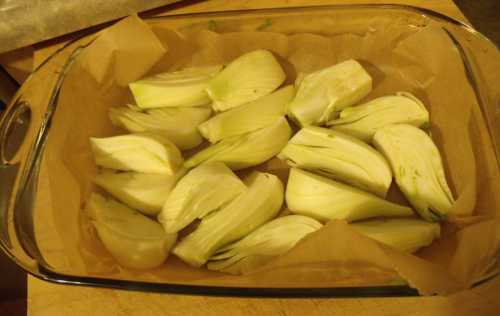
Fennel bulbs are mild and crunchy, with an almost sweet flavor and celery-like texture. Adding them raw to salads is my favorite way of using the bulb, and with the abundance of fennel in my home in recent weeks, I’ve enjoyed many a salad topped with thinly sliced pieces of this mild root. I’ve discovered that my favorite combination is mixed organic greens, red onion and fennel topped with sprouts and a simple balsamic vinegar-olive oil dressing.
Roasting or grilling the bulb is another way to use it, and is a particularly popular accompaniment to pork dishes. Pork loin is often prepared by roasting it atop a bed of fennel bulbs. The texture of roasted fennel reminds me of roasted onions, though with a milder flavor.
To roast fennel, trim the bulb and cut it into quarters or slices. Coat it lightly with olive oil (and balsamic vinegar, if you wish), add a sprinkle of salt and freshly ground pepper, and place in a roasting pan or on a baking sheet. (I like to line mine with parchment paper to aid in the cleanup.)
Roast in a 400 degree oven until tender and beginning to caramelize, usually between 20 and 30 minutes, depending on your oven and the size of the fennel. In my slow oven it takes a bit longer.
Fennel is considered an effective carminative, that is, an herb or preparation that aids in the prevention (or, otherwise, expulsion) of gas in the digestive system. Fennel tea may be made for this purpose by pouring a cup of boiling water over a teaspoon of bruised fennel seeds.
The Roman naturalist Pliny ascribed 22 remedies to fennel, including strengthening of eyesight. Through the years herbalists continued this belief; even Longfellow alludes to this virtue in one of his poems:
“Above the lower plants it towers,
The Fennel with its yellow flowers;
And in an earlier age than ours
Was gifted with the wondrous powers
Lost vision to restore.”
Anethole, the primary component of fennel’s volatile oil that gives it its distinctive flavor, is a phytonutrient that has repeatedly shown to reduce inflammation and prevent the occurrence of cancer.
The fennel bulb is a good source of vitamin C, which is important for immune support and antioxidant protection. It also contains healthy stores of fiber, folate, and potassium, which aid in cardiovascular and colon health.
Below is a recipe for a roasted fennel and cauliflower soup I created last night for dinner. Though the process is amazingly simple, I found the soup to be rich and satisfying. I hope you enjoy it!
Roasted fennel and cauliflower soup
1 head cauliflower, cut into small pieces
2 large fennel bulbs, trimmed and quartered or sliced
4 medium shallots, peeled and roughly chopped
Olive oil
Kosher salt and freshly ground pepper
1 quart vegetable or chicken stock
½ cup milk of your choosing
First roast the vegetables. Toss them with olive oil, kosher salt and freshly ground pepper to taste. Place in a roasting pan or on a baking sheet and roast in a 400 degree oven until tender and caramelized, about 20 to 40 minutes, depending on your oven and the size of the vegetables. (Allow them to thoroughly roast to ensure good flavor.)
Simmer the roasted vegetables with a quart of stock until extremely tender and falling apart. Once they reach this stage, puree the soup using an immersion blender. (A food processor or blender may also be used. If using a blender, be sure to hold the lid tightly closed with a towel or the vacuum created by the heat may cause the lid to explode off!)
Off heat, stir in the milk. I used a product I just discovered: a coconut milk beverage made by “So Delicious” and stored in a carton in the refrigerated section of the store. This product is very different than canned coconut milk and doesn’t have a coconut taste. Any milk or milk substitute may be used.
Taste and adjust seasonings if needed. (I added a bit more salt, but used enough pepper when roasting the vegetables that adding more was unnecessary.
Thin with a bit more milk if soup is too thick.
The vegetables may be roasted ahead of time and stored in the fridge until soup is made.
Recipe by Esther Oertel. Makes six – eight servings.
Esther Oertel, the “Veggie Girl,” is a culinary coach and educator and is passionate about local produce. Oertel teaches culinary classes at Chic Le Chef in Hidden Valley Lake, Calif., and The Kitchen Gallery in Lakeport, Calif., and gives private cooking lessons. She welcomes your questions and comments; e-mail her at
Follow Lake County News on Twitter at http://twitter.com/LakeCoNews , on Facebook at http://www.facebook.com/pages/Lake-County-News/143156775604?ref=mf and on YouTube at http://www.youtube.com/user/LakeCoNews .
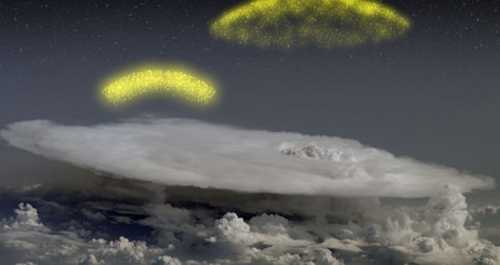
Scientists using NASA's Fermi Gamma-ray Space Telescope have detected beams of antimatter produced above thunderstorms on Earth, a phenomenon never seen before.
Scientists think the antimatter particles were formed inside thunderstorms in a terrestrial gamma-ray flash (TGF) associated with lightning. It is estimated that about 500 TGFs occur daily worldwide, but most go undetected.
“These signals are the first direct evidence that thunderstorms make antimatter particle beams,” said Michael Briggs, a member of Fermi's Gamma-ray Burst Monitor (GBM) team at the University of Alabama in Huntsville (UAH).
He presented the findings Jan. 10 during a news briefing at the American Astronomical Society meeting in Seattle.
Fermi is designed to monitor gamma rays, the highest energy form of light. When antimatter striking Fermi collides with a particle of normal matter, both particles immediately are annihilated and transformed into gamma rays.

The GBM has detected gamma rays with energies of 511,000 electron volts, a signal indicating an electron has met its antimatter counterpart, a positron.
Although Fermi's GBM is designed to observe high-energy events in the universe, it's also providing valuable insights into this strange phenomenon.
The GBM constantly monitors the entire celestial sky above and the Earth below. The GBM team has identified 130 TGFs since Fermi's launch in 2008.
“In orbit for less than three years, the Fermi mission has proven to be an amazing tool to probe the universe. Now we learn that it can discover mysteries much, much closer to home,” said Ilana Harrus, Fermi program scientist at NASA Headquarters in Washington.
The spacecraft was located immediately above a thunderstorm for most of the observed TGFs, but in four cases, storms were far from Fermi.
In addition, lightning-generated radio signals detected by a global monitoring network indicated the only lightning at the time was hundreds or more miles away.
During one TGF, which occurred on Dec. 14, 2009, Fermi was located over Egypt. But the active storm was in Zambia, some 2,800 miles to the south. The distant storm was below Fermi's horizon, so any gamma rays it produced could not have been detected.
“Even though Fermi couldn't see the storm, the spacecraft nevertheless was magnetically connected to it,” said Joseph Dwyer at the Florida Institute of Technology in Melbourne, Fla. “The TGF produced high-speed electrons and positrons, which then rode up Earth's magnetic field to strike the spacecraft.”
The beam continued past Fermi, reached a location, known as a mirror point, where its motion was reversed, and then hit the spacecraft a second time just 23 milliseconds later. Each time, positrons in the beam collided with electrons in the spacecraft. The particles annihilated each other, emitting gamma rays detected by Fermi's GBM.

Scientists long have suspected TGFs arise from the strong electric fields near the tops of thunderstorms.
Under the right conditions, they say, the field becomes strong enough that it drives an upward avalanche of electrons. Reaching speeds nearly as fast as light, the high-energy electrons give off gamma rays when they're deflected by air molecules. Normally, these gamma rays are detected as a TGF.
But the cascading electrons produce so many gamma rays that they blast electrons and positrons clear out of the atmosphere. This happens when the gamma-ray energy transforms into a pair of particles: an electron and a positron. It's these particles that reach Fermi's orbit.
The detection of positrons shows many high-energy particles are being ejected from the atmosphere. In fact, scientists now think that all TGFs emit electron/positron beams. A paper on the findings has been accepted for publication in Geophysical Research Letters.
“The Fermi results put us a step closer to understanding how TGFs work,” said Steven Cummer at Duke University. “We still have to figure out what is special about these storms and the precise role lightning plays in the process.”
NASA's Fermi Gamma-ray Space Telescope is an astrophysics and particle physics partnership. It is managed by NASA's Goddard Space Flight Center in Greenbelt, Md. It was developed in collaboration with the U.S. Department of Energy, with important contributions from academic institutions and partners in France, Germany, Italy, Japan, Sweden and the United States.
The GBM Instrument Operations Center is located at the National Space Science Technology Center in Huntsville, Ala. The team includes a collaboration of scientists from UAH, NASA's Marshall Space Flight Center in Huntsville, the Max Planck Institute for Extraterrestrial Physics in Germany and other institutions.
Dr. Tony Phillips works for the National Aeronautics and Space Administration.
Follow Lake County News on Twitter at http://twitter.com/LakeCoNews , on Facebook at http://www.facebook.com/pages/Lake-County-News/143156775604?ref=mf and on YouTube at http://www.youtube.com/user/LakeCoNews .

Large wildlife die-off events are fairly common, though they should never be ignored, according to the U.S. Geological Survey scientists whose preliminary tests showed that the bird deaths in Arkansas on New Year’s Eve and those in Louisiana were caused by impact trauma.
Preliminary findings from the USGS National Wildlife Health Center's Arkansas bird analyses suggest that the birds died from impact trauma, and these findings are consistent with the Arkansas Game and Fish Commission's statement.
The state concluded that such trauma was probably a result of the birds being startled by loud noises on the night of Dec. 31, arousing them and causing them to fly into objects such as houses or trees.
Scientists at the USGS NWHC performed necropsies – the animal version of an autopsy – on the birds and found internal hemorrhaging, while the pesticide tests they conducted were negative. Results from further laboratory tests are expected to be completed in two to three weeks.
“Although wildlife die-offs always pose a concern, they are not all that unusual,” said Jonathan Sleeman, director of the USGS NWHC in Madison, Wis., which is completing its analyses of the Arkansas and Louisiana birds. “It's important to study and understand what happened in order to determine if we can prevent mortality events from happening again.”
In 2010, the USGS NWHC documented eight die-off events of 1,000 or more birds. The causes: starvation, avian cholera, Newcastle disease and parasites, according to Sleeman.
Such records show that, while the causes of death may vary, events like the red-winged blackbird die-off in Beebe, Ark., and the smaller one near Baton Rouge, La., are more common than people may realize.
And Sleeman should know – he directs a staff of scientists whose primary purpose is to investigate the nation's wildlife diseases from avian influenza to plague and white-nose syndrome in bats.
“The USGS NWHC provides information, technical assistance, research, education, and leadership on national and international wildlife health issues,” Sleeman added.
According to USGS NWHC records, there have been 188 mortality events across the country involving 1,000 birds or more during the past 10 years (2000-2010).
In 2009, individual events included one in which 50,000 birds died from avian botulism in Utah; 20,000 from the same disease in Idaho; and 10,000 bird deaths in Washington from a harmful algal bloom.
Mass mortality events occur in other animal populations as well, according to the USGS NWHC. For example, prairie dog colonies in the West can be destroyed by sylvatic plague, which can then kill off the highly endangered black-footed ferret that preys on prairie dogs exclusively.
The USGS NWHC is involved with developing vaccines, delivered through bait, which can immunize prairie dogs against plague.
In the 1970s and 1980s, most USGS NWHC die-off investigations involved large numbers of waterfowl deaths from avian cholera, avian botulism, and lead poisoning; in the 1990s, the USGS NWHC was highly involved in investigating the emergence of West Nile virus in North America.
In 2008, the USGS NWHC discovered the cause of white-nose syndrome, a fungal disease that has devastated cave hibernating bat species in the Northeastern U.S.
Public reporting of wildlife mortality events is important, and in 2010, the USGS Wildlife Disease Information Node initiated an experimental reporting system to facilitate this. Visit http://www.whmn.org/wher/ for more information.
More information on the USGS NWHC and its involvement in the recent bird die-off events can be found on the NWHC Web site, www.nwhc.usgs.gov/ .
Follow Lake County News on Twitter at http://twitter.com/LakeCoNews , on Facebook at http://www.facebook.com/pages/Lake-County-News/143156775604?ref=mf and on YouTube at http://www.youtube.com/user/LakeCoNews .
Richard Persons, chief executive officer of the Lake County Fair since 1996, said the fair is potentially facing “draconian” funding cuts that could both hurt operations and improvement projects at the fairgrounds.
The 78 fairs that have been supported by the state since 1933 are targeted to lose 100 percent of the $32 million budgeted for operational support and capital improvements on fairgrounds in Brown's proposed budget, said Persons, who explained that the $32 million is used at seed money.
He cited a state economic impact study completed last year that found fairs generate more than $2.55 billion in economic impact to California's economy each year, creating 28,000 jobs, and generating more than $135 million in state and local government tax revenues.
The Lake County Fair has an annual budget of $650,000, and operates with four full-time employees – including Persons – and two half-time employees on a year-round basis, he said.
During the annual Lake County Fair – visited by more than 38,000 people annually – more than 750 people are employed on the fairgrounds, about 100 of them by the fair itself. Persons said hundreds more can be found volunteering in a variety of jobs.
The fair also has an eight-member board of directors, appointed by the governor.
In a nod to Brown's executive order this week to have state employees turn in 48,000 cell phones – at an anticipated savings of $20 million – Persons said that no fair staffers have ever been provided cell phones.
The Lake County Fair is a state agency that operates state-owned property, in this case the 34-acre fairgrounds property, located at 401 Martin St. in Lakeport, which has 30 buildings, most of which are available for public use, he said.
The fairgrounds' activities directly or indirectly created the equivalent of 75 full-time jobs and more than $10.9 million in local economic impact, including approximately $2.4 million in salaries and wages, Persons said.
In addition, he explained that the fairgrounds generates more than $102,000 in tax revenues like sales tax, local possessory interest tax for use of government property, and a variety of other licenses, fees and permits.
Persons said the fair's mission is to be Lake County’s local event center.
He said the fairgrounds hosts local activities nearly every day of the year – sometimes with several events in a single day.
Of those activities, 96 percent are produced by Lake County individuals or organizations, and 64 percent are produced by nonprofit organizations, mostly for fundraising, he said.
During the county fair event at the end of summer, more than 85 percent of the commercial spaces are filled by organizations from Lake and Mendocino counties, Persons said. More than 90 percent of the thousands of competitive exhibits that fill the buildings and barns during the Lake County Fair come from Lake County residents.
The state's fairs run on a calendar year budget, rather than the July through June fiscal year budget observed by the state, Persons said.
The fair has received three-quarters of its 2011 funding, and Persons said he expects to receive the entire budgeted amount by year's end. “The Department of Food and Agriculture says they have it,” he said.
However, the outlook ahead is far more uncertain for 2012 and beyond.
In the 2011-12 state budget cycle, which would cut into the second half of the fair's 2011 budget, Persons said the Lake County Fair was set to receive $172,000 in operational funding, or approximately 25 percent of the annual operating costs, with the rest being derived locally from the annual county fair event and rentals of the fairgrounds during the year.
The fair also would lose 85 percent of its capital expense funds, which Persons said range between $30,000 and $150,000 annually, depending on projects.
He said the fairs compete with one another for state capital improvement infrastructure grants, with fairs getting additional points if they put up some of their own money.
Such money has helped improve the Lakeport fairgrounds, said Persons. “We had a series of projects that we started this year.”
In the first of three proposed phases, he said they tore out 60-year-old horse barns, installed new water lines to feed the Baldwin Pavilion area at the back of the property, then put in a street so there is a circle around the racetrack, at a total cost of $122,000, he said. The second, $75,000 phase included a new horse barn.
The third phase, estimated to cost $125,000, would include asphalt repairs and seal coasting that would help the fairground's asphalt surfaces to last another decade. But Persons said that project is now in limbo due to the proposed budget.
“In some way's we're fortunate, because decades ago the state provided more than 80 percent of operating funds, so the slow shift away from state funding over the years may allow us to keep the doors open,” he said.
“But if the governor's proposal passes the legislature, it's going to be painful for the local community. And of course, the loss of capital funding means no construction work, no asphalt, no new roofs, no paint. Virtually all of those jobs are done by local companies,” he added.
Persons said he and the fair's board of directors will watch the state budget process closely over the coming months, and examine the entire fair operation for both expenditure cuts and increases to revenue.
He said possible changes could include reductions in staffing, reduced operating hours and increases in rental rates.
“We have to start planning now,” he said.
This year's Lake County Fair, scheduled for Sept. 1-4, has “Make Some Magic!” as its theme.
Visit the fair online at www.lakecountyfair.com .
E-mail Elizabeth Larson at
Joshua Isaac Wandrey Sr., 36, of Rohnert Park is expected to be released next week after the motion to dismiss the charges is heard Jan. 21.
Deputy District Attorney Art Grothe filed a motion Friday which stated, in part, “it is my professional opinion that there is currently insufficient evidence to proceed with this matter” against Wandrey.
He announced his intention to dismiss the case at Wandrey's trial readiness conference Friday in Lakeport.
After court Grothe said he had no further comment on the case in advance of next week's hearing.
Grothe's decision was “the correct thing to do,” said Wandrey's attorney, Stephen Carter.
Carter credited District Attorney Don Anderson and Grothe for recognizing and realizing that the dismissal should take place.
Wandrey was arrested in November 2009 following the attack the previous month on 49-year-old Ronald Greiner of Lakeport, who was shot, beaten, hogtied with barbed wire and robbed of 10 pounds of marijuana at his home, as Lake County News has reported.
Wandrey and co-defendant Thomas Loyd Dudney, 60, of Fulton, were charged with attempted murder, mayhem, torture, home invasion robbery, burglary, assault with a firearm, assault likely to cause great bodily injury, a special allegation for alleged gang activity and another special allegation for use of a firearm.
The case had been handled since its inception by former District Attorney Jon Hopkins, who left office last month after losing his reelection bid last year.
Grothe's motion explained that on or around Dec. 7 he received Wandrey's case file “as part of a reassignment of cases” that resulted from Hopkins' departure.
“Following that reassignment I reviewed all reports, evidence, and prior hearings conducted in this case,” Grothe stated.
Based on that review, as well as discussions with witnesses, investigators and other District Attorney's Office personnel, Grothe said he concluded that he didn't have the evidence needed to move forward.
Carter said Wandrey will have no further risk of any prison time associated with this case after the dismissal takes place.
“Of course he is pleased with that outcome and glad to put it behind him and move on,” Carter said.
However, Grothe's motion indicated the case could be taken up again in the future, as the investigation regarding Wandrey is continuing.
Grothe's motion goes on to note, “if further evidence is secured, then the case will be reevaluated upon its merits at that time.”
E-mail Elizabeth Larson at
The Food and Drug Administration (FDA) is currently considering approval of a type of genetically engineered (GE) farmed Atlantic salmon which would be the first ever GE animal approved for human consumption.
The FDA is also considering whether or not to require labeling should it be approved for sale domestically.
The California State Grange, which is supporting the bill, believes that not enough is currently known about the potential impacts of GE salmon to conclude that it is safe for the environment in general or wild fish populations specifically.
“Assembly member Huffman's bill is important for all Californians, not just seafood consumers,” explained Dr. George Leonard, director of Ocean Conservancy's aquaculture program. “While the FDA has yet to make a final decision on GE salmon, California and Assembly member Huffman are making it clear that mandatory labeling is needed to provide families with the information they want and need when buying food. Once again, California is leading the nation in assisting consumers make informed decisions in the marketplace.”
California Grangers agreed with this assessment when they resolved to oppose marketing GE salmon without sufficient testing and labeling last October.
“Consumers have the right to determine the suitability of the food they feed their families,” commented Bob McFarland, president of the California State Grange. “I would be suspicious of any food producer that would want to prevent us from knowing the nature and origin of their products.”
In addition, the Grange also has policy on scientific studies and testing on all GE/GMO food products. “Consumer safety should never be a hit-or-miss proposition,” said McFarland.
The proposal currently pending before the FDA has generated significant concern and opposition. Since FDA held pubic hearings on the issue in September, 29 members of the House of Representatives and 12 Senators have written urging a rejection of the proposal. This came on top of more than 368,300 public comments in opposition as well as a strong public rebuke from 14 elected officials in California, led by Huffman.
“At the end of the day, this issue is larger than salmon - it is about the future of fish. If and how to proceed with GE salmon should be part of a broader national debate about sustainable seafood and how to proactively plan for the future we desire,” said Leonard. “Approval of GE salmon would set a dangerous precedent. It could open the floodgates to approval of other GE fish and fundamentally alter the nature of our seafood supply.”
Follow Lake County News on Twitter at http://twitter.com/LakeCoNews , on Facebook at http://www.facebook.com/pages/Lake-County-News/143156775604?ref=mf and on YouTube at http://www.youtube.com/user/LakeCoNews .