 How to resolve AdBlock issue?
News
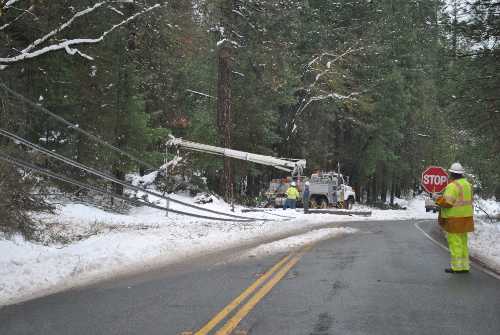
LAKE COUNTY, Calif. – Pacific Gas & Electric company crews were continuing to work through the weekend to restore power to customers who have been without electricity since late last week due to the winter storms.
PG&E spokesman J.D. Guidi said late Saturday that 2,630 customers in Lower Lake, Cobb, Hidden Valley and Middletown still had no power.
Guidi said the majority of the customers waiting for power were in Middletown.
Most of the customers involved had not had power since about 7 a.m. Thursday, Feb. 17, Guidi said.
Accessing equipment due to terrain and snow remains an issue, Guidi said.
The company had mobilized crews to make repairs in Lake County, bringing them in from less impacted areas of the state.
“Crews will continue to work around the clock to restore power as quickly and safely as possible,” Guidi said.
He added, “At this time it looks like we expect a majority – if not all – to be restored by Sunday evening at the latest.”
The National Weather Service issued a hazardous weather outlook for Lake County on Sunday, warning of low temperatures in the days ahead, but no snow or rain until the middle of the week, when chances of showers return.
E-mail Elizabeth Larson at
I’m dating myself here, but back in the 1980s a book was written by humorist Sandra Boynton for chocolate lovers called “Chocolate, the Consuming Passion.” (I, of course, devoured every word.)
The book extolled the virtues of chocolate (rightly so, I might add), but there was an overtone of discrimination against vanilla, as though those who prefer its flavor over chocolate are somehow lacking.
I must admit that I’ve been party to that kind of chocolate snobbery much of my life, but somewhere along the way my eyes were opened to vanilla’s vastly valuable qualities.
Not only does it stand alone as a marvelous flavor, it provides a back note to an amazing array of otherwise-flavored items, kind of like an unseen but important backstage helper.
Vanilla is the most widely used flavoring in pastries, confections and other desserts. What would chocolate brownies or banana bread be without its requisite shot of vanilla?
Unfortunately, the word “vanilla” is often used to describe things that are boring, ordinary or overly homogeneous.
When I plugged the word into my Internet search engine, for example, an article popped up that opined on whether a certain NASCAR driver was “too vanilla.” In that case, it meant boring, without much personality.
But vanilla is anything but. It’s exotic, sultry, enticing, subtle and sweet. It knows it doesn’t have to shout; instead, it persuades quietly. In a culinary context, it may be the most “come hither” scent aside from garlic.
And no wonder. It hails from the tropics deep within Mexico, where, I would imagine, the flora is dripping with mystery.
Vanilla beans are the seed pods of the pretty vanilla orchid, a tropical climbing vine that sports a delicate white or pale yellow flower.
These pods are painstakingly cultivated, a process that includes laboriously pollinating them by hand at a very specific time of day when blossoms appear on the vine for a short one-month flowering period.
Some vanilla blossoms last only a day, so farmers must be diligent about observing flowers in bloom.
Hand harvesting of the pods occurs four to six months after the fruit appears on the vine (some sources say it takes nine months for the pods to reach maturity), requiring much patience on the part of the farmers.
After harvest, the pods go through processes lasting another six months where they’re “killed,” “sweated,” slow-dried and “conditioned,” sort of like spa treatments for spice.
“Killing” the pods refers to the process of stopping the vegetative growth and initiating the enzymatic reactions responsible for vanilla’s aroma. There are a variety of methods used for this, the most popular being a hot water bath.
The pods are then wrapped in woolen blankets to “sweat” in the sun for at least an hour and up to ten days, allowing enzymes to catalyze the reactions begun during the “killing” process. This allows the pods to develop not only vanilla’s characteristic aroma, but its color and flavor, as well.
The pods are then slow-dried in the sun to prevent rotting. This curing process also locks the aroma in the pods.
Once slow-dried, “conditioning” (or fermenting) occurs over a period of months via storing the pods in closed boxes so the flavor develops.
The beans are then sorted by quality and graded by the length of the bean. The longer beans contain more vanillin, the main flavor component of the 171 aromatic compounds identified in vanilla beans.
Grade A beans are the longest and are considered gourmet or prime beans. They’re typically sold whole.
Grade B beans are also called “extract beans,” and, as implied, are used to make vanilla extract.
It is interesting to note that vanilla orchids growing wild in Mexico were pollinated by bees or hummingbirds capable of penetrating the tough membrane that separates the plant’s pistol and stamen.
Until the mid-19th century, Mexico was the largest producer of vanilla beans.
In 1819, French entrepreneurs shipped vanilla beans from Mexico to tropical islands in the Indian Ocean under their control (namely, Mauritius and Reunion). They hoped to cultivate vanilla there.
While vanilla orchids grew well in the new tropical locales, seed pods were not produced because the plants weren’t being pollinated. Importation of Mexican bees proved unsuccessful.
It wasn’t until 1841 when a 12-year-old former slave on the island of Reunion developed a method for hand pollination of the vanilla orchid that cultivation in places other than its native Mexico became successful.
This young vanilla bean husbandman, Edmond Albius, fertilized the plants using a bamboo skewer to lift the plant’s membrane and his thumb to smear the pollen. His method is still in use today, even in Mexico.
The hard work (not to mention investment of time) involved in harvesting vanilla makes it the most expensive spice next to saffron and cardamom.
Today most vanilla is cultivated in Madagascar. The vanilla produced there and in Mexico is considered superior to that produced in Indonesia or Tahiti, though Tahitian vanilla is beautifully aromatic and used in perfumes.
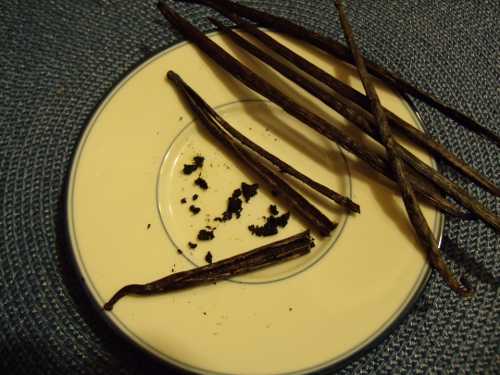
The dark brown, slender vanilla beans contain thousands of tiny black seeds which may be scraped, paste-like, from within the pod to flavor food.
The pod, with or without its seeds, may be used to flavor liquids and sauces. The longer it steeps in the liquid, the stronger the flavor. Use about one pod per pint of liquid if a strong vanilla flavor is desired.
One method is to bring the liquid to a boil, turn off the heat and add the bean(s) to steep for about an hour as the liquid cools.
I generally allow the bean(s) to simmer in the liquid. I use them when making syrup or flavoring a hot beverage, such as spiced cider.
Believe it or not, a whole bean may be used more than once if washed, dried and stored in an airtight container.
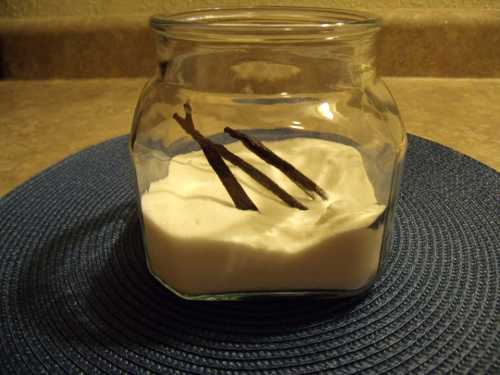
An interesting way to store vanilla beans is in sugar. Use a jar with a tight-fitting lid and bury the beans so that no light hits them. After two or three weeks, the resulting sugar is vanilla-flavored and may be used in recipes or to flavor drinks. (It’s great in coffee, iced tea or hot cocoa.)
When selecting vanilla beans, choose plump ones, as they contain more seeds. The bean should be dark brown, almost black, and pliable enough to wrap around your finger without breaking.
If beans have hardened, they may be softened in the liquid of your recipe before use.
If you discover what looks like sugar crystals inside a bean pod, it means you’ve found pure vanillin crystals.
In the U.S., vanilla extract is more widely used than whole vanilla beans, though they’re gaining popularity. In Europe, whole beans are generally preferred.
Extract typically uses alcohol as a flavor carrier, though some are made using glycerin instead.
Vanilla powder is also available commercially, which is made from grinding vanilla beans.
Homemade vanilla extract is a treat, and I’ve heard professional chefs and home cooks alike remark about the difference it makes in their food. The vanilla extract procedures below are courtesy of About.com.
Enjoy, and remember, vanilla is anything but boring!
Homemade vanilla extract
To make your own vanilla extract, chop three or four vanilla beans into small pieces, being careful to retain all the seeds and crystals.
Put into a clean jar and cover with about a half cup of brandy liquor. Let steep for one to six months. Strain and use with or without the pieces as your recipe defines.
The mixture keeps indefinitely, and you can continuously add to it. If you find the brandy flavor too strong and have more time, use one split bean steeped in 3/4 cup of vodka, letting it stand at least six months.
Esther Oertel, the “Veggie Girl,” is a culinary coach and educator and is passionate about local produce. Oertel teaches culinary classes at Chic Le Chef in Hidden Valley Lake, Calif., and The Kitchen Gallery in Lakeport, Calif., and gives private cooking lessons. She welcomes your questions and comments; e-mail her at
Follow Lake County News on Twitter at http://twitter.com/LakeCoNews , on Facebook at http://www.facebook.com/pages/Lake-County-News/143156775604?ref=mf and on YouTube at http://www.youtube.com/user/LakeCoNews .
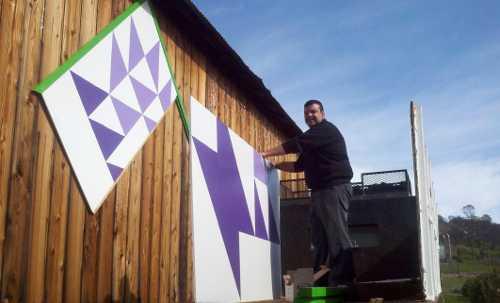
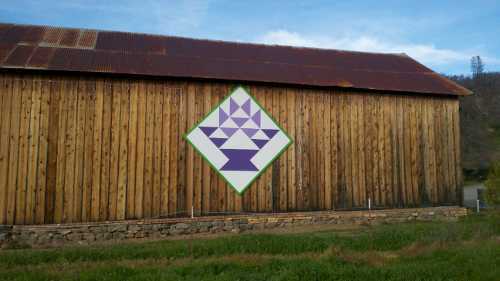
CLEARLAKE OAKS, Calif. – A beautiful new addition to the fast-growing Lake County Quilt Trail now hangs on the barn at yet another historical location – this one in Clearlake Oaks adjacent to High Valley Vineyard.
The quilt block was installed on Mr. Dennis West’s barn on Saturday, Feb. 3.
West has lived on that homestead, which he inherited from family, for more than 25 years. It was originally part of Pluth Ranch, he said.
This quilt is the second to adorn the Northshore, according to Marilyn Holdenried, owner of Wildhurst Vineyards and major sponsor of the Kelseyville Pear Festival’s Lake County Quilt Trail. The other hangs high on the breathtaking property of Tulip Hill Winery in Nice.
The new quilt pattern resembles a basket of grapes, therefore this quilt block is appropriately named, “Grape Basket,” she said.
“The pattern and colors were chosen by the committee from the Clearlake Oaks-Glenhaven Business Association,” Holdenried said. “They wanted the purple for the fruit, grapes and the green frames for the leaves to match the greenery there around the valley. There are vineyards in the area and the committee wanted to reflect the surroundings.”
It's official: The sun is a sphere.
On Feb. 6, NASA's twin STEREO probes moved into position on opposite sides of the sun, and they are now beaming back uninterrupted images of the entire star – front and back.
“For the first time ever, we can watch solar activity in its full 3-dimensional glory,” said Angelos Vourlidas, a member of the STEREO science team at the Naval Research Lab in Washington, DC.
NASA released a “first light” 3D movie on, naturally, Super Bowl Sun-day.
“This is a big moment in solar physics,” said Vourlidas. “STEREO has revealed the sun as it really is – a sphere of hot plasma and intricately woven magnetic fields.”
Each STEREO probe photographs half of the star and beams the images to Earth. Researchers combine the two views to create a sphere.
These aren't just regular pictures, however. STEREO's telescopes are tuned to four wavelengths of extreme ultraviolet radiation selected to trace key aspects of solar activity such as flares, tsunamis and magnetic filaments. Nothing escapes their attention.
“With data like these, we can fly around the sun to see what's happening over the horizon – without ever leaving our desks,” said STEREO program scientist Lika Guhathakurta at NASA headquarters. “This could lead to significant advances in solar physics and space weather forecasting.”
Consider the following: In the past, an active sunspot could emerge on the far side of the sun completely hidden from Earth. Then, the sun's rotation could turn that region toward our planet, spitting flares and clouds of plasma, with little warning.
“Not anymore,” said Bill Murtagh, a senior forecaster at NOAA's Space Weather Prediction Center in Boulder, Colorado. “Farside active regions can no longer take us by surprise. Thanks to STEREO, we know they're coming.”
NOAA is already using 3D STEREO models of CMEs (billion-ton clouds of plasma ejected by the sun) to improve space weather forecasts for airlines, power companies, satellite operators, and other customers. The full sun view should improve those forecasts even more.
The forecasting benefits aren't limited to Earth.

“With this nice global model, we can now track solar storms heading toward other planets, too,” pointed. “This is important for NASA missions to Mercury, Mars, asteroids … you name it.”
NASA has been building toward this moment since Oct. 2006 when the STEREO probes left Earth, split up, and headed for positions on opposite sides of the sun (movie). Feb. 6, 2011, was the date of "opposition" – i.e., when STEREO-A and -B were 180 degrees apart, each looking down on a different hemisphere.
NASA's Earth-orbiting Solar Dynamics Observatory is also monitoring the sun 24/7.
Working together, the STEREO-SDO fleet should be able to image the entire globe for the next eight years.
The new view could reveal connections previously overlooked.
For instance, researchers have long suspected that solar activity can “go global,” with eruptions on opposite sides of the sun triggering and feeding off of one another. Now they can actually study the phenomenon.
The Great Eruption of August 2010 engulfed about two-thirds of the stellar surface with dozens of mutually interacting flares, shock waves, and reverberating filaments.
Much of the action was hidden from Earth, but plainly visible to the STEREO-SDO fleet.
“There are many fundamental puzzles underlying solar activity,” said Vourlidas. “By monitoring the whole sun, we can find the missing pieces.”
Researchers say these first-look images are just a hint of what's to come. Movies with higher resolution and more action will be released in the weeks ahead as more data are processed.
Stay tuned.
Dr. Tony Phillips works for the National Aeronautics and Space Administration.
Follow Lake County News on Twitter at http://twitter.com/LakeCoNews , on Facebook at http://www.facebook.com/pages/Lake-County-News/143156775604?ref=mf and on YouTube at http://www.youtube.com/user/LakeCoNews .
The National Weather Service on Friday evening said snow was likely to continue overnight, with the chances of snow showers decreasing on Saturday.
That overnight prediction proved accurate, as late in the evening snow was widely reported around the county – including in Upper Lake, Nice and parts of Lucerne, where sustained snowfall hadn't taken place previously.
On the other side of the county, in Cobb and Kelseyville, snow once again clogged roadways.
Shortly after 7 p.m. the California Highway Patrol reported several vehicles were spun out in the snow on the Glasgow Grade near Lower Lake on Highway 29.
At about the same time on Highway 175 over Cobb, just south of Harrington Flat Road, a big rig pulling a flatbed trailer with two telephone poles on it was stuck in the now, the CHP reported.
On the Glasgow Grade the snow was making the highway passable only for four-wheel drive vehicles or those with chains, according to the report.
While a tow company pulled vehicles out of the snow, Highway 29 between Lower Lake and Kelseyville was closed for several hours, finally reopening shortly before midnight, the report said.
Meanwhile, back on Highway 175 over Cobb near Harrington Flat, the CHP reported that power lines above the roadway were coming down and arcing over vehicles shortly before 1 a.m.
Pacific Gas & Electric – which has had crews out in full force over the last few days in order to repair damaged equipment and restore power to customers – planned to respond to the area before 2 a.m., according to the report.
Regarding other highway conditions, Caltrans reported that Highway 29 over Mount St. Helena was closed once again due to snow.
Highway 175 was closed from the junction of Highway 29 to five miles west of Middletown due to downed trees, Caltrans said.
The CHP reported early Saturday that all of South Highway 175 was under chain requirements.
For the most part, Friday was quieter for local first responders, who reported call volumes were down from the previous day.
Sgt. Tim Hobbs of the Clearlake Police Department said during his daytime shift on Thursday the department took 115 calls for service, of which he said 105 were related to weather, crashes and power lines being down.
“It was definitely busy,” he said.
CHP Officer Joe Wind said Friday, “It's calmed down greatly since yesterday,” noting that Thursday was “crazy,” with a call volume three to four times the normal amount.
He said all available personnel remained on the roads on Friday.
“Yesterday we had the snow, today we had the ice,” said Wind.
One of the positive benefits of the winter storms – Clear Lake's level jumped from 5.80 feet Rumsey – the special measure used to record its depth – to 6.73 feet Rumsey at about midnight Saturday, its highest level for February in five years, according to Lake County Water Resources records.
E-mail Elizabeth Larson at
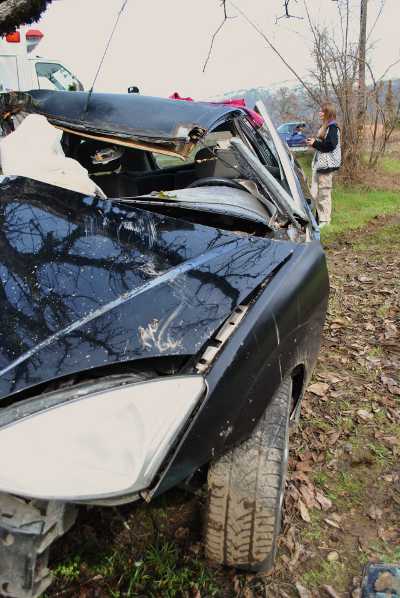
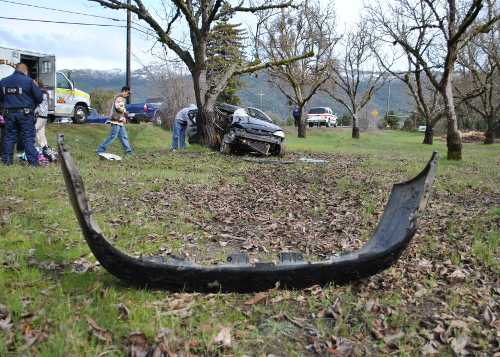
LAKE, Calif. – A single-vehicle crash on Friday resulted in minor injuries.
The collision was reported just after 11:15 a.m. on Elk Mountain Road a quarter-mile north of the Mendocino National Forest Ranger Station, according to the California Highway Patrol.
A small Ford two-door car driven by a 19-year-old woman with a 20-year-old female passenger went off the road and into an orchard, with the passenger side of the car hitting a tree, according to reports from the scene.
California Highway Patrol Officer Joe Wind said a full report on the crash wasn't yet available, but said initial indications were that the crash was not weather-related, and that it appeared the driver may have been going too fast and lost control in a curve.
The CHP said the crash resulted in minor injuries. The names of those involved and specifics about their injuries was not immediately available.
Northshore Fire Protection District responded to the scene to give medical aid to the two young women.
E-mail Elizabeth Larson at
Education
Health
Business
Obituaries
Veterans
Recreation
Religion
Arts & Life
Government & Politics